How a mobile home community in South Florida is organizing against a looming eviction
The tenants of Li’l Abner are suing their landlord over orders to leave their vibrant neighborhood to make way for a new development being presented as affordable housing
The fuschia hibiscus bush encircling Sergio Zamora’s home in Li’l Abner Mobile Home Park was planted over 30 years ago. Zamora’s in-laws planted the bush as a young seedling, knowing that over time, it would act as a natural fence for the property in Florida. Behind the verdant veneer, a screened porch houses a collection of orchids, tended to with care by Zamora’s family over three decades. But soon, the orchids will need to find new homes, and the hibiscus bush will become dust as tenants in the enclave are threatened with a potential eviction.
Residents were ordered to leave the mobile home park in Sweetwater, Florida, when its management company, CREI Holdings, announced plans to redevelop the site into government-subsidized affordable housing, displacing nearly 6,000 residents across 900 homes. Notices were issued in October 2024, giving residents until May 19 to make alternative living arrangements, a move many residents and legal experts argue violates Florida’s landlord-tenant statutes. Last month, Li’l Abner residents filed a class-action lawsuit challenging the legality of pending evictions. The case highlights broader affordable housing issues amid South Florida’s ongoing development boom despite growing income inequality.
“People were amicable [when I first moved here], mostly kept to themselves. A lot of them are pretty friendly, although that’s changed ever since the eviction notices,” said Zamora, 30, who has lived in the park for five years with his wife and in-laws. His in-laws, who have lived in the park for 32 years, now face an uncertain future. “Everywhere else is way too expensive, million dollars for a hut in the woods. It’s been a really hard thing to look at.”
CREI offered $14,000 to residents who agreed to vacate by mid-January. The Urban Group, a development management company overseeing the transition, said 117 tenants had already relocated, and another couple hundred or so had indicated that they planned to move. Those who leave by April can get $7,000 in compensation, while those who stay until May will receive $3,000, according to documents cited in the lawsuit. This incentive would be in addition to moving stipends required by Florida law, under which CREI is required to offset relocation costs by offering $3,000 and $6,000 for single- and double-wide homes, respectively. CREI did not respond to Prism’s requests for comment.
But many residents told Prism that the landowner’s financial package paled in comparison to what they stood to lose. Not long ago, Li’l Abner’s main artery was marked by a community center with a playground, park, and pool accessible to all residents. The space even had a day care for young children. But, today, the land has been razed, and in its place is Li’l Abner II, an eight-story contemporary condominium looming over the community’s suburban sprawl of single-floor homes—a harbinger of what’s to come for the rest of Li’l Abner. Behind the taupe, cube-like building, construction is ongoing for its twin—another addition to what has been deemed more palatable affording housing for the area.
But the homes that form Li’l Abner’s community, though classified as mobile, are far from portable.
“Most of these aren’t really trailers—they’re houses,” Zamora said. Many of the homes are simply too old to move, leaving families in a precarious position.
“I’ve been very nervous these days because I cannot move. I’d go live under a bridge,” said Francisco Pablo, who has limited mobility and has been renting a room in a shared trailer in the Li’l Abner community for 13 years. “I don’t have anywhere to go.”
Pablo said he already pays $1,300 per month and that rent has been increasing.
“Life is peaceful here, but what’s not peaceful is the rent because you have to pay a lot,” said Pablo. “And now they’re asking for more, and I can’t with my physical state and financial state.”
Pablo hopes that developers find alternative housing for residents. According to the website of construction company L&R Structural Corp., once Li’l Abner III is complete, 40% of the residences will be reserved for households making up to 80% of the area’s median income (AMI). The remainder will be restricted to individuals earning 120% of the AMI. Additionally, 40% of the project will be age-restricted for seniors age 55 and over. The Urban Group confirmed to the Tampa Bay Times that park tenants will have priority access to the apartments in Li’l Abner III and any future developments on the land.
The Urban Group did not respond to Prism’s request for comment.
But many residents and their supporters remain distraught.
“These people have done nothing wrong. They’re hardworking people who are probably going to be forced to start all over again,” said David Winker, an attorney representing the Li’l Abner residents.
Residents have claimed that they were misled by prospectuses that explicitly stated the park would not be redeveloped. “Some people spent $150,000 on trailers, they had a piece of paper that said they had no plans to develop the property,” Winker explained.
Legal advocates, including a team led by Winker and attorney Eric Wasoloski, have stepped in to represent the tenants in court. The lawsuit alleges that Li’l Abner’s owner failed to provide proper notice as required by Florida law and misrepresented plans for the property to prospective buyers. According to a Florida statute, the owner must provide written notice to the homeowners’ association of its right to purchase the mobile home park first.
“There’s contract issues, there’s statutory issues,” Winker said. “They haven’t done what they’re supposed to do. They haven’t provided the proper notices.”
The park has also become a flashpoint of political irony. Donald Trump propaganda and MAGA flags fly high along Li’l Abner’s paved streets. One resident sells Trump memorabilia on his front lawn, directly across from the meeting point for the Miami chapter of the Democratic Socialists of America and Florida International University DSA canvassers who are helping to organize the residents.
The process is about more than just information sharing. It’s a way to empower residents with skills, like using communication platforms such as WhatsApp, and to build a network for mutual support.
“We’re also trying to get a block captain program going, where we begin to engage the folks here to take care of each of their blocks,” said William Suarez, an organizer with Miami DSA. “[We’re] making sure folks are constantly plugged in to what’s going on, and giving them avenues to get plugged in as well, not rushing people, not forcing them to get involved, but showing them that there is a whole family of folks here who are ready to fight, ready to help them.”
The predominantly Republican residents find themselves in opposition to a developer they perceive as benefiting from “crony capitalism,” or the improper use of government connections to secure contracts and funding.
“There’s a Trump flag on every other house, this is Republican central,” Winker said. “They’re voting Republican, and what are they getting in return? It’s ironic to see this happening.”
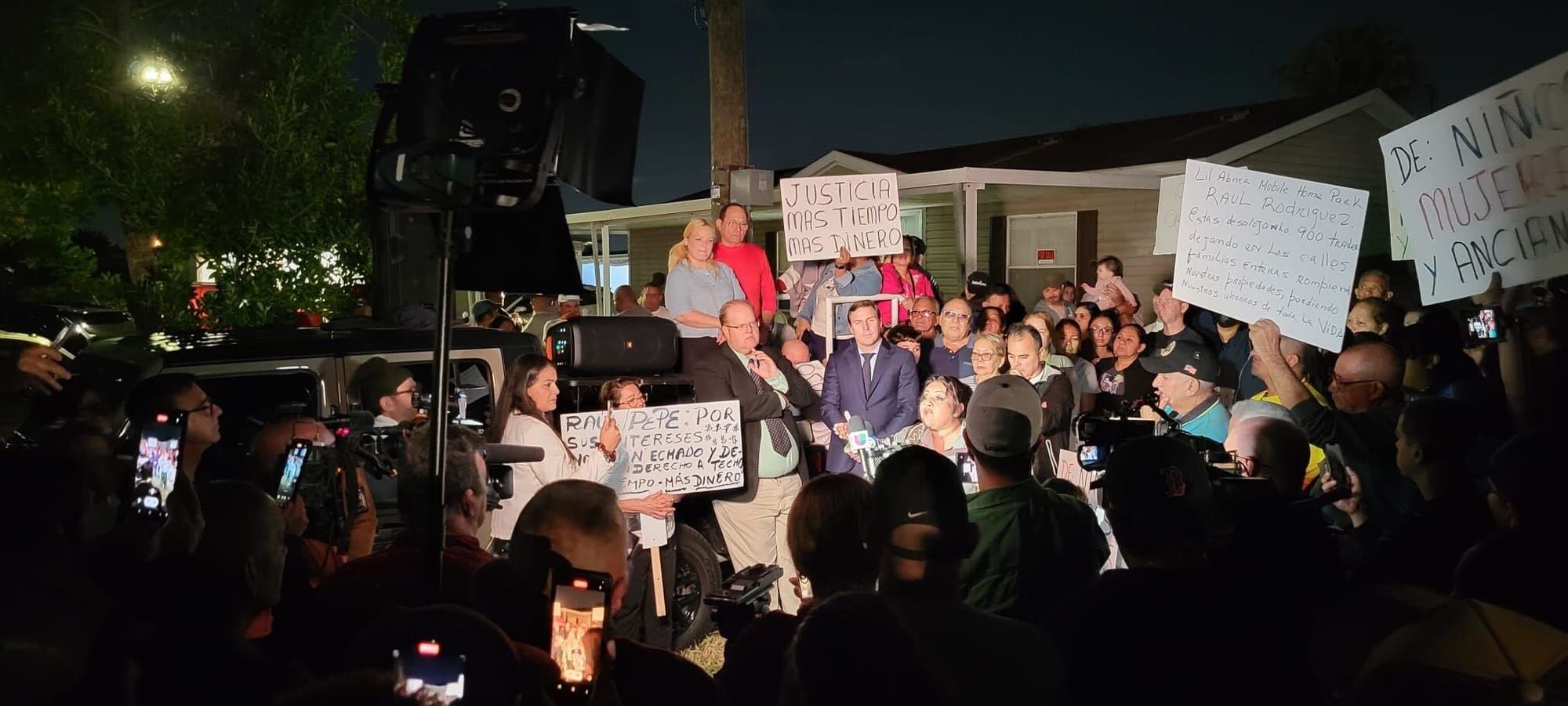
Community outrage sparked a wave of protests late last year. Residents rallied under the cry of “Más tiempo, más dinero” (more time, more money), demanding fair treatment and adequate compensation. One of the protests on Dec. 3, 2024, was spurred by the arrest of 61-year-old Vivian Hernandez, described as a leader within the coalition after she suffered injuries during a confrontation with police while trying to pay her rent inside the property owner offices. Residents then protested outside of Sweetwater’s City Hall in solidarity with Hernandez.
“She got emotional because they kept ignoring her,” Zamora said. “When they asked her to leave, she said no, I need my answers. A cop grabbed her, pulled her out of her chair, and slammed her to the ground. … She’s on a cane now because of it.”
Residents quickly rallied to support Hernandez, raising $1,000 through a GoFundMe campaign to cover her medical expenses. They now hold protests regularly.
“The residents protest almost every day,” Suarez said. “It’s part of their strategy to let the community know that the folks here are suffering, and they want to make sure that everyone here understands what’s going on to these people, over thousands of people getting evicted.”
While the class-action has temporarily paused the evictions, fears of safety and stability linger. Vacant homes have already been targeted by looters and squatters.
“The fewer people here, the more dangerous it gets for those who stay,” Zamora said.
Many residents are still hesitant to join the lawsuit or the protests, and overcoming that fear is a priority for organizers. The block captain program plays a crucial role in this, as captains check on their neighbors, provide mutual aid, and assess the willingness of others to join the fight.
The situation at Li’l Abner has drawn attention to the affordable housing crisis in Miami-Dade County, where rising rents and development pressures are squeezing low-income families out of the market. Critics argue that displacing these residents without adequate protections or alternatives creates a ripple effect, further straining social services and destabilizing vulnerable communities.
“This is affordable housing: 6,000 people, 900 homes living in under market conditions that allow these people to thrive. This community is thriving, and this owner developer is going to displace all these people from this affordable housing, so he can build government taxpayer subsidized affordable housing?” Winker asked. “So it’s taxpayers not only subsidizing the new housing; taxpayers are now going to be covering 6,000 families that need services suddenly.”
Developers have claimed that their plan to demolish the mobile home park and build affordable housing will help the community. Suarez disagrees.
Mobile homes are already an affordable option for many. Bulldozing them to build ‘affordable housing’ is redundant at best and sinister at worst.
William Suarez, Miami DSA organizer
“Mobile homes are already an affordable option for many. Bulldozing them to build ‘affordable housing’ is redundant at best and sinister at worst,” he said. “We all know most of those new homes won’t be truly affordable. Residents here struggle to pay $1,000 a month. How can they afford market-rate rents?”
This disconnect underscores the community’s belief that the development project prioritizes profit over people. “Replacing affordable housing with ‘affordable housing’ is just a play for more money,” Suarez said.
Yesenia Guadalupe, a community advocate whose family has lived in the community for about 20 years, said it’s not just about housing, but about preserving the culture and history of Li’l Abner, a place where residents have spent decades building their lives. The newly built condos in the area, which Guadalupe believed would not be affordable to the displaced families, stand in stark contrast to the homes the residents have built.
“The people who lived there built the neighborhood; now they’re being pushed out by developers,” she said.
“One of the things people can do is volunteer,” Guadalupe said, adding that even showing up to protests can make a big difference. “The key is to make sure that these actions don’t go unnoticed.”
Public pressure on local authorities is one way to ensure accountability. “Contact the city of Sweetwater and the commissioners directly on social media. They care about their reputations, and we need to let them know we’re watching,” Guadalupe said.
The class-action lawsuit is just beginning, with plaintiffs seeking damages and a court declaration invalidating the evictions.
While some evictions for nonpayment of rent have already been processed, the legal team is urging residents to stay current on their obligations to strengthen their case.
For now, the residents of Li’l Abner await a resolution, hoping their fight will secure their homes and shine a light on broader issues of equity and justice in housing policy.
When knocking on doors, Suarez often asks residents how the threat of eviction has affected their lives. “The moment you ask those questions, people start crying,” he said. “They tell you how they’ve lived here for decades and how losing everything feels like being thrown out like dogs. It’s heartbreaking.”
Yet, despite the grief, Suarez sees hope. “I believe that if we come together, and we make a strong, tight organization, we will be able to fight, and we will be able to win,” he said.
Guadalupe emphasized that the community’s demands go beyond just compensation: They want justice and the chance to rebuild the vibrant community that once was. “In my wildest fantasies, the folks who lived there would be able to buy the land and rebuild the community,” she said.
Author

Alexandra is a Cuban-American writer based in Miami, with an interest in immigration, the economy, gender justice, and the environment. Her work has appeared in CNN, Vice, and Catapult Magazine, among
Sign up for Prism newsletters.
Stay up to date with curated collection of our top stories.