‘Who Killed My Family?’: An inquest into the violence of liberal chic
There is an emptiness at the heart of cosmopolitanism, one where even daily videos of shredded children in Gaza are not enough to get liberal elites to stop their savagery
In the established discourse, it is not your cruelty that counts. It is your tone. This is a disturbing reality that we have all been inundated with, especially since the Israeli genocide in Gaza began.
The twisting of language and the omission of history to sanitize carpet-bombing has driven all kinds of professional writers mad. When she resigned as poetry editor of The New York Times in the early weeks of the massacres, Anne Boyer admitted that she could no longer “write about poetry amidst the ‘reasonable’ tones of those who aim to acclimatize us to this unreasonable suffering.”
Zionist-funded lobby groups have certainly led the authorities in the United States, Canada, France, Germany, and the United Kingdom to finish off whatever was left of meaningful rhetoric. But the euphemization of atrocities did not begin in the last couple of years, even though it may have reached its peak.
Two decades before the world’s first live-streamed genocide began—which has resulted in the deaths of at least 58,000 Palestinians and 3,000 Lebanese, with tens of thousands of children left orphaned, critically burned, or without limbs—nearly 1 million Iraqis were killed either during the American-British invasion of Iraq, or perished because of the subsequent conditions: undrinkable water, unavailable medicine, and lynchings carried out by American and British forces.
Just like the present—where we witness an endless barrage of op-eds and TV segments dedicated to fear-mongering about Iran, conditioning the public to loathe a nonexistent bogeyman—in the early 2000s, there was no shortage of soft-spoken liberals who tried to sway reluctant middle- and upper-class members of the American and British electorates into supporting the overthrow of Saddam Hussein. While these public intellectuals didn’t have a significant effect (ironically, even Barack Obama, a lowly state senator at the time, couldn’t be budged from his anti-war stance), their comforting presence on PBS, C-SPAN, and the BBC was meant to legitimize an illegal invasion, while also offering well-meaning people reasons for regime change other than those put forward by the likes of Dick Cheney. Rather than advocating for seizing Iraqi oil, blowing up mosques, and spreading American hegemony, these panelists spoke vaguely about protecting the Kurds or mused about supporting democratic movements.
Michael Ignatieff, the former director of the Carr Center for Human Rights Policy at the Harvard Kennedy School, was one of the most notorious, yet gentle propagandists for the invasion of Iraq. A devotee of Isaiah Berlin, Ignatieff remade himself in the early 2000s as a Zionist and foreign policy hawk. This ugly transformation, sadly, took place after many years of freelancing out of the U.K., observing and documenting atrocities being committed against Bosnian Muslims, Kurds, and—those who he probably wishes to forget—Palestinians.
To give a glaring example of how age does not necessarily make one wiser: In the mid-1980s, Ignatieff wrote a book-length essay titled “The Needs of Strangers: An Essay on Privacy, Solidarity, and the Politics of Being Human,” in which he movingly, albeit vaguely, attempted to grapple with the notion of suffering. You would not recognize the writer in the mid-2000s, when—after a brief sojourn back to Canada to lead the Liberal Party—he stood up in Parliament and sneered about how he “wasn’t losing any sleep” over Israel’s occupying forces bombing dozens of children while they were sleeping in their beds near the South Lebanese village of Qana. Ignatieff did this to appease his Zionist donors, including billionaires Gerald Schwartz and Heather Reisman, who have sent hundreds of millions of dollars to finance so-called lone soldiers as they go door to door in occupied Palestine.
How does one go from mining the subjects of solidarity and consolation—traveling the world and trying to understand human rights abuses—to advocating for the invasion of Iraq and the occupation of Palestine in the pages of The Atlantic? In his leap back across the ocean, Ignatieff became a kind of stenographer to editor Jeffrey Goldberg, a former guard in a concentration camp for Palestinians, and abandoned any sort of empathy for nonwhite peoples.
As a liberal academic and essayist, being in line with the establishment of the Democratic Party is a safe pathway to riches.
Perhaps the answer is simply monetary: Harvard, The Atlantic, and The New York Times all have plump endowments. As a liberal academic and essayist, being in line with the establishment of the Democratic Party is a safe pathway to riches. But for the Palestinian people nearing a century of uninterrupted occupation and ethnic cleansing, those like Ignatieff—who would fall neatly under novelist and essayist Pankaj Mishra’s classification of “liberal chic”—have never been anything but inherently violent.
For poets such as Anne Boyer, who encountered the monsters of respectable legacy outlets, or for essayists like Édouard Louis, who has documented the destruction of his working-class family at the hands of liberal reforms, someone like Ignatieff, regardless of what form he takes, is an eternal servant of power. His language, his background, his inconsistency, and his penchant for playing with ideas, merging classroom idealism with merciless institutionality, are all warning signs of an effete individual who laments much but is able to compartmentalize human lives with frightening ease and distance. For the Ignatieffs of the upper-middle classes—obsessed with dead Western philosophers, from their beginnings as writers to their sorry ends as pundits—the concept of liberal democracy alone is what matters. Those who die along the way—the poor, the working class, brown and Black people overseas—don’t count at all.
The image of political violence cultivated by liberal chic outlets—from The Atlantic to Le Monde, from CNN Español to Deutsche Welle—is explicit, yet tightly controlled. We have come to expect nationalist politicians raging against migrants, gunmen fighting it out in narrow alleys, missiles flying through the night. The more gruesome images—mass graves in Rafah, blinded fathers and sons in Beirut, mutilated daughters and mothers in occupied Jerusalem—are kept away from expensive advertising space.
But these two types of violence—the kind that is gleefully shown and the kind that is carefully omitted—are not the only ones. There is a third, fatal kind, which is terrifyingly subtle, yet pervasive. The gentlest of people are capable of it … or, at least, of ordering and legitimizing it.
It is in his nonfiction book “Who Killed My Father?”, Louis, in an attempt to better understand his dad, who struggled to love his son, indicts the political class. He comes for all the men and women who destroyed his father. He shows us the line—the violent line—between “those who wear suits and those who wear tee shirts, between the rulers and the ruled, between those who have money and those who don’t, those who have everything and those who have nothing.”
The liberals who hold the “correct” positions—they are unconditionally in favor of gay marriage, abortion, free trade, electric vehicles, and token minorities in the cabinet—and live in the best neighborhoods are, in fact, the same people who break the backs of men like Louis’ father. By gutting pensions and disability care, by hiking the price of gas and refusing to raise wages, they have no problem forcing an injured factory worker who was crushed by a piece of machinery to work 25 hours a week as a street sweeper in order to keep his welfare benefits. This is smilingly described by the polite liberal state as a way to “incentivize a return to employment.”
“This is something I realized when I went to live in Paris,” Louis writes, reflecting on his journey from a small, northern town, where he was tormented for being weak and gay, to the romantic center of Western civilization. “The ruling class may complain about a left-wing government, they may complain about a right-wing government, but no government ever ruins their digestion, no government ever breaks their backs … politics never changes their lives, at least not much.”
“What’s strange, too, is that they’re the ones who engage in politics, though it has almost no effect on their lives. For the ruling class, in general, politics is a question of aesthetics: a way of seeing themselves, of seeing the world, of constructing a personality. For us, it was life or death.”
When Obama lavishes praise on Israel, almost a decade after leaving office, is it because he needs the money? When former journalist and government official Samantha Power—a protégé of Ignatieff’s who used to make a living writing about genocide—clings desperately to public salaries and defends weapons shipments to Israeli Prime Minister Benjamin Netanyahu, has she forgotten that her husband, a defender of the Bush administration’s torture policy, earns almost $600,000 a year from Harvard? Or that the revolving door allows her to return to Harvard whenever she pleases? For what reason do they persist in their exporting of violence?
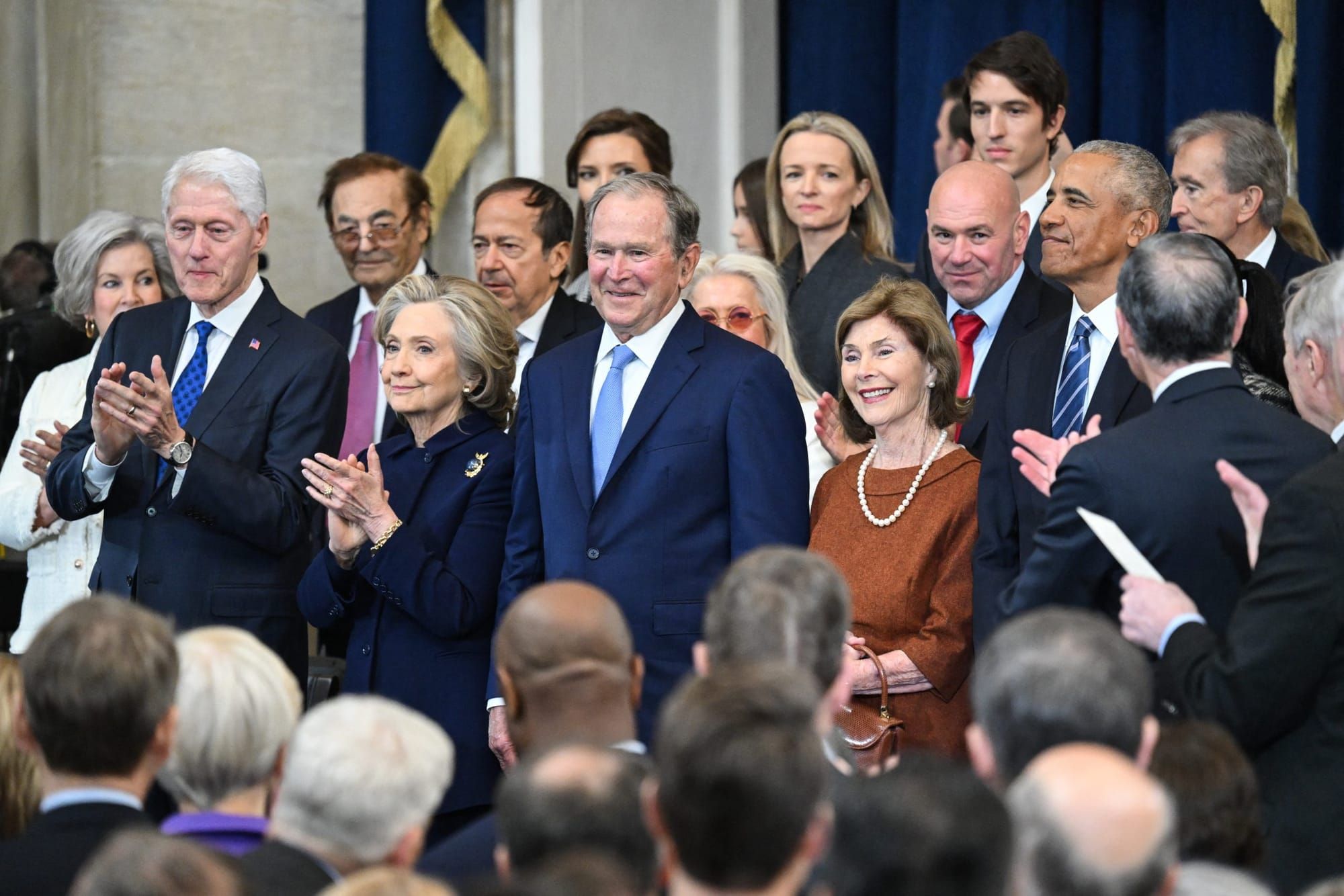
I am left with no better answer than the one provided by Édouard Louis. This must be a matter of self-realization. The most prominent contemporary faces of liberal chic—Obama, the Clintons, former Vice President Kamala Harris, French President Emmanuel Macron, former Canadian Prime Minister Justin Trudeau—and their cronies think very highly of themselves and the civilization they preside over. And though their polished language contrasts with thugs nudging Palestinian bodies off buildings, they represent the same power. They have grown comfortable with their violence.
The violence examined in “Who Killed My Father?” is domestic, related to the subjugated classes within a Western liberal democracy. For a good chunk of his life, Louis’ father votes for the National Front, which channels the rage of the white working class toward migrant laborers from North Africa or toward the abstract Middle East. Writer and historian Mike Davis and professor Justin Akers Chacón depict a similar trend in the 2006 book “No One Is Illegal,” outlining how the white inhabitants of blighted towns process their rage through the Republican Party.
But since the donors who finance the major Western liberal parties desire cheap, vulnerable labor, they push their malleable candidates to the right—as happened with Harris employing dehumanizing immigration discourse—so as to manipulate anti-immigrant electorates, while still proceeding to hire foreigners and move operations overseas.
Importing labor, exporting violence. This is a devastating formula at the center of the modern Western myth.
Importing labor, exporting violence. This is a devastating formula at the center of the modern Western myth. If Canadian and Dutch miners aren’t calmly litigating Central American and African countries to get access to their water and metals, it’s the American and German governments supplying bombs to wipe out colonized people in more vivid scenes. The likes of Michael Ignatieff and Samantha Power are kept on numbing TV networks to discuss gender equality, migration, and poverty alleviation, offering cover to destructive policy.
Occasionally, however, the mask slips off. A few months before the pandemic, Ignatieff admitted that during his brief political career, in the Canadian towns he would visit where the American factories had closed, “the liberal gradualism of the kind that I passionately believe in has often met its limit. … It’s kind of empty.”
Indeed, the emptiness at the heart of liberal cosmopolitanism is stunning. While many can live well—with frequent travel, ceaseless consumerism, and plentiful (censored) cultural spaces—whole regions have collapsed thanks to the dominance of an outsized financial sector, which dispatches capital with the touch of a screen. Addiction has proliferated at the margins and moved to the center, destroying even the children of the rich. The arming of Ukraine and Israel is cause for relief in the industrial enclaves that are still holding on, with underemployed blue-collar workers contracted to churn out the bombs and ammunition that are too sensitive to be outsourced.
Basic liberal ideals—with a broad and outdated use of the word “liberal”—seem pointless to contest, as the vast majority of us wish to live in societies that respect religious liberty, sexual freedom, the right to property, universal education, or basic solidarity through a welfare state. The main reason why Louis fled to Paris is that he wished to live securely as an openly gay man and earn a living as a writer. The metropolis can sometimes offer us a chance to escape rigid tradition, religiosity, or nationalism. How can we deny someone a “liberal” life?
Still, the kind of liberal chic that has emerged is deeply intolerant, harboring a prejudiced secularism designed to target those of non-Christian faith. This multicolored pseudo-system is hopelessly entangled with weapons manufacturing, Zionism, oligopolies, and subservience to the financial and media sectors. And, if you so much as criticize the depravity of the liberal chic, you are accused, varyingly, of wanting either Soviet socialism, Trumpist fascism, Chinese authoritarianism, or Taliban-style theocracy.
We cannot always be asked to pick from the lesser of two evils. We need to ask ourselves: How many people have to suffer and die to produce a wealthy liberal democracy?
But when even the advocates of this morally empty form of trendy liberalism are admitting to its deep economic failings—and when they are living examples of how ignorant and violent such a way of organizing the world can be—there’s clearly something very wrong, something that needs urgent addressing. We cannot always be asked to pick from the lesser of two evils. We need to ask ourselves: How many people have to suffer and die to produce a wealthy liberal democracy?
We can run out of pages counting unmoved liberals, whose nonchalance cost many lives. The writer James Baldwin, for instance, recalled a 1963 meeting that he and fellow Black artists and intellectuals attended with then-Attorney General Robert F. Kennedy, America’s most famous liberal. Lorraine Hansberry, the playwright best known for “A Raisin in the Sun,” confronted RFK over the white mobs attacking African American children who were integrating schools:
We wanted him to tell his brother, the President, to personally escort to school, on the following day or the day after, a small Black girl already scheduled to enter a Deep South school. “That way,” we said, “it will be clear that whoever spits on that child will be spitting on the nation.” He did not understand this, either. “It would be,” he said, “a meaningless moral gesture.” “We would like,” said Lorraine, “from you, a moral commitment.”
He looked insulted—seemed to feel that he had been wasting his time.
It would take the assassination of his brother—followed by Malcom X and Martin Luther King Jr.—as well as the carpet-bombing of millions in Vietnam, for RFK to (sort of) get it. And, by then, it was too late.
Today, in the United States at least, it appears that even daily videos of shredded children in Gaza, or of Israelis raping Palestinians in desert concentration camps, are not enough to move the upper-class liberal audiences who claim to cherish authors like Baldwin and Hansberry. Even well-credentialed Jewish surgeons—who return from medical missions with details about Israeli snipers putting bullets in babies—are unable to compel the comfortable Democratic elites to stop their savagery.
But, in the end, Harris was defeated. The Palestine movement can take credit for that. So, perhaps there are some comfortable liberals out there who, over these past several months, stopped reading these ghoulish euphemisms, looked at their screens and—like you and like me—couldn’t bear it anymore.
Editorial Team:
Tina Vasquez, Lead Editor
Carolyn Copeland, Top Editor
Rashmee Kumar, Copy Editor
Author
A historian by training, Avik Jain Chatlani is the author of This Country is No Longer Yours. He has taught in schools and prisons in Latin America and the United States.
Sign up for Prism newsletters.
Stay up to date with curated collection of our top stories.