Less than a year into the Trump administration, queer-serving organizations are pushed to the brink
The Rainbow Youth Project, the Trevor Project, and other groups providing mental health services to LGBTQIA+ youth report a massive rise in need

Roughly a year ago, a national nonprofit focusing on the mental health of young queer people received 3,000 calls a month from across the country to its crisis hotline. Under the Trump administration, that number has tripled to 10,000.
Founded in 2022, the Rainbow Youth Project (RYP) provides young LGBTQIA+ people with access to free mental health and suicide prevention counseling—services in growing demand, according to RYP’s Executive Director Lance Preston. This need is due in large part to President Donald Trump taking particular aim at queer youth, including targeting their health care, ability to play in school sports, and affirming teachers.
RYP isn’t alone in seeing a significant uptick in demand for its services. The Trevor Project, a nonprofit suicide prevention organization for LGBTQIA+ youth, reported that on Election Day last year, its call, chat, and text crisis services received nearly 700% more calls than normal. Lambda Legal, the nation’s oldest and largest legal nonprofit devoted to LGBTQIA+ people and people living with HIV, said that by June of this year, it had received more calls for assistance than in all of 2024.
And Joseph Myers, the director of mental health therapy at IYG, formerly Indiana Youth Group, said that after the election, almost all of the young queer people in their nascent counseling program were in crisis.
“We’re not a 24/7 crisis center, we don’t get the crisis-type calls per se, but what we have seen is the amount of suicidal ideation in our in our clients has increased,” Myers said. “In the two or three weeks after the election, almost every single client who was seeking services was on some support plan, due to ideation, self-harm, anything of that nature.”
And since then, Myers said what he calls “passive suicidal ideation” has become increasingly common. Many of the young people who seek counseling services through the organization report that they don’t currently envision a world in which things get better, and they don’t feel as if they are wanted, Myers explained to Prism.
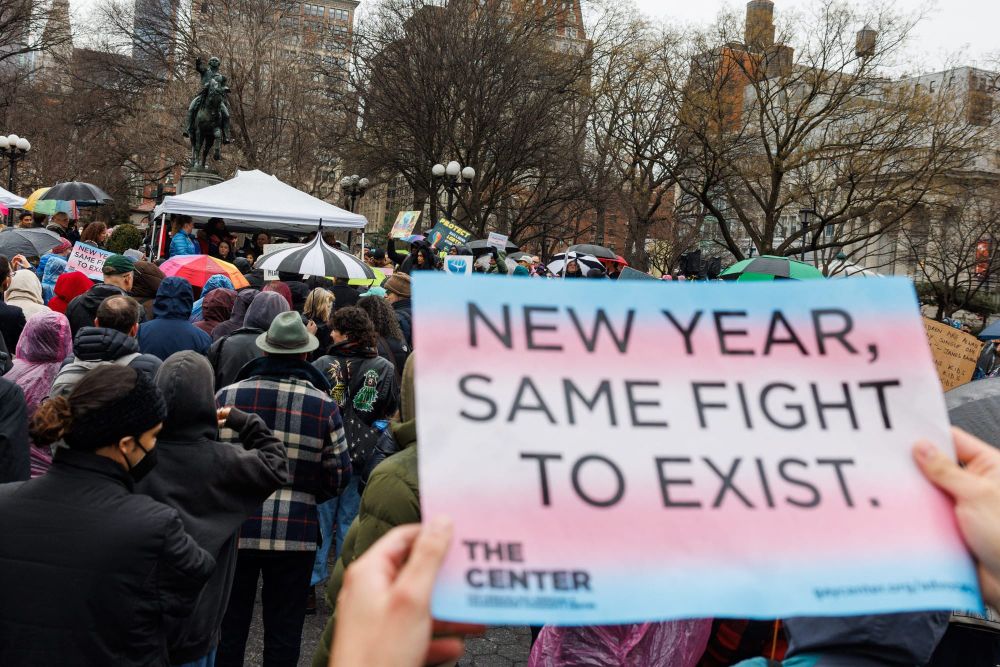
That dramatic rise in mental health crises and calls for help reflects what queer people have felt for years: an escalating hostility in almost every aspect of life, and a historic rollback in hard-fought civil rights that shows no signs of slowing down.
Harassment, bigotry, and hate
Organizations such as RYP and the Trevor Project are facing overwhelming requests for aid as attacks on the communities they serve continue to ramp up.
The latest examples include the Supreme Court potentially examining marriage equality and oral arguments last month in a case poised to strike down bans on conversion therapy. This type of counseling, aimed at changing the sexual orientation of gay teenagers, is a demonstrably harmful pseudoscience universally according to nearly every major medical association and health care professional both in the U.S. and internationally.
“It’s terrifying because we’ve seen people wanting our services, but there’s only six of us doing therapy—four of us here in Indianapolis doing therapy, six of us across the state for IYG—but there’s only so much bandwidth that we have to meet that need,” Myers said. “We’re seeing social services just kneecapped at every step of the way, so folks can’t seek help, can’t seek services. We’re a free service, but we only have so much capacity.”
The young people seeking care through Myers’ organization can’t afford to go anywhere else, so the only way for IYG to make it through an increasingly long waitlist is to offer short-term counseling in eight-to-10-week sessions.
To put a finer point on what queer youth have had to deal with, Myers said it’s not just Trump attacking them. They’ve also had to witness purported political allies, such as California Gov. Gavin Newsom, former Vice President Kamala Harris, and state legislators, turn their backs on trans people in particular. And even seemingly innocuous social media use comes with a deluge of harassment, bigotry, and hate that weighs heavily on young people who haven’t built a resilience to it—as many older queer people have had to for decades.
During Pride month in June, the Trump administration announced plans to eliminate 988’s LGBTQ+ youth services, which connected LGBTQIA+ callers to the nation’s suicide and crisis lifeline with a counselor specifically trained to support their unique mental health needs. Compared to their peers, LGBTQIA+ youth are more likely to experience persistent feelings of sadness and hopelessness, and they are more likely to attempt suicide. These young people are now without the option of being counseled by culturally competent people during some of the most dire moments of their lives.
Experts say the Trump administration’s actions not only send an intentionally cruel message to queer people who need these resources, but they also foist the thousands of calls that would ordinarily go to that line onto organizations already facing a massive influx of calls and requests for resources. NPR reported that in the three years since its launch, the hotline’s LGBTQIA+ program fielded more than 16 million calls, texts, and chats.
In addition to the influx of calls, many organizations are also operating with significantly less funding from local, state, and federal governments. And alongside these funding issues, many report that donors are also afraid to contribute as they once did out of fear that they will be targeted by critics of these organizations.
Silent precarity
According to Preston, RYP has seen a nearly 70% drop in individual donations this year, and staffers at IYG say they’ve also seen donations drop considerably.
The drop in donations comes as Trump also attacks the principal fundraising arm of the Democratic Party, ActBlue, which many organizations have relied on for contributions. Earlier this year, Trump directed the U.S. Department of Justice to launch a probe into ActBlue, and just weeks ago, campaign finance regulators in Maine levied a $100,000 fine against the platform for filing a report two weeks late.
But even unprecedented attacks haven’t stopped some committed donors from taking extreme measures to make sure their dollars get into the deserving hands of organizations. Zoe O’Haillin-Berne, director of engagement at IYG, spoke of one woman who drove two hours to donate $100 by hand out of fear that a digital donation could be traced back to her. This level of fear has become increasingly common as Trump targets anyone he deems a political adversary.
The broader challenge is the heel-turn by the federal government from the Biden and Trump administrations. The last presidential election only exemplified the sometimes silent precarity queer-serving institutions have always operated under, and it cemented what they’ve always known: that the victories they’ve fought hard for could be taken away at any moment.
Some national organizations, such as RYP and the LGBT National Help Center, had the prescient wherewithal to refrain from relying on government funds out of fear that, as they are seeing now, that funding could be pulled at any time. In the case of the LGBT National Help Center, Executive Director Aaron Almanza said the group’s work as an anonymous hotline means it has not been eligible for federal funds. And while that may have previously seemed like an impediment to the help center’s work, now it feels ironically fortunate. Earlier this year, the Trump administration was ordered to restore more than $6 million in grant funding to organizations that offer health and support services for LGBTQIA+ people, including those living with HIV.
And for organizations that serve young people in life-or-death crises, a sudden lack of funding and a quickly shuttered program can have deadly consequences.
It’s not just that a program went away. We’re taking a great risk of losing a life.
Lance Preston, executive director of Rainbow Youth Project
“We deal with kids who are extremely suicidal, who are isolated, mostly living in very rural areas where there are no resources,” Preston said. “So for us, if that program goes away, it’s not just that a program went away. We’re taking a great risk of losing a life.”
This crisis is felt more severely at local organizations without the sprawling resources that can come with a national reach.
At IYG, which touts itself as the oldest continuously operating queer youth group in North America, expansion efforts were paused after local and federal funds dried up under the current political climate.
IYG operates a handful of community centers across Indiana where there aren’t any other queer-serving organizations, particularly in rural areas that O’Haillin-Berne calls “support deserts.” And while the organization is committed to keeping existing centers open, efforts to expand are in question amid the current funding gap, particularly after recent layoffs.
“It’s a really tough position to be in, because kids need us more than ever, and we have fewer resources than ever,” O’Haillin-Berne said. “We know that LGBTQ+ young people are disproportionately affected by mental health concerns, homelessness, all of these things. And I always want to make it so abundantly clear to anyone who doesn’t understand: They’re not facing these because they’re queer. They’re facing these because of how people treat them for being queer.”
For staffers at these organizations—and in RYP’s case, hundreds of volunteers who handle crisis calls—the work is increasingly difficult. But at the same time, it’s also incredibly personal, as queer people and people who know firsthand what it’s like to need help in their darkest moments.
“I was one of those kids,” Preston said. “I attempted at the age of 18 due to religious persecution. I had a supportive family, but a community and a church that hated my family for supporting me. And that led to a lot of isolation, a lot of depression, and I was on life support for seven days at the age of 18.”
And as dire as things are right now for these organizations, Preston and Almanza said that if there’s a silver lining in all of this—and it’s razor-thin at best—it’s that they’ve been buoyed by the way volunteers for their crisis lines have stepped up to meet this need. Almanza said that after the election, more than a dozen volunteers returned to take calls. According to Preston, out of 251 volunteers, only two have ever stepped away since RYP was founded three years ago.
The volunteers in particular bear the burden of responding to people in their darkest moments— and not every call ends with a life saved. The organizations do what they can to also offer counseling to those on the frontlines, but even leaders such as Preston said they’ve had to step away for their own mental health.
To make matters worse, Preston said the organization also receives calls threatening volunteers and the organization. “You never know what you’re going to get” when a volunteer answers a call, Preston told Prism.
“Sometimes it’s just a kid that just wants to say hello and ask if they’re going to be OK,” Preston said. “Sometimes it’s a kid that really needs desperate help, and sometimes it’s someone saying, ‘I want to kill you. I’m going to blow up your building. I’m going to shoot you when you leave work today.’”
But despite these compounding crises, the work continues. And in the absence of federal support, some states have taken it upon themselves to offer services of their own.
Earlier this year, Illinois launched Illinois Pride Connect, a first-of-its-kind legal hotline and resource hub for LGBTQIA+ residents. The hub boasts resources related to health care, immigration, housing, and other legal issues, cementing the Prairie State as a place of refuge for queer people across the country fleeing discrimination and persecution.
Additionally, organizations say queer people have stepped up where their allies have fallen short, reinforcing the notion that the queer community will take care of itself in the face of landmark attacks—as they always have.
For IYG, that lesson is baked into their history. The organization was founded in the mid-1980s by people working for a queer crisis hotline who kept getting calls from children in need.
“They were getting all these kids in crisis, and there was nowhere for them to turn, so [the founders] got some of their friends together from that hotline and created IYG,” O’Haillin-Berne said, adding that those early days of IYG were spent in a Steak ‘n Shake to help a safe space for queer youth.
“It’s an example of how the queer community will find a way. If something is a need, the queer community will find a way to make it work. If that’s meeting in a Steak ‘n Shake, that’s meeting in a Steak ‘n Shake. If that’s throwing a brick at Stonewall, that’s throwing a brick at Stonewall. Our transcestors and queer ancestors have paved the way for us.”
Editorial Team:
Tina Vasquez, Lead Editor
Carolyn Copeland, Top Editor
Rashmee Kumar, Copy Editor
Author

Adam Rhodes is an investigative journalist whose work primarily focuses on queer people and the criminal legal system. They currently work as a training director at Investigative Reporters and Editors
Sign up for Prism newsletters.
Stay up to date with curated collection of our top stories.