Violence deconstructed: Dehumanizing immigration policy is being justified to protect white women
The Laken Riley Act’s lack of distinction between legal and undocumented immigrants reminds us that immigrant justice can’t be predicated on legality
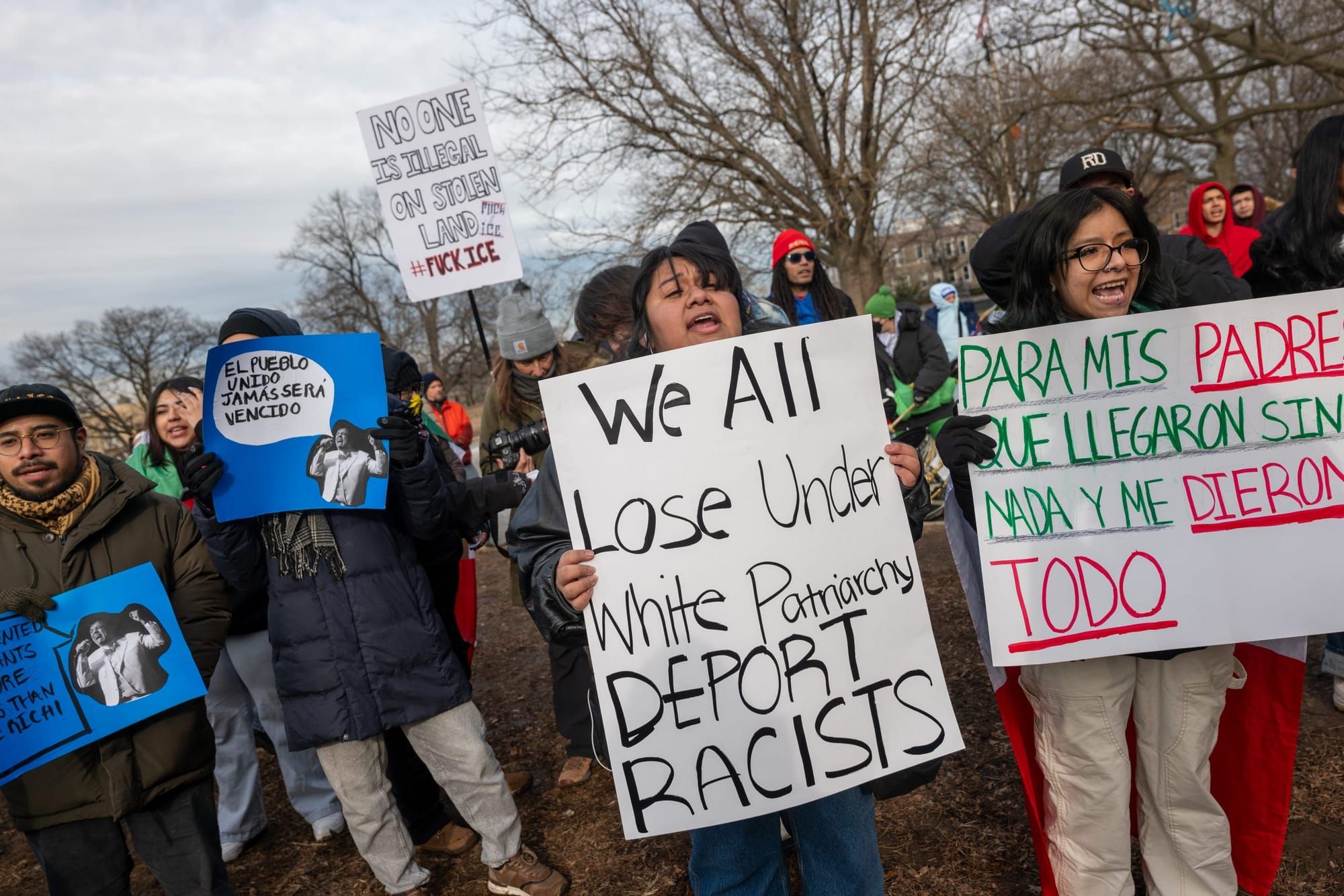
President Donald Trump campaigned on a pledge to carry out mass deportations and won reelection. Former Vice President Kamala Harris, the Democratic nominee, tried to frame Trump as weak on immigration, pledging to fortify the border further and deport more “criminals” than Trump did in his first term. Their unsettlingly similar approaches reflect a bleak reality: Violent xenophobia is a bipartisan position. And as of this congressional session, Republicans and Democrats are increasingly working together on a sweeping agenda to strengthen the mass deportation apparatus by citing faux concerns about women’s safety—all as these bills place abuse victims at greater risk.
In policymakers’ imaginations, immigrants are endangering white women. Propagandizing against nonwhite, often Black or brown men as an innate, violent threat to white womanhood is an age-old tactic of white supremacy, used to facilitate further colonial violence against entire groups. In reality, the lawmakers presenting immigrant men as an existential threat to women’s safety are perhaps the greatest threat to us, with their abortion restrictions, vile attacks on trans women and queer people, and, of course, their legislation directly targeting immigrants who are victims of abuse and gender-based violence.
Last month, Congress passed the Laken Riley Act, which Trump signed into law on Jan. 29. The law was named after a 22-year-old nursing student who was killed in 2024 by an undocumented immigrant man who had previously been charged with shoplifting. The law allows immigrants, including those who legally live and work in the U.S., to be indefinitely detained without being charged with a crime—even if they’re arrested by mistake. The bill’s lack of distinction between legal and undocumented immigrants reminds us that immigrant justice can’t be predicated on legality. A coalition of victim advocates sharply condemned the bill, accusing it of exploiting their cause to advance xenophobia—all while further harming immigrant survivors, who are “less likely to seek help from authorities” if they “fear retaliatory accusations that could lead to detention,” the National Network to End Domestic Violence said. The Tahirih Justice Center stressed that the Laken Riley Act’s emphasis on petty crimes and shoplifting carries particular harm for domestic violence victims, who are often falsely accused of or forced to commit such crimes under duress.
Last month, the House of Representatives also passed the heinously named Preventing Violence Against Women by Illegal Aliens Act, or HR 30. The bill’s lead sponsor is Rep. Nancy Mace, R-S.C., who has similarly wielded “women’s safety” as a warped justification for her crusade against trans people. HR 30 claims to protect abuse victims by amending the Immigration and Nationality Act so that domestic abusers who are accused of abuse but haven’t been convicted of a crime can be deported. But the bill actually renders it easier for immigrant victims to be deported if they defend themselves against their abuser or are falsely accused of abuse by them This is a common, highly effective tactic among perpetrators of abuse called DARVO (deny, attack, reverse victim and offender.) Almost a quarter of survivors say that when they called 911 on their abusive partner, they—not their partner—were the ones arrested or threatened with arrest because police officers perceived them as the abuser.
On the House floor, Mace proudly declared in a graphic, wildly racist rant that she sponsored HR 30 “to demonize illegal immigrants who are here raping our women and girls, murdering our women and girls, and who are pedophiles, molesting our children,” further accusing “a hoard of illegal aliens” of “molesting American children, battering, and bruising and beating up American women, and violently raping American women and girls.” I repeat: To Mace and her base, the fictionalized women and girls in question are white.
The lawmakers presenting immigrant men as an existential threat to women’s safety are perhaps the greatest threat to us.
Historically, Black and brown men have been reduced to bestial, hypersexualized caricatures to justify an array of state violence, including colonization as a means to “civilize” them and slavery to deny them self-determination. In the U.S., the state has condoned extrajudicial, white supremacist violence in the form of lynchings; in the famous case of Emmett Till, a Black child was tortured and killed by a hoard of white men over a white woman’s claim that the child had whistled at her. At least 4,743 lynchings occurred in the U.S. from 1882 to 1968, though the NAACP estimates this to be an undercount. The perpetrators justified this racial terror and brutality by framing their victims as an innate and immediate physical threat—primarily to white women and girls—just by existing.
In September, the state of Missouri lynched Marcellus “Khaliifah” Williams, a Black man who was charged with murdering a white woman, despite serious flaws in the state’s case against him, including unreliable witness testimony, lack of forensic evidence, and racial bias in jury selection. As Hannah Greene wrote for Prism at the time, “In the cruel imagination of the state, Williams was reduced to the Black brute caricature, preying on helpless white women—nothing but a threat to be destroyed.”
We continue to see these tactics—the justification of state violence through the dehumanization of men of color—abroad, where the U.S. continues to facilitate colonialism. In Palestine, false allegations of a coordinated, mass campaign of sexual violence against Israeli settlers by Hamas fighters serve as the basis of Israel’s genocide. These allegations, peddled by occupation forces and Western media, draw on overtly racist stereotypes about Palestinian and Arab men as barbaric rapists who must be punished, tamed, and controlled and who can’t be trusted with freedom and self-determination. This portrayal, of course, is entirely warped, as colonial logic always is: Occupation forces have long wielded sexual violence as a weapon against Palestinians, while justifying their U.S.-funded terror campaigns against Palestinians by portraying Palestinians themselves as rapists.
In the U.S., the border functions not just as an extension of imperialist, gendered violence, but also as a fundamental act of gendered violence itself. In December, Texas Gov. Greg Abbott unveiled a $100,000, state-funded billboard campaign threatening undocumented immigrants with sexual violence if they crossed the border. “How much did you pay to have your daughter raped?” they read. “Your wife and daughter will pay for the trip with their bodies.” Another says, “This 14-year-old girl was raped by more than 20 men on her way to the border. Protect your family. Change their fate.” Between 60% and 80% of women and girls face sexual assault crossing the border. In 2018, a Border Patrol official said that migrant girls as young as 12 are put on birth control pills “because they know getting violated is part of the journey.” Sexual violence committed by immigration authorities is rampant in immigrant detention centers too. All of this is a direct consequence of the U.S. willfully transforming the border into a militarized zone, shrouding migration in manufactured criminality and violence.
Mace has further advocated for HR 30 by claiming that “keeping criminal illegal aliens … off our streets is just common sense,” and “women should be able to walk down the street without fear.” But the notion of rape and gender-based violence solely as street-based crimes is right-wing propaganda to bolster support for police. Gender-based violence primarily takes place in the home, perpetrated by partners and acquaintances; the likelihood of its lethality is maximized by state defunding of domestic violence shelters and other resources.
Perpetrators of violent crime in the U.S. are overwhelmingly citizens, but this is immaterial to anti-immigrant lawmakers because their goal is mass deportations; they’re uninterested in splitting hairs about criminality and reality. An average of 70 women are shot and killed by an intimate partner every month. Congress has yet to pass a bill addressing this violence. Across the country, federal funding for domestic violence shelters and hotlines has sharply declined in recent years, all while the Laken Riley Act will cost over $3 billion to enforce. The state itself is the foremost abuser of women and survivors—all as it hides behind racist caricatures and graphic, anti-immigrant atrocity propaganda.
Editorial Team:
Lara Witt, Lead Editor
Carolyn Copeland, Top Editor
Rashmee Kumar, Copy Editor
Author

Kylie Cheung is a freelance writer reporting on politics and culture. She is the author of Survivor Injustice: State-Sanctioned Abuse, Domestic Violence, and the Fight for Bodily Autonomy.
Sign up for Prism newsletters.
Stay up to date with curated collection of our top stories.