Filed Under:
Kentucky prisons cut communication access while maintaining telecom ties
Citing “security issues,” the Kentucky Department of Corrections has eliminated the ability to use tablets for video and phone calls, further isolating incarcerated people from their loved ones
Mo Viviane
Real journalists wrote and edited this (not AI). Independent, community-driven journalism survives because you back it. Donate to sustain Prism’s mission and the humans behind it.
Real journalists wrote and edited this (not AI)—independent, community-driven journalism survives because you back it. Donate to sustain Prism’s mission and the humans behind it.
For incarcerated people in the rural South, maintaining connections with loved ones and others on the outside has always required perseverance.
From Beattyville, Kentucky’s Lee Adjustment Center, where he’s been incarcerated for six years, Lavar Melton described the prison’s dismal communications offerings.
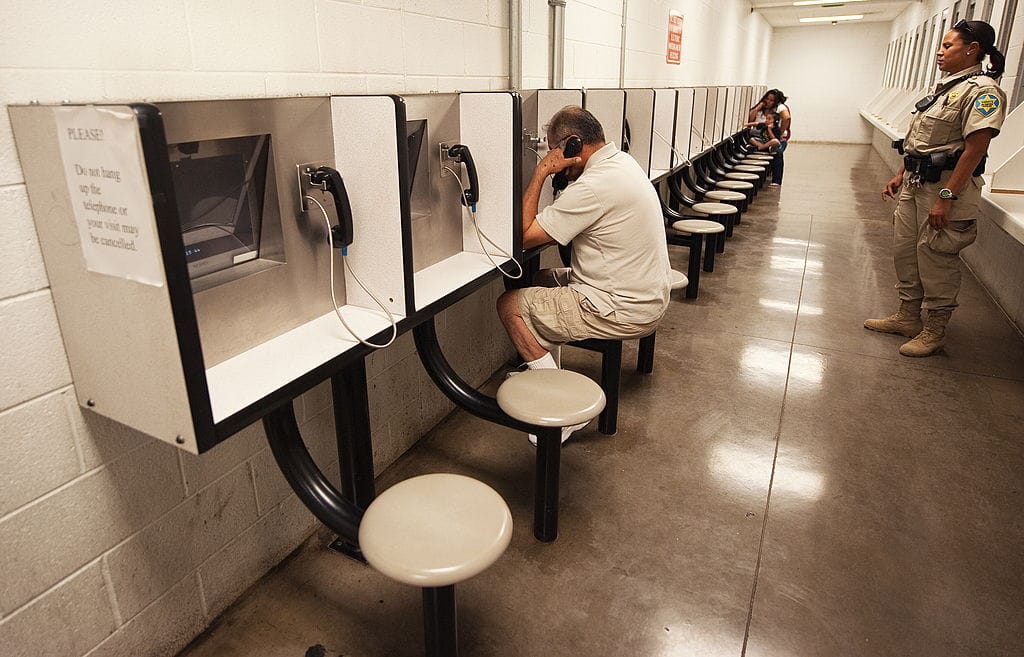
The prison has limited wall phones, and people inside can only use them for four 15-minute calls a day. There are kiosks that allow for video visits, but gone are the tablet apps that enabled phone and video calls to loved ones. The absence of tablet apps also means incarcerated people can no longer send pictures and videos to family and friends, severing an important connection to the outside world.
“Securus has, on multiple occasions, tried to set [Kentucky Department of Corrections] up with the tablets that allow for both phone usage and video visits, but the state won’t allow it. They claim the cameras would be a security risk and the phones were too hard to keep up with monitoring,” said Melton in a Securus message.
From prisons banning in-person visits in favor of exploitative tablet services, to prison telecom companies such as Securus charging exorbitant fees, the tools marketed as “communications solutions” only seem to create more barriers—if incarcerated people such as Melton can even access them at all.
The communications challenges at the Lee Adjustment Center are only mounting.
People incarcerated inside Lee told Prism that in recent weeks, it’s been impossible to maintain contact with their loved ones.
“A betrayal”
In 2022, the companies Securus Technologies and ViaPath Technologies dominated approximately 80% of the U.S prison telecom market. Their contracts include profit-sharing arrangements with correctional agencies, which have historically incentivized higher prices.
Securus Technologies began its contract with the Kentucky Department of Corrections (DOC) in 2006. Initially, the contract was a revenue-generating master agreement for inmate telephone services, where Securus provided and maintained the phone systems at no cost to the state in exchange for charging incarcerated people and their families for calls. In turn, the state received significant revenue in the form of commissions—a financial structure that Securus and Kentucky DOC maintained through multiple contract extensions after their agreement ended on May 30, 2020. For example, in 2020, Kentucky DOC received $3.2 million in phone commissions from Securus.
However, in a stark reversal from its 2024 decision to set limits on prison phone and video call rates, the Federal Communications Commission (FCC) voted to roll back these limits in November 2025. Under the new interim rules, phone calls will cost up to $0.11 per minute, and video calls will cost up to $0.23 per minute in large facilities. Meanwhile, in small facilities, video calls will cost up to $0.41 per minute.
Along with Oklahoma and Florida, Kentucky’s rates are already above these new caps. Officials allege that rates have increased due to staffing shortages and as a way of making up for the FCC’s previous ruling that set limits on rates.
FCC Chair Brendan Carr, who championed the recent rate increase, told Oklahoma Watch last year that higher rates are necessary to ensure that prison and jail staff can adequately monitor calls.
“Those [previous FCC] rules have resulted in serious unintended consequences,” Carr told the publication. “For example, by limiting how facilities could recover safety and facility costs, some prisons or jails were forced to scale back or even stop offering calling services altogether.” Advocates noted limited evidence supporting the claim that the previous rate cap made jails and prisons cash-strapped.
Bianca Tylek, the founder and executive director of the nonprofit Worth Rises that is fighting to end the exploitation of incarcerated people and their families, characterized the FCC’s abrupt shift in policy as “a betrayal of the families who entrusted the FCC to protect them from the notoriously predatory correctional telecom industry.”
‘Devastating consequences’
For months now, advocacy organizations and people incarcerated in Kentucky have sounded the alarm on Kentucky DOC’s decision to limit calls and other communication. The phone limitations may also be a violation of the state’s own policy.
Having an hour a day for phone calls might seem generous, but for those who are living inside prison walls—where every connection to family, legal assistance, and the outside world is a lifeline—the cap is inhumane. The policy shift is also a reflection of a deeper crisis: understaffed facilities, outdated technology, and the ripple effects of mass incarceration that treat human connection as an afterthought. Murky policy language also makes it unclear whether these communication cuts are allowed.
The only concrete language about tablets appears in an acknowledgment form as part of a recent update to Kentucky DOC policy regarding communication, mail, and visiting: “Tablet use is a privilege and not a right.” The language leaves a lot of room for interpretation.
In a statement to Prism, Kentucky DOC said it “provides individuals in its custody with opportunities to communicate with family, friends, attorneys and the community through in-person and virtual visitation, written correspondence, telephone calls, and secure electronic messaging.”
The agency did not directly comment on its communications restrictions.
While some incarcerated people in the state would like access to Securus services to better communicate with loved ones, many facilities in Kentucky have moved away from Securus Technologies altogether.
Kentucky’s Louisville Metro Department of Corrections (LMDC) told Prism that its contract with Securus Technologies expired, and after issuing a request for proposal to evaluate potential replacement vendors, the agency chose a new provider: Smart Communications, which recently filed for bankruptcy.
Access to tablets in Kentucky prisons varies, with no official statewide policy dictating their use. Broadly, many prisons within Kentucky DOC have eliminated or limited their use, citing security concerns due to ongoing staffing shortages.
For incarcerated people who are not from the state where they are incarcerated and who have no family nearby, the denial of a tablet can have devastating consequences.
“That makes life for people like myself who are not from here and have no family here even more difficult to stay in touch,” Melton said.
By removing incarcerated people’s ability to make calls from their tablets, prisons such as the Lee Adjustment Center have created a new set of problems. Melton told Prism that people inside cannot even make the four, 15-minute calls they’ve been allotted each day because so many are waiting to use the phone. According to Milton, he’s only getting calls out “at best twice a week,” and that is only if he has enough money.
Since the state removed phone capabilities from tablets, tensions inside have also intensified.
“I went from sitting in my cell during count talking on the tablet phone, to getting into fights over who’s got next on the wall phone,” Melton said.
The prison’s reliance on communication technology also creates a barrier for the elderly and often results in communication lags.
“Setting up a Securus account is becoming more difficult with every passing year,” Melton said. “My mother is 87 and has no idea how to create an account, so she gave up and just talks to me when I catch my sister with her.”
When his sister passed away, Melton learned of the devastating news through a message that took three days to arrive on his tablet because messages first have to be approved and cleared by prison staff. According to Melton, when he brought the issue to prison staff, he was met with hostility and sent to solitary confinement.
Chance, who is only using his first name for fear of retaliation, has been incarcerated at the Lee Adjustment Center for about a year. With a backlog of people each day waiting to make calls, he said it’s difficult to find time to communicate with friends or his broader family. “I try to use my calls to keep in contact with my children,” he told Prism via Securus message.
The prison’s communication cap is also forcing people to ration their connections to their loved ones.
“I’m not able to just call and make sure someone made it to a destination, or wish a happy birthday,” Chance explained. “Your calls have to be selective and make sure they cover everything.”
For parents with multiple children or complex custody arrangements, this burden is even more pronounced. “Now imagine holidays. It’s hard to keep up with the world in four calls,” Chance said.
Houston Bunton, also incarcerated at the Lee Adjustment Center, has a case pending in the Kentucky Court of Appeals. An appeal is a stressful process, and Bunton said if not for his support system—including his mother, brother, and aunts—he’s not sure how he could manage.
“Without those four people, my prison time would have been much different,” Bunton said in a Securus message. But his transfer to Lee, which is four hours from his family’s home base, has made visits “few and far between.” Some prisons no longer even offer the option.
LMDC, for example, has halted in-person visitations.
“Traditional in-person visitation has increasingly been replaced by technology-based visitation throughout jails nationwide to reduce the risk of contraband entering the facility while still allowing individuals to remain connected with approved contacts,” an LMDC spokesperson told Prism in a statement.
Removing visitation, coupled with the loss of tablet cameras, has worsened already painful divides for incarcerated people across Kentucky.
Bunton lost his grandmother in August 2024, and due to the communication limitations imposed by the prison, he didn’t get to say goodbye.
“I could not even send a current picture home or video call her or talk to her in her last moments due to the limitations placed on us by the facilities and the DOC,” he explained.
At Lee, Bunton said that a wing of 48 people share just four phones, with access further limited by mandatory count times when correctional officers count each incarcerated person in the wing. The phones also have a 9 p.m. cutoff.
“The saddest part is [when] we had tablets, we had the ability to call using our tablets, which allowed us to call anytime we wanted, from 6 a.m. to 11 p.m.,” Bunton said. “But that ability was taken away due to ‘security risk.’”
The tablets, once a critical communication tool, are now mostly an expensive distraction. “They have essentially become large MP3 players with a messaging app,” Bunton explained.
“Jailbreaking the imagination”
The communication restrictions in Kentucky are not just inconvenient; advocates say they are fundamental failures of the state’s rehabilitative mission.
Research shows that incarcerated people who maintain consistent contact with loved ones are significantly more likely to succeed upon release and also less likely to reoffend. By making communication tools inaccessible, Kentucky’s policies actively undermine rehabilitation and recidivism efforts.
The Kentucky DOC is obligated to facilitate the connections that support rehabilitation and lower recidivism. But by removing camera capabilities from tablets, limiting calls, and relying on outdated infrastructure, people inside say the state cares more about control than helping them prepare for successful reentry.
Still, families are finding ways to maintain connections. Loved ones continue setting up Securus accounts and scheduling video visits online, navigating the platform’s complexities and costs to speak to their loved ones inside.
Worth Rises has pushed for legislation to cap prison phone rates at the state level, and the organization is also demanding more transparency around the telecom contracts prisons enter into.
Reimagining communication access is a part of what abolitionist organizers Mariame Kaba and Kelly Hayes refer to as “jailbreaking the imagination,” which, they say, at the bare minimum demands envisioning a world that does not prioritize the depletion of human life.
Across the U.S., states such as New York, California, Colorado, Connecticut, Massachusetts, and Minnesota are taking a more humane approach, prioritizing free phone calls in state prisons.
The Kentucky DOC, on the other hand, has made a choice to further isolate incarcerated people instead of embracing a model that prioritizes their humanity and connections to the outside.
Editorial Team:
Tina Vasquez, Lead Editor
Carolyn Copeland, Top Editor
Stephanie Harris, Copy Editor