‘We waited a year, then they shut the door’: Iranian students denied U.S. visas
Students say their dreams are crushed and their lives are on hold after the Trump administration invoked a special authority typically used for national security to issue blanket visa rejections
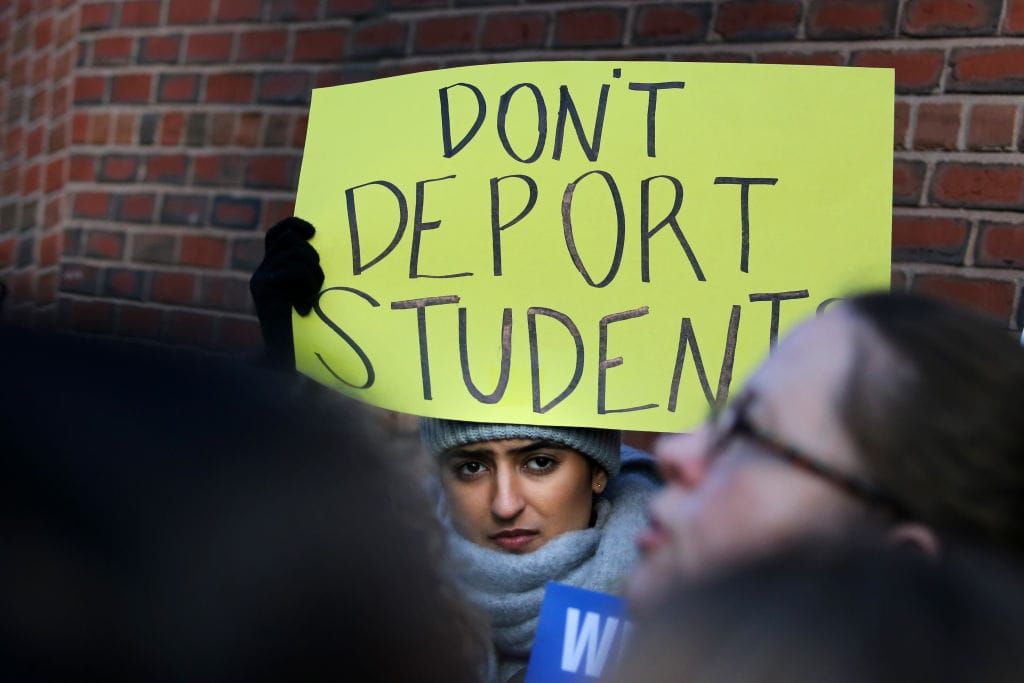
For more than a year, Iranian graduate students and their spouses held on to a single hope: that after months of visa delays and administrative silence, they would finally be allowed to begin their studies, or reunite with their partners, in the U.S. Instead, hundreds of students were abruptly denied visas this spring under Section 212(f), a presidential authority typically invoked for national security. No specific charges were levied, and no individualized threats were cited, just blanket rejections.
The surge in denials—many issued after nearly a year of administrative processing—comes amid growing concerns from civil rights organizations about a parallel increase in immigration arrests targeting the Iranian American community, many involving long-term residents with no recent legal infractions. The denials also come on the heels of the so-called 12-day war between Iran and Israel in June, which the U.S. also joined, that sparked a regional crisis and ended with a fragile ceasefire.
“I’m sure this number has gone up by now, but it appears that over 130 Iranians have been detained in a little over a week,” said Ariana Amini, a spokesperson for the National Iranian American Council (NIAC), in an interview with Prism. “Many with no criminal record … it’s targeting people who have been here for decades.”
For nearly a year, Zahed Golabi checked the U.S. embassy’s visa portal daily. A PhD-bound software engineer, Golabi was accepted into a top American university and completed his visa interview in July 2024 at the U.S. embassy in Yerevan, Armenia. It was a costly and logistically difficult trip from his home in Iran, which has no U.S. embassy, but it was worth it to fulfill his dreams. The officer told him his application was under “administrative processing,” a routine phrase signaling a series of background checks familiar to most Iranian students.
However, like hundreds of other Iranian students with long-pending visa applications, Golabi’s case has now been effectively frozen. As Golabi continues to wait and hope for a resolution, students are being turned away.
“This level of scrutiny has made it difficult to plan my academic future with confidence,” Golabi told Prism over email. “It’s disheartening to feel that my nationality, rather than my qualifications or intentions, is the main reason for the delay. While I understand the importance of security procedures, the experience has been emotionally and mentally draining.”
NIAC has tracked a troubling correlation, Amini said: Every time tensions flare between the U.S. and Iran, Iranian nationals and Iranian Americans feel the fallout.
Under U.S. immigration law, the president may invoke Section 212(f) to deny entry to foreign nationals deemed “detrimental to the interests of the United States.” While often framed as a national security tool, advocates argue its current use, particularly against students and long-term residents, constitutes collective punishment based on nationality.
Golabi is one of 30 Iranian students who reached out to Prism—all of whom are currently affected by the U.S. visa system’s prolonged clearance delays, now compounded by a new travel ban targeting Iranians and nationals from 11 other countries. Many students are now being denied visas outright, often just weeks before their programs begin.
Mahsa Talebi accepted a fully funded PhD in chemical engineering at the University of Kentucky and waited over a year after her June 2024 interview in Ankara, Turkey, for her visa. She then learned that embassies had begun rejecting cases like hers under Section 212(f), despite her clean record.
“This is deeply unfair and devastating—after waiting for so long,” Talebi said in an email interview. “If I were truly a threat, that would have been determined during the past year of clearance. It’s painful to think that all of my hard work could be wasted simply because of where I was born.”
Talebi’s attorney filed a legal complaint to expedite her visa under existing U.S. statutes, though the costly and time-consuming process ultimately led nowhere.
Zeinab Nourmohammadi, another student who had hoped to begin a PhD in dentistry at the University of Illinois, Chicago, described her experience as “completely devastating.” After a visa interview in Ankara last July, she, too, was placed into administrative processing, waiting patiently for updates that never came. With the fall 2025 semester approaching, she’s now at risk of losing her spot entirely.
“The PhD in our field is so competitive and exclusive,” Nourmohammadi said. “I do not have many options around the world, and this travel ban completely disappointed me [in] pursuing my dream and studying the PhD program at UIC.”
Similarly, Saeed, who requested to use only his first name, is a 27-year-old environmental science scholar with a passion for groundwater remediation and a dream to contribute to global environmental studies. Admitted to both Montana Technological University and the University of Southern California for a fully-funded PhD, Saeed has been waiting more than eight months for a decision on his F-1 student visa. Now, his dreams are indefinitely deferred.
“I have no ties to the military, my academic background is purely scientific and apolitical, and I do not work in any field considered sensitive or high-risk by U.S. authorities,” Saeed said in an email. “Every day that passes without a visa decision adds to the cost, not just financially, but emotionally and psychologically. I feel like my future is being held hostage, despite possessing the qualifications and the right intentions to make meaningful contributions to global scientific research.”
Although former President Joe Biden revoked the “Muslim Ban” from Trump’s first term in 2021, the use of 212(f) has returned in more targeted forms, including this latest directive. While it technically allows for waivers in exceptional cases, advocates and attorneys say the process is opaque, inconsistent, and leaves students in a state of indefinite uncertainty.
Iranian students have long faced additional hurdles when applying to U.S. universities. Some report being denied interviews by professors after revealing their nationality. Others were unable to even apply to certain institutions due to blanket state-level restrictions, such as those enacted by Florida, where several universities have barred Iranian applicants from key STEM fields.
“While my visa has not been officially denied, the effect has been the same,” said Saeed. “I remain stuck in limbo—unable to pursue the academic path I’ve worked so hard for, and now faced with the added fear of being unjustly and permanently barred from the U.S. without any chance to appeal or clarify my case.”
Despite these obstacles, Iranians continue to rank among the top international student populations in U.S. graduate programs, especially in engineering and science. Though they are consistently recognized for their academic achievements and research contributions, that hasn’t translated into equitable treatment.
“When I was applying to universities or interviewing with professors, some of them changed their minds once they realized I was from Iran,” Talebi said. “Some institutions even stated openly that they no longer accept Iranian students due to visa-related challenges. This has been deeply discouraging … it’s disheartening to see so many doors closing—not because of lack of ability or ambition, but simply because of where we were born.”
As the U.S. restricts entry for Iranian nationals, Israel’s war on Iran closes off exits. Bombings, financial collapse, and infrastructure failures have made daily life precarious. Banks are closed, flights are limited and often unsafe, and communication is unreliable.
“At night, we are often kept awake by the sound of bombardments, and during the day, we are occupied with trying to keep up with basic necessities—electricity, water, communication,” Saeed said before the ceasefire went into effect. “I, too, feel stuck—unable to move forward with my studies, my career, or even personal milestones like marriage. It’s hard to plan anything when your future depends on a decision over which you have no control.”
For Iranians already living in the U.S., Immigration and Customs Enforcement’s (ICE) increased presence also poses threats. A recent high-profile case involved Donna Kashanian, a 64-year-old Iranian woman who has lived in the U.S. for nearly five decades. Kashanian’s husband is a U.S. citizen, and her daughter was born in the U.S. In June, Kashanian was detained while gardening in her backyard in New Orleans.
“It’s tearing families apart,” Amini said. “People who have sought asylum here and haven’t been back to Iran for decades may not have somewhere to go to.”
NIAC has condemned both the visa rejections and ICE arrests as forms of racial profiling, noting that while some Department of Homeland Security memos cite “suspected terrorists,” most detained Iranians or rejected students had no such connections.
“This is very racially motivated when they’re rounding up people with [no] criminal records, but also just explicitly stating we’ve rounded up Iranian nationals who are suspected terrorists,” Amini said. “There’s a clear disconnect there, just in terms of the label and what those labels mean. And again, I think that’s very, very dangerous and just adds to this disturbing trend.”
While NIAC does not offer direct legal services, it can connect families to immigration attorneys and help maintain an open line for community support. Their recent poll with YouGov found that 49% of Iranian Americans fear their civil rights are at risk under the current administration.
Samaneh Rezaei, a software engineer with over 15 years of experience, has been separated from her husband, a U.S.-based PhD student, for more than two years. She is one of many Iranian spouses and students who find themselves in what they call a “cruel paradox”: urgently needing to leave a politically unstable region, but blocked from entering the U.S. by policies tied to that very instability.
“We do everything right and still face walls. It’s hard not to feel forgotten and left behind,” said Rezaei, whose F-2 visa application was denied twice and has been stuck in administrative processing since May 2024.
Students and advocates are calling for immediate policy relief, including the exemption of student and dependent visas from Section 212(f) for applicants who have cleared background checks, greater transparency in embassy procedures regarding timelines and reasons for denials, stronger institutional support from U.S. universities through deadline flexibility, housing guarantees, and expanded mental health resources for those enduring prolonged separation, uncertainty, and financial strain.
The fear, Amini said, is not just about what’s already happened, but what may come next.
“If that ceasefire is broken, then whatever level of attack that we’re seeing now on Iranian nationals in the U.S. could very well increase even more,” Amini said.
Editorial Team:
Sahar Fatima, Lead Editor
Carolyn Copeland, Top Editor
Rikki Li, Copy Editor
Author
Alexandra is a Cuban-American writer based in Miami, with an interest in immigration, the economy, gender justice, and the environment. Her work has appeared in CNN, Vice, and Catapult Magazine, among
Sign up for Prism newsletters.
Stay up to date with curated collection of our top stories.