Prison breastfeeding program in Florida helps build bonds between incarcerated mothers and their infants
“I can’t hold him every day, but I take comfort knowing I’m still allowed to feed my child”
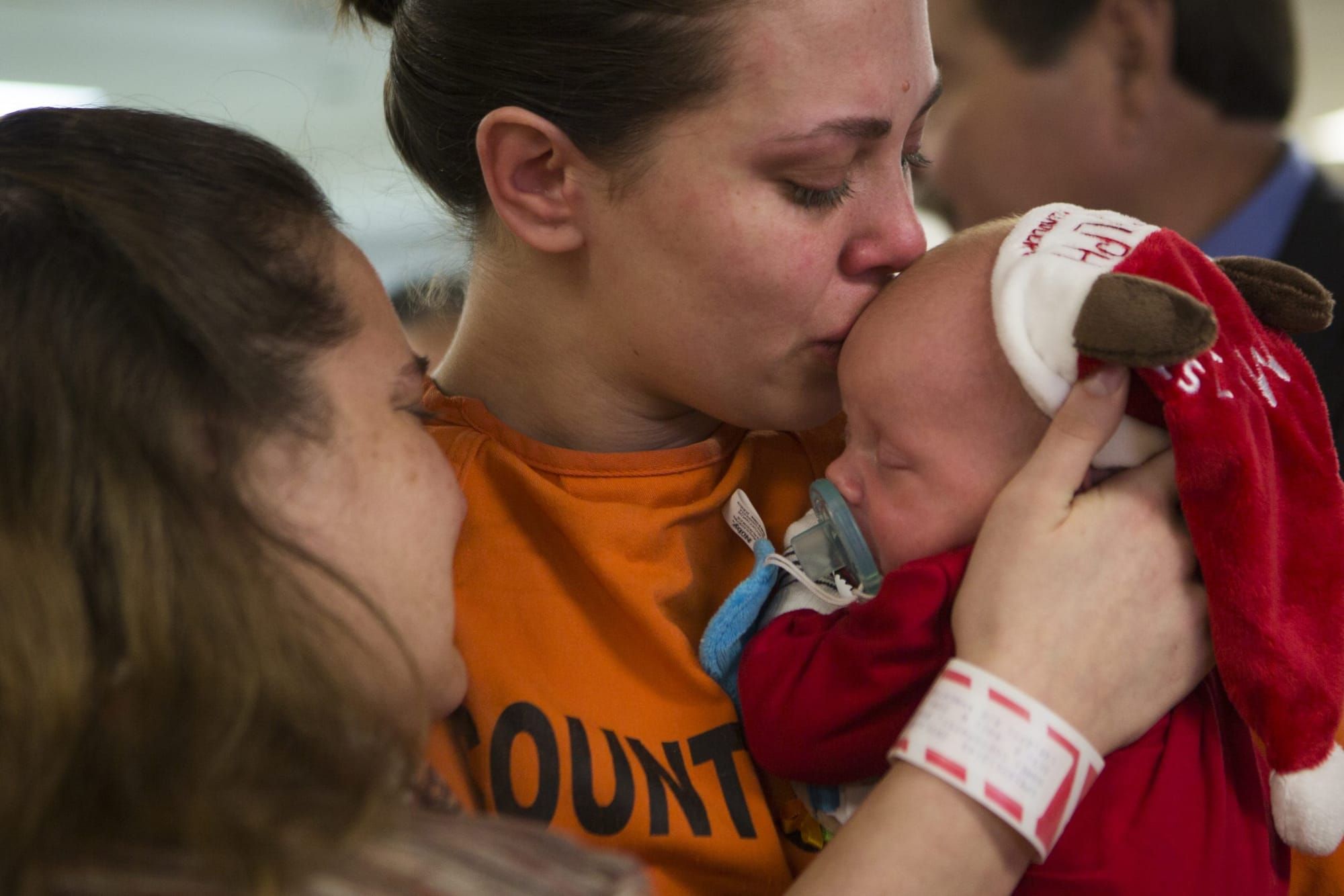
In the visiting room of a Florida prison, Bianca Marchand held the hands of her giggling 10-month-old son as he toddled across the floor. Though she can’t raise him herself, she painstakingly pumps breast milk between visits to hand off to his caregiver.
“I can’t hold him every day, but I take comfort knowing I’m still allowed to feed my child,” she said. “I think he can smell my scent in the milk because he presses his face into my neck like he’s sniffing me.”
Marchand is enrolled in a new lactation program available in the Florida Department of Corrections, which allows incarcerated mothers to pump breast milk for their babies. However, getting it to their infants is far from easy, requiring a high level of commitment from the participating mothers and their friends and relatives on the outside. Pumping requires hundreds of hours of physical labor throughout the day and night, and those picking up the milk may also have to commute from hours away.
In Florida, the Department of Children and Families’ (DCF) Healthy Start initiative, along with federal funding from the Women, Infants, and Children (WIC) program, supports these incarcerated mothers by providing hand or battery-operated breast pumps and collection bags. For a year, they are allowed to pump and freeze their breast milk, which approved relatives, family members, and guardians of the infants can then pick up at regularly scheduled visitation sessions.
“I jumped at the opportunity to pump for my daughter, Marley,” said Elizabeth Gilley, another mother in the program. “I want my children to be healthy. My pediatrician told me breast milk helps a baby’s immune system and protects against developing serious allergies.”
Gilley and Marchand live in the pre- and postnatal dorm for women who are newly entering the prison system from county jails or who became pregnant while incarcerated in state prisons. Outside the ranch-style dorm, women in varying stages of pregnancy stroll around a park-like area adorned with trees, picnic tables, and benches. Inside is a small kitchenette with a counter and sink area to clean breast pumps and a refrigerator and freezer to store collected breast milk bags. A secluded area with padded chairs is set aside for the mothers using the pumps.
Even with a designated space, keeping a regular pumping schedule isn’t easy. The women pump every two to four hours, including throughout the night, something many mothers are encouraged to do by doctors and lactation consultants as a way to encourage one’s body to produce enough milk.
It’s hard to pump at midnight, then get up again at four in the morning. Plus, I get depressed. My sentence is long. I know my family will love my son, but will he be alright without me?
Bianca Marchand, incarcerated mother in FLorida
“It’s hard to pump at midnight, then get up again at four in the morning,” Marchand said. “Plus, I get depressed. My sentence is long. I know my family will love my son, but will he be alright without me?”
Like Marchand, other women in the program also struggle with their mental health. Studies show that more than 30% of incarcerated pregnant women have symptoms of moderate to severe postpartum depression (PPD) during pregnancy and after birth, while the PPD rate for mothers on the outside is around 13%.
“Postpartum depression is definitely a problem,” said Stephanie Carroll, another mother in the program. “The officers working in the dorm try to give us an extra measure of empathy and consideration. I can’t say her name, but one sergeant was a grandmother and listened to and mentored me. Without her encouragement, I would have given up pumping.”
Once a woman gives birth, she is required to stay in the pre- and postnatal dorm for up to two months before transitioning back to the general population. However, mothers without family or friends outside of prison aren’t qualified to pump, and their babies are taken by the DCF.
“Your milk has to dry up before the prison sends you back to a regular dorm,” said Marchand. “I imagine it’s hard to go through that knowing so many of us are pumping.”
Friends and family must also apply for approval from the Department of Corrections for permission to visit the mother and access her breast milk. Among numerous requirements, they must have had no contact with law enforcement for seven years and proof of a relationship with the mother.
“My baby’s father had to go through a serious background check in order to get approval to pick up my milk.” Marchand said. “Sometimes he has to wait three or four hours in line to get into the prison. It’s hard on him and my children, especially having to wait outside in the winter.”
Participating in the program is even more challenging when there are difficulties finding an approved guardian for the child. When a woman gives birth while incarcerated, the baby must be picked up from the hospital within 24 hours. DCF requires a guardian to have no record of a complaint or case lodged against them for 20 years, along with a clean arrest record for five years.
Darlene Phillips gave birth to her son, Xavier, in November 2024. Her mother lives in another state, is an amputee, and cannot easily travel. Without an approved guardian, Phillips would have been forced to surrender her baby to the labyrinth of foster care. Her first choice of custodian completed a DCF case management plan only 15 years ago, rendering her ineligible to pick up Xavier, so Phillips was forced to make tenuous plans with a friend she had met in prison. The friend’s mother managed to pass the inspection and qualify as an approved custodian. On short notice, they drove six hours from Marathon, Florida, to Marion County to pick up the baby.
Phillips recently came home from prison, but no one was able to pick up her breast milk while she was incarcerated, making her ineligible for a breast pump. Her friend offered to pay shipping charges to mail the milk to Xavier, but this was against prison protocol. To keep her milk flowing, Phillips tried expressing by hand, to no avail.
“I really tried, but it was just too hard. I’m still leaking,” Phillips said with tears before she left prison. “I’ll be dry before I’m released.”
When asked what improvements they would like to see, women in the program mentioned wanting private breastfeeding areas in the visitation center and resources like prison day cares. Bedford Hills, a women’s prison in New York, allows incarcerated mothers to keep their babies for up to 18 months. By contrast, the Florida Department of Corrections has never offered a program in which mothers and infants can stay together for any length of time.
Despite their struggles, most mothers are grateful to at least have the chance to pump breast milk for their children. Gilley and Marchand are nearing their end date when they will no longer be qualified to stay in the program.
“I try not to think about it too much,” Marchand said with a hitch in her voice. “I’ve counted up the days.”
Correction, Monday, March 10: An earlier version of this story stated that Darlene Phillips was still in prison. She was released on Jan. 16.
Editorial Team:
Rikki Li, Lead Editor
Carolyn Copeland, Top Editor
Rashmee Kumar, Copy Editor
The Right to Write (R2W) project is an editorial initiative where Prism works with incarcerated writers to share their reporting and perspectives across our verticals and coverage areas. Learn more about R2W and how to pitch here.
Author

Catherine LaFleur is the inaugural winner of PEN America's Belle Chevigny Award for Women's Prison Writing and the 2023-24 Luis Angel Hernandez Poet Laureate for O Miami. She teaches with Exchange for
Sign up for Prism newsletters.
Stay up to date with curated collection of our top stories.