Incarcerated firefighters risk their lives in LA wildfires for slave wages
Californians voted against banning slave labor in prisons. A few months later, over 1,000 incarcerated firefighters were deployed to save the very state that upheld their exploitation
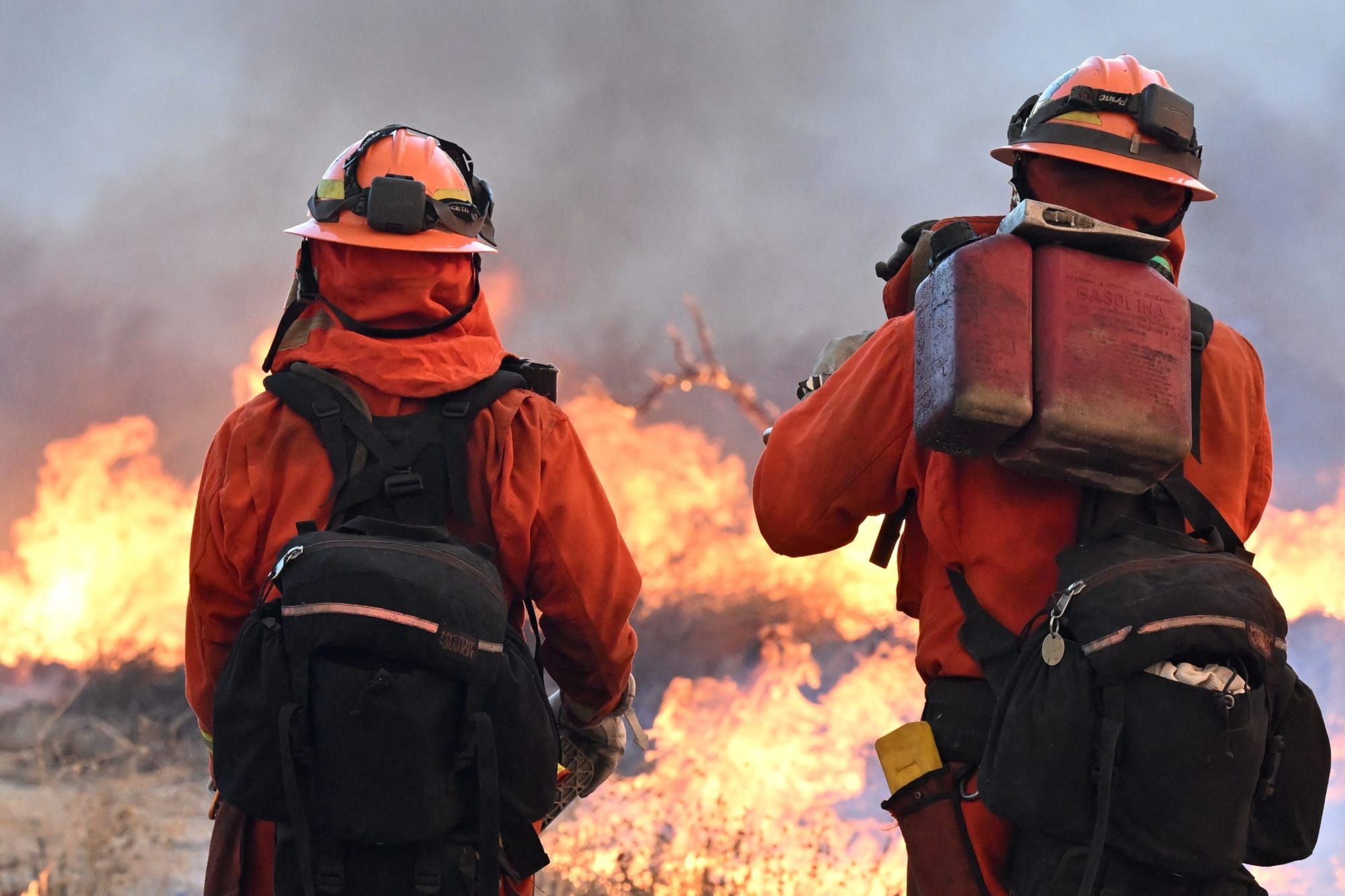
Barely three months after Californians voted against ballot measures on criminal justice reform, rent control, raising the minimum wage, and banning slave labor in prisons, more than 1,000 incarcerated firefighters were sent to the frontlines to fight devastating wildfires across the Los Angeles area. Had Proposition 6 passed last year, it would have amended the California Constitution to prohibit involuntary work assignments for incarcerated people. Instead, as the wildfires raged, incarcerated workers were forced to risk their lives to help save the very state that refused to protect them, all while being paid nothing more than slave wages for their efforts.
“I see this depiction of our currently incarcerated firefighters as being very romanticized, very superficial,” said Communities United for Restorative Youth Justice (CURYJ) Executive Director George Galvis. “Of course, they’re courageous, but no one is diving deeper to look at the conditions of exploitation and the conditions of confinement and the oppression that forces someone to have to choose between concrete walls versus risking their life.”
The exploitation of incarcerated workers has been woven into the fabric of our society for decades. In 1865, the 13th Amendment abolished slavery except as punishment for a crime—an exception the authors presented to appeal to former slaveholders, allowing slavery to continue, just under a different name. Today, incarcerated workers across the country produce more than $2 billion a year in goods and commodities, and over $9 billion a year in services for the maintenance of the prisons where they are held. In states like California, incarcerated populations are paid nothing for most of that labor. The incarcerated firefighters currently placing their lives on the line for people and property are forced to work 24-hour shifts for $5.80 to$10.24 a day. By contrast, non-incarcerated firefighters braving the frontlines alongside them make $42.26 per hour.
Incarcerated firefighters are also four times more likely to incur object-induced injuries, and eight times more likely to be injured from smoke inhalation compared to their non-incarcerated counterparts. Excluded from basic worker protections and earning into the social safety net, many use criminalization to justify treating incarcerated workers as machines whose only goal is to produce capital gains for the very entities that strip them of their humanity. According to the California Department of Corrections and Rehabilitation, incarcerated firefighters are estimated to save the state $90 million a year. Yet, since 2019, the California Department of Forestry and Fire Protection (CAL FIRE) budget has nearly doubled from $2 billion to $3.8 billion.
Despite the dangers and disparities, wages for incarcerated first responders are highly coveted when compared to the pennies other forced laborers earn—or the punishment they’d face should they refuse to work at all. In California, incarcerated people who refuse to work lose access to family visits, recreational or entertainment activities, and all personal packages. They can also face solitary confinement for 10 days or receive write-ups that can hinder parole. As Galvis reminds us, there is no true autonomy or choice when the options are to either be punished behind concrete walls or risk your life outdoors.
The exploitation of incarcerated labor also contradicts the premise of incarceration, which claims to prioritize rehabilitation. Instead, prisons use this labor to sustain themselves. Up to 80% of an incarcerated person’s slave wages are deducted from their paychecks for court-imposed fines, taxes, family support, restitution, room and board, and other fees. Upon release, individuals also struggle to find jobs in the fields they worked in while behind bars. In the case of firefighters, Galvis said most cannot find positions in municipal fire departments after incarceration. Instead, they can continue their role with CAL FIRE or the U.S. Forest Service, which pay significantly less.
Perhaps what’s most disturbing is that when faced with the choice to end incarcerated slave labor at the ballot box, many Californians chose instead to perpetuate the destabilization and criminalization of vulnerable populations, communicating a clear and willing descent into fascism—one that will only worsen during Donald Trump’s second presidential term.
According to Italian novelist Umberto Eco, a key element of fascism includes the fear of difference and contempt for the weak and disenfranchised—both of which are often used to subjugate incarcerated populations and justify the need for criminalization. We saw this at play in California in November when the passing of Proposition 36 defunded Proposition 47, which reclassified some felony charges as misdemeanors and diverted millions in funding from arrests, convictions, and imprisonment back into communities.
In a fascist regime where law and order is a key tenet, the construction of criminality will likely contort and expand to cannibalize more people who don’t belong in the “in-group,” thus increasing the dependence on slave labor in a hellish feedback loop. As Jason Staley, the author of “How Fascism Works: The Politics of Us and Them,” writes, “The most telling symptom of fascist politics is division. It aims to separate a population into an ‘us’ and a ‘them.’”
A person who committed a crime should not have to transfer their bodily autonomy into the hands of the state.
Forced servitude, in any context, is a depraved practice, and those who perpetuate it need to be held to account. While voters must decide on amendments to a state’s constitution, human rights are supposed to be inalienable, and a person who committed a crime should not have to transfer their bodily autonomy into the hands of the state, especially when we can draw a direct line from slave plantations to today’s incarcerated labor exploitation. As 4 million Black Americans were emancipated, the 13th Amendment’s exception originated out of a necessity for population control and cheap labor, helping to re-cement the second-class citizenry that chattel slavery’s abolition had taken from the ruling class.
It should be no surprise that today, Black folks comprise 37% of the incarcerated population while being only 13% of the U.S. population. This suggests that the legacy of enslavement isn’t a legacy at all, but a reality that its descendants and other marginalized groups are still living. As we descend into the second Trump presidency, we must contend with the fact that fascism has always been embedded in our country’s DNA; it just depends on who you ask and consider worthy of humanity.
Editorial Team:
Rikki Li, Lead Editor
Carolyn Copeland, Top Editor
Rashmee Kumar, Copy Editor
Author

Hannah Greene is a New Haven-raised and based Yale College graduate. With a B.A. in African American Studies, Greene is no stranger to questions about her degree's utility. As a young Black woman, she
Sign up for Prism newsletters.
Stay up to date with curated collection of our top stories.