Filed Under:
In America’s ‘asthma capital,’ Detroiters fight back against rampant air pollution
Residents and advocates say recent rollbacks of EPA protections will make things worse in an already struggling city
Ethan Bakuli
Real journalists wrote and edited this (not AI). Independent, community-driven journalism survives because you back it. Donate to sustain Prism’s mission and the humans behind it.
Real journalists wrote and edited this (not AI)—independent, community-driven journalism survives because you back it. Donate to sustain Prism’s mission and the humans behind it.
As a child growing up on Detroit’s west side, Nina Wimberley’s life was consumed by her asthma symptoms. Living within walking distance of Interstate 96, Wimberley routinely carried an inhaler between school and home.
“Coughing was a part of life, having a headache was a part of life, and it wasn’t until I went to other [cities] and saw their quality of life that I was just like, ‘yeah no, this isn’t right,’” Wimberley said.
For decades, Detroiters like Wimberley have lived and worked among the city’s numerous pollution sources, weathering emissions from industrial corporations such as petrochemical refineries, trash incinerators, automotive assembly plants, and heavy trucks that drive through residential neighborhoods.
The Motor City’s legacy of industrial and mobile pollution has contributed to its reputation as a difficult place for residents living with respiratory issues. The Asthma and Allergy Foundation of America listed Detroit as the most challenging city in the nation to live with asthma in 2025, while the American Lung Association gave the region an “F” rating for air quality in its annual State of the Air Report.
It’s a reality that Wimberley and air quality advocates worry will only worsen with the recent rollback and policy repeal of several federal environmental protection laws.
In January, the Environmental Protection Agency (EPA) announced that it will stop considering how many deaths are prevented and how much money is saved in health care costs when considering air pollution rules for particulate matter and ozone.
An EPA spokesperson told Prism in an email that the agency is “still evaluating the health impacts of fine particles and ozone pollution,” but choosing to update its methods “so every rule we make is backed by the most precise, credible science available.”
“We’re pausing putting a dollar amount on these health benefits because pollution levels have already gone down so much that the extra improvements are harder to measure accurately with today’s tools,” the agency said.
But the recent federal approach, environmental and health experts warn, could compound health risks for Detroit’s fenceline communities, with homes adjacent to industrial or chemical facilities.
Detroiters mobilize against health burdens of industry corridors
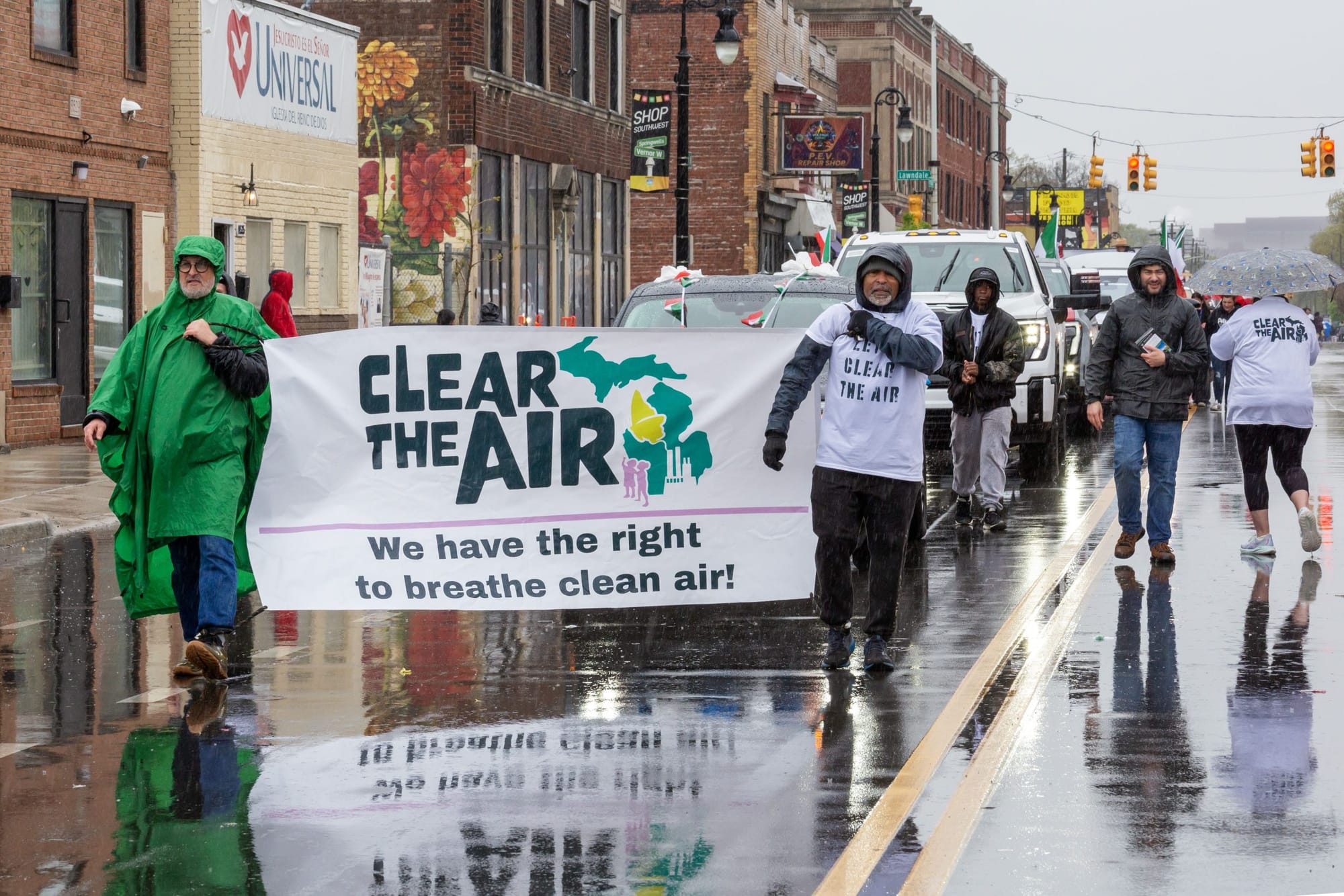
In the wake of the EPA’s rollbacks, Michigan organizers, lawmakers, and health care professionals have rung the alarm about the impending challenges for communities that have looked to federal law for protections against industry polluters.
“The cost will be more disease and death in an already stressed and failing health care system,” Kindra Weid, a resident nurse and a board member of Michigan Clinicians for Climate Action, said at a news conference the group held about the federal rollback to particulate matter standards. “There will be more hospitalizations on poor air quality days, more missed days of school and work, and more premature loss of life.”
Research links particulate matter, or PM 2.5, to severe health issues, such as heart and lung damage, stroke, and asthma.
In Detroit, pollutants such as particulate matter and ozone are responsible for about 1,500 annual hospitalizations for respiratory and cardiovascular disease, as well as 660 premature deaths, a 2016 University of Michigan study found.
Watching the rollback has been “jarring,” Wimberley said. Outside of a few years attending college in northwest Ohio, Wimberley has rooted her activism in her hometown’s environmental woes. She currently works as a coordinator at the Michigan League of Conservation Voters.
“A few years ago, we were having conversations about how toothless the EPA was and how we need to give them more power,” Wimberley said.
Now the Trump administration’s efforts aim not only to ignore the health toll of air pollution, but also to reverse Biden-era air quality standards for PM 2.5 and eliminate greenhouse gas standards for cars and trucks.
In 2024, the EPA estimated that stronger PM 2.5 protections would prevent up to 4,500 premature deaths, 290,000 lost workdays, and $46 billion in public health costs in 2032.
The combined effects of those rollbacks increase pollution levels in cities like Detroit that have already failed to meet federal standards.
About 14.8% of Detroit adults and 11.5% of Michigan adults had asthma between 2021 and 2023, according to the Michigan Department of Health and Human Services. Between 2019 and 2023, Detroiters were hospitalized for asthma four times more than residents across the state.
Kathleen Slonager, executive director of the Michigan chapter of the Asthma and Allergy Foundation of America (AAFA), said these federal rollbacks to air pollution regulation are going to be “devastating for those who suffer any kind of respiratory illness.”
Detroit’s old building stock already contributes to a bevy of indoor air quality issues, Slonager said. The city’s health care system, she added, also limits the types of medical support asthmatic Detroiters can access.
“There aren’t too many standalone asthma specialists in Detroit,” she said. “Most of them are hospital-based, so if you try to get into an asthma clinic in Detroit, it’s a month or more of a wait, and so usually then everybody ends up in the emergency department.”
Wimberley, who studied environmental science at Bowling Green State University in Ohio, said her time away from Detroit temporarily improved her health. About an hour south of Detroit, Wimberley said the air quality surrounding the college campus was noticeably cleaner than the area where she spent her childhood in northwest Detroit.
“I didn’t have to go to the doctors. … I would just get [an inhaler] refill every once in a while,” Wimberley recalled. “They always say Detroit is one of the most segregated cities in the United States, and it’s like everything that they kind of warned me against in college … I’ve seen it play out here: incinerators, trash piles, factories, fallout.”
Slonager said the federal repeal of environmental protections means that “folks need to be even more of an advocate for their own help now.” Since 2022, AAFA has run the Health Equity Advancement and Leadership (HEAL) program, an asthma intervention program that aims to reduce asthma deaths and hospitalizations across cities such as Detroit, St. Louis, Los Angeles, and Chicago.
Slonager said that the HEAL program has already shown some positive outcomes: lowered hospitalization rates, better understanding of the disease process, and improved asthma medication intake.
Wimberley, who enrolled in the program in 2022, credited the program with equipping her “with the language to advocate for myself, and then also know what I was looking for.”
Grassroots air monitoring drives Detroit’s air pollution organizing
In the past decade, Detroit has seen a rapid proliferation of air quality sensors across the city, made up of projects run by community organizations, tech startups, local universities, and regional governments.
“We continue to build more and more community resilience on these issues with communities doing their own air monitoring, tracking their own data,” said Jeff Gearhart, research director at the Ecology Center, a Michigan environmental justice nonprofit.
The growing network of community monitoring and access to data is shining a light on the worst sources of pollution and empowering residents and local officials, said Gearhart. He pointed to recent ordinances in Detroit and neighboring towns to regulate fugitive dust and freight truck traffic around residential streets.
In certain cases, air monitors in southwest Detroit and other communities across Southeast Michigan have shown levels above the EPA’s threshold for pollutants.
Laonis Quinn said she has witnessed the challenges of living with asthma in Detroit firsthand. A nurse by trade, Quinn is also founder of Breathe: Anthony J Chapman Asthma Foundation, a nonprofit that aims to “provide meaningful solutions to individuals and families who are most impacted by asthma,” according to its website.
The nonprofit is named after Quinn’s son, who died at 21 following an asthma attack.
“I’m asthmatic myself, but my son Tony had bad asthma since the age of 2—severe, sometimes uncontrollable,” said Quinn, who recalled taking her son back and forth from the city’s Children’s Hospital for allergy shots and different medications.
While her organization is relatively new, Quinn said, it has been gratifying to pair local families with information and resources to manage their asthma, such as providing air purifiers and allergy pillow covers. Her ultimate goal is to launch a free asthma clinic.
“I’ve met … a lot of mothers who’ve lost children,” she said. “Just to be around like-minded people who understand my walk for real … that has helped me keep moving forward with what I’m doing.”
Editorial Team:
Sahar Fatima, Lead Editor
Lara Witt, Top Editor
Stephanie Harris, Copy Editor