Activists end 5-day hunger strike as calls for ceasefire in Gaza continue
Activists who participated in the hunger strike said they wanted to escalate their tactics to drive the message home
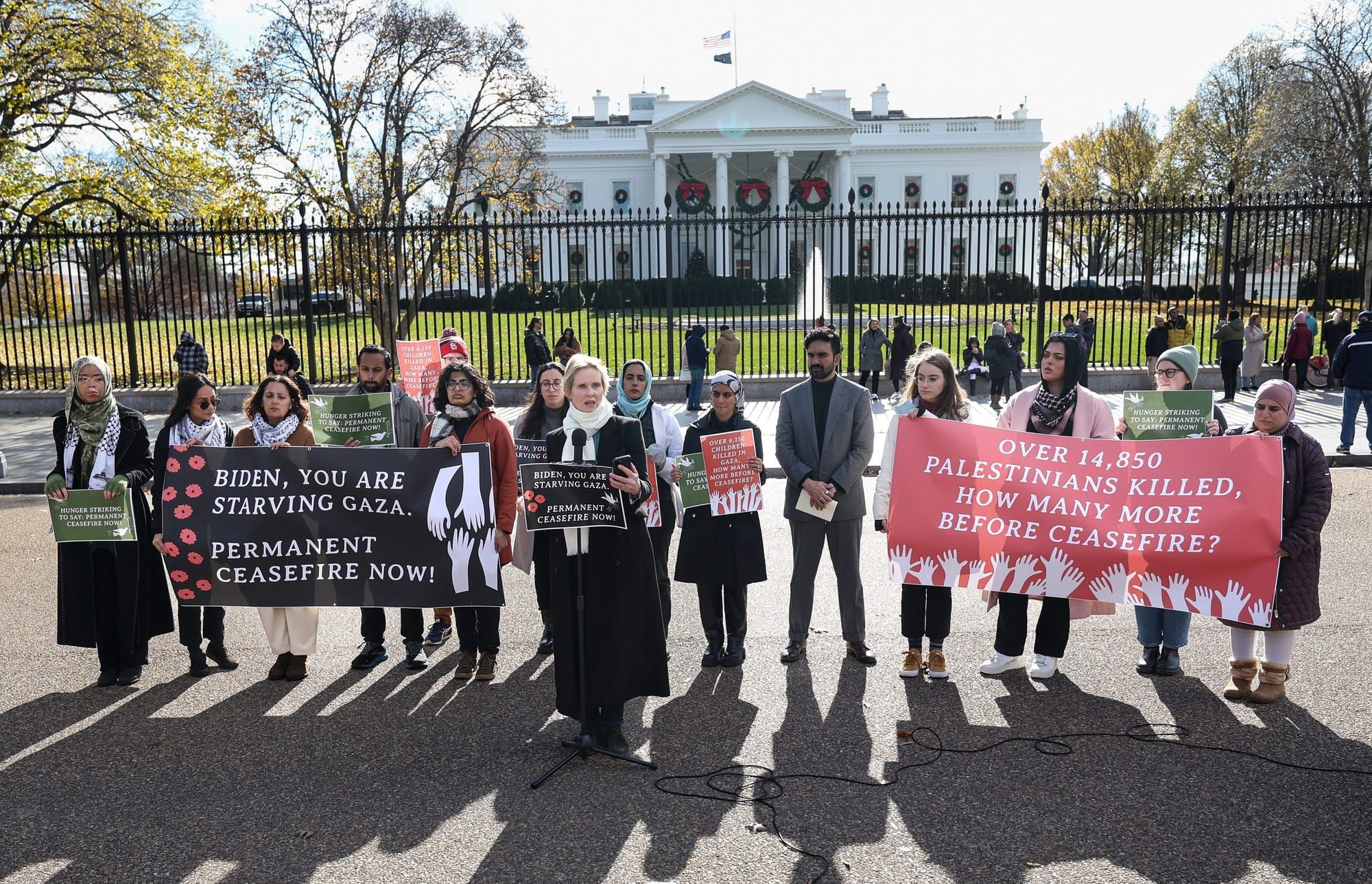
More than 20 activists, including actress Cynthia Nixon and Democratic Reps. Rashida Tlaib of Michigan and Cori Bush from Missouri protested outside of the White House last week, calling for a ceasefire in Gaza. The protest, which began on Nov. 27 and lasted until Dec. 1, included a handful of activists who also went on a five-day hunger strike. The activists prayed, sang songs, and held conversations about the genocide. The action also included a painting of red teardrops on a banner to represent tears of blood for each Palestinian killed by Israeli forces in Gaza.
“Given the level of destruction, the massacres, the fact that it’s just become abundantly clear that Israel is not acting in self-defense and, in fact, is going on an all out offensive … we felt like there needed to be an escalation of tactics to really illustrate to our government that the U.S. government is complicit in this on so many levels,” said Sumaya Awad, a Palestinian activist and author. “We can’t just watch this happen as Americans.”
Awad says they wanted to escalate tactics and needed something to drive the message home.
“We’re trying to illustrate a fragment of what Palestinians are going through—a tiny, tiny fragment of what they’re going through because of U.S. policy, because of U.S. funding,” Awad said. “That is quite literally starving hundreds of thousands of Palestinians.”
This was Awad’s first time going on a hunger strike, and she said her experience was difficult. Amid the cold weather, Awad stayed outside from 9 in the morning until 7 at night all five days. Without food to keep her warm, the cold, which reached a low of 26 degrees Fahrenheit, exacerbated the conditions.
“The bitter cold really set in in a way that I hadn’t experienced before,” said Awad. “And that I would say that was one of the most difficult parts. And just the first few days in particular as my body got used to it, just really bad headaches.”
Despite the difficulties, Awad was able to keep going because she knew there was an end date, a reality not afforded to Palestinians.
“It’s not a choice for them in the same way that it’s a choice for us. We made a choice, we knew what we were doing,” Awad said. “For Palestinians that choice has been made for them by Israel and by our government. And so I think keeping that top of mind helped us keep going each day and sort of reaffirmed the importance of doing anything.”
Members of Congress and other visitors stopped by and showed support for their cause. Part of the action included a participatory painting in which they rolled out about 5 meters of paper each day and painted red teardrops to represent the blood of Palestinians killed by the Israeli Defense Forces in Gaza.
One woman in particular, Awad says, stands out because she was from South Korea on a trip and approached her. She held Awad’s hands, and Awad remembers that they were warm while hers were freezing, and she told Awad that she supported her.
“Little instances like that actually made a huge difference and underscored exactly what we were out there to say, which is that the majority of people, not just in the U.S., but the majority of people are calling for a ceasefire and recognize that what’s happening is wrong,” Awad said.
According to a recent survey from Data for Progress, 61% of Americans support a ceasefire. On Dec. 1, one of the country’s largest labor unions, United Auto Workers (UAW), officially endorsed a ceasefire. United Electrical Workers (UE) and United Food and Commercial Workers (UFCW) Local 3000 have also been circulating a petition calling for the labor movement to demand a ceasefire.
“I think there is definitely a shift that’s happening that’s bigger than anything I’ve seen,” Awad said. “And I think the reason for it is just how blatant and brutal Israel’s actions have been in the last seven weeks.”
After mounting pressure from millions of people worldwide and hundreds of thousands in the U.S. calling for a ceasefire and an end to Israeli occupation in Palestine, President Joe Biden called for a temporary pause on the war in Gaza, during which 240 Palestinians detained in Israeli prisons—nearly half of them children—and about 100 Israeli hostages were returned. Awad says if a pause was possible then, a permanent ceasefire should be possible as well.
“Palestinians also deserve to be grieved and to be mourned,” Awad said. “And they, of course, also deserve to live, and that was the foundation on which we built the hunger strike.”
Author

Alexandra is a Cuban-American writer based in Miami, with an interest in immigration, the economy, gender justice, and the environment. Her work has appeared in CNN, Vice, and Catapult Magazine, among
Sign up for Prism newsletters.
Stay up to date with curated collection of our top stories.