Hundreds in California rally for pardons for immigrants ahead of Trump presidency
With Trump’s plans for mass deportations, pardons could protect those who have served their sentences, advocates say
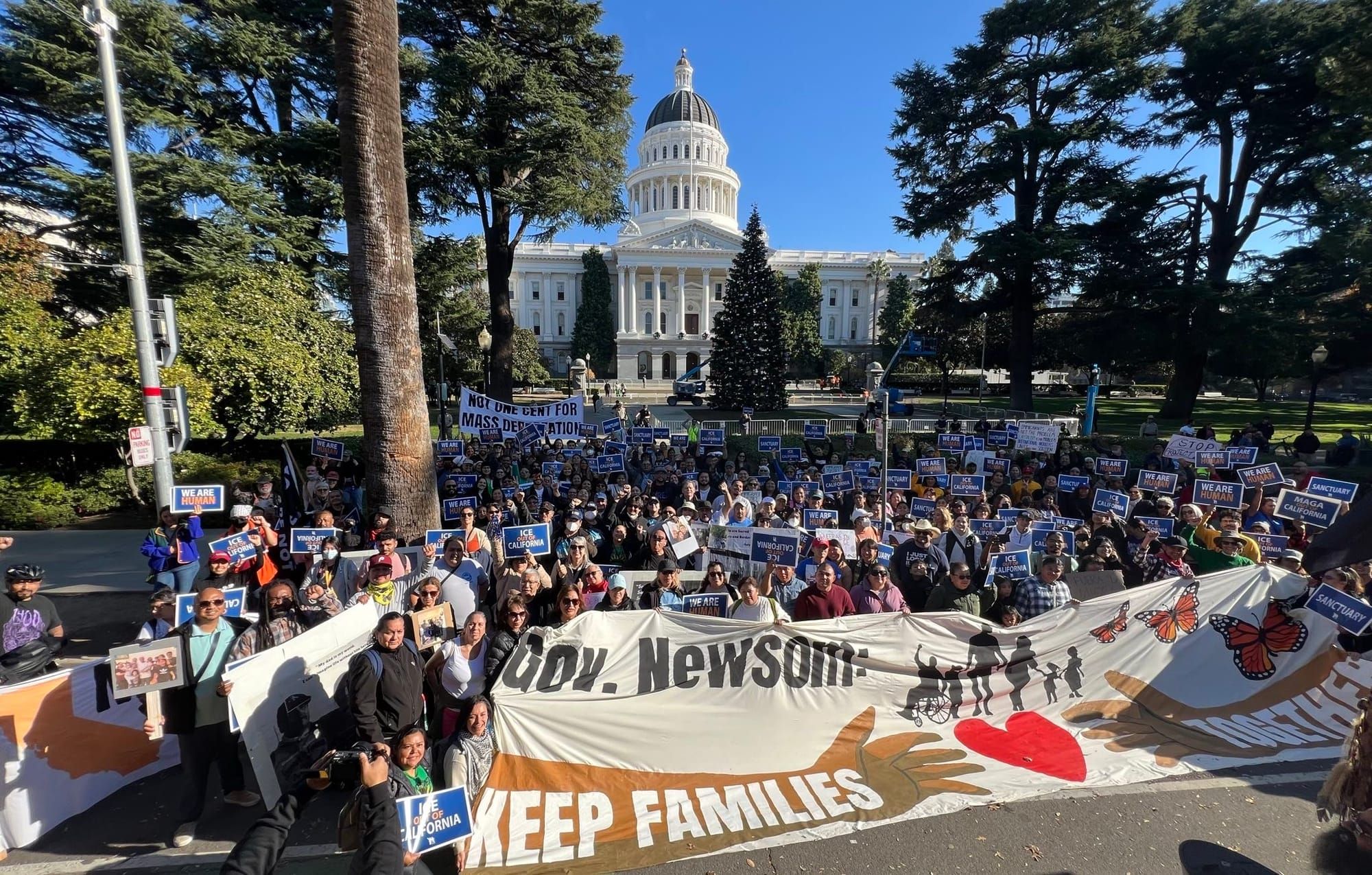
Hundreds of advocates and supporters from across California gathered Monday in Sacramento to demand the safety and protection of immigrant communities across the state ahead of Donald Trump’s incoming presidency. Advocates from the groups, including the ICE out of CA Coalition and Freedom for Immigrants, articulated three specific demands of Gov. Gavin Newsom: to exercise his power to pardon immigrants who have pending applications on his desk, to refuse to use state tax dollars toward mass deportation efforts, and to not sell or lease any land to be used for mass detention.
Monday also marked the first day of the California legislative session, creating potential opportunities for legislators to take meaningful action.
“You can imagine our eyes are all on what’s going to happen or what’s going to come out of the special session,” said Laura Hernandez, executive director of Freedom for Immigrants and the emcee of Monday’s rally. “We have an idea that a lot of it is going to be just really moving money around or giving the Attorney General the money that he needs to fight back [against Trump] with lawsuits, but we’re really looking for some action from the governor to do more than that, to go above and beyond.”
Monday’s rally also comes on the heels of the Los Angeles City Council officially adopting a sanctuary city ordinance. The ordinance works toward protecting Los Angeles residents—of whom more than 1.35 million are immigrants—from being targeted by Immigration and Customs Enforcement (ICE). The ordinance permanently enshrines sanctuary policies into municipal law, including prohibiting the use of city resources (including property and personnel) for immigration enforcement. It further prohibits the city from cooperating with federal immigration agents, including direct or indirect data sharing.
In 2017, the City Council passed a resolution declaring Los Angeles a “City of Sanctuary,” but sanctuary policies were not codified into the municipal law at that time. Council member Nithya Raman, who introduced the initial motion from which the ordinance emerged alongside council members Hugo Soto-Martinez and Eunesse Hernandez, described this shift as “common sense policy for LA.”
A “potential sea change”
During Monday’s rally, community advocates expressed the unique vulnerability facing immigrant communities across the state in light of Trump’s reelection.
Among those speakers was Hulissa Aguilar, who shared her shock at having to live through another Trump presidency and the concrete ways his policies have shaped her own youth.
“If you had told my 11-year-old self that I would be speaking today at a march for immigrant rights under attack by Donald Trump’s planned policies, I wouldn’t have believed you,” Aguilar told the crowd. “For one, I never imagined Trump would still be running for president—he was already in office when I was that age. What would have shocked me most, though, is that even today, I’m still fighting for the same things I fought for when my dad was detained by ICE. Seven years later, families are still being torn apart just as mine was.”
Aguilar said her renewed fears about Trump are rooted in his campaign platform and recent activity by and on behalf of private prison companies immediately following his reelection.
In an earnings call held the day after the election, George Zoley, founder and executive chairman of The GEO Group, Inc., the country’s largest private prison company, shared optimistic business projections given the “potential sea change” that will be ushered in as Trump reenters office.
“We expect the incoming Trump administration to take a much more aggressive approach regarding border security as well as interior enforcement and to request additional funding from Congress to achieve these goals,” said Zoley, as reported by Bloomberg.
Meanwhile The GEO Group President Wayne Calabrese shared on the same call that the company has communicated with ICE about the company’s ability to “rapidly scale up [its] capabilities to monitor and oversee several hundreds of thousands, or even several millions of individuals in order to achieve the federal government’s immigration law compliance objectives.”
Though mainly known to the public for its maintenance of private prison facilities, The GEO Group, as well as CoreCivic, have also contracted with ICE to detain migrants before deportation. During the recent election season, The GEO Group, using subsidiary and sister companies, donated $1 million to Make America Great Again Inc., a super PAC supporting Trump. That investment has seemingly begun to pay off as stocks in private prison companies surged over 80% following Trump’s reelection.
Thus, while moves like Los Angeles’ adoption of a formal and permanent sanctuary city policy are meaningful, Trump’s plans to execute the “largest deportation program in American history” render demands from organizers—such as those with the ICE out of California coalition—increasingly urgent.
Of the three demands outlined on Monday, Laura Hernandez says that granting pardons is among the most pressing and the easiest for Newsom to implement, as he can execute them independently.
“[Since] we woke up on Nov. 6, the immigrant population has been in fear,” Hernandez said. “With the agenda that’s being talked about of putting people with convictions at the top of the [deportation] list, we’re asking the governor to utilize his power to pardon folks that have already completed their sentences so that they’re not forced to be triply punished at this point just based on convictions that are a lot of times 20 years old or more.”
Hernandez noted that Newsom currently has about 1,000 pardon applications sitting on his desk, though it’s unclear how many of those petitions carry immigration consequences. It is notable however that Newsom has been significantly slower with granting pardons than his predecessor Gov. Jerry Brown.
According to a recent press release from Newsom’s office, the governor has granted 205 pardons while in office since 2019. Brown, during his governorship from 2011 to 2019, granted more than 1,300 pardons.
As reported previously by Prism, while Newsom’s administration has taken great pains to rehabilitate the public image of the California Department of Corrections and Rehabilitation (CDCR), advocates say they have yet to see those efforts improve the safety and well-being of those currently in CDCR custody. For Hernandez, that also includes those whose cases carry immigration consequences.
“If you’re going to invest so much money into rehabilitation, then it only follows to say that you believe in the redemption of human beings,” Hernandez said. “That’s why it’s so important and so vital that pardons are given especially to the immigrant community who have served their time, done everything that they can to become a contributing member to society, and don’t want to be separated from their family.”
Author

Tamar Sarai is a writer, journalist, and historian in training. Her work focuses on race, culture, and the criminal legal system. She is currently pursing her PhD in History at Temple University where
Sign up for Prism newsletters.
Stay up to date with curated collection of our top stories.