Hawai‘i residents challenge U.S. military over leases on sacred lands
The coalition of Native Hawaiians and local residents organizing against the government’s operations has only grown since 2021, when a military-owned bunker spilled jet fuel into an aquifer, poisoning thousands of families
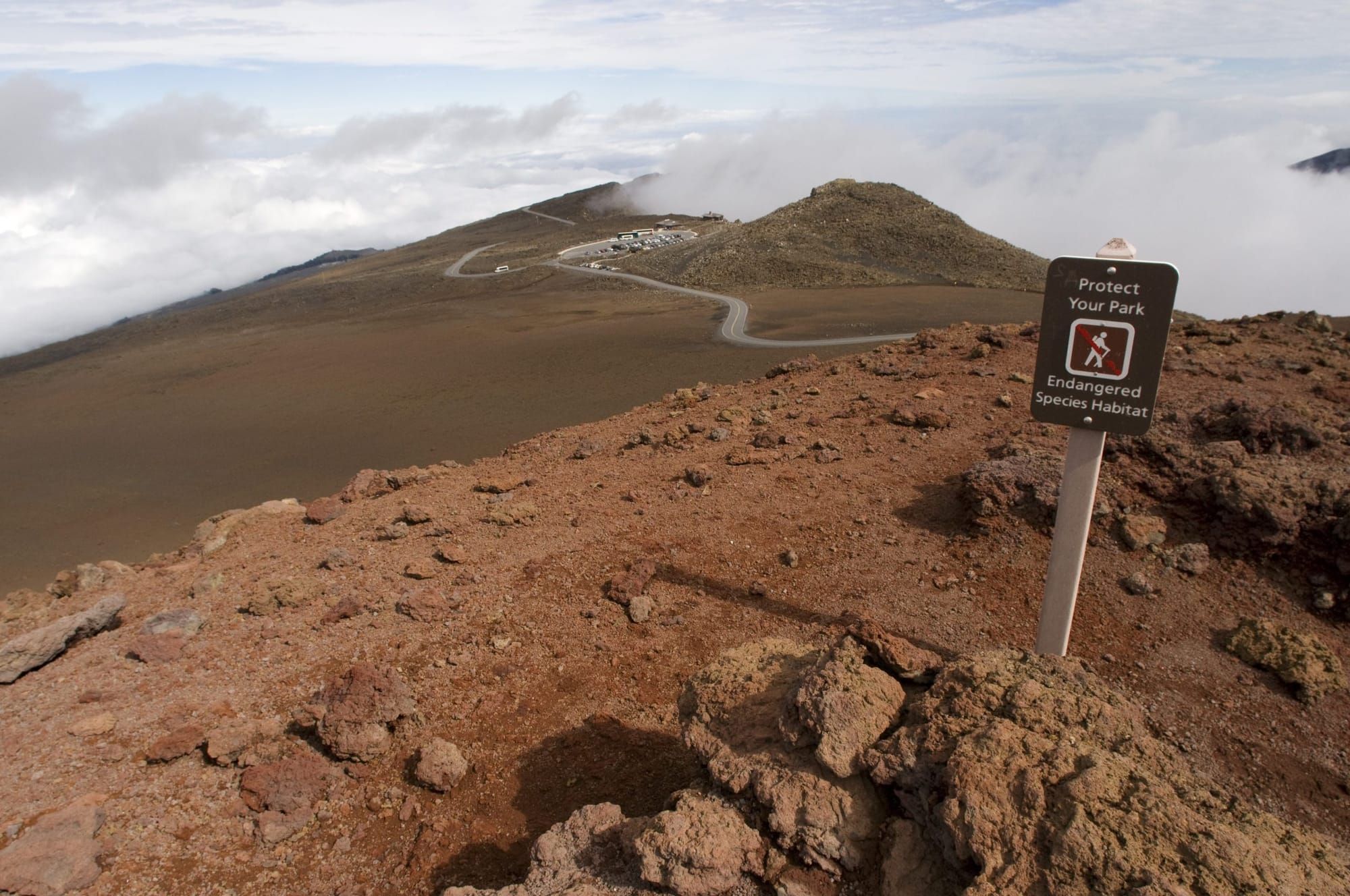
In Hawai‘i, a long-standing struggle over the U.S. military’s use of sacred and stolen lands is coming to a boiling point, as Native Hawaiians and Hawai‘i residents push back against the government’s attempt to renew leases to Pōhakuloa, the largest training area for all branches of the U.S. military outside of the contiguous United States.
According to state and federal officials, a military presence on Hawai‘i is critical to national security, but environmental advocates and others say that maintaining the integrity of the land requires a return of the land—no strings attached. Organizers assert that the ability to steward the land might be within reach, as support for the military’s presence in Hawai‘i diminished in the wake of the 2021 disaster at Red Hill, when water polluted with jet fuel poisoned thousands of families.
“There’s a historic amount of opposition,” said Kainoa Azama, a Kānaka Maoli activist fighting for Hawaiian sovereignty. “No amount of money or economic benefit can justify the further poisoning of more of our islands’ natural resources [that] we need to survive.”
If the military succeeds in reupping the lease to Pōhakuloa or facilitating what organizers call a land swap, in which the current leased lands are exchanged for nearby private or public lands, it will speak volumes about how the military continues to operate in the region despite trust in the military’s role on the island plummeting among locals. On the other hand, a victory for Kānaka Maoli, or Native Hawaiians, means that momentum in the movement for Hawai‘i’s sovereignty is growing, along with the effort to return stolen lands taken in 1893 with the support of the U.S. military in order to overthrow the Hawaiian Kingdom.
The military is committed to maintaining its hold on Pōhakuloa Training Area (PTA), which spans 23,000 acres on Hawai‘i Island (also known as the “Big” Island) between Mauna Kea and Mauna Loa. The training area also sits above an aquifer. Pōhakuloa is just one of many parcels of land that the state leased to the military in 1964 for $1, which are used for various training exercises by the Army, Navy, and Air Force across Kauai, O‘ahu, Maui, and Hawai‘i Island. Since the 1950s, the military has also used Pōhakuloa for live fire training, in which the Army tests weapons with real munitions. Pōhakuloa also serves as a central piece of the Rim of the Pacific Exercises, in which members of the military denote bombs, sink ships, and conduct live fire training. For residents, Native Hawaiians, and environmental activists, these “exercises” are nothing more than environmentally destructive war games. Activists say that depleted uranium has been found in the soil at PTA and in water held in the aquifer that sits below the site.
The leases for the military’s use of state-owned lands end in 2029. However, the Army has spent years preparing necessary materials and studies required by state laws, including archeological and environmental studies, in order to acquire new contracts for the Pōhakuloa land.
PTA is zoned as state conservation land and made up of at least five parcels, two of which are under federal control with at least three others falling under state jurisdiction. Different entities have varying jurisdiction of the parcels, creating a patchwork of legal processes. Land controlled by the state are referred to as public trust lands, parcels that the U.S. stole from the Hawaiian Kingdom and transferred back to the State of Hawai’i after incorporation, which are now held in trust for the benefit of Hawaiians and the general public. There are also “ceded” lands retained by the federal government and land transferred to Hawai’i prior to statehood that are not public land trust lands.
Negotiations for the land leases slated to end in 2029 triggered the first time officials from the Pentagon, the Environmental Protection Agency (EPA), and the U.S. military met with locals and residents, Azama told Prism. Initially, he said, agency officials and community members were “very open to finding a solution.” Kānaka Maoli land defenders and community activists assert that the sacred Pōhakuloa land—home to endangered species, trails used by cultural practitioners, multiple holy sites and objects, and burial grounds—should be returned, and steps should be taken to demilitarize Mākua Valley on O‘ahu’s west side. Mākua Valley also has mixed ownership, with parcels of the training area held by both state and federal entities. In the environmental impact statement, the Army indicated that it planned to relinquish state lands it uses, but not federal lands.
Live fire training exercises ended in Mākua Valley in 2004 after the environmental law organization Earthjustice filed a lawsuit in 1998 on behalf of a community group, citing the desecration of more than 100 cultural sites and artifacts. While inaccessible to the public, Kānaka Maoli are able to enter Mākua Valley with permission and supervision from the military, which the government claims is for safety reasons, as unexploded ordnances and other weapons remain on the land. Mākua Valley, the land that bore the Hawaiian people and escorts ancestors to the spirit realm, is mediated by a lease that also ends in 2029. Activists predicted that the military may try to point to the collaboration with Kānaka Maoli to open up the sacred site as evidence of its ability to draw a balance between respect for Native Hawaiian culture and national security needs.
The U.S. Army did not respond to Prism’s request for comment by publication time.
Can stolen land be leased?
Years into discussions with military representatives, Kānaka Maoli have soured at the premise that facilitating relationships with sacred lands is the best the government can do–especially if the military no longer uses the land for training. In Mākua Valley, activists allege that the military neglected to adhere to the caretaking standards outlined in the original 1964 lease agreements—standards that also apply to parcels such as Pōhakuloa.
Azama told Prism that it’s a concerning trend that the federal government is willing to return lands depending on how polluted those lands are: the more polluted, the less the federal government wants them. There’s a frustrating irony under the surface, Azama said: The lease for Pōhakuloa was never the state’s to offer in the first place, because the land in question was “illegally transferred to the United States” after the 1893 overthrow.
But a sea change might be afoot.
In May, the Board of Land and Natural Resources rejected the Army’s final environmental impact statement (FEIS) for the Pōhakuloa land because the document did not fulfill a number of criteria for approval, such as substantive evaluation of historic, cultural, and archeological sites as mandated by state and federal laws. In August, the Hawai‘i County Council for the Big Island unanimously voted to end all “desecration activities” at Pōhakuloa. The resolution also opposed any lease agreements or land swaps unless remediation is agreed to.
Kyle Kajihiro, an assistant professor of ethnic studies at the University of Hawai‘i, organizes around the issue of military land leases. He told Prism that he was surprised by the outcome of the FEIS because state agencies are not historically allies to the struggle for Hawaiian sovereignty.
The Army can file an amended environmental impact statement, though it’s unclear how quickly that can be done. The prolonged timeline may disrupt what military and state officials likely hoped would be a year-end finalization of the land lease deal.
Kajihiro is not so sure that the denial of the FEIS necessarily hampers the military’s path to reacquisition of the PTA land. In fact, it may lay the groundwork for a deal that sidesteps a formal approvals process altogether.
He may be right. On behalf of the state and in partnership with the Army, in September, Hawai‘i Gov. Josh Green signed a statement of principles, which noted the “Army’s need for continued use of training lands at Pōhakuloa Training Area” and a mutual desire to explore “a suitable land arrangement that satisfies their respective goals.”
It’s not just the executive office that wants to see a continued military presence on Hawai‘i’s most sacred lands. Wayne Tanaka, the director of the Sierra Club chapter in Hawai‘i, said that in the wake of the Red Hill disaster, the Department of Health was initially hard on the Navy, but that has changed in recent months.
Preceding the November 2021 Red Hill spill was a May 2021 leak in which nearly 20,000 gallons of fuel went missing from a storage facility. That leak wasn’t investigated until the crisis came to a head in November, but by that point, families had been drinking water laced with jet fuel throughout the summer.
It’s what Tanaka characterized as a “pattern of incompetence or negligence or deception, and a lack of meaningful accountability from the regulators.” The wounds of Red Hill are still open, Tanaka said. The military “poisoned their own people and lied to them [and] they robbed parents of their ability to protect their children.”
For Tanaka, it raises the question that if the military couldn’t be trusted to manage the disaster at Red Hill, why should they be trusted to conduct operations on stolen Hawaiian lands?
A “crisis of legitimacy”
More people appear to be willing to question the military and its applications for new leases because, in 2021, the military misled the public about jet fuel contamination of the sole source of clean water for 93,000 people on O‘ahu.
Concerns are also coming from service members themselves.
“We came there with two extremely healthy children,” said Army Maj. Mandy Feindt, who lived in military housing fed by the Red Hill water line in 2021. In the summer of that year, she brought her son to the doctor to be treated for what she thought was eczema. Instead, they learned he was experiencing chemical burns from bathing in jet fuel-contaminated water.
The Red Hill Bulk Fuel Storage Facility was built in secret during World War II, and it consists of 20 underground tanks with the capacity to store 100 million gallons of jet fuel to be used in war or for training purposes. As the public now knows, Red Hill almost immediately began leaking fuel into the aquifer 100 feet below. A 2014 leak put local regulators on high alert for the first time. However, it took seven more years and a catastrophic leak to get Red Hill shut down in 2022 by then-Secretary of Defense Lloyd J. Austin.
Feindt has spoken out about Red Hill since she and her family were poisoned. She’s stationed in Virginia now, and the proximity to Washington, D.C. has allowed her to continue fighting for justice for those impacted by the leak. Her time in Hawai‘i came at a cost: She lives with an environmental traumatic brain injury resulting from exposure, and her public confrontation of the military’s actions required her to request Department of Defense whistleblower protection.
Her advocacy is critical in part because it appears the Navy is trying to pretend the fuel leak never happened—or that it isn’t responsible for the leak’s cleanup.
Ernest Lau is the manager and chief engineer of the Board of Water Supply, which manages O’ahu’s municipal water resources and distribution system. He told Prism that the Navy has refused to pay for the financial impacts of the Red Hill spill, such as the cost of shutting down the Hālawa Shaft and ʻAiea and Hālawa wells, structural components of the network that bring water from the aquifer to customers.
In July, the Board of Water Supply filed a lawsuit under the Federal Tort Claims Act for the $1.2 billion it will cost to replace the shaft and wells in a location “beyond the reach of contaminants emanating from the Red Hill facility,” Lau said. If the Navy doesn’t foot the bill, it falls to the ratepayers to absorb the cost, Lau explained, “which we think is an injustice.”
The Board of Water Supply isn’t a regulator, but a stakeholder, Lau clarified, which means that the best the board can do is to vocalize its “concerns about the facility.”
“Unfortunately, the people that had authority didn’t listen and the owner of the facility didn’t listen,” Lau said.
Some residents who were sickened by the water allege military malfeasance at best, and a cover-up at worst. The military claims that it engages in responsible environmental stewardship of leased lands and that it is responsive to community needs, but the government can’t seem to see that its approach to land and community has generated an irreparable public relations crisis.
Kajihiro said the military is experiencing a “crisis of legitimacy,” one that has given those organizing in Hawai‘i a “single point of consolidation” for their efforts.
This time, it isn’t just Kānaka Maoli who are opposing the military’s presence on Hawai‘i, but military families themselves who feel betrayed by their own institution.
Katherine McClanahan once believed that military service members operated by a code of honesty and integrity because her husband, who spent his career in the Air Force, was an honorable man. But in the days and weeks following the November 2021 leak, she watched as military officials pivoted their talking points and evaded questions from families. That’s when McClanahan thought, “They are lying to us.”
McClanahan wanted answers for why she, her husband, and their sons struggled with a host of gastrointestinal, neurological, and other health issues when none of them experienced such issues prior to being stationed in O’ahu. McClanahan said she was diagnosed with Parkinson’s disease; doctors speculated that the atypical onset may have been toxin-induced based on her symptoms.
Based on her own data analysis from documents obtained through Freedom of Information Act requests, McClanahan found a concerning trend in water testing and reporting that she said demonstrates a willful negligence in reporting and chain of command, delays in water testing processing, mishandling of water samples, and dubious application of testing standards, all of which contributed to a lack of urgency and alarm among the military, which meant the Hawai‘i Department of Health could not address chronic leak issues.
“It should not be that hard for the Hawai‘i Department of Health—who is the regulator—to receive reports on time from an agency like the Navy,” McClanahan told Prism.
The Hawai‘i Department of Health did not respond to Prism’s request for comment.
By comparing water sample collection dates taken from the U.S. Navy Joint Base Pearl Harbor Hickam where Red Hill is located with reporting dates to state regulators, McClanahan identified three instances between the months of May and November 2021 when drinking water samples showed unsafe levels of pollutants. However, these issues were not reported to regulators prior to the November fuel leak. She claimed that these delays in reporting prevented agencies with the authority and ability to address public health concerns from doing just that.
The U.S. Navy did not respond to Prism’s request for comment.
The disaster at Red Hill created a big tent for Kānaka Maoli, Hawai‘i residents, and military families to come together and organize for the protection of public goods such as water. But there has also been a secondary, less expected effect: broken trust between military families and the institution they vowed to serve, which has allowed military families to see what Kānaka Maoli had been speaking out against for decades.
“I think it’s going to cost [Native Hawaiians] a lot, to be honest,” said McClanahan. “Not just in money, but in their land and their wai [water] that’s not only … sacred, but they are now being placed in a position where it’s not usable. On every level, that’s just so tragic.”
Correction, Oct. 30: This story has been updated to correct that Katherine McClanahan‘s husband served in the U.S. Air Force, not the Army. The story has also been updated to include more details about her Parkinson’s diagnosis.
Editorial Team:
Tina Vasquez, Lead Editor
Carolyn Copeland, Top Editor
Rashmee Kumar, Copy Editor
Author

ray levy uyeda is a staff reporter at Prism, focusing on environmental and climate justice.
Sign up for Prism newsletters.
Stay up to date with curated collection of our top stories.