Communities organize across the political spectrum for ‘green schools’
Tens of thousands of schools across the country are in need of HVAC upgrades, as students suffer from extreme heat and increased pollution
Nellie Moreno has been part of Chicago Public Schools (CPS) for decades. A graduate of the school system herself, she’s now a parent to three CPS students and a parent mentor coordinator at two elementary schools.
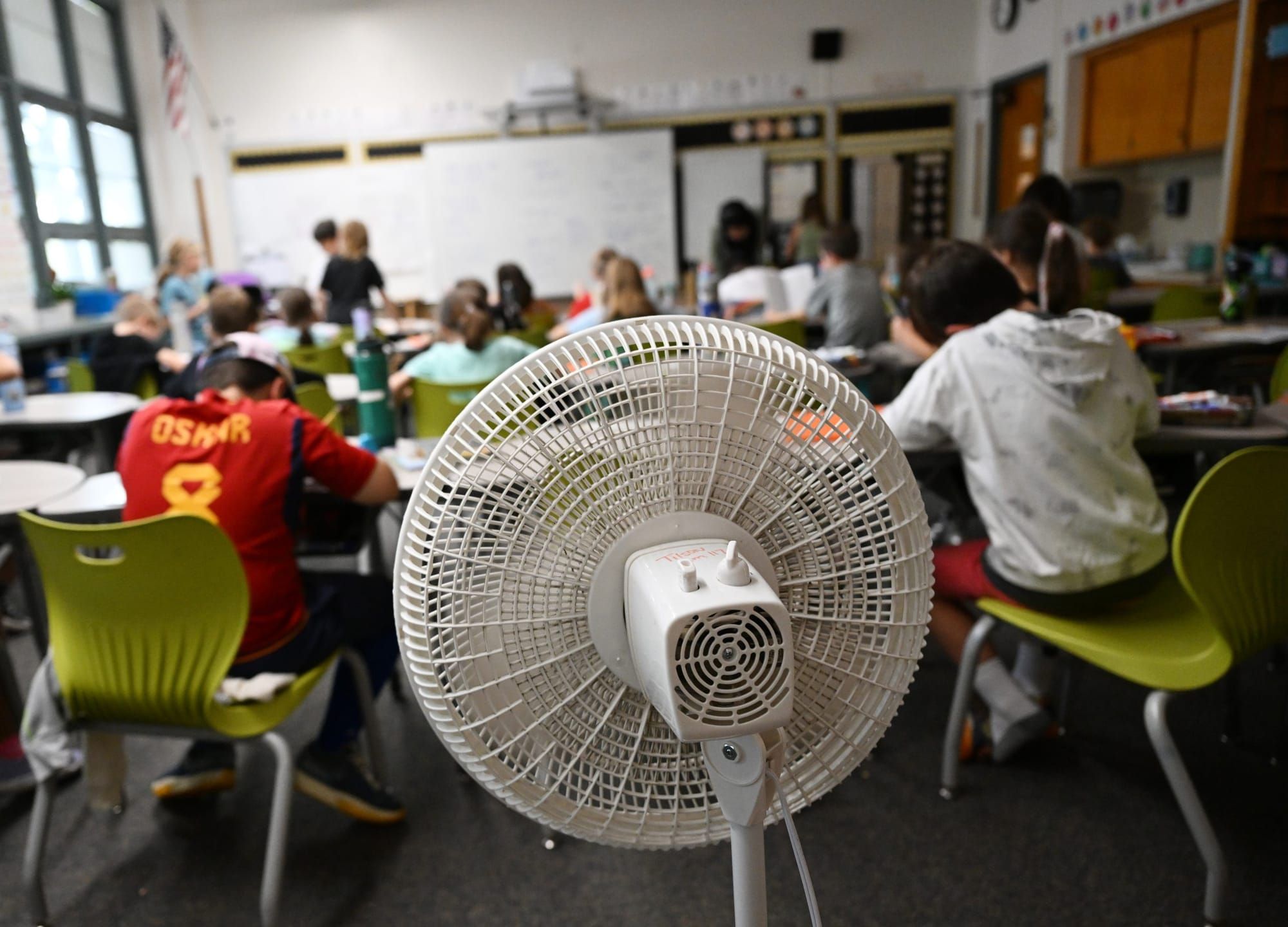
“I have seen the conditions of the school buildings get worse,” Moreno said in an email. Last year, one of Moreno’s sons missed 45 days of school because, she said, there were no clean air vents or air conditioning in his school. “He has suffered asthma attacks and, as a result, undergone many nebulizer treatments,” she said.
Moreno is among dozens of parents involved in Organizing Neighborhoods for Equality (ONE) Northside, which is fighting for “green schools” in Chicago. The campaign calls for school environments where students and teachers can learn and thrive with proper infrastructure that is clear of lead and toxins and fair conditions for workers. It’s a rallying cry for parents not just in Chicago, but across the country, as aging public school buildings struggle to keep students comfortable and climate change exacerbates hot weather and pollution.
“I would like to be at ease knowing [my son] is safe and in a healthy learning environment free of toxins, with clean water and air, and proper ventilation, cooling, and heating,” Moreno said.
A 2020 survey by the U.S. Government Accountability Office found that about half of all public school districts across the country needed to upgrade or replace multiple building systems or features in their schools. About 41% of districts needed to upgrade heating, ventilation, and air conditioning (HVAC) systems in at least half of their schools, or 36,000 nationwide.
The average age of the 649 schools in Chicago is 84, almost double the national average. Schools in Chicago suffer from leaking water, mold, lack of ventilation, outdated HVACs, and asbestos, exacerbated by windows that don’t open.
In El Paso, Texas, Ana Fuentes, the executive director of Amanecer People’s Project can relate. After losing a ballot measure to limit the influence of fossil fuel companies in politics, the group looked to the community to see what needed to change.
Through these conversations, the group developed the Escuelas Frescas campaign, fighting for proper air conditioning in more than 20 schools across Texas. With temperatures now rising over 100 degrees regularly, the lack of proper cooling is causing heat stroke, and even worse for students and teachers.
“The people who hold power in El Paso are the polluting elite, mostly white men who have made their fortunes in the refinery,” Fuentes said. “Their decisions are guided by self-interest … not prioritizing the well-being of the community.”
A 2018 paper by Harvard University researchers determined that without air conditioning, each 1-degree Fahrenheit increase to school year temperature reduced how much students were able to learn by 1%. With proposed upgrades, organizers in Texas say they anticipate higher school attendance, better quality of education, and a future-proof education experience in one of the hottest states in the country.
Funding green schools
All of the schools Amanacer is fighting for are in low-income, majority Spanish-speaking and immigrant communities. In higher-income neighborhoods, the schools are mostly upgraded—proving the reality to be rooted in inequality, not finances.
Recently, the school district tried to close 18 of these schools, Fuentes said. As the only educational facilities for many families, a closure would have cost the education of generations.
But the Escuelas Frescas campaign had already built up support, including by engaging community members inside and outside of the schools and working with groups such as the local chapter of the NAACP, and teacher unions. The campaign was able to stop the closures.
Now that doors remain open, the campaign to ensure the schools are fit for students to attend continues. In spite of local interference, there’s a federal solution: Funding for green schools is available through the Inflation Reduction Act (IRA), which both Amanacer and ONE are fighting to access.
“There’s been years of underinvestment in Chicago’s Black and brown communities,” said Seri Lee, deputy organizing director at ONE Northside. “We see the choice being clear: We can leave millions of dollars for our schools on the table, or we can leverage this unprecedented federal investment and state funding to produce our own renewable future.”
Working across the political spectrum
But that federal funding is now precarious. With President Donald Trump’s executive orders and threats to repeal the IRA, many are wondering how long the funds will even be available.
However, the fight for green schools isn’t a partisan one—it’s a multigenerational one that ranges from the students themselves to their grandparents, and it’s important to people across the political spectrum.
“This campaign has allowed us to expand what the people who are involved look like. Ideologically, parents who are really conservative or Trump supporters are part of it,” Fuentes said, adding that one mother involved was praying Trump wouldn’t close her children’s schools.
The nonpartisanship is mirrored in Chicago, where the green schools campaign has brought together unions, environmentalists, community members, and generations of concerned families.
“Everyone has a connection to someone in public schools, whether it be their own children or young family members, teachers, community members. Even if you don’t go to the school, the playground is a community space,” said Itzelle Garza, environmental justice organizer at ONE Northside. “Although there might be polarization on other issues, the idea of having clean air to breathe is really important for all community members.”
With so many different communities involved in fighting for IRA funding and improved facilities for young people, the political backlash of a repeal from Trump could be considerable. In fact, the majority of funds allocated from the IRA are intended for Republican districts.
Unlocking collective futures
Regardless of Trump’s policies or efforts, community members believe that this fight for federal funding is only one part of a longer-term battle—and it won’t stop if the IRA doesn’t exist, or if Trump freezes federal funding for all social programs.
“The main issue that we’ve come across is that there’s a lack of imagination due to the decades of underinvestment from the state government,” Lee said. “Part of this campaign is expanding the imagination of the people in the community and pushing that for our decision-makers and district leaders to imagine if we were able to work in a more collaborative way.”
Fuentes agreed. At community meetings, canvassing, events, and rallies, she said she’s seeing people work across political parties to unlock a future that might be possible.
“As organizers, we need to change people’s lives and perspectives,” she said, “and bring in people by making a material change, like improved schools, improved learning environments.
Editorial Team:
Sahar Fatima, Lead Editor
Carolyn Copeland, Top Editor
Rashmee Kumar, Copy Editor
Author

Umme Hoque is a writer, editor, and organizer. She's passionate about writing about and investigating issues for low-income workers and communities of color, lifting up the experiences of those who ar
Sign up for Prism newsletters.
Stay up to date with curated collection of our top stories.