Green New Deal Network leads nationwide For the People Tour in a push for climate justice
At the heart of a Green New Deal is the goal to prioritize communities most affected by inequality, climate disasters, and pollution
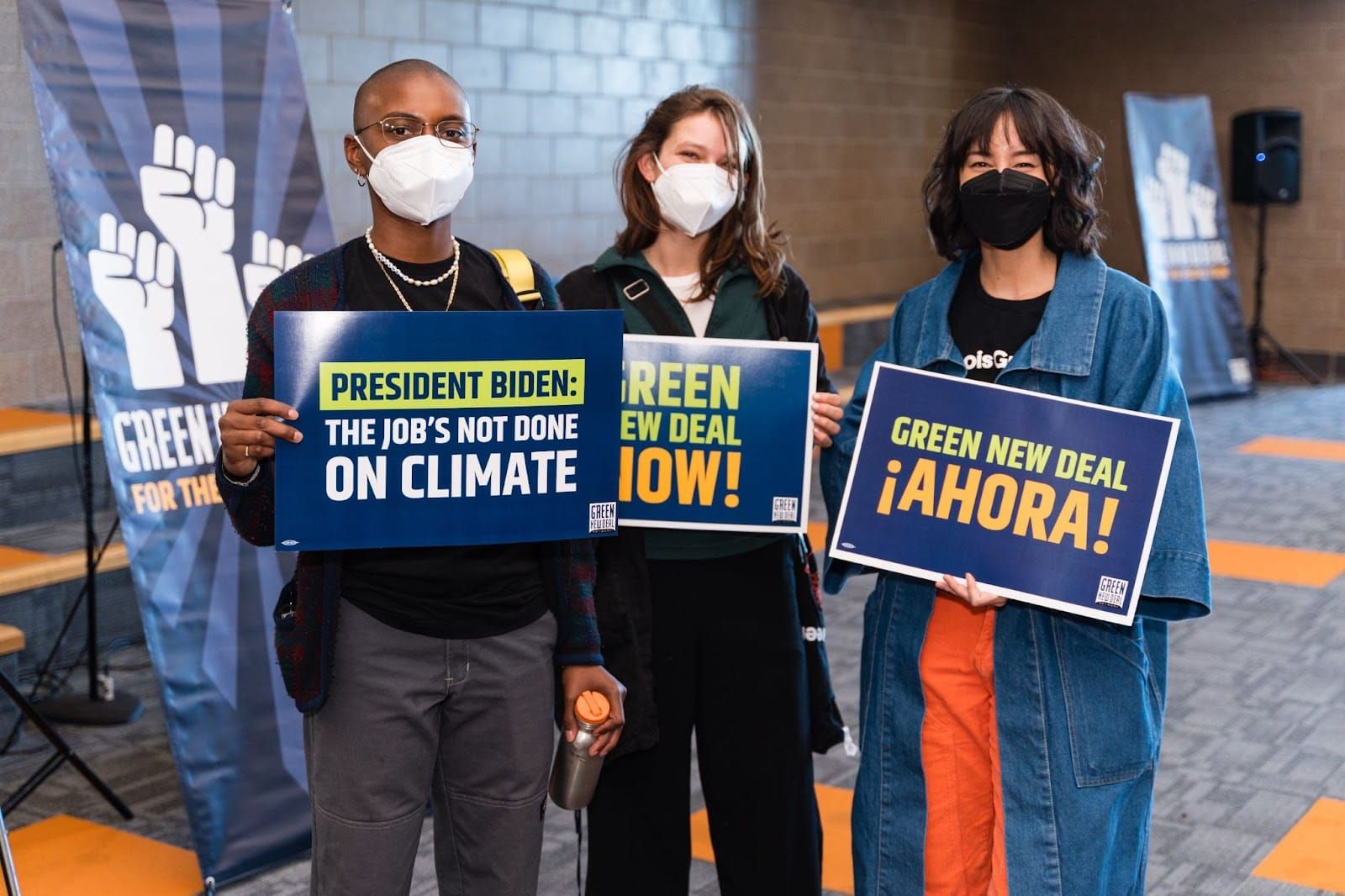
A coalition of community organizations around the country wants you to imagine a future that centers climate justice. They hope you remember a past—not so long ago—when the largest climate bill in U.S. history was passed.
That’s the drive behind the Green New Deal Network’s For the People Tour: to galvanize the present moment around opportunities to equitably transform the environment one city at a time.
“I’m excited for this tour to spread the word about how hard we fought to win something this big and how transformative it will be for our communities and to let as many people know as possible that this is just the beginning, but it is the first step toward a vision of a Green New Deal,” said Betamia Coronel, the senior national organizer at the Center for Popular Democracy, one of the organizations in the Green New Deal Network (GNDN).
GNDN was formed in 2019 and stands today as a coalition of 14 member organizations implementing climate justice initiatives nationwide to ensure federal funds go to communities that need them the most.
Opportunities for climate justice abound in the Inflation Reduction Act (IRA), a progressive piece of legislation that the GNDN is credited with pushing through Congress. The tricky part now is ensuring the theory translates to practice. The For the People Tour hopes to highlight just how to do so.
“If we’re focused on investments and projects it’s really possible to bring folks together,” said Saul Levin, the legislative and political director at Green New Deal Network. “When we focus on what people need, how can we have those needs met, how can we make sure people have water and shelter and food—there’s a lot of people all around the country who are in deep alignment with that.”
Previously called the Build Back Better Act, the IRA allocated $369 billion to clean energy alone. The bill was monumental for the climate movement and marked a turning point in economic justice.
It introduced a Corporate Minimum Tax requiring corporations with profits more than $1 billion to pay at least 15% in taxes. This move offsets the Trump administration’s 2017 tax cuts, which allowed some of the country’s most lucrative companies to pay nothing in federal taxes.
The IRA is not the only pocketbook the GNDN wants to secure for communities. Two other bills promising climate reform were signed into law in 2021: the Infrastructure Investment and Jobs Act and the American Rescue Plan Act.
“The Green New Deal is really about transforming society as we know it in order to address climate change,” Coronel said. “We know we need trillions of dollars in investment from our federal government in order to invest in the kinds of jobs and care these communities need.”
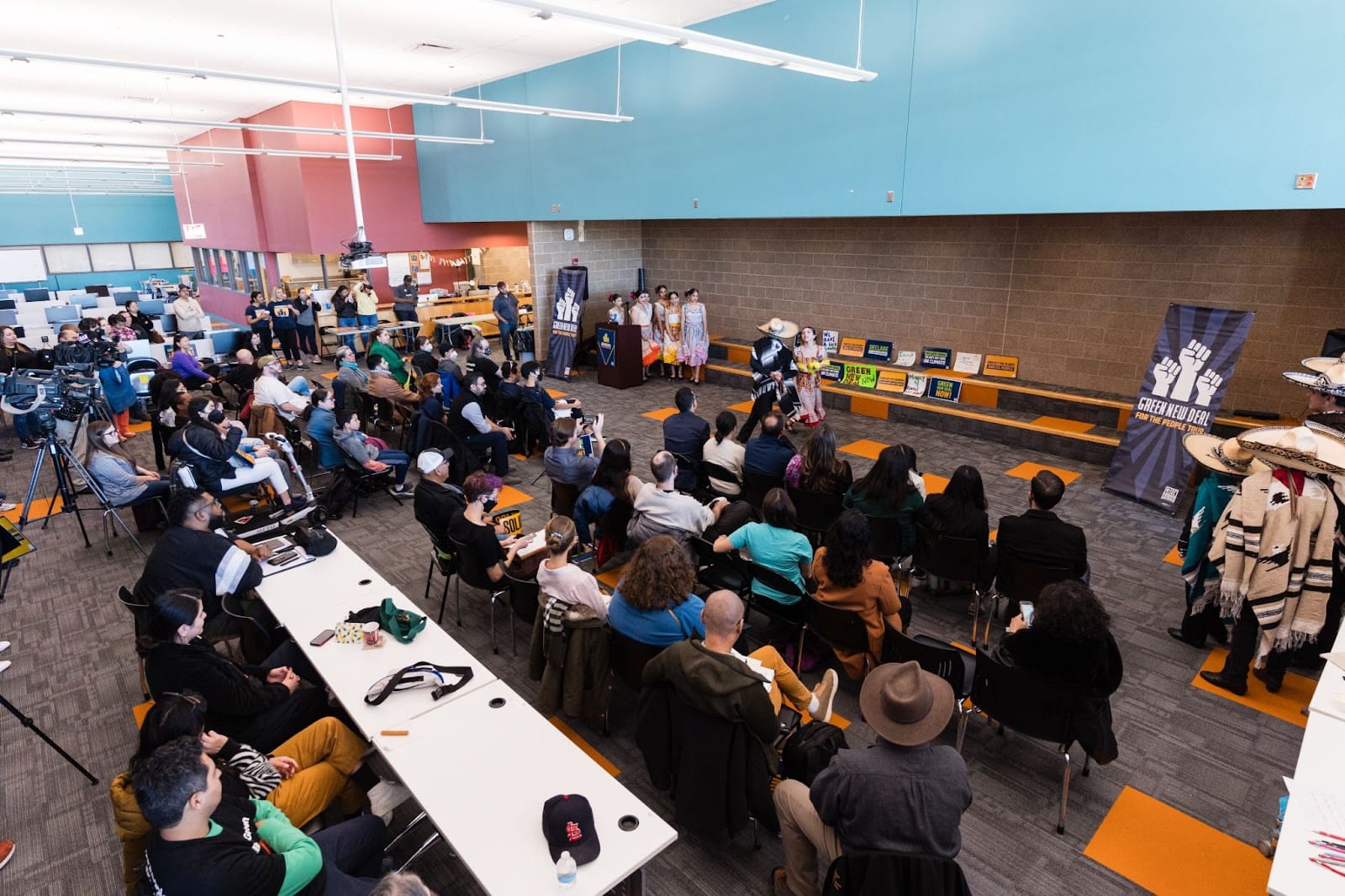
Saturday, Nov. 18, brought the tour to Chicago, where a slew of local organizations, unions, and representatives welcomed them at the library of Little Village Lawndale High School.
Speakers at the tour stop included U.S. Rep. Delia Ramirez, Chicago Chief Sustainability Officer Angela Tovar, and Chicago grassroots organizations, including Grassroots Collaborative and United Working Families.
The tour invites the politicians who advocated for the Green New Deal from day one to the stage. Some of the featured Green New Deal champions include Reps. Ilhan Omar, Cori Bush, and Summer Lee.
“Everyone in Illinois and our nation deserves a future where they can thrive without the fear and effects of a climate crisis,” said Rep. Ramirez to an audience of activists in Chicago. “The Green New Deal is a framework of hope that can get us to the renewable future our communities yearn for with safe housing, clean air and water, living wage jobs, and a transformative economy.”
In Michigan, U.S. Rep. Rashida Tlaib—a longtime champion of the Green New Deal—joined forces with the coalition as one of the keynote speakers. Rep. Tlaib made headlines two days later when the House voted to censure her in a stark move to control the narrative around Israel’s genocide in Gaza.
The Green New Deal Network collectively stands for a ceasefire in the region and immediate humanitarian aid. A public statement released Oct. 19 reads, “For too long, American tax dollars have financed war and weapons. Our money should be invested in ensuring racial, economic, and environmental justice so all people can live safe and healthy lives.”
A pocket of the Inflation Reduction Act was at risk last week when House Republicans attempted to pass a bill sending $14.3 million to Israel in funds originally allocated to the Internal Revenue Service. The bill, which passed in the Republican-run House, was shot down by Senate Democrats.
“It is important to separate people and government,” Rep. Tlaib said in a statement. “The idea that criticizing the government of Israel is antisemitic sets a very dangerous precedent. And it’s been used to silence diverse voices speaking up for human rights across our nation.”
The Sunrise Movement, a youth-led national climate coalition, is one of the key organizations in the GNDN and shows up strong throughout the For the People Tour. The movement held sit-ins in 2018 demanding a Green New Deal, and Rep. Alexandria Ocasio-Cortez revealed a blueprint detailing the proposal.
At the heart of a Green New Deal is the idea that addressing climate change is an opportunity to remake U.S. society to be more equitable by prioritizing communities most affected by inequality, climate disasters, and pollution.
The For the People Tour kicked off Nov. 5 in Dearborn, Michigan. It honors an age-old tradition of campaigning the fall before a presidential election year to pressure candidates to adopt resolutions in their own campaigns. The hope is to create a measure of accountability.
Another key purpose behind the For the People Tour is to highlight progressive wins around the country and cross-pollinate climate justice concepts in every city.
“There’s a really rich level of enthusiasm in addition to serious ideas exchanged across different geographies from federal to local,” an organizer with GNDN said.
The IRA and Green New Deal have crucial differences, perhaps the strongest being the IRA’s leniency for the fossil fuel industry, even mandating pipeline deals. Despite these departures, advocates in the GNDN want to remind American cities that there is much to be gained from tapping into streams of funding in the IRA.
“The tour is about visiting all these places where campaigns are kicking off to use some of that money that’s coming down to provide proof of concept for why this is what we need to scale and invest in our communities,” Coronel said.
One of the key differences between the Green New Deal and the IRA is that the IRA placed less focus on improving public transportation and climate-resilient affordable housing. Transportation is a cornerstone of the Green New Deal strategy.
The Green New Deal features walkable cities and urban development centered on public transportation, wider sidewalks, and bike-friendly infrastructure. For many in the U.S., this is incredulous. The average one-way commute in 2019 was 27.6 minutes. A 2023 study from the University of Michigan’s Center for Sustainable Systems revealed that 87% of passenger miles in the U.S. were in personal vehicles in 2020.
The Green New Deal hopes to mitigate climate change by reducing reliance on personal vehicles in ways that simultaneously improve accessibility and promote eco-friendly infrastructure. This is especially important for communities built on the edges of highways.
A slew of environmental racism, like highways built in low-income neighborhoods, led to Black, brown, and Indigenous communities disproportionately facing the negative health impacts of climate change, including asthma, cancer, and a lower life expectancy.
“We have an existential threat right now. But we also have the biggest opportunity ever to transform our communities,” Coronel said. “That’s also what makes the Green New Deal different: being at the intersection of solving the biggest problem and dreaming of a completely different future at the same time.”
Author

Kat Grimmett is a writer, educator and herbalist. As a South Florida native, her work explores community-based solutions to issues regarding the food system, environment and urban development.
Sign up for Prism newsletters.
Stay up to date with curated collection of our top stories.