‘My body is as besieged as my city’: Israel’s blockade drives Palestinians into daily negotiations with their dignity
Women have become the front-line managers of scarcity in Gaza. Yet their suffering is often erased by Western policy and humanitarian discourse
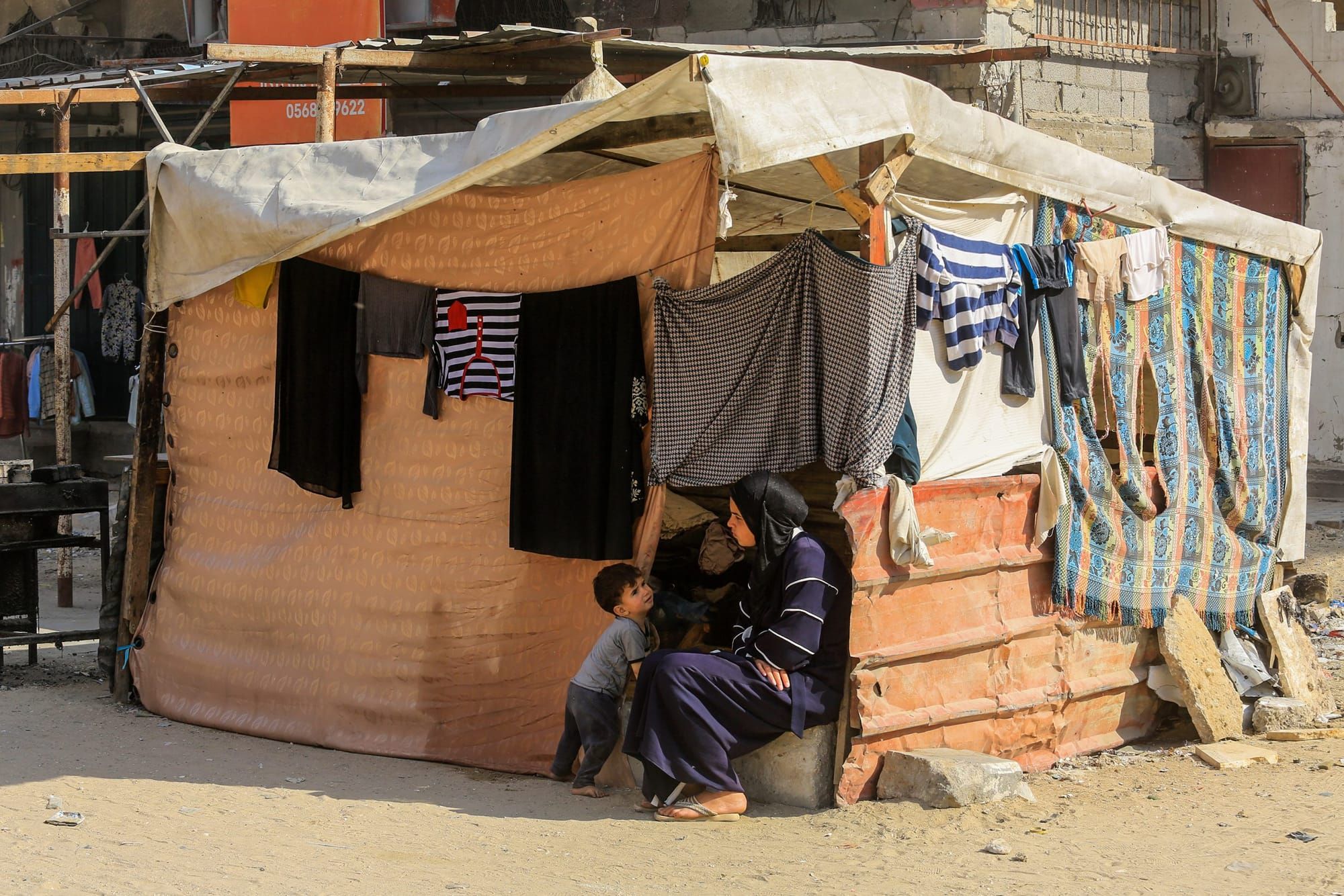
In Gaza, where Israel’s genocide against Palestinians has been waged for nearly two years, even survival carries a tax.
Under Israel’s U.S.-backed siege, the economy has unraveled into a shadow world of predatory exchanges where flour, fuel, medicine, and even money itself are rationed, scarce, and unbearably costly. Here, a bag of flour can become a dowry, a gallon of fuel a bargaining chip. Even the act of withdrawing cash becomes a transaction that strips families of nearly half their lifeline.
One displaced father told me that he waited three days to access a $200 remittance from his brother abroad, only to receive $120 after “commission fees” imposed by money changers.
“It feels like I am buying back my own money,” he said, his voice breaking.
In Gaza, money is no longer an instrument for survival—it is its own commodity, bartered and resold at impossible prices.
Israel’s siege has not only starved Gaza of food and medicine, but also of liquidity. Banks hold little cash. ATMs stand empty. Families who rely on remittances—once a modest cushion against hardship—now find themselves trapped in a cycle of extortion. Commissions to withdraw money from abroad can reach as high as 40%. This means a $100 transfer might shrink to $60 by the time it reaches a desperate family.
Meanwhile, smugglers and traders profit from the manufactured scarcity. Flour, fuel, and basic hygiene products flow through clandestine channels, their prices inflated to the point that it feels as if dignity itself is up for sale. Women barter jewelry for medicine; parents pawn blankets to secure fuel for cooking. Survival is not free—it exacts a toll on both body and soul.
To better convey what this all means on an intimate scale, I spoke with Palestinian poet Fidaa Zeyad, who has endured the siege in its most personal form.
“Privacy has become a luxury in war,” she told me. “Even finding sanitary pads or a simple cream feels like a battle.”
For Zeyad, the blockade isn’t just about bombs and rubble; it is about how every corner of Palestinian life has been intruded upon. She describes the humiliation of borrowing money at impossible rates, standing in line for hours only to be told the bank has no cash, and watching her family ration painkillers because they cannot afford more.
“My body is as besieged as my city,” she said.
What should be the most private aspects of her life—her health, her care, her dignity—are now dictated by the scarcity imposed from outside of Gaza by Israel and sustained inside by black markets.
Israel’s war inscribes itself differently onto women’s bodies. When cash is scarce, women are often the first to sacrifice their needs to preserve food or medicine for their children. Menstruation becomes a crisis when sanitary pads are unavailable or unaffordable. Fertility itself is haunted by trauma, miscarriage under fire, and the impossibility of proper health care.
Care labor—the work of cooking, nursing, comforting, and shielding children—is magnified under siege. Women become the front-line managers of scarcity, forced to turn the impossible into daily survival. Yet their suffering is often erased by the sanitized language of Western policy and humanitarian discourse, which speaks of “conflict” and “shortages” instead of starvation, humiliation, and embodied pain.
The market that emerges under siege is not a sign of resilience—it is a system of predation born of deliberate policy.
None of this is accidental. The blockade is an architectural design intended to weaponize scarcity. Funded and shielded by U.S. military and political power, it ensures that Gazans cannot live, cannot rebuild, and cannot die with dignity. The market that emerges under siege is not a sign of resilience—it is a system of predation born of deliberate policy.
This reality did not emerge in a vacuum. Siege, bombardment, and starvation are not just tools of war; they are a strategy designed to push Palestinians into bargaining with their own existence. Backed by U.S. power, the occupation has turned basic rights into privileges: a sip of clean water, a charge of electricity, a loaf of bread, a painkiller. What once was natural has become rare; what once was a right has become a commodity.
This is how Palestinians in Gaza are driven into daily negotiations with their bodies and their dignity: choosing between food for their children or medicine for their parents, sacrificing privacy to beg for help from strangers, selling pieces of their homes or memories for a gallon of fuel. The genocide, the famine, the blockade—these cruelties are shaped by policies that transform human beings from rights-holders into survival-seekers, from citizens into customers in a market of scarcity. The psychological toll is profound: a constant sense of helplessness, the loss of control over the simplest aspects of life, the erosion of both individual and collective dignity. This is the deeper violence of occupation: It not only kills Palestinians with bombs but dismantles their ability to live without bargaining for life itself.
In the end, the stories converge into one unsettling truth: Survival in Gaza is not given; it is bought piece by piece, at prices no one should be asked to pay.
As Zeyad told me, her words trembling: “Every day, I feel I am negotiating my dignity just to stay alive.”
For Palestinians in Gaza, this is a daily battle: What does survival mean when its price is nothing less than human dignity itself?
Editorial Team:
Tina Vasquez, Lead Editor
Carolyn Copeland, Top Editor
Rashmee Kumar, Copy Editor
Author

Mariam Mohammed Al-Khateeb is a writer, poet, and social activist from Gaza. She is currently studying Dentistry while pursuing her passion for literature and cultural resistance. Her writings, which
Sign up for Prism newsletters.
Stay up to date with curated collection of our top stories.