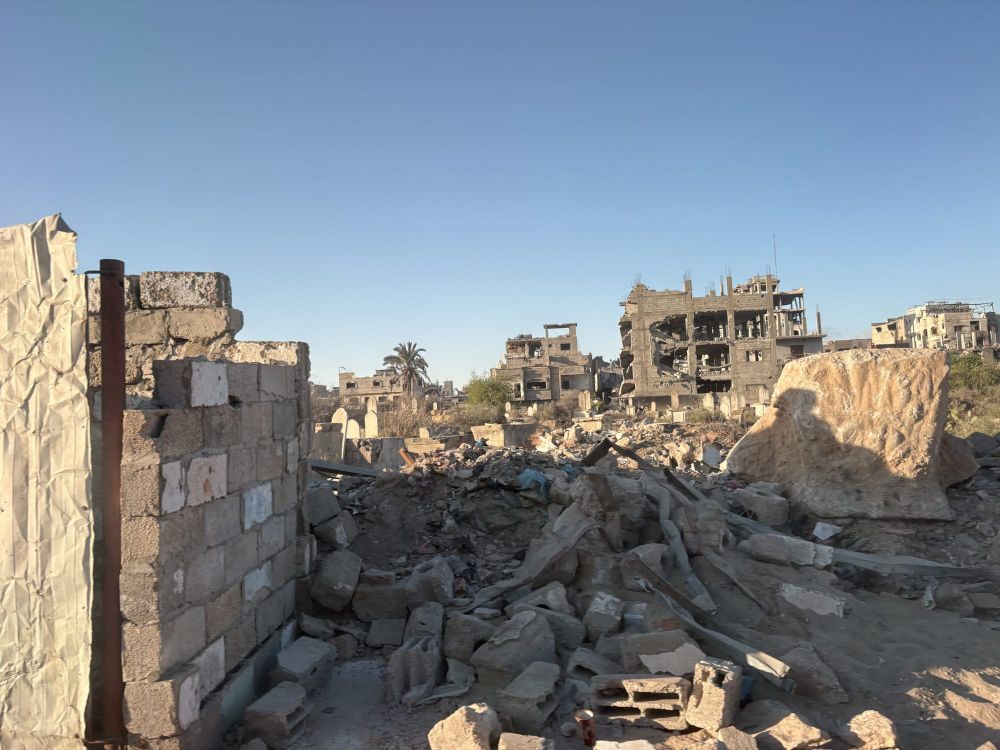
Israel’s decimation of Gaza has made it ‘impossible’ for hospitals to function
In part one of a Q&A with Prism, surgeon and humanitarian worker Dr. Feroze Sidhwa detailed the catastrophic conditions he witnessed during a medical mission at the European Gaza Hospital

Real journalists wrote and edited this (not AI)—independent, community-driven journalism survives because you back it. Donate to sustain Prism’s mission and the humans behind it.
Editor’s note: This story contains graphic and distressing descriptions of the suffering experienced by children and families in Khan Younis.
Since the start of Israel’s genocide in Gaza in October 2023, Dr. Feroze Sidhwa has completed two medical missions in Khan Younis. On March 25, 2024, Sidhwa conducted his first mission, spending two weeks in the European Gaza Hospital (EGH) Trauma Center with the Palestinian American Medical Association. He returned to Gaza one year later, serving for four weeks at Nasser Medical Complex’s trauma bay with American nongovernmental organization MedGlobal. He embarked on a third mission to Gaza with MedGlobal on Nov. 10, but was rejected at the border by Israel.
Sidhwa is a triple-board certified general, trauma, and neurocritical care surgeon and humanitarian worker based in California. He is a fellow of both the American and International College of Surgeons. He has worked extensively in Palestine, Ukraine, Zimbabwe, the Dominican Republic, Haiti, and Burkina Faso. Sidhwa spoke with Prism in September, elucidating the unprecedented depravity in Gaza. His harrowing testimony has been split into two parts, detailing what he witnessed in his first two missions.
In this first part, Sidhwa outlined his experience at EGH. He highlights Israel’s decimation of the health care infrastructure in Gaza, the rapid destruction of Khan Younis, and Israel’s targeting of children.
This interview has been edited for clarity and brevity.
Marah Abdel Jaber: Can you detail the conditions of the European Gaza Hospital?
Feroze Sidhwa: I arrived at EGH on March 25, 2024. Beit Lahia, Beit Hanoun, Jabalia, and Al-Shuja’iyya had been largely destroyed at this point, Gaza City had been mostly evacuated, and a lot of the population was living between Deir al-Balah, Khan Younis, and Rafah. Rafah still existed at the time. The hospitals had become shelters because there was such an overwhelming, unprecedented displacement of people. Every United Nations school and spare building was turned into a shelter, and people lived with family members or in tents in Mawasi, but it was still not enough. When we arrived, we drove into a displaced persons camp on the hospital’s grounds. I’ve seen videos of EGH from when it was built. It was a fairly new hospital, and it was a really beautiful campus lined with trees, which is unusual for Gaza because it’s a heavily urbanized area. But when I got there, 100% of the surface area was taken up with tents, and that was just outside. Twenty-thousand people were sheltering on the grounds of the hospital, and another 1,500 people, who weren’t patients, were sheltering inside, lining the hospital walls. They were sharing four toilets and one water spigot. It was atrocious. Families were sheltered there for a roof over their head, some electricity, and protection from the winter rain.
Abdel Jaber: How did the overcrowding affect hospital operations?
Sidhwa: EGH was operating at a 220-bed capacity, and there were about 1,500 patients admitted when I got there, according to the hospital administration. When we would try to wheel somebody from the emergency department to the operating room, two people had to walk ahead of the stretcher to make sure an infant didn’t run in front and get decapitated. While [removing dead tissue from wounds, known as] debriding a wound, little kids were running in, looking at, and touching the wounds. Women would be cooking pita on an open hot plate in the middle of a mass-casualty event in the [emergency room]. There were cats in the morgue. There was no soap or cleaning supplies; you couldn’t even put bleach on your hands. I would wash my hands once a day when I got to the volunteer quarters in the Palestine College of Nursing. The entire hospital was filthy.
This hospital sewage system is not meant to process over 20,000 people. Little kids were publicly using the restroom because there were no toilets for them anywhere, and there was a huge line outside of the toilets 24 hours a day. The sewage system would back up every few days and flood the radiology department on the ground floor of the hospital with feces. People were sleeping on that floor. The head radiologist cared for his elderly mother and father, who both had Alzheimer’s disease. They were sheltering in the hospital, sleeping on the floor of the radiology department on a sewage-soaked mattress. Their son would pick them up, try to get them to stand for a little while, shake off their mattress, sweep the feces into the sewage system again, and they would go back and continue about their day. Forget sterility; it’s impossible for a hospital to function properly in this situation.
Abdel Jaber: How did you alter your practice to accommodate this?
Sidhwa: Almost every day, we would have multiple mass-casualty events with 20 to 60 wounded arriving. About half would be small, preteenage children, and the remainder was split between women, men, and elderly folks. I would regularly remove pieces of shrapnel between an inch to half an inch long from patients’ bodies. I normally wouldn’t perform this on a hospital floor, but there were no [operating rooms] available, and I’m walking over people in the ER to get to a patient. One woman had a giant piece of tile flooring that was ripped up in an explosion and thrown into her leg. Her son had some medical training, so I had him put on gloves and assist me in removing the shrapnel, and then I showed him how to pack the wound. If she had serious bleeding, I would have needed to put a tourniquet on her and wait until an OR was available, which would never happen. There are four operating rooms at EGH. How on earth are we going to operate on all these people, separate from the mass-casualty events? Two hundred to 250 people needed operative wound care under anesthesia. Their wounds were festering. This is beside the orthopedic care, spinal care, neurosurgery, and hemorrhage control operations for people who are flooding into the ER.
To manage, I spent my first few days organizing a nurse-led wound care service. We trained nurses in wound debridement and changing dressings, simple things to minimize the demand for doctors. I also started stealing ketamine from anesthetic carts and administering it to patients on the floor. Ketamine is a unique, dissociative anesthetic that allows you to continue breathing while unconscious. Most sedatives stop you from breathing, so you can’t use them outside of an operating room. I brought a little pulse oximeter with me from Amazon, and that was my monitoring. I do ketamine sedation in the U.S. all the time for my patients, but normally, you have heart monitoring, a respiratory therapist at bedside, etc. I had nothing, but I was doing this because people were dying of wound sepsis on the floor. It was completely ridiculous, but that was the best we could do.
Abdel Jaber: Did you notice any trends in injuries or diseases?
Sidhwa: There were still starvation deaths back then, which people seem to have forgotten about. Some food was coming in at the time, but everyone in Gaza was hungry. The Integrated Food Security Phase Classification reports stated that 70% of the territory was in Phase 5 [famine and catastrophe] at the time. Everybody else was in Phase 4 [emergency]. When we left, everyone told us, “When you come back to Gaza, don’t remember me like this. I’ll look like this.” And they would show me their phone with an older picture of them when their face was more filled out. The hospital staff who had the worst malnutrition were all the ones who had been taken from Shifa Hospital. They were all extremely thin. Every time we would walk into a room, somebody had jaundiced eyes, likely indicating hepatitis A in this situation. Every child had diarrhea and a cough. While I was at EGH, Israel initiated the ground invasion of Khan Younis, so there were ground troops in the area. We saw small children shot in the head or the chest very regularly. It was a common thing that anyone who was in the presence of ground troops across the Gaza Strip saw.
When you use military hardware on children, it’s going to flay them open. And if they’re lucky enough to survive, they’re in for an awful life.
Dr. Feroze Sidhwa
Abdel Jaber: Was there any case from your first mission that stuck with you?
Sidhwa: Yes, a sweet 9-year-old girl named Jury. Everyone was eating iftar, but I was in the pre-op area trying to get cases done. Jury was rolled in and put to the side, so the nurse asked if I could take her case. I said no because I didn’t know what she needed done. There was no family with her, and she didn’t speak English. But when I looked at her, it was obvious that she was going to die in a few hours or days. She was in septic shock and had an external fixator [a device that helps keep bones in place] on her leg. She was acting like a toddler screaming, “Wein Baba (Where’s my dad)?” She would scream if we got near her or touched her anywhere, so we couldn’t tell what was wrong with her. Her heart rate was around 170 to180, which is dangerously high, and her blood pressure was life-threateningly low. I actually couldn’t feel her radial pulse, so [orthopedic surgeon] Mark Perlmutter and I took her case.
She had an IV, so we started giving her fluids. Once we could feel a pulse, we took her to the OR. We couldn’t find her family, we didn’t know what was going on, and we didn’t even know what operation she needed, but we decided to figure it out because otherwise she was going to die. Once we got her anesthetized and could examine her without terrifying her, we found that her right arm and both of her legs were broken, with her left leg in an external fixator. She was missing two inches of her femur on the left; her quadriceps and hamstring muscles were completely destroyed. I actually really don’t understand how her leg was still attached to her. Her skin was entirely ripped off the muscle, but was still attached at the end of the tear. She shouldn’t have had any blood flow left to her foot, but she did. Someone had just stuck the skin back onto the muscle, which isn’t going to work. Any doctor worth their weight in salt would know that. All the detached skin dies over a few days because it doesn’t have a blood supply left. The only reason Jury wasn’t dead was that maggots infested her wounds and were eating the dead tissue. It was horrendous. We washed the maggots out of her and cut the dead tissue away. It was 2-3 pounds of tissue from an extremely thin 9-year-old girl. She’ll need to have that leg amputated eventually. When you use military hardware on children, it’s going to flay them open. And if they’re lucky enough to survive, they’re in for an awful life.
Mark and I were furious about the severity of her injury, but we were angrier at the doctor who treated her. We looked into it, and it turned out that the orthopedic surgeon who was on call that day was dead. His junior resident and medical students treated Jury, and they just did the best they could. They didn’t know what to do. You can’t blame them. Thankfully, she’s alive, and she evacuated to Egypt.
Abdel Jaber: Did you ever learn how Jury was injured?
Sidhwa: I met her dad after the operation and learned Jury’s story. Her mom and dad lived in Khan Younis. They’re not refugees in Gaza. The Israeli forces dropped leaflets on their neighborhood telling them to leave, so they evacuated to Jury’s grandparents’ home in Rafah. They dropped the kids off there and then went out to get supplies that you need to keep old people and children alive. While they were gone, the house was bombed. When they returned, the neighbors told them that most of their kids were taken to Kuwaiti Specialty Hospital, and one went to EGH. The mom went to Kuwaiti and the dad went to EGH and found Jury.
Jury is quite intelligent. Suddenly, she wakes up in a hospital, and her mom and siblings are not with her; it’s just her dad. She realized he’s so happy that she’s alive, he’ll do anything for her. She started negotiating with him over her anesthesia, telling him she’ll only do it if he gets her honey melon and phone calls with her siblings. She doesn’t understand that this is a land in famine, and there’s no cell service. This poor man was so sweet. He thought she was going to sit in a corner and die, and he was elated that somebody was taking care of her, because her surgeon was dead. Even in these circumstances, Jury got to be a little girl again. She bossed her dad around; her dad got to dote on her. He would go out and always come back with something sweet for her to eat. He would constantly tell her I love you. It was really nice to see a father try to give his daughter some semblance of normalcy in the midst of a genocide.
Editorial Team:
Tina Vasquez, Lead Editor
Carolyn Copeland, Top Editor
Stephanie Harris, Copy Editor
Author

Marah Abdel Jaber is a Palestinian writer, researcher, and creative. She was the team lead on Palestine Square’s “Firsthand Accounts from U.S. Medical Missions in Gaza” series, collecting testimonies
Sign up for Prism newsletters.
Stay up to date with curated collection of our top stories.