The U.S. is forcing Americans to ‘subsidize the mass murder of children’ in Gaza
In part two of a Q&A with Prism, Dr. Feroze Sidhwa discussed his second medical mission in Khan Younis at the Nasser Medical Complex, where American-made weapons were used by the Israeli military to bomb the hospital

Real journalists wrote and edited this (not AI)—independent, community-driven journalism survives because you back it. Donate to sustain Prism’s mission and the humans behind it.
Editor’s note: This story contains graphic and distressing descriptions of the suffering experienced by children and families in Khan Younis.
Dr. Feroze Sidhwa, a triple-board certified general, trauma, and neurocritical care surgeon and humanitarian worker based in California, has completed two medical missions in Khan Younis, Gaza. In part 1 of his Q&A with Prism, Sidhwa discussed his first medical mission at the European Gaza Hospital (EGH) Trauma Center in March 2024 with the Palestinian American Medical Association, detailing the horrific conditions he encountered as a result of Israel’s annihilation of the region’s health care system.
At EGH, Sidhwa told Prism, thousands of Palestinians were sheltering and awaiting care. The situation was dire; the hospital sewage system on the ground floor—where people slept—backed up every few days and flooded the radiology department with feces. He also shared the story of a 9-year-old girl named Jury. The child’s right arm and legs were broken, she was missing two inches of her left femur, and her quadriceps and hamstring muscles were destroyed, making it unclear how her leg was still attached to her body. Jury’s skin was almost entirely ripped off the muscle, Sidhwa said, and maggots infested her wounds.
Sidhwa returned to Gaza in March 2025, serving for four weeks at Nasser Medical Complex’s trauma bay with American nongovernmental organization MedGlobal. He returned for his third mission with MedGlobal last month, but was rejected by Israel at the border.
In the second part of his conversation with Prism, Sidhwa recalled his experience at Nasser Medical Complex. He reflected on the fragile ceasefire at the start of 2025, Israel’s direct targeting of hospitals, and the U.S.’s role in the genocide of Gaza.
This interview has been edited for clarity and brevity.
Abdel Jaber: How did the conditions at Nasser Medical Complex compare to EGH one year prior?
Sidhwa: When I arrived, the troops had withdrawn from Khan Younis to the buffer zone. There were still drones, but the closest troops were in the Philadelphi Corridor, south of Rafah. I got there during the so-called ceasefire period, which ended on March 18, around 2:30 in the morning. The first thing I noticed was that no one was camping inside the hospital. I was so relieved. There still wasn’t much soap or hand sanitizer, but I brought my own. We actually had living quarters. It was a much more comfortable place to be. The European Hospital was miserable. It was not as crowded because Nasser had been besieged and forcibly evacuated in February and March of 2024, while I was at EGH, and Al-Shifa [Hospital] was being destroyed. The hospital was made functional again around June of that year. The Ministry of Health and the hospital administration prohibited camping in the hospital because it couldn’t function. It’s not fair, because people have nowhere else to go, but the hospital needs to work. The sanitation was way better, and there wasn’t widespread bombing, until it resumed on March 18. Then Nasser became a charnel house.
Abdel Jaber: Was there anything striking about the physical environment?
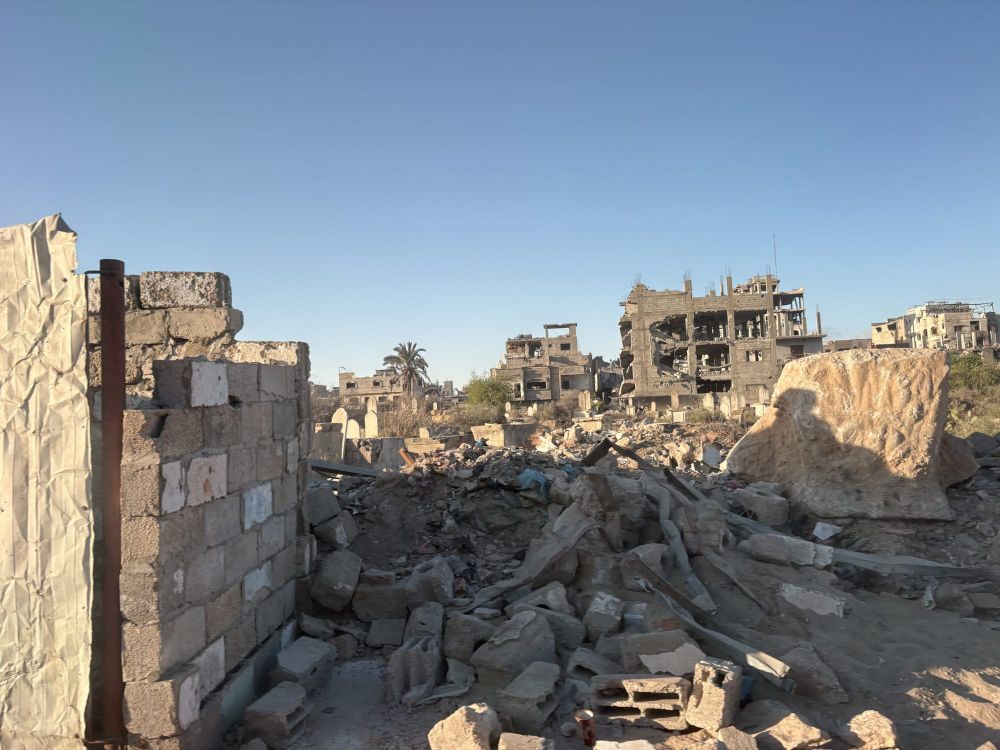
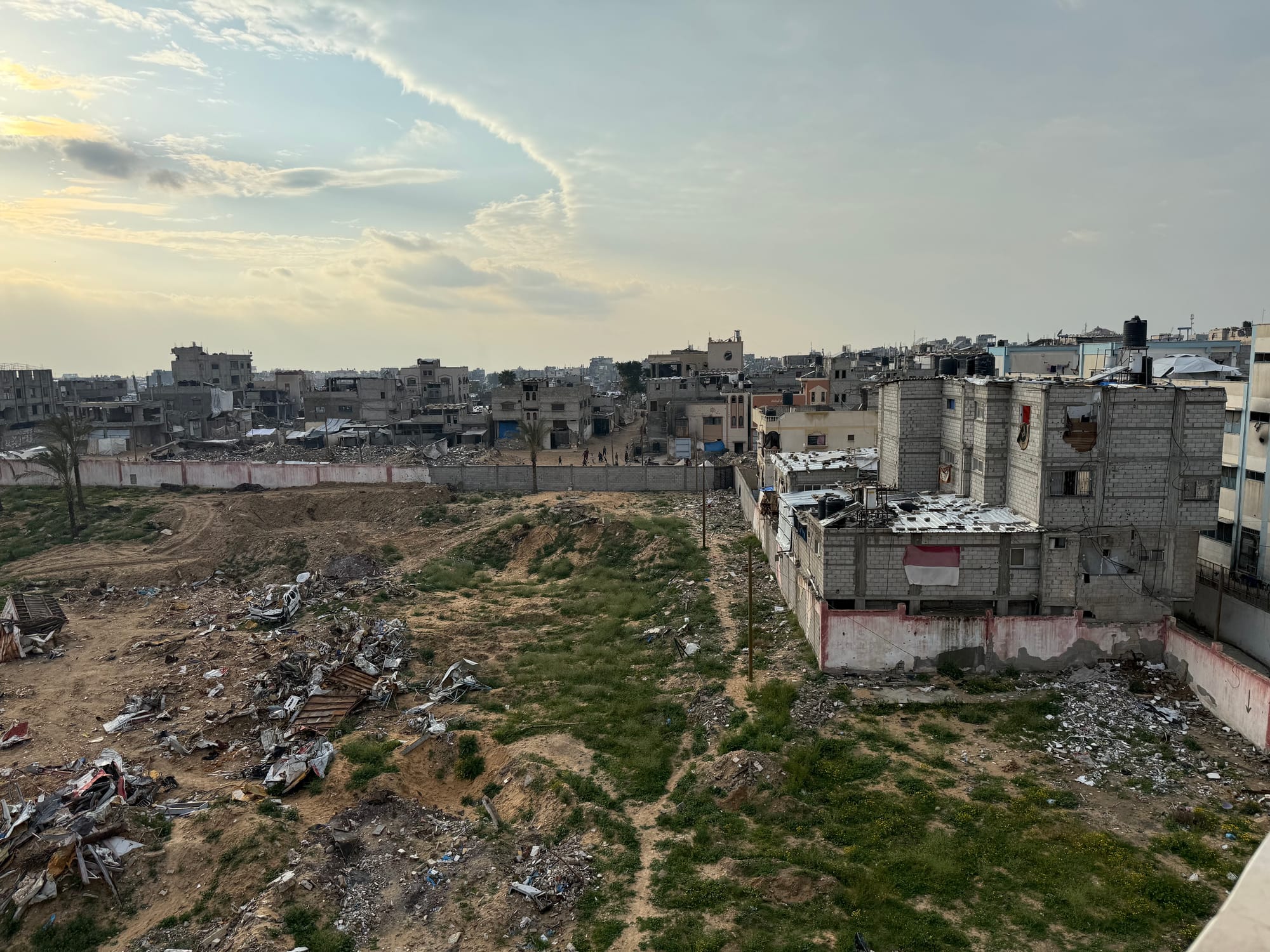
Sidhwa: Because of the ceasefire, I could actually walk around Khan Younis. I couldn’t believe the destruction. I’ve seen the drone footage, but it was utterly shocking to walk past these buildings in person. The director of nursing at Nasser took us to his home, and it had a really potent smell of burning, like char. He told us the Israelis occupied his home and forced his family into a single room for days. When the soldiers left, they forced the whole family outside and torched their house in front of their eyes. He’s a Gaza native; his family has been in Khan Younis for generations. He took pains to show us how beautiful his home used to be. As we went up the stairwell, he took his phone light out to show us how nice the banister was. Khan Younis was a part of Gaza that hadn’t been as severely destroyed by Israel, and it was jarring. It was a disaster, but it wasn’t Rafah, Beit Lahia, or Shuja’iyya. His oldest son had just returned from Gaza City, and he couldn’t even describe the destruction.
Abdel Jaber: Did the ceasefire period affect the state of famine in Gaza?
Sidhwa: It was perfectly obvious that the malnutrition was much worse when I got back, even though more aid had gone in since the ceasefire. But that was all cut off on March 2. I ate a pared-down version of maqluba with goat when I arrived on March 6. The next time I ate animal protein was March 28 or 29. That’s not a complaint, but to highlight the severe lack of food resources given my privilege. It was also Ramadan, so people only ate one meal per day. They would bring us food from World Central Kitchen, and I didn’t even realize until my second week in Gaza. I felt terrible that I was eating their food. We would eat a plate of rice and a smattering of either canned tomatoes or fava beans. That was it. The major mode of starvation right now in Gaza is protein starvation for children. About half of Gaza’s children have had a sufficient number of calories not to die, but they have virtually no protein available to them.
Abdel Jaber: What was your experience like at the hospital after Israel broke the ceasefire?
Sidhwa: On the morning of March 18, Nasser Medical Complex saw 221 patients, half of whom were small children. Around 90 patients died. That’s insane. If you take all of the level one trauma centers in Boston—Boston Medical Center, Brigham and Women’s [Hospital], Beth Israel, Mass General, Tufts, and Boston Children’s Hospital—it’s six hospitals. Altogether, they have around 4,000 beds, 400 surgeons capable of doing trauma care, and hundreds of operating rooms. Collectively, they saw 281 patients on the day of the Boston Marathon bombing. I was a resident of Boston Med Center at the time. Everyone thought the world was ending. We didn’t think it was possible to care for so many patients.
Nasser was a 300-bed facility with six operating rooms, six surgeons, and two international volunteers capable of doing trauma care: myself and [trauma and vascular surgeon] Morgan McMonagle. The differential in resources to patients is absurd. I did 10 hemorrhage control operations that morning. I usually do 10 every few months in the U.S., and I work at an unusually busy trauma center. There’s no other mass-casualty event in history that even remotely approaches this, at least not that’s been reported on in the literature. And it’s not a one-time event. There’s no way any hospital could do this. You could take all of the level one trauma centers in Boston, put them in Khan Younis—forget the rest of Gaza— and they still would not cope with this properly. The scale of bombing was overwhelming.
Abdel Jaber: Were there any cases that stuck with you?
Sidhwa: There was a 16-year-old boy named Ibrahim, who was the last case that I did on March 18. He was injured in a tent bombing, and he came in with shrapnel injuries to his abdomen. We opened his abdomen and found wounds to the lower part of his colon and rectum. We repaired them, but we had to give him a colostomy due to the severity. He was also a smart kid, like Jury. He’d memorized the whole Quran by age 14. He was one of those cantankerous teenage boys who took pleasure in telling the doctor something he didn’t expect to hear. The only thing I can say when I’m examining a patient in Arabic is: “Fi waja?” Does this hurt? He would always say no when I asked and never requested pain meds. When I told him he had to walk, he jumped out of bed and started moving. There’s no way it didn’t hurt like hell, but he wanted to get better. Since there were no toilets, his family made some jokes about how he’s lucky now that he doesn’t have to poop like everyone else, and he would laugh. Most 16-year-olds would feel like they’ve been mutilated with a colostomy and a giant scar in their abdomen. He was recovering really well. I operated on him around noon on March 18, and by March 23, he was ready to go home. Virtually 100% of our patients had complications, but he was a relatively healthy teenage boy. He was starving, like everyone else in Gaza, but 16-year-olds are robust.
On the night of March 23, after iftar, I decided I was going to remind his family one more time that Ibrahim was going home the next day, and to make sure they understood the colostomy. We lived on the fourth floor of the hospital by the ORs and intensive care unit, and Ibrahim was in the men’s surgical ward, on the second floor. On my way to the stairs, a Palestinian doctor stopped me and told me there was another 16-year-old boy in the ICU who had just been transferred and was still bleeding after surgery. I notified the OR staff to take him in while I headed down the stairs to Ibrahim’s room. In 90 seconds, I would’ve been in his room. As I pushed the ICU door open, it pushed back on me, and I didn’t know what happened. The Palestinians immediately grabbed me. They knew that the hospital had been hit. I assumed Israel bombed the emergency room. The administration put the hospital on lockdown because they didn’t know if it was going to be raided or bombed again. After an hour, they lifted the lockdown, but there was still the 16-year-old boy bleeding to death in the ICU. He needed to go to the operating room, or he was going to die, so I told the anesthesiologist, but I was redirected to check if anyone needed an operation from the explosion.
I assumed I had to go to the first floor, but there was this crazy hullabaloo on the second floor. I walked over and realized that the surgical ward was hit. Ibrahim’s room exploded. They told me all the patients were taken down to the emergency room, and only one person died. I thought, “How on earth could they have bombed the hospital directly and only kill one person?” The Israeli military used some sort of small munition to target the room directly and destroy the surgical ward. I met [emergency medicine specialist] Tammy Abughnaim in the ER, and she told me the attack was targeted against 56-year-old Ismail Barhoum, whom Israel claimed was the prime minister of Gaza. He was the patient who died. As she said that, a few men ran down the stairwell with a body wrapped in a sheet. We thought it was someone needing an operation, so they put him on the bed in the trauma bay and opened the sheet. I saw his abdomen first. I instantly knew it was Ibrahim. I looked up at his face, and sure enough, it was him. His abdomen was torn open. His colostomy was torn in two. He was covered in soot. I was furious. I’m a trauma surgeon, I’m used to my patients dying, but I’m not used to them being killed in their hospital bed after I’ve put them back together and they’re scheduled to go home in a few hours. The attack was at 10 p.m., and Ibrahim was going to be discharged at six o’clock the next morning. Because he happens to be the distant cousin of Ismail Barhoum, they put them in the same room to make family visits easier. Ibrahim had to die because Israel wanted to murder a Hamas politician. The BBC initially stated that he was Ismail Barhoum’s aide. Their news story remains uncorrected, although I told them it’s not true.
Human Rights Watch says that Israel is using starvation as a weapon of war. That’s not quite accurate. They’re using starvation as a tool of genocide.
Dr. Feroze Sidhwa
Abdel Jaber: What might the injuries you treated indicate about the weapons and type of warfare being used by Israel against civilians in Gaza?
Sidhwa: I don’t think it matters specifically what kinds of weapons are being used so much as the fact that they are weapons of war. Israel is using MK series bombs, some of them have [Joint Direct Attack Munition] guidance systems on them, and some of them don’t. They’re large, several 100 pound munitions with several 100 pound warheads that are meant to be dropped on troop reinforcements, concrete bunkers, or mountains. They’re not meant to be dropped on flimsy concrete structures that house old people and children. All explosive weapons that militaries use are meant to be used against other militaries. There is no way to use an explosive weapon discriminately in a crowd. There is no way to fire an explosive weapon into a hospital that comports with international law. Hospitals have very clear, specific protections under international law. That’s one of the really scary parts about the Israeli-U.S. attack on Gaza. These protections, specifically for hospitals and health care workers, are being absolutely obliterated. More than [two] health care workers have been killed on average every day in Gaza since the invasion started. Israel’s attack on Gaza is an utterly outrageous use of military hardware, directed at civilians and civilian objects. It’s probably the worst attack on civilians since the Rwandan genocide. Human Rights Watch says that Israel is using starvation as a weapon of war. That’s not quite accurate. They’re using starvation as a tool of genocide. You can invert that statement, and it remains true. Israel is using war as a weapon of starvation. The Israelis are using war as a tool of genocide. The destruction of Gaza is far more severe than any kind of destruction that has ever been carried out anywhere. You would have to go back to the time of Genghis Khan, razing entire cities to even remotely approximate this.
Abdel Jaber: How do you perceive the United States’s role in the systemic destruction of Gaza?
Sidhwa: This is not an Israeli attack on Gaza, it’s a U.S.-Israeli attack. Without our critical support—70% of the arms, virtually 100% of the funding—it would stop instantly. The American political class seems to be genuinely and fanatically dedicated to this project of destroying the Palestinians. Yet, even from the standpoint of the American empire, it’s self-defeating to use violence in this way. My own government is forcing me to subsidize the mass murder of children. I don’t want that, and I don’t think Americans do either.
Editorial Team:
Tina Vasquez, Lead Editor
Carolyn Copeland, Top Editor
Rashmee Kumar, Copy Editor
Author

Marah Abdel Jaber is a Palestinian writer, researcher, and creative. She was the team lead on Palestine Square’s “Firsthand Accounts from U.S. Medical Missions in Gaza” series, collecting testimonies
Sign up for Prism newsletters.
Stay up to date with curated collection of our top stories.