In Gaza, we cannot trust that our food is safe
Israel has destroyed Palestinians’ ability to raise their own livestock for food. Now concerns are growing about the safety of chicken coming from Israel

Real journalists wrote and edited this (not AI)—independent, community-driven journalism survives because you back it. Donate to sustain Prism’s mission and the humans behind it.
My family and I had not tasted chicken for nine consecutive months. Israel had closed Gaza’s border crossings and banned the entry of meat and poultry into the Strip. After the October ceasefire, Israel allowed limited quantities of frozen chicken and red meat to enter, and the moment we had been waiting for finally arrived.
One day, my father bought a chicken from the market for nearly 100 shekels (about $30), a high price beyond the reach of thousands of families in Gaza. We cooked it with a deep sense of longing. The moment was heavy with all the deprivation we had endured. My younger sister, Twlin, 11, said, “Finally, we’ll be able to eat chicken for the first time in months.”
Our joy did not last long.
When we tasted the chicken, its flavor was unpleasant and unfamiliar. At first, we assumed it might have expired, so we checked the packaging and confirmed that the production and expiration dates were still valid. However, all the information was written in Hebrew.
Since my family and I do not speak Hebrew, I used Google Translate to read what was written on the package. The chicken was labeled “treif.” In Israel, the word is used to denote non-kosher items and stems from the word “treifah,” which literally translates to “torn,” “damaged,” or “unfit for consumption.”
My father told us to stop eating the chicken and throw it away immediately. We would not get to enjoy our long-awaited meal.
Because Israel has destroyed Palestinian farms and livestock, most of Gaza is reliant on imported aid for food. In the markets, much of the chicken available at the moment is treif chicken. In 2016, the freed Palestinian prisoner Hilal Jaradat investigated this classification of meat after encountering bad-tasting chicken; he was reportedly told by the company exporting the poultry that this meat was not intended for consumption within Israel due to religious reasons and thus, was exported to Gaza. Now, the label is beginning to raise alarms within Gazan households as multiple Palestinians report that the chicken they’re consuming has an unpleasant taste.
Much of the chicken available is also frozen, not fresh, which can lead to a host of potential risks. Though it’s unclear if the treif label is any indication of the quality or taste of the meat, it is nevertheless sparking fear and concern as Palestinians remain mistrustful of Israeli authorities’ ability or desire to provide food that is safe for consumption.
Fears begin to spread
On Jan. 6, the World Organisation for Animal Health announced a new outbreak of avian influenza at a farm in the north of Israel among approximately 2,000 ducks. Ninety birds died, and the rest were culled.
Though the risk of contracting bird flu from eating affected poultry is extremely low, the news reignited fears in Gaza. With no local capacity for health inspection or food safety oversight, questions intensified about the possibility that sick birds could be slaughtered, frozen, and exported to Gaza’s markets. And with Gaza’s food controlled wholly by the very entity perpetrating its genocide, many began to fear the Strip was becoming a dumping ground for diseased poultry.
With Gaza’s food controlled wholly by the very entity perpetrating its genocide, many began to fear the Strip was becoming a dumping ground for diseased poultry.
Under Jewish and Islamic principles, one of the conditions that can render meat unsuitable to consume—or not be kosher or halal—is if it comes from an animal that is ill and close to death.
In 2016, a former inspector from Israel’s Ministry of Agriculture told investigative reporters with the news outlet Al Araby Al Jadeed that the quantity of treif chicken in Israel balloons during avian influenza outbreaks, and the meat is sometimes exported to Gaza.
The fear of consuming potentially unsafe meat has spread across Gaza.
Alia Safi, a 40-year-old mother of eight, said she was deprived of eating chicken for more than nine months. When it finally became available, the price of one kilogram reached 70 shekels (about $22)—frozen, not fresh.
“We bought it despite the price because we missed it. But after cooking, we discovered it was treif,” Safi said, adding that the taste was unpleasant. “With the spread of avian influenza in Israel, I fear that Gaza will become a market for disposing of diseased birds.”
Destruction of food security
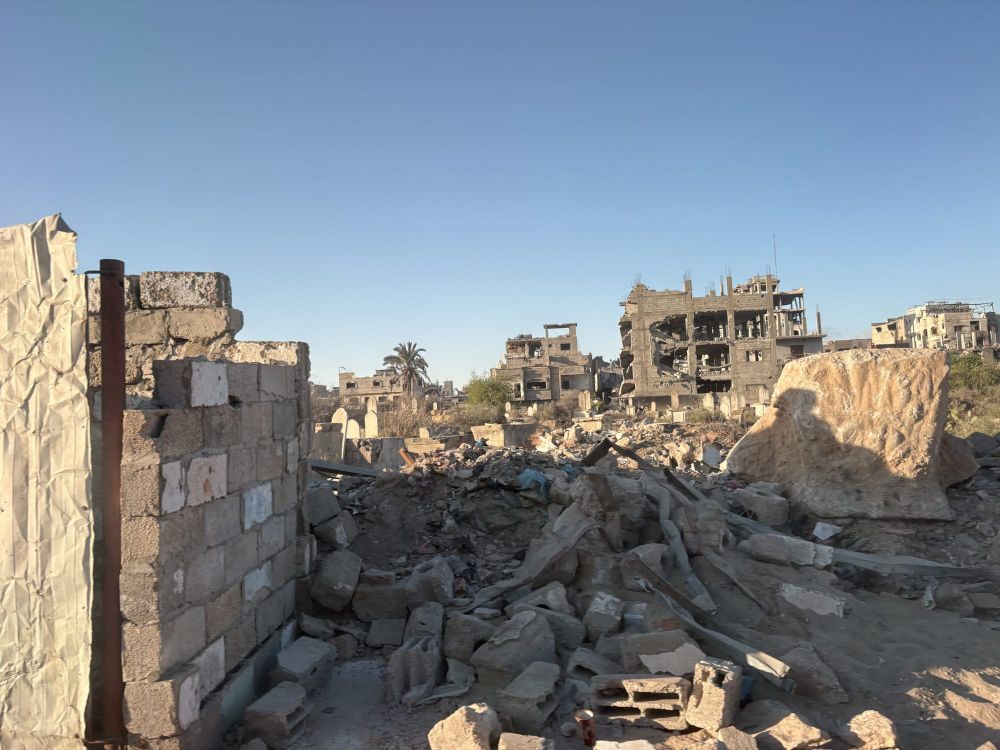
Gaza’s reliance on imported food comes after Israel’s systematic attacks targeted not just civilians, but also livestock, which constitutes a fundamental pillar of Gaza’s economy and a primary source of food security. Israel has worked to eliminate this sector either through the direct bombardment of farms and animal shelters, or through a policy of starvation that led to the death of vast numbers of animals.
I’ve witnessed the destruction firsthand. My cousin Ahmed Nassar owned a small poultry farm of around 500 chickens at his home in Jabalia. On Oct. 10, 2023, Nassar was forced to flee after his house sustained partial damage from the bombing of a neighboring home. Before leaving, he placed all the available feed and water for the chickens.
“My heart broke because I left the chickens to an unknown fate, and I did not know what I could do to protect them,” Nassar told me.
Two weeks later, Nassar was able to return to his home to check on the chickens, only to find that most of them had died after a wall collapsed on them.
According to Euro-Med Human Rights Monitor, before the war the Gaza Strip had approximately 6,500 poultry farms producing nearly 3 million chickens per month. However, more than 93% of these farms have been completely destroyed, while the remaining farms have ceased operations entirely. The Gaza Strip also previously had approximately 15,000 cows; more than 97% of them have perished, either from direct bombardment or starvation, while some were slaughtered early in the genocide for food.
Khalil Naji, known locally as Abu Riya, worked at a calf farm in northern Gaza, where he said more than 50 workers were employed, in addition to dozens of workers in butcher shops selling fresh meat. During the genocide, the farm was destroyed, and all of these workers lost their jobs.
Abu Riya said that he was able to return to the farm for the first time during the ceasefire, where he found that most of the calves had died.
Importing frozen chicken
With farms destroyed, imported frozen chicken has become a key source of food for Palestinians in Gaza. The chicken arrives in the Gaza Strip through Karam Abu Salem Crossing, the designated goods entry point. Shipments of poultry take several days to reach Gaza, and upon arrival, they face a major problem: a lack of sufficient refrigeration facilities. As a result, large quantities of frozen chicken are sold on street stalls, exposed to the sun for long periods. They are then sold to citizens in a semi-defrosted state, which can lead to potential spoilage and bacteria.
Ibrahim Nasr, owner of a small poultry stall in Gaza, said, “I buy a small carton of frozen chicken every day and sell it in small portions. But I often cannot sell the entire carton, and I cannot keep it for the next day, as it spoils. Occasionally, I manage to store it temporarily in my friends’ refrigerators.”
The problem is not limited to street stalls. Even shops and warehouses that store poultry face significant challenges due to the ongoing electricity shortages, and the high cost of solar power and diesel fuel required to run refrigerators.
As a result, people often end up buying chicken that is partially spoiled or improperly frozen, with a clear difference in taste between frozen and fresh chicken.
Health concerns
Consuming this frozen chicken has sparked major concerns among Palestinians, particularly those who may be more vulnerable, such as pregnant women who are already battling malnutrition caused by Israel’s aid blockades.
Khadija Al-Khaldi, 29, is eight months pregnant. She said doctors told her that she was suffering from severe malnutrition and advised her to consume protein.
“I waited for the crossing to open so I could eat meat, but my doctor warned me against treif chicken because it could transmit serious diseases to me and my unborn child,” Al-Khaldi said.
Hakeem Mohammed, 54, a nurse at Al-Shifa Medical Complex in Gaza, confirmed that the hospital records cases of food poisoning almost daily. He noted that a large number of patients report having eaten chicken before the onset of symptoms.
Mohammed warned that consuming contaminated or unregulated food can lead to serious complications, particularly for children, pregnant women, and elderly people.
Despite those risks, Palestinians in Gaza are left with few options. Here, food is no longer a matter of preference or variety. It is a brutal equation between hunger and risk. Between a siege that blocks food, and a partial opening that allows the entry of products of questionable safety, more than 2 million people live in a gray zone: There is no guarantee of what is placed on the table, and no real choice for those who are simply trying to stay alive.
Editorial Team:
Sahar Fatima, Lead Editor
Carolyn Copeland, Top Editor
Rashmee Kumar, Copy Editor
Author

Ohood Nassar, 23, from the northern Gaza Strip, is a teacher and writer. She contributes to We Are Not Numbers, Electronic Intifada, Institute for Palestine Studies, and The New Arab. She graduated wi
Sign up for Prism newsletters.
Stay up to date with curated collection of our top stories.