The famine in Gaza exposes the best and the worst of us all
We are all confronting hunger, but our approaches are very different, from pure creativity to blatant exploitation
In May, in the midst of Israel’s siege and famine of Gaza, I woke up and went to sit with my mother as I do each morning. I was shocked to find her drinking coffee for the first time in months.
But it wasn’t coffee at all. Not even close.
“I roasted some chickpeas, then ground them and added some spices, and now we have coffee,” my mother explained. “What can we do, my child? We have to invent and create to get through this hardship.”
After refusing to implement a ceasefire agreement in March, Israel besieged the Gaza Strip again—this time with a suffocating, ongoing blockade. Water was cut off, and so was electricity to the drinking water desalination plants, creating its own crisis. Crossings are completely closed, and the entry of food, medicine, and fuel is totally banned.
There are many Palestinians in Gaza who have refused to surrender to these conditions, and instead, they confront the challenges imposed by the blockade head-on.
Twenty-five-year-old Hossam Abu Khalil, for example, launched a makeshift refinery that produces fuel by melting plastic and other flammable materials. He helps support his family by selling the fuel to people to fill their cars and generators.
Abu Khalil’s enterprising idea comes with serious risks to the environment, human health, and even the lifespan of vehicle engines. Engines could explode, and the process of rendering the fuel creates a thick smoke that causes coughing and respiratory issues for anyone nearby.
Still, Abu Khalil said many young men are turning to this work. “Life here is tough,” Abu Khalil told Prism. “We have to work at anything.”
In Gaza, it feels as if every vital part of life is out of reach. Israel’s measures have left us stunned and desperate, as store shelves are empty of essential goods and clean drinking water is almost impossible to access. Over the last few months, bakeries have gradually closed due to the lack of flour. Previously inexpensive food items like rice, oil, and sugar became totally unaffordable. Every day, we encounter more instances of mothers struggling to keep their children alive, and patients suffering from Israel’s restrictions on essential medicines, making survival a daily battle.
Due to its own blockade and under increasing international pressure to allow in aid, Israel worked with the United States to propose a solution: the Gaza Humanitarian Foundation (GHF), which has set up “aid sites” to replace the hundreds run by the United Nations and the U.N. Relief and Works Agency for Palestine Refugees. Since it began operating in May, the organization has not eased the severity of Israel’s large-scale starvation campaign. Instead, it has been a death trap for Palestinians struggling to get aid.
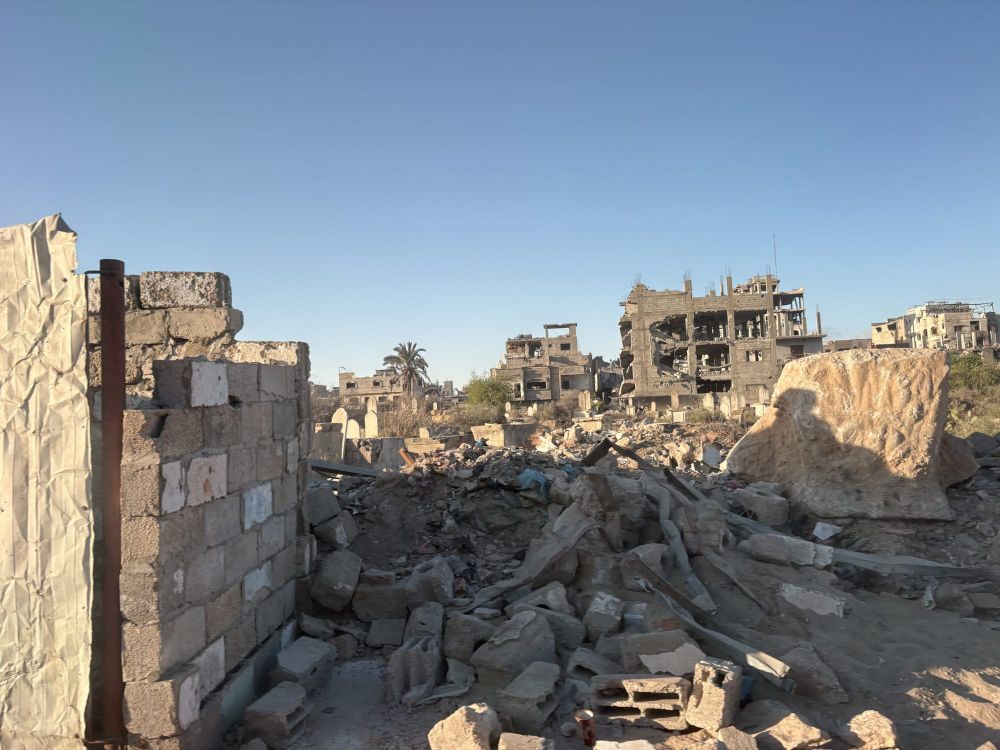
More than 1,560 people have been killed by Israeli soldiers while trying to access aid. Those of us who are still alive are forced to choose between submission and starvation. We wonder how the Israeli regime’s strategy will take shape next, how the occupation will again manage to lure large numbers of Palestinians toward areas falsely labeled as “safe,” only to target them with bullets and bombs.
People have had no choice but to go to GHF sites because of the famine. Some who have survived and were actually able to access aid have exploited the crisis, selling these goods at exorbitant prices. The item most in demand is flour. In June, I saw a bag of flour at the market selling for $76 per kilogram.
Under these dire conditions, Gazans have had to adapt and innovate to survive famine, relying on their cooking knowledge, new ideas, and experimentation.
Old recipes, new ingredients
In the earlier days of the famine, Gazans simply limited their food intake to make supplies last. They divided a loaf of bread among several people, for example, or skipped meals. Soon, these measures were not enough, said Maysr Abu Rukab, a widow and mother of six. Three of Abu Rukab’s children have disabilities, and she largely supports her family through aid from others.
“We can be patient without chicken or meat, but bread is the essential commodity in every home,” Abu Rukab said.
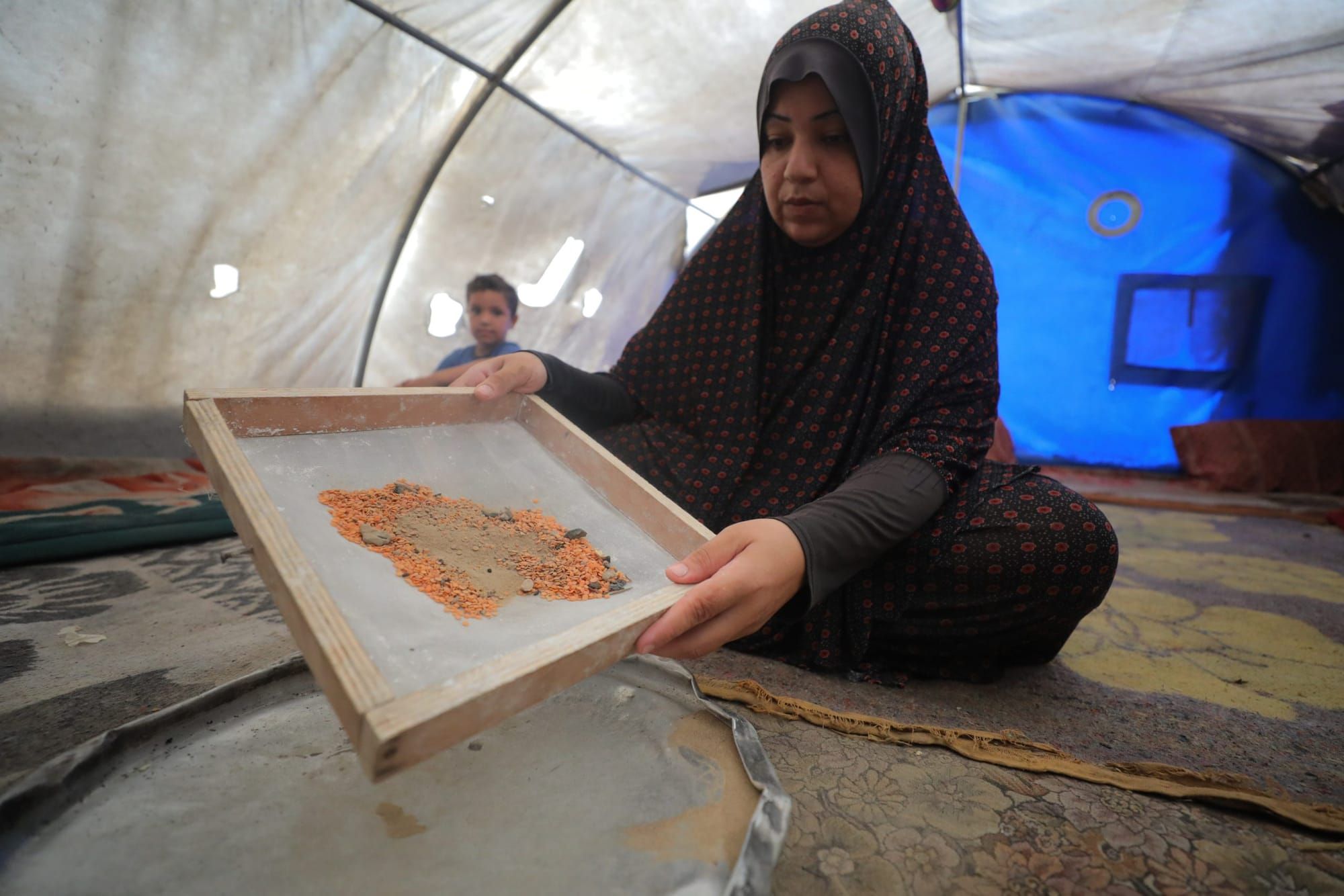
Looking for ways to stretch meager amounts of flour, families have invented new kinds of bread by mixing a small amount of flour with rice, lentils, or ground pasta. Some homes even mix flour with canned beans or peas.
“The bread is not really edible,” Abu Rukab said. “But we are forced to eat it even though it causes stomach pain—and by the next day, it may already be spoiled.”
Families have also become inventive when creating a new version of Palestinian duqqa, a combination of roasted spices, legumes, nuts, and seeds. Instead, they roast and grind together what they have access to: lentils, pasta, and bulgur. This alternative hardly resembles the original duqqa except in color. Despite its poor quality and lackluster flavor, the new duqqa is now a staple that families rely on, morning, noon, and night.
My mother was an innovator when she first roasted chickpeas and spices to make a coffee substitute. Now, many Gazans grind roasted chickpeas to prepare a hot drink. It conjures the memory of coffee, but it is nothing like it.
“It has none of the real coffee taste or aroma—just a hot brown drink,” my mother said.
Even during a genocide, life’s wheels keep turning. Each day, it seems a new food is invented. Chips, once made out of potatoes, are now made out of corn and eaten across Gaza. Stevia, a sugar substitute commonly used in the U.S., was a rarity in Gaza, but it is now used to sweeten chickpea “coffee.”
Asma Baraka, a mother raising a 3-year-old child during the genocide, is distressed by her inability to access even basic staples, such as milk and eggs. She’s taken to looking in some unusual places to find ingredients she wouldn’t otherwise purchase.
“When I saw an advertisement for powdered eggs on Facebook, I didn’t hesitate for a moment to order them,” Baraka said. “I know they won’t match the quality of real eggs or even their nutritional value, but I would be able to provide a meal for my child.”
Nutrition, of course, is a major concern. The inventive new foods Gazans are turning to during the famine may temporarily fill their bellies, but they are lacking in vitamins and essential nutrients. Over time, a lack of fresh water, fruits, and vegetables can cause serious health issues and can even be deadly. More than 300 people in Gaza have recently died of starvation; almost half are children. Countless others are treading water, eating and drinking barely enough to survive.
Givers and takers
The blockade and resulting famine have been enough to push our society to the brink of collapse, and as conditions worsen, the impacts go beyond the material.
There is a growing moral division in Gaza. On one side, there are poor people who are being crushed by unprecedented levels of inflation. On the other are the merchants who have a monopoly on the black market and are driving up the costs of basic goods that can only be afforded by the rich.
We are all confronting hunger, but our approaches are very different. There is pure creativity, and there is blatant exploitation. Perhaps it will surprise some of you to learn that the group who overwhelmingly chooses to face hunger with dignity, endurance, morals, sweat, and hard work is children. Many are no older than 12, and instead of being in school, they set out each day to secure bread—or rather the ingredients to make what we now call “bread.” Before the genocide, these innovative young people loved learning and focused all of their attention on education. Now their days are spent scouring the streets for food or cobbling together ingredients for some semblance of a meal.
On Facebook, journalist Sally Thabit wrote about one of these children. Maher Al-Habat now spends his days selling drinks to support his family, but his hunger for education remains. He has memorized the Qur’an.
“What saddens me most is that these children have lost their childhood and carried the burdens of their families too early,” Thabit wrote.
Abdullah Al-Roubi, an 11-year-old child in Gaza, told Prism about how dismayed he is by the prices of flour and other basic goods. Abdullah and his cousin buy flour from those who risked death at a GHF aid site. The boys have no choice but to pay the exorbitant price because the flour they purchase also helps them raise money for their families. The flour is used to make baked goods such as ghraybeh, shortbread cookies that they sell at the market. However, the money they make from sales on any given day is rarely enough to buy a meal for their families.
“I was one of the top students in school and I dreamed of becoming an engineer, but because of the war, we were forced to leave school and became preoccupied with supporting our families and putting food on the table,” Abdullah said.
Then, there are the takers, those who hoard aid, raise prices, and treat hunger as a business opportunity. For them, the siege isn’t just a tragedy but an opportunity to profit. Food that should have been free finds its way to private warehouses where it is priced far beyond what the majority of Gazans can afford. These individuals represent the darker face of the crisis, deepening our wounds and widening the divide among us.
Forced choice
Both the givers and the takers breathe the same air, live in the same neighborhoods, hear the same explosions, and walk through the same destroyed streets. However, the choices forced upon them drive them in opposite directions. This moral division is not just about personal choice, but the product of the extraordinary conditions imposed by the siege.
Amid the rot, there is also solidarity. Each day, families and community groups work to support those in need—even as their own needs go unmet.
Palestinians gather each day to discuss how they will obtain food during the genocide, which strikes at every foundation of society and forces people to make “choices” they would never otherwise make. This leads to shifts in values and behaviors, altering people’s personalities and priorities as we all fight for survival. And yet, amid the rot, there is also solidarity. Each day, families and community groups work to support those in need—even as their own needs go unmet.
Under occupation, life in Gaza has never been easy, yet we try to resist through whatever means available. Now, we must fight to live with dignity in the most undignified of conditions. Each day in Gaza is complex and multidimensional. While the siege has emptied the markets and exhausted families, we cannot let it break our spirits.
I do not believe it has.
From the rubble of homes and dark alleys, humanity emerges in the form of bread shared between Gazans, new recipes that make the most out of nothing at all, and in the way I’ve witnessed people deny themselves a meal so that their friend, family member, or neighbor can eat. But most of all, we resist through our undying love for Gaza and our belief that we will once again breathe life into this land.
But carrying this hope for the future comes at a cost.
Surviving under genocide is not the same as living life; it is merely a daily fight against disappearance. And while the people of Gaza have taken their respective sides—those who help/support and those who take/exploit—the truth is we should have never been forced to make such a choice in the first place.
Editorial Team:
Tina Vasquez, Lead Editor
Carolyn Copeland, Top Editor
Rashmee Kumar, Copy Editor
Author

Mohammed Al-Ta'ban is a Palestinian writer from Gaza who focuses his work on documenting the humanitarian situation in Gaza, away from traditional political narratives. He writes for Al Jazeera and th
Sign up for Prism newsletters.
Stay up to date with curated collection of our top stories.