Families left behind in Gaza: The silent pain of separation
As some Palestinians in Gaza are evacuated for medical treatment or education abroad, the families they leave behind struggle in their absence
Since the beginning of the genocide in Gaza and the accompanying siege, Israel has cut off all crossings in and out of the Strip. No one has been able to leave Gaza freely since Israel’s invasion and closure of the Rafah crossing in May 2024, the only gateway through which people could exit the territory.
However, thousands of people have been evacuated from Gaza through the Karem Abu Salem crossing for reasons such as pursuing education, receiving medical treatment, or holding dual citizenship. Many of them are fathers, mothers, and spouses who were forced to leave either alone or with one or two family members, while the rest remained trapped inside Gaza due to the strict Israeli restrictions and arbitrary border procedures. The inconsistent and restrictive policies have led to many families becoming separated when some family members receive a chance to escape, but others don’t.
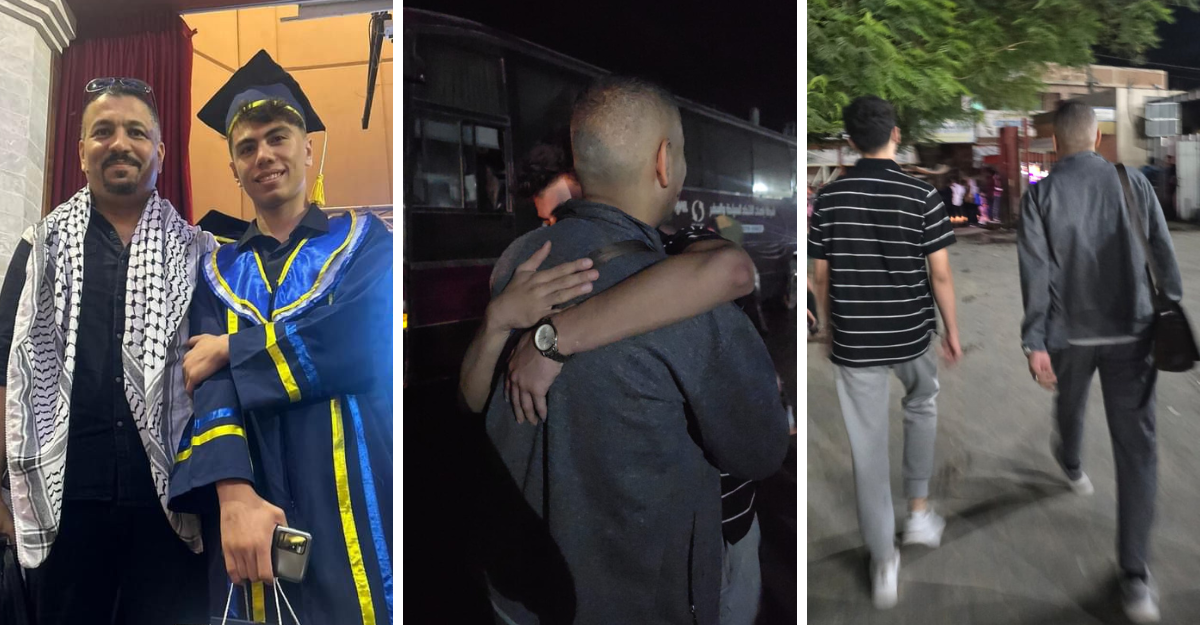
That is exactly what happened with my father, Dr. Mohammad Abushawish, who was evacuated from Gaza alone on Sept. 29.
My father’s story began in October 2023, when he was granted an opportunity to complete his postdoctoral studies through a scholarship in Italy. However, this dream was soon confronted by the eruption of a genocidal war on Gaza. Despite multiple calls from the Italian Embassy urging him to evacuate, he refused to leave, choosing instead to remain with us through the early months of devastation and displacement.
He believed that the genocide would soon come to an end and that he would then take us with him to Italy. However, that hope slowly faded with time. After more than 700 days, we reached the painful conviction that this suffering might last indefinitely.
Eventually, my father made the difficult choice to call the embassy again, asking if they could evacuate us safely. A few weeks later, on Friday morning, an embassy officer called back with the news: “You’ll be evacuated on Monday.” Before he could even ask, she added, “But unfortunately, alone.”
I was sitting beside him when he inquired in despair, “What about my family?” The response came quietly but firmly, “We can’t include your family in the evacuation list at this stage, just you. You have two hours to think about it.”
He completely refused at first, but as he always does, he gathered us to hear our thoughts. I was the one who strongly encouraged him to go, while my mother and siblings agreed, though not with the same insistence.
Back then, it felt like a once-in-a-lifetime chance, a rare glimmer of hope for our family. I promised him that I would take full responsibility and bear any consequences in his absence. For two long hours, we sat together, weighing the choice between our hearts and minds. And in the end, we decided to listen to reason rather than emotion.
He decided to leave with the hope that, once he arrived, he could reunite our family, rescue us from the overwhelming reality we are living in, and help us build a better future than the one we are destined to face here.
“I feel like time has stopped for me. I can’t move forward or even focus on my work or studies. All I think about is how to bring you to safety.”
Mohammad Abushawish, Ahmad’s father
From the moment he reached Italy, he did everything possible to bring us to safety. He visited asylum offices and parliamentary institutions, met with lawyers, and appealed to international humanitarian organizations. Yet, he was always met with the same response: “It’s too complicated to get your family out of Gaza.”
“I feel like time has stopped for me. I can’t move forward or even focus on my work or studies. All I think about is how to bring you to safety,” my father told me during one of our daily video calls on WhatsApp.
Yearning for parents
As the oldest son in my family, it hasn’t been easy for me either. Living without my father and being responsible for a family of seven at the age of 19 has been incredibly difficult, especially in a place where even the most basic necessities, such as water and food, are no longer guaranteed.
It’s not just about going to the market and buying what we need—it’s about searching for untorn banknotes to satisfy the seller, who charges three or four times the normal price for basic necessities. It’s about walking hundreds of meters every day to secure the minimum amount of clean water needed to wash, cook, and drink.
I breathe the suffering in every aspect of life without my father. At times, I feel like I can’t go on, but somehow I must because that is the only choice I have.
On Oct. 14, results for the Tawjihi secondary education certificate exam were announced in Gaza, a day that usually carries special excitement and emotion for high school students across the Strip. But this year was different. I, along with 30,000 other students, had remained stuck in the same phase for two years due to the deliberate disruption of education by the Israeli occupation.
Results day came after two years of struggle, studying under relentless bombing, through starvation, and in tents during displacement. It was supposed to be one of the most remarkable days of my life, as I achieved an excellent GPA of 96.6%. Yet, it passed without real joy, because the person who used to fill our home with celebration, buying candies and decorations, wasn’t here.
I wasn’t the only young student forced to celebrate without all their loved ones.
“When the SMS with my results arrived, I was shocked—I didn’t even know that today was the announcement day,” said Rasha Nattat, 19, who also took the Tawjihi exams in Gaza this year. “I couldn’t believe it at first because I had always imagined this moment under better circumstances, at least with my mother beside me.”
Nattat’s mother, Ahlam, was evacuated to Norway with Nattat’s two brothers, one of whom needed treatment for a severe injury. Nattat stayed behind in Gaza with her father and sister, Mona.
“I learned my result and sat alone, as if it wasn’t graduation day,” she said. “No one was waiting or excited to share this moment with me. My father is always busy, and my sister forgot. … No one could fill my mother’s place at that time.”
It wasn’t the first time Nattat needed her mother desperately.
“I extremely needed her after just one day of her evacuation when I suffered a severe shortness of breath. My hands and legs went completely numb. I couldn’t stand or move,” Nattat said. “I was alone, gasping for air, trembling in pain and fear. The only thought in my head was, ‘Where is my mother? Why isn’t she here to help me?’ It was the weakest moment of my life; I felt utterly helpless.”
Separation, for us, is more than just physical distance. For me, my father’s absence left me carrying a heavy load of duties and responsibilities that no one my age should ever have to bear, especially in a place where even survival is uncertain.
It also makes me wonder why we, as Gazans, have been destined to endure such an immense amount of pain. Over the past two years, we have experienced every form of suffering imaginable: starvation, ethnic cleansing, displacement, and separation. Sometimes it feels as if being Palestinian is a curse. But in some way, if I had the choice to be born again with any nationality, I would still choose to be Palestinian, because our struggle carries a meaning that no nation in this world has.
Editorial Team:
Sahar Fatima, Lead Editor
Carolyn Copeland, Top Editor
Rashmee Kumar, Copy Editor
Author
Ahmad Abushawish is a writer and an activist based in Gaza. His dream is to study and get a scholarship in a prestigious university abroad.
Sign up for Prism newsletters.
Stay up to date with curated collection of our top stories.