The hidden struggles of people with disabilities in Gaza
Israel’s genocide in Gaza has been cruel to disabled people, whose disabilities have been exacerbated by inadequate access to food, medicine, and support

Real journalists wrote and edited this (not AI)—independent, community-driven journalism survives because you back it. Donate to sustain Prism’s mission and the humans behind it.
Amna Fayyad lives in Gaza with a mobility disability caused by a hormonal disorder that resulted in short stature. Despite the challenges this has brought, the 39-year-old pursued education, maintained work, and cared for her family, relying heavily on the support of loved ones. Then the genocide struck, wiping out much of what she had built.
Displacement further hindered her access to care. Constant movement worsened Fayyad’s back pain and muscle weakness, while finding a safe place for herself and her family became nearly impossible. She lost access to treatment and many of her personal belongings during sudden evacuations, leaving her with a deep sense of ajz—an Arabic term describing helplessness or powerlessness—despite her responsibilities as the primary caregiver for elderly relatives, children, and a sister who is a martyr’s widow.
Support from outside was scarce. “Everyone focuses on securing basic needs: food, water, shelter. Even the simplest necessities were often unavailable, and I had to endure without help,” Fayyad recalled.
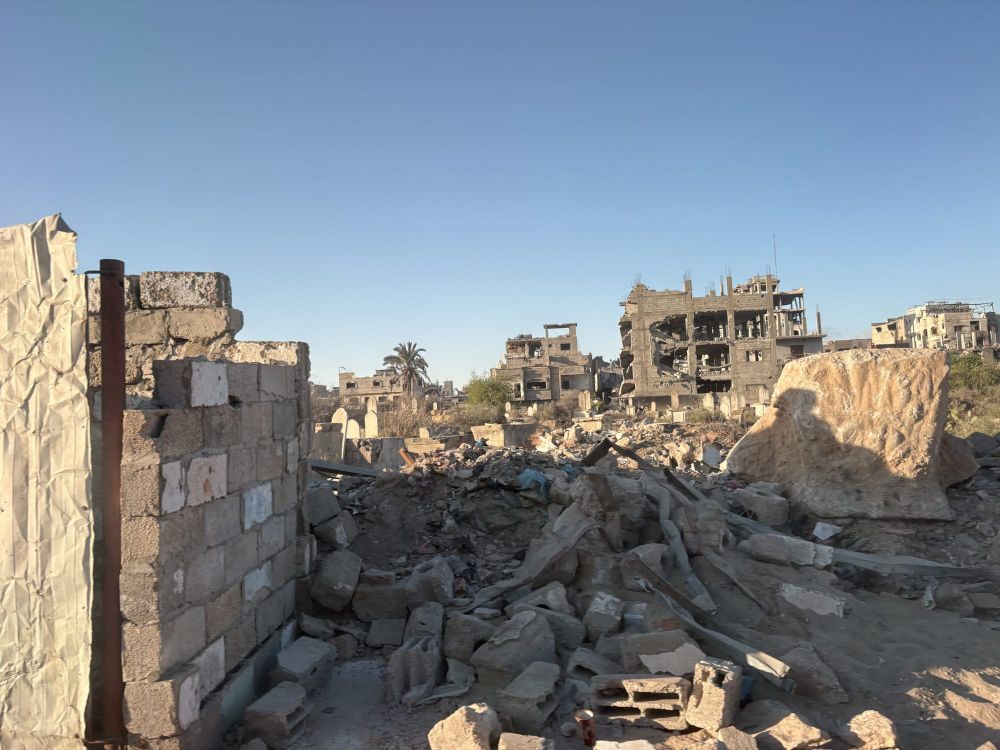
In Gaza, the lives of people with disabilities are marked by struggles that few can imagine. They face daily obstacles, despite the so-called ceasefire, that go beyond physical limitations: loss of mobility, access to medicines, safe shelter, and even basic dignity. Each bombardment, each displacement, strips away the fragile support they have, leaving them to navigate a world that often overlooks their existence. Meanwhile, Israel’s genocide has disabled even more Palestinians, including tens of thousands of amputees.
This is not just survival; it is a relentless fight to hold onto life, care for loved ones, and be seen as human in a place where humanity is under siege. The stories shared with Prism offer a glimpse of the depth of pain, courage, and the urgent need for the world to respond—not with pity, but with action.
Caretaking without support
Even before the genocide, Fayyad faced serious barriers to achieving success in school and at work, including discrimination and a lack of services. Securing a scholarship and completing exams demanded immense effort, and she relied on her faith and the support of her family in order to keep going.
But Israel’s genocide in Gaza, including periods of food scarcity and limited medical supplies, took a heavy toll. Fayyad’s malnutrition caused urinary infections, weakness, and other illnesses. Daily treatments, including for seizures, were often unavailable, and the stress of deprivation left Fayyad irritable and exhausted.
Some moments were especially traumatic. When her mother was injured during displacement, Fayyad feared losing her and bore the full weight of supporting her family, managing shelter, work, and medical care alone.
Daily life during displacement was grueling. Securing water, food, shelter, and internet access required that Fayyad navigate long lines and scarce supplies, causing exhaustion, headaches, and sunstroke. The physical demands of walking long distances, cooking over open fires, and sleeping in wet beds during winter were nearly unbearable.
“I want the world to see our suffering and help us,” she said.
Continuing advocacy through struggle
Amira Abu Salim, 28, has lived with severe visual impairment since 2021, when she lost most of her sight over the course of a week due to an untreated eye condition. Despite this sudden change in circumstances, she dedicated herself to education, advocacy, and empowerment projects, striving for independence while supporting others.
Her professional experience spans social, medical, and empowerment fields. She trained with several nonprofits organizations, including delivering workshops, and worked at the Islamic University of Gaza’s radio station, where assistive computer technology was adapted for her visual needs. Her work also includes contributing to projects with Our Children for the Deaf, where she engaged in activities such as baking sweets and pastries for the youth. Within the United Nations Women project, she served as a facilitator for peer-support workshops in camp settings, providing guidance to participants ages 18 to 25, both with and without disabilities. She also worked with Catholic Relief Services under the “Salalem: Prosperity and Advancement for Palestinian Women and Youth” program as a secretary in a hospital physical therapy department, and has trained disabled people in media literacy and storytelling.
Life changed dramatically after Oct. 7, 2023. Sudden displacement caused Abu Salim to lose most of her assistive devices—her cane, magnification tools, and medical glasses—as well as essential medications, leading to moments of ajz. Scarcity of water, food, and hygiene supplies, combined with malnutrition, intensified her migraines, back pain due to a spinal deformity, and vision problems.
“Between the darkness I see with my eyes and the pain that lives in my spine, I am still resisting as a mom … searching for treatment, for a job opportunity, and for a sense of dignity for myself and my daughter in this world,” Abu Salim told Prism.
Medical care became nearly impossible, she said. Essential medication, including daily eye drops, monthly multivitamins, and migraine treatments, was in short supply. Her eye pressure rose from stress, putting her vision at risk, and her spine now requires urgent surgery. Without it, she risks permanent loss of mobility and possible worsening of her vision. Painkillers were unavailable, making everyday tasks excruciating.
Displacement also made survival a constant struggle. Sleeping in one room without privacy or proper hygiene, cooking over open fires, walking through unsafe areas, and protecting her daughter from danger added relentless pressure.
Abu Salim epitomizes the neglect faced by disabled people in Gaza. Many lost assistive devices, medications, and homes, and humanitarian services rarely meet their needs. To raise awareness, she shares her own and others’ stories on Instagram, advocating for access to essential tools, medicines, and resources.
Her urgent appeal to the world is clear: a stable monthly income, access to health care, and institutions that provide basic needs could protect her mobility, vision, and her daughter’s well-being. She urges governments, medical institutions, humanitarian organizations, and activists to stand with the disabled in Gaza.
Despite extreme hardship, Abu Salim continues her advocacy. “We are strong,” she said, “but we need your support to survive and thrive.”
Challenges as a student
Since childhood, Imad Qudaih, 22, has lived with complete visual impairment. His eyesight began deteriorating at age 7 due to nearsightedness, which eventually led to retinal detachment in his right eye and later affected the left. Despite multiple surgeries abroad, his vision could not be restored.
Before the current crisis, he led an active life, balancing studies, work, and social engagement with the support of family and friends. He developed skills and creativity that allowed him to contribute meaningfully to society, particularly in initiatives supporting people with disabilities.
Now a university student, Qudaih studies translation at the Islamic University of Gaza, nearing his fourth year, while also working as a freelance journalist for BBC News. Poetry remains a passion of his, though he has paused writing due to the emotional impact of the ongoing violence.
In our dictionary, there is nothing impossible. In the face of the challenges, we will never give up. Our only option is to survive.
Imad Qudaih, university student and freelance journalist
“In our dictionary, there is nothing impossible,” Qudaih said. “In the face of the challenges, we will never give up. Our only option is to survive.”
Repeated bombardment and displacement have made daily life exceptionally difficult. Access to mobility aids like white canes is limited, and destroyed infrastructure forces reliance on others for navigation. The inability to move independently often leaves him with a profound sense of ajz that can make simple tasks exhausting.
Educational opportunities are also limited. Without access to a laptop, Braille materials, or writing devices, Qudaih relies on a phone and online audiobooks, making note-taking and use of advanced software challenging.
Periods of food scarcity and lack of medical supplies have further affected his health. Malnutrition, rising food prices, and the scarcity of medications—including essential eye drops—have created additional obstacles. He has been using a temporary protective lens in his eye in place of the original.
Displacement has brought with it many traumatic experiences, including evacuations in severe weather and bombardments that have caused injuries. Limited access to basic services compounded the distress.
Qudaih emphasized the urgent need for global attention and support. He called for recognition of the suffering of people with disabilities in Gaza and advocates for humanitarian aid, life, and dignity. Despite the ongoing crisis, he remains determined to pursue an education, rebuild his community, and express his creativity.
“Stand with Gaza, stand for freedom, stand for humanity,” he urged.
Editorial Team:
Sahar Fatima, Lead Editor
Carolyn Copeland, Top Editor
Rashmee Kumar, Copy Editor
Author
Taqwa Ahmed Al-Wawi is a 19-year-old Palestinian writer, poet, and editor from Gaza, studying English literature at the Islamic University of Gaza. You can find more of her work at: https://tqwaportfo
Sign up for Prism newsletters.
Stay up to date with curated collection of our top stories.