Holding onto childhood: How a Palestinian NGO is helping Gaza’s children play and heal
While volunteering with Nafs for Empowerment, I saw how group activities can restore hope and offer psychological support to children facing impossible circumstances during the genocide
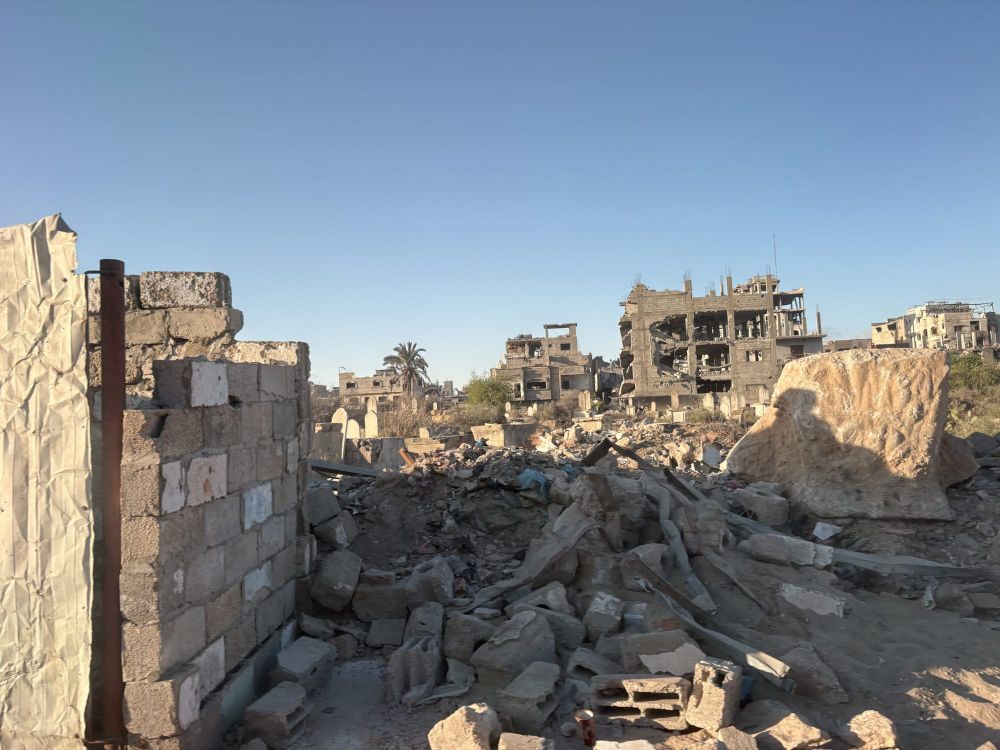
In Gaza, where children make up nearly half of the population, Israel’s genocide has destroyed schools and playgrounds. Yet amid the destruction, grassroots groups and local NGOs are creating hope by establishing small spaces where children can play and heal.
These initiatives organize recreational activities, art and storytelling workshops, and psychosocial support sessions that offer children a chance to smile and learn, even for a short time.
From my experience volunteering with Nafs for Empowerment, a Palestinian humanitarian organization established in 2010 to promote psychological support and community resilience, I have witnessed firsthand how its programs restore a sense of safety and hope to children. The organization aims to provide sustainable mental health support, train local volunteers, and strengthen family and community networks so that even in times of crisis, children and their families feel less isolated and more empowered to cope with trauma.
These initiatives include two main types of sessions. The first is a series of recreational sessions designed for kindergarten and primary school children. In these sessions, we use simple and colorful tools such as hoops, cones, small colored balls, and skipping ropes. We also play cheerful children’s songs to create an exciting atmosphere that encourages the kids to participate and immerse themselves in play.
Through these activities, children engage in fun and healthy competitions, laugh, and build connections with one another—moments that help them release stress and restore some sense of normal childhood.
During one of our team’s activities at a kindergarten, a small boy caught our attention. He sat quietly, withdrawn, his face far too sad for his tender age. His name was Jawad, a 4-year-old who had lost his father in the war. Though he is young, Jawad felt his father’s absence at every moment.
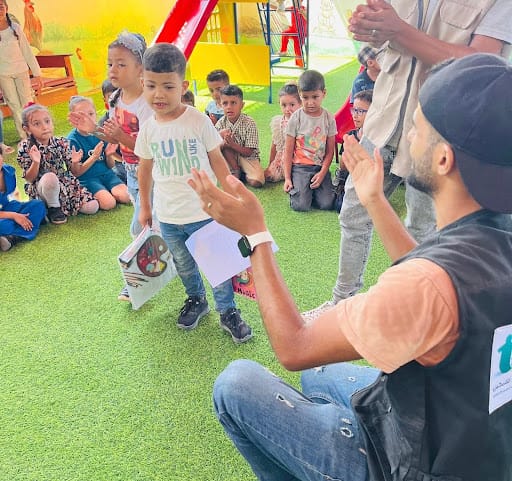
That day, Aug. 20, happened to be his birthday. Instead of playing and laughing like the other children, Jawad stayed apart, silent, his eyes filled with tears. We approached him gently, spoke to him with warmth, and asked his teachers about him. When we learned his story, we couldn’t simply carry on as usual. We decided to turn that day into a beautiful memory for him.
We paused our activity and created a small celebration just for Jawad. Our team embraced him with the tenderness of the father he had lost. The kindergarten’s staff gave him a gift, and we began to sing the birthday song. Gradually, his face changed: First a shy smile appeared, then a clear laugh, and soon his classmates joined in singing “Happy birthday, Jawad!”
His grandfather was there too and nearly wept with joy seeing his grandson smile again after so many days of pain. These moments were full of warmth and humanity—not just a birthday party, but a genuine act of healing.
Jawad left that day with a lighter spirit and a true smile. We left with a renewed sense that our mission in life can begin with a child’s smile.
For us, it was a success story. We managed to bring happiness to a wounded heart and to show that psychological support is not only a concept but an action. Jawad left that day with a lighter spirit and a true smile. We left with a renewed sense that our mission in life can begin with a child’s smile.
Then there was Elias. Elias is a 5-year-old child who has spent nearly half of his young life amid genocide and deprivation. He has been denied the rights every child in the world deserves: education, safety, peace, and love.
Elias also lives with cerebral palsy, which prevents him from standing and affects his mental abilities. Yet despite his illness and the hardships he has endured, Elias joined our activities with love and enthusiasm from start to finish.
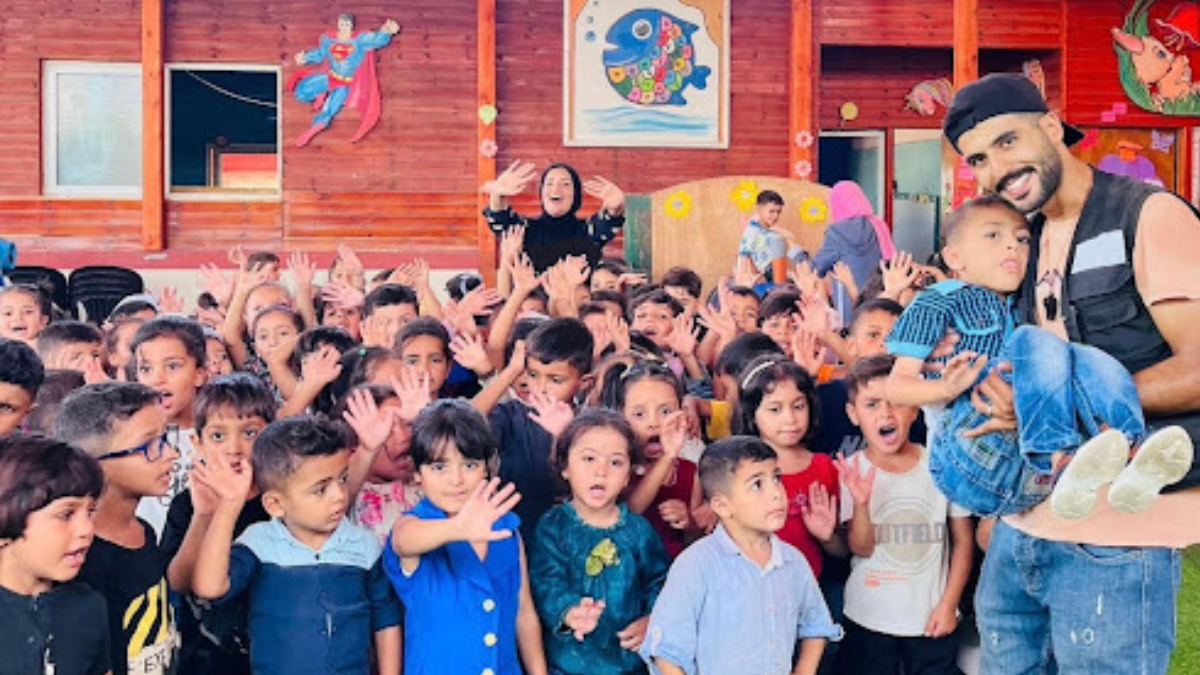
At the end of the day, he asked us to carry him so he could appear in the photo like his classmates. My colleague Hussien lifted him, and he waved to the camera with the same joy and pride as the other children. His courage and smile inspired everyone present with perseverance, patience, acceptance, and love.
The second type of sessions we provide are psychosocial support sessions designed for adolescent girls and sometimes also for the children’s parents. These sessions focus on emotional release and healing. We create safe spaces where participants can speak openly about their experiences, the happy and the painful. This process helps them feel heard and experience solidarity.
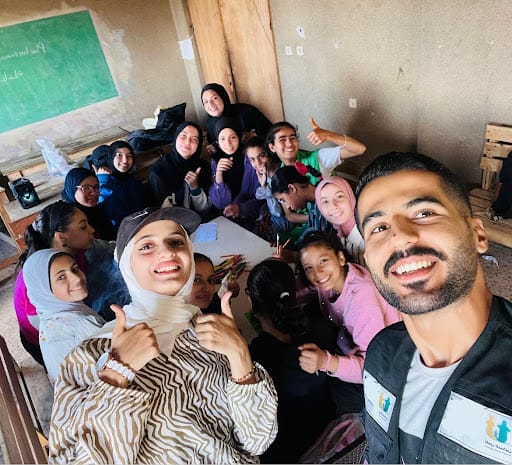
One of the most powerful sessions is called “My Favorite Day and My Least Favorite Day,” in which participants draw or describe these two days in their lives. The stories we hear are often heartbreaking. Many girls link both their favorite and least favorite days to the same person or place.
I remember one girl who described her favorite day as a joyful gathering at her extended family home during a holiday. It was filled with delicious food that her aunties made. Her least favorite day, however, was the day her entire family was brutally killed, and the home she loved was destroyed. She drew her home, a missile landing from the sky, and several bodies on the ground, surrounded by blood.
Another girl drew her favorite day as one when she could eat meat, fruit, chips, and chocolates that she used to eat daily before the war. She drew her father entering the house with a packet full of the snacks she and her siblings love. But her least favorite days were when she lost her father and with him, all the meanings of happiness.
Someone else drew a huge cup of tea with three pieces of sugar. She explained that her last happiest moment was drinking this cup of sweet tea after months of hunger and lack of food, when they didn’t even have bread to eat, not just sugar for their tea.
This session is always painful because it reveals how simple and beautiful life once was, just family and togetherness in a safe home. It shows how much we have lost and how many small hearts are broken. Yet it also highlights the innocence of these children and young people, and the importance of giving them a space to speak and be heard.
We always end our psychosocial support sessions with “The Ideal City.” In this session, we give the participants a very large sheet of paper or a board and ask them to draw what they imagine their ideal city to be. This activity excites them; they work together on one big drawing, adding all the places and details they love.
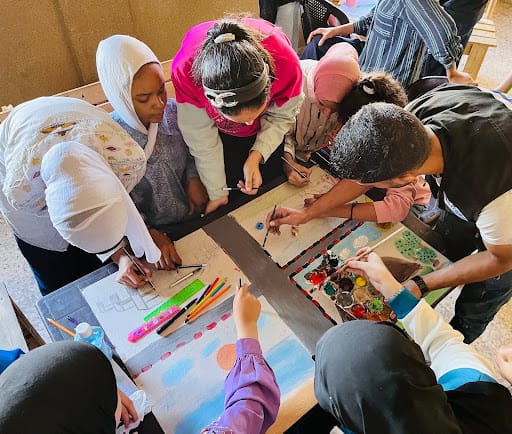
In our most recent session, the children drew a sea without the tents for displaced people that they are used to seeing along the shore. In front of it, they sketched people swimming and children playing happily in the sand, building castles. In another corner, they drew a large, intact house with no shattered windows, no burned floors, no signs of shelling—just a normal house with a beautiful garden in front.
They also drew their favorite restaurant, the one they used to visit but is now destroyed, with tables full of the foods they used to order and their families gathered around them. In addition to the houses, the sea, and the restaurants, the girls also drew a picture of their school. They illustrated the morning assembly where they would line up at 6 a.m., listen to the school broadcast that used to be delivered by a student standing in front of them, and then sing the national anthem before entering their classrooms. They drew their classroom with the desks, students in their uniforms, the teacher at the front, and the blackboard filled with questions. Through this drawing, they expressed their deep sadness and longing to return to school.
And because they were designing a whole city, they added streets and an avenue with many cars driving, without the donkey carts or the humiliating transportation that we use nowadays—just normal roads like any other city.
Everything the students drew represented the Gaza of the past or any normal, safe city. Even though they have lost so much, expressing their hopes through this drawing gave them a sense of optimism and a feeling that one day Gaza might be rebuilt, and their simple, happy life could return.
At the end of our sessions in each area, we always see how attached the children have become to each other and how sad they are when our activities finish.
To reach as many children as possible, we move from one area of Gaza to another, despite all the challenges we face in finding safe places to hold our activities. Many areas are simply too dangerous to reach. Transportation is also hard to find, and we have to walk long distances to reach our destinations. Sometimes there is also a shortage of resources and materials.
Yet, despite these obstacles, we try to keep going for the sake of the children, their smiles, and the incredible energy we feel with them. Our recreational and psychosocial sessions not only bring happiness and relief to the children, but also to us as facilitators. We find ourselves laughing, playing, and even feeling like children again alongside them.
My volunteering with Nafs for Empowerment has been one of the few beautiful things I have experienced during the assault on Gaza. The work gave me purpose and a way to do something meaningful and make a difference, instead of sitting at home, waiting for my fate. Being with the children reminded me that even in the darkest times, we can choose to create light.
Editorial Team:
Sahar Fatima, Lead Editor
Carolyn Copeland, Top Editor
Rashmee Kumar, Copy Editor
Author
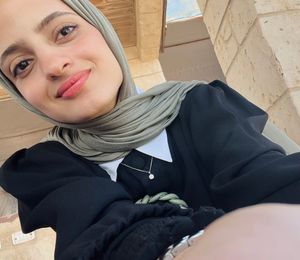
Esraa Abo Qamar is a writer and English Literature student from Gaza.
Sign up for Prism newsletters.
Stay up to date with curated collection of our top stories.