Gaza’s ‘mediator’ isn’t neutral, and Palestinians are paying the price
Many Palestinians now see negotiations not as a path to peace, but as a tool of genocide

For months now, time has passed before the eyes of Palestinians in Gaza as if it were meaningless. The days are long, exhausting, filled with crying, hunger, and waiting, yet the months go by quickly, void of any memory worth keeping. No one knows when July ended or when August began. While the days drag on more slowly than decades, they are packed with events and feel endless. A single day is full of children crying from hunger, of desperate searches for a bite of food, and of routine mourning for a friend or classmate who was killed, whether while seeking aid at the deadly “American aid centers” or by a joint American-Israeli missile.
It is mourning laced with a strange sense of relief. Today, it’s common to hear: “Those who survived have died, and those who died have survived.” Survived the repetition of days, the hunger, and above all, the false hope. Beneath this rubble of time, people were waiting for news of a ceasefire, just one moment to breathe.
Despite the bombing, despite the hunger, there is a deeper agony: the agony of the soul. A student watches his future collapse before his eyes. A wounded person waits for the Israeli authorities to allow him to leave Gaza to complete his treatment to avoid death—after they were the ones who shot or bombed him—or a father wants to feed his children. These false hopes are tied to something that hurts more than the body: a blend of heartbreak, rage, and oppression. These emotions paint the faces of people walking through Gaza’s destroyed markets. Faces hard to describe but easily understood. Bulging, lifeless eyes—the closest description would be “dead eyes”—and deep, dark circles beneath them.
How could it be otherwise when the gangs controlling the aid supplies follow the news closely, and the moment negotiations fail, they raise the prices? The average civilian in Gaza is left in shock: Are they crying because the negotiations failed? From hunger? Or because they fell into the trap of hope once again?
On July 25, after U.S. Special Envoy to the Middle East, Steve Witkoff, publicly rejected the latest ceasefire proposal, he said that Hamas’ response to the latest proposal showed “a lack of desire.” The impact was more devastating than that of missiles. Not because anyone truly believed the U.S. was a neutral party—how can the mediator also be the main sponsor and funder of genocide?—but because his rejection marked the collapse of what little faith remained among many in Gaza that anyone was trying to end this catastrophe.
For weeks, Israeli and American media had broadcast positive messages. The U.S. president appeared daily, saying: “We have some good news on Gaza.” Many clung to this fragile thread, hoping it would be a lifeline.
Hungry? Displaced? Afraid? Living in tents? In hell? It was said all of this would end soon; we just needed to wait for the truce.
But that thread was cut. This wasn’t just another failed round of negotiations. News started circulating about a possible occupation and annexation of Gaza. Famine hit harder. Israel spread news in the media that it would act decisively in Gaza, particularly in the central refugee camps, under the pretext that hostages were there. The same excuse it used to destroy both southern and northern Gaza completely. And now Israel is laying the groundwork to repeat the same scene in the central camps, despite knowing that all the captives could be retrieved if it simply agreed to the ceasefire it walked away from under U.S. sponsorship.
That moment marked the end of the last diplomatic mask. Witkoff’s statements were nothing but the official voice of Israel, dripping with moral outrage at the Palestinian delegation, while entirely ignoring Israel’s monthslong aggression. This bias is not just immoral. It’s dangerous. It legitimizes the blockade and justifies the collective punishment of over 2 million civilians.
Dalia is a mother of four and the wife of a Palestinian prisoner. She was displaced from her home in Tel al-Sultan, north of Rafah, and now lives in a tent in Khan Younis. Prism is not using Dalia’s last name for her husband’s safety.
“I used to tell my children: Just a few days left, and we’ll go back to our house in Tel al-Sultan. Your father will come out of prison. I’ll cook the best food for all of you. I’ll buy four chickens, one for each of you. We’ll eat nothing but meat and chicken, instead of these cruel days,” Dalia said.
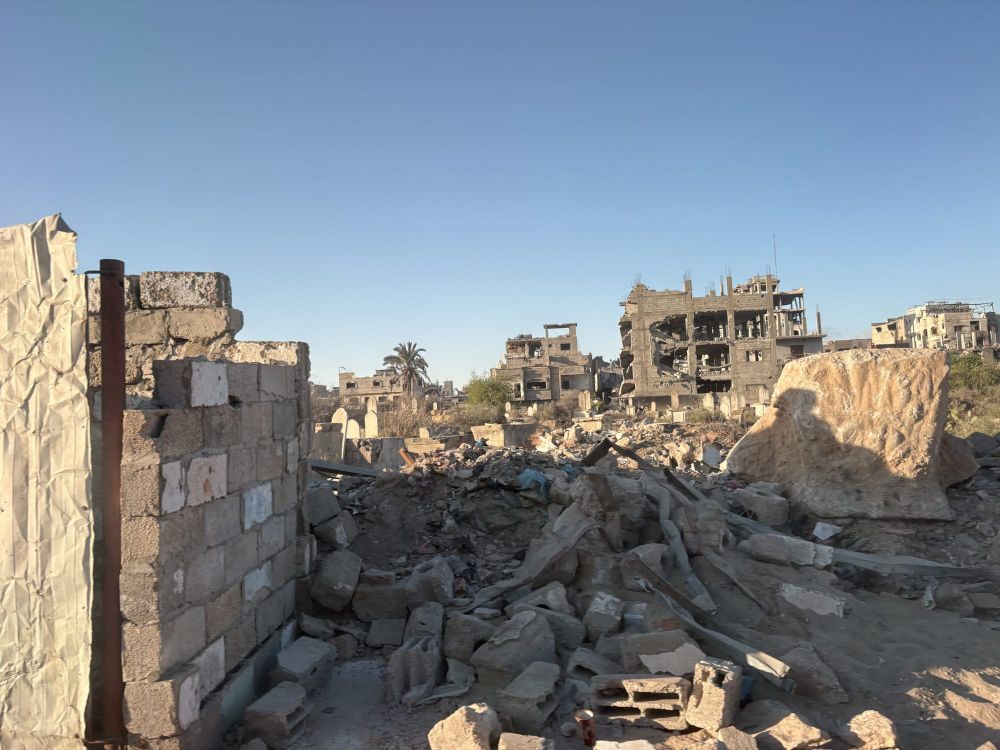
When asked about the state of her house in Tel al-Sultan, now a devastated disaster zone flattened off the map, Dalia told Prism: “During the last truce, the house had no walls, and the upper floors were at risk of collapse, but we had no other choice. Despite everything, I can’t bear the tent. I recently saw aerial photos of the area, and I fear it’s been bombed. I just pray they didn’t bulldoze it, so I can at least retrieve something from the rubble.”
Yasser Al-Hour, a displaced student from Al-Nuseirat Camp who lost two of his three siblings when an Israeli bombing on their neighbor’s home killed them, was waiting for the truce to travel with his brother for urgent treatment following a head injury.
“Since [Oct. 7], Israel has destroyed Gaza’s hospitals, starved its people, and shattered its infrastructure. Patients die in hospitals from a lack of medicine and essential equipment. My brother needs urgent care outside Gaza,” Al-Hour said. “They kept telling us, ‘Wait.’ But for how long?”
America kills the victim and walks in their funeral, just like the old Palestinian saying.
Yasser Al-Hour, a student from Al-Nuseirat camp
“We hoped the truce would open the crossing. Then suddenly, Witkoff comes out, announces America’s withdrawal, and the collapse of the talks,” he continued. “America kills the victim and walks in their funeral, just like the old Palestinian saying. They call for negotiations and send weapons. Do they think this purifies their crimes in Gaza?”
Many Palestinians now see negotiations not as a path to peace, but as a tool of war. Dragging out the talks and creating headlines about a “pending truce” is nothing but psychological warfare. The illusion of progress is used to crush hope and commit massacres under the cover of diplomacy. While the world was reading about peace, Gaza’s children were dying of hunger.
Mohammed Al-Taaban is a high school student from Nuseirat who told Prism that he hasn’t been able to take his final exams because of the genocide.
“When I saw the ceasefire news, I started studying at dawn, hoping I could get my certificate and continue my university education. For a moment, I imagined myself studying engineering at a university outside Gaza, waiting to return one day. But everything collapsed suddenly. Without a truce, I can’t take the exams, and I’m stuck at zero again,” Al-Taaban said.
People in Gaza no longer ask, “When will the war end?” but “What disaster is next?”
After the last negotiations failed, the crossings were closed, and Israeli Prime Minister Benjamin Netanyahu’s security cabinet approved the plans for Operation Gideon’s Chariots on May 5. People are terrified of what’s coming. They mourn the lost years of their lives and their children’s lives. Even those who managed to escape Gaza feel helpless, like Rawan Qatawi, who left for Turkey with her sister Rola in 2024 to continue their education.
“I told my mother that the first thing I’d do after the ceasefire was buy her a ticket so she and my little sister Yafa could visit us—me and Rola—in Turkey. Now, whenever I read about the war and famine, I feel completely paralyzed,” Qatawi said. “Can you imagine your family in such a situation? It’s enough to destroy you from the inside.”
By portraying Gaza’s suffering as a result of Palestinian choices, the U.S. absolves Israel of its crimes. By ignoring the reality of the blockade as a form of collective punishment, it blames the victims themselves. In doing so, it paves the way for the next massacre, the next famine, the next failed truce.
There was no ceasefire coming.
And now, Gaza knows that, through its continuing agony.
Editorial Team:
Lara Witt, Lead Editor
Carolyn Copeland, Top Editor
Rashmee Kumar, Copy Editor
Author
Hassan Abo Qamar is a Palestinian writer, programmer, and entrepreneur from Gaza, focusing on documenting the humanitarian situation in Gaza, as distinct from traditional political narratives. He writ
Sign up for Prism newsletters.
Stay up to date with curated collection of our top stories.