Starved, crushed, forgotten: The reality behind ‘lifesaving’ aid drops to Gaza
Israel allowed some aid to be airdropped into Gaza last month. But the move amounted to little more than another theatrical attempt to manipulate global opinion
Imagine living in a tattered tent in Gaza: your entire world reduced to 5 square meters of stitched plastic and scrap wood, the only shelter left after surviving repeated displacements. Around you, the world collapses: airstrikes overhead, starvation underfoot, fear in every breath. You sleep not knowing if you’ll wake—whether an Israeli airstrike or a sniper’s bullet will come for you next.
And then, in the cruelest twist of fate, death arrives, not with a missile, but with a box marked as aid.
This is exactly what happened in Gaza in October 2024, in Mawasi, Khan Younis, when 3-year-old Sami Mahmoud Ayyad was killed in his family’s tent by an air-dropped box of aid after its parachute malfunctioned.
But despite the proven risks and minimal reward of this method of distributing food aid, Israel turned to it again last month, allowing some countries to airdrop aid into Gaza as international outrage intensified surrounding Israel’s induced starvation of the strip.
This came as the Israeli occupation on July 27 announced a “humanitarian ceasefire,” a 10-hour window allowing aid into specific areas of Gaza, including Al-Mawasi (a coastal zone designated as a so-called safe area), central Deir al-Balah, and parts of Gaza City.
Together, however, these orders amounted to little more than another theatrical attempt to manipulate global opinion. While Israeli officials spoke publicly of flooding Gaza with aid, the reality on the ground told a different story, with very little food actually reaching starving people.
On the first day of the pause, only 160 trucks were allowed in, and less than 8% arrived at their destinations at the headquarters of NGOs. The rest were either looted by armed groups or seized by desperate, starving civilians. These numbers are not enough to meet the needs of even the smallest neighborhood in Gaza; the United Nations says Gaza needs at least 500 to 600 trucks daily.
“The air-dropped aid is not only insufficient to meet people’s needs, it also causes us harm,” said Iktimal Abu Mattar, a volunteer at a U.N.-affiliated refugee center. “Most of the time, the aid is seized by armed groups or desperate individuals, leaving the majority of Gaza’s population without access to it. What we truly need is the entry of at least a thousand trucks every day to begin addressing the starvation crisis.”
The impossible idea of “safe” aid from the sky
The Ayyad family was sitting down for breakfast on Oct. 20, 2024, having scraped together enough to eat in the midst of genocide. It was a rare moment of stillness, a moment to feel human again.
That moment was shattered in an instant when an aid box plummeted from the sky. It tore through their tent, their last refuge, and crushed Sami, killing him on the spot. His small body was buried beneath a crate wrapped in the language of compassion, but turned into another mode of killing.
This was not a tragic accident. It was the brutal result of a system that pretends to offer help, while refusing to address the real root of suffering: the blockade and the denial of safe humanitarian access.
I remember the first time I saw the massive military transport aircraft heading toward northern Gaza, which was starving at the time in early 2024. I was overwhelmed with joy, believing these planes had finally broken the aid blockade imposed by the Israeli occupation.
But that joy didn’t last long.
Soon, horrifying scenes began circulating on social media: videos of people stampeding, pushing, and scrambling desperately to grab anything that could ease their hunger. It was a moment of deep humiliation for a people known for their generosity, kindness, and dignity.
Gaza was not only starved of food but stripped of its humanity.
This method feels humiliating. It’s not dignified for people to be forced to run and fight for aid falling from the sky.
Yasmin Dolah, palestinian living in Al Nuseirat camp
“This method feels humiliating. It’s not dignified for people to be forced to run and fight for aid falling from the sky,” said Yasmin Dolah, a 27-year-old displaced woman living in Al Nuseirat camp with her mother, four sisters, and her 7-year-old brother. “The right way should be through organized and respectable aid distribution centers where people can receive help with dignity from the World Food Kitchen or UNRWA or whatever.”
The idea of air-dropped aid itself is deeply flawed. Instead of facilitating aid through well-established modes or building new systems that genuinely help, the current air-drop model creates tragedies, like the story of Sami, whose only fault was not having a ceiling to protect him. Dozens more have been injured or killed, either directly by the drops or by the chaos they spark.
In March 2024, for instance, a humanitarian aid package whose parachute failed to deploy fell onto a crowd of people waiting for food near the Al-Shati refugee camp, killing five Palestinians, including two boys, and injuring 11.
“When the aid is dropped from the air, it’s unpredictable where it will land,” Dolah said.
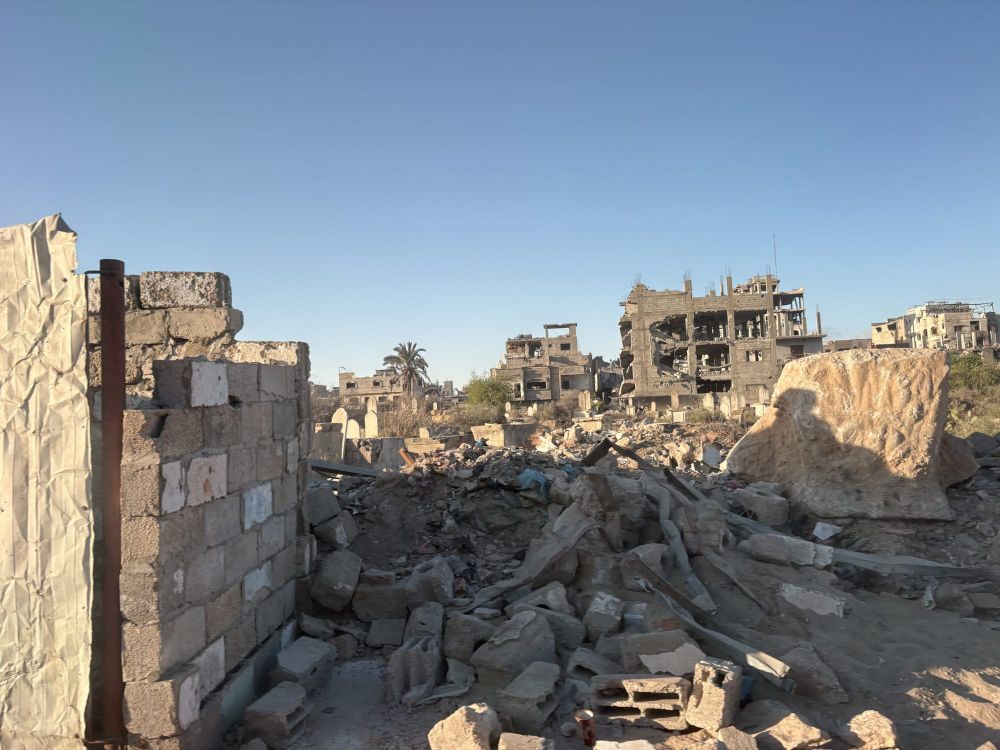
Gaza is densely populated, particularly as Israel has destroyed 92% of residential buildings since the start of the genocide, which makes airdrops especially at danger of falling onto people. The majority of people in Gaza are now living in tattered tents, and when an aid parcel falls on one, it can cause severe injury or even death to those inside.
Some packages were dropped into the Mediterranean Sea off the coast of Gaza, posing another danger; on March 26, 2024, 12 people drowned in a desperate attempt to get aid parcels from the water.
Distribution points
As if that weren’t enough, we now also live with the fear of the Gaza Humanitarian Foundation’s (GHF) “American aid points,” better known among locals as death traps.
Since the GHF started operating in the enclave in late May, at least 875 people have been killed trying to get food, according to the U.N., which said on Tuesday that 674 of those deaths had occurred “in the vicinity of GHF sites.” These systems that pretend to help us are, in fact, contributing to our death. They’re dressed in the language of “humanitarian aid” but function as death traps for the desperate.
“The way American aid is distributed, alongside the air-dropped supplies, makes me feel like we’re living in a jungle—only the strongest can benefit from it,” said Dolah. “As girls living alone, we cannot go out to get the aid. It’s not safe, and the chaos around the drops makes it even more difficult.”
My cousin Adel Al Khatib, only 21 years old, took a bullet to the chest at the Morag drop point—not because he was holding a weapon, but because he was holding onto hope that he could return with food for his displaced family living in a tent in Al-Mawasi.
Israel’s war on truth and humanity
Israel used the propaganda of air aid to convince the world that it is allowing humanitarian assistance into Gaza. At the same time, it systematically prevents journalists from documenting the massive destruction on the ground. As the BBC’s Jeremy Bowen put it: “Israelis don’t want us to film outside the window at the devastation in Gaza. … Communities in the north of Gaza are flat—there’s nothing left.”
Israel wants to blind the world’s eyes. It wants to hide its brutal actions—actions that have dragged us back a thousand years. What’s unfolding here is not just war; it’s erasure.
Why doesn’t the world simply open the crossings and allow the U.N. and NGOs to distribute aid safely, fairly, and with dignity? Palestinians are not asking for luxury. We are simply asking: Please, don’t kill us.
“Like the majority of Gazans, we have no real chance of getting the food from these aid methods,” Dolah told me.
And that is exactly what the psychopathic Israeli occupation wants: Palestinians trapped in a cycle of chaos, stripped of dignity, torn apart by desperation, and left to suffer the ugliest kinds of death. Whether by hunger, stampedes, drowning in the sea, or being crushed under falling aid crates, it doesn’t matter to them—as long as we are dying.
The strategy is clear: Break the spirit of the people, pit them against each other, and make mere survival feel like a curse. In this brutal system, every meal becomes a battlefield, and every act of aid becomes another weapon of war.
Editorial Team:
Sahar Fatima, Lead Editor
Lara Witt, Top Editor
Kyubin Kim, Copy Editor
Author
Ahmad Abushawish is a writer and an activist based in Gaza. His dream is to study and get a scholarship in a prestigious university abroad.
Sign up for Prism newsletters.
Stay up to date with curated collection of our top stories.