Filed Under:
The true cost of a houseplant: Florida nursery workers demand binding labor protections
“Planting Justice” campaign launched with a report highlighting labor and human rights conditions in the $50 billion U.S. houseplant industry

Alexandra Martinez
Real journalists wrote and edited this (not AI). Independent, community-driven journalism survives because you back it. Donate to sustain Prism’s mission and the humans behind it.
Real journalists wrote and edited this (not AI)—independent, community-driven journalism survives because you back it. Donate to sustain Prism’s mission and the humans behind it.
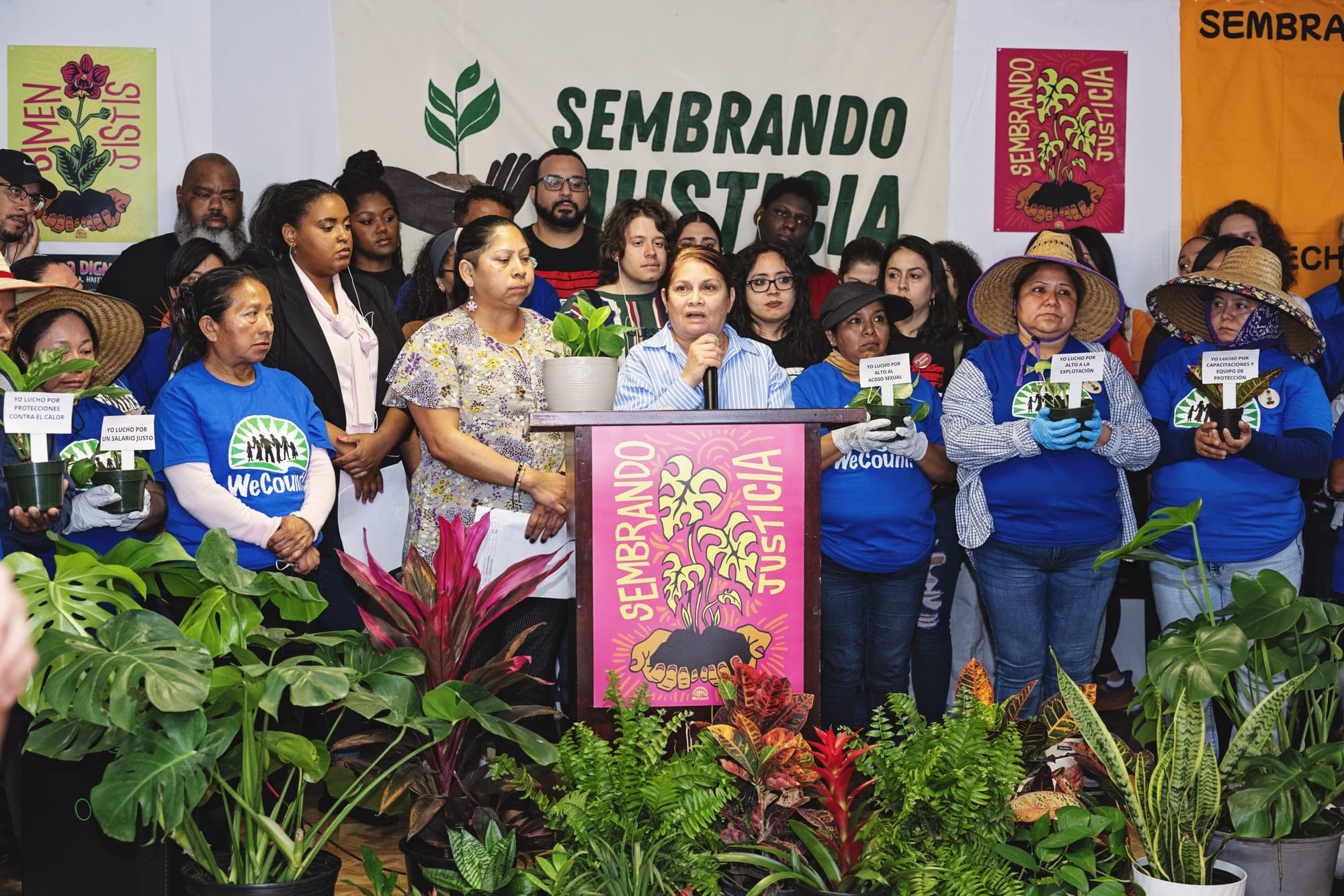
On Valentine’s Day, as shoppers across the country filled carts with orchids, anthuriums, and heart-shaped succulents, plant nursery workers gathered in South Florida with a different message: The houseplant boom that began during the pandemic is thriving on their labor and, too often, on their exploitation.
A Feb. 14 press conference outside the headquarters of immigrant workers’ rights group WeCount! in Homestead marked the official launch of Planting Justice, a new campaign led by WeCount! in partnership with public policy and movement organizations Dēmos and Partners for Dignity & Rights. The effort coincides with WeCount!’s release of a national report, “The Human Cost of Houseplants,” which documents labor and human rights conditions in the $50 billion U.S. houseplant industry.
“People across the country buy flowers, but also plants to give to their loved ones,” Oscar Londoño, WeCount!’s co-executive director, said in an interview ahead of the Valentine’s Day launch. “We wanted to begin to raise awareness … of what are the labor conditions behind these beautiful plants and flowers we buy on holidays.”
The national epicenter of an invisible workforce
According to the report, Florida produces nearly 70% of the country’s indoor foliage, with Miami-Dade County serving as the top producing region. Londoño said more than 1,500 nurseries operate in the county alone, employing thousands of workers who grow and cultivate plants sold through major retailers, garden centers, and grocery chains nationwide.
But while the industry has flourished, workers say labor standards have not kept pace.
At the press conference, a WeCount! worker leader named Ana described nursery work as essential yet largely invisible to consumers. Behind the plants that symbolize happiness and connection to nature, she said, is a hidden reality of extreme heat, unsafe conditions, and low wages.
“All of this was so that we, as workers, would be recognized as human beings and not as production machines,” Nelly Rodriguez, a Coalition of Immokalee Workers organizer, said.
The newly released report draws from a 2024 survey of more than 300 plant nursery workers in Miami-Dade County. Among its findings is that 86% of surveyed workers reported suffering an accident, injury, or illness on the job.
Workers described laboring through extreme heat without consistent access to shade, rest, or clean drinking water. The report details routine exposure to pesticides and ergonomic strain from repetitive tasks and heavy lifting.
In remarks at the press conference, Candace Milner, senior policy analyst at Dēmos, said the data reveals “an industry structured around exploitation.”
The report found average hourly earnings of $12.57, far below the $22.43 living wage estimate for South Florida cited in the study. More than 20% of surveyed workers reported never or only sometimes receiving the minimum wage, and over a third said they experienced late pay. Many workers reported lacking paid sick days, overtime pay, and written contracts, conditions that push them to work while injured or ill.
“Part of what’s going wrong in the industry is that there’s so many laws already on the books,” Londoño said, referencing wage laws, Occupational Safety and Health Administration standards, and civil rights protections. “But for many of the nursery workers … these rights aren’t made real in the nursery because of lack of enforcement, because of lack of monitoring, and because of a strong culture of retaliation that makes it difficult for workers to speak up.”
According to the survey, 1 in 6 workers reported facing intimidation for organizing, and more than half said they had witnessed retaliation against co-workers who exercised their rights.
A worker-driven solution
Planting Justice is modeled on a framework known as worker-driven social responsibility, which links enforceable workplace standards to corporate purchasing power.
Under the proposed program, major retailers would sign binding agreements committing to a worker-developed code of conduct across their supply chains. The code would be backed by independent monitoring, year-round audits, and market consequences, including suspension of contracts for growers found out of compliance.
Participating retailers would also pay a premium on certified plants, which would be used to raise wages and offset growers’ compliance costs, Londoño said.
“Worker-driven social responsibility is able to eradicate labor abuses in a way that government agencies have not been able to,” Londoño told Prism.
Majelia Ampadu, representing Partners for Dignity & Rights, told the crowd at the press conference that similar models have transformed labor conditions in other industries. She cited the Fair Food Program, developed by the Coalition of Immokalee Workers, which now includes 14 major produce buyers and has dramatically reduced labor abuses in Florida’s tomato fields. She also referenced the Milk with Dignity program in Vermont and international garment safety accords as evidence that binding agreements can succeed where voluntary corporate pledges have failed.
“The Planting Justice program is based on this model that has transformed workplaces from Florida to Bangladesh and from Vermont to Pakistan,” Ampadu said.
WeCount! is urging major retailers, including Home Depot, Lowe’s, IKEA, Costco, Whole Foods, Walmart, and Trader Joe’s, to join the program.
Some of those companies already participate in worker-driven programs in other sectors of their supply chains, Londoño noted. The campaign’s goal is to expand that accountability to houseplants.
“With immense purchasing power comes responsibility,” Milner said. “Retailers must respect the workers who grow the products they sell.”
WeCount! is also calling on large nursery growers to sign on independently, even without retailer participation, positioning themselves as industry leaders in ethical production.
Beyond legislation
The campaign emerges in a political climate in which workers say public enforcement has weakened. Agricultural workers were excluded from key labor protections in the 1930s, and many of those exclusions remain, Londoño said. At the state level, Florida has increasingly preempted local labor protections, including efforts to pass local heat standards.
“Plant nursery workers cannot depend on legislation to eradicate these labor abuses,” Londoño said. “We’ve seen at the federal level, the dismantling of federal enforcement agencies and the scaling back of labor regulations. It’s in the context of these legal and policy failures that we believe looking to the private sector for solutions is the path forward.”
For workers gathered in Homestead, the campaign is about recognition as much as reform.
“Throughout history, farmworkers have led powerful movements and achieved great victories,” Ana said. “Today we are here … to write a new chapter.”
As Americans bring new plants into their homes, WeCount! hopes they will begin asking who grew them and under what conditions.
“We can all be part of the solution,” Ana said. “Si se puede.”
Editorial Team:
Sahar Fatima, Lead Editor
Lara Witt, Top Editor
Stephanie Harris, Copy Editor