FIU workers were directed to secretly deliver equipment to ‘Alligator Alcatraz’
Public records and a Florida International University employee confirm that at least one operations trailer was transported to the immigration detention facility in the Everglades
This is a developing story. Prism will continue to follow it closely. If you are an FIU employee, student, or community member with information about this incident or related issues, you can reach out to us confidentially at prismreports@proton.me.
Florida International University (FIU) employees were instructed to covertly deliver university-owned equipment on June 27 to the new Immigration and Customs Enforcement (ICE) facility near Big Cypress National Preserve known as “Alligator Alcatraz,” according to an FIU staff member who spoke to Prism on the condition of anonymity out of fear of retaliation. Emails Prism obtained through a public records request from FIU confirm the equipment delivery.
FIU’s collaboration with ICE comes after Miami New Times reported last month that the detention facility was built in part by a company whose president is chair of FIU’s Board of Trustees. It also comes as U.S. District Judge Kathleen Williams on Aug. 7 ordered a two-week temporary halt to construction at the site, ruling that no additional industrial lighting, paving, filling, excavating, fencing, or new structures could be added. The order, part of an ongoing preliminary injunction hearing, does not limit immigration enforcement activities at the center, which already holds hundreds of detainees and can detain up to 3,000 people in temporary tent structures. Placing FIU’s equipment delivery in the context of this active legal battle over the facility’s rapid expansion underscores the heightened public scrutiny and legal uncertainty now surrounding “Alligator Alcatraz.”
The June 27 FIU operation has raised questions about the university’s transparency, its involvement with the facility, and the safety of its largely immigrant workforce.
The source told Prism that the transfer was carried out under the direction of the university’s senior operations leadership. Workers were told to transport at least one emergency operations trailer—equipment typically used to establish a mobile command center, according to the source—to the ICE site. Official decals were removed from university vehicles and drivers were dispatched in plainclothes, the source said.
Public records obtained by Prism confirm that senior leadership of FIU’s Operations and Safety coordinated directly with the Florida Division of Emergency Management (FDEM) to deliver specialized university equipment to the detention site. FDEM is the lead agency overseeing construction and operations of the facility. Construction was accelerated under Gov. Ron DeSantis’s 2023 emergency declaration on immigration.
In a June 26 email, Ian Guidicelli, bureau chief of response and State Emergency Response Team at FDEM, wrote to Javier Marques, FIU’s senior vice president for Operations and Safety and chief of staff, requesting that one of FIU’s “FORTs Units”—a mobile operations and coordination center—be sent to “our site to assist with onsite Coordination.” FORTs did not immediately respond to a request for comment.
Marques replied, “I am looping in our team and will plan to have it delivered tomorrow morning. Let me know if you should need anything further.”
Associate Vice President of FIU’s Operations and Safety Thomas Hartley then responded to Marques, “Thank you…we’ll plan accordingly.”
The emails copied two FDEM officials, Incident Commander Frankie Lumm and Incident Management Team Logistics Chief Dwayne Crouch, as points of contact for the delivery.
Neither FIU nor FDEM responded to Prism’s requests for comment about the arrangement, including whether the delivery was authorized under a formal agreement and why it was not disclosed publicly. Guidicelli, Marques, Hartley, Lumm, and Crouch did not respond to Prism’s requests for comment.
The FIU employee told Prism that some employees expressed discomfort to Hartley with the task of transporting equipment to the ICE facility. The source added that employees are fearful of retaliation and that the university’s broader relationship with federal immigration authorities has become a growing point of concern. Operations and safety workers declined to respond to requests for comment out of fear of retaliation.
According to the source, the official university decals were removed from university pickup trucks, and workers were instructed to change out of their FIU uniforms into plainclothes and transport one large “Emergency Operations Center” trailer to the facility. The source said they could not find a record of the operation in internal university systems, and in response to a public records request FIU responded that there are no records responsive to the request.
The source said that drivers were told by operations leadership that the trailer would help ICE set up an emergency operations room.
FIU operations leadership did not respond to Prism’s requests for comment on the university’s relationship with ICE and this specific incident.
Meanwhile, the employee said that FIU operations leadership has provided no transparency about whether the equipment delivery is part of a broader arrangement with ICE under the controversial 287(g) agreement, which allows local entities to enforce federal immigration law.
The university’s decision to enroll in the federal 287(g) immigration enforcement program, a partnership with ICE, has already sparked outrage among students, faculty, and community advocates at a campus where more than 60% of students identify as Latinx and many are immigrants or international students.
FIU applied for the 287(g) Task Force Model late last year. Under this arrangement, campus police officers could be granted immigration enforcement powers, including the ability to identify and detain undocumented individuals during routine policing. Advocates worry that the program creates a climate of fear on campus, discourages victims or witnesses from reporting crimes, and disproportionately targets immigrant communities.
The secrecy around the delivery takes on heightened significance given the deeper connections between FIU’s governance and the ICE facility itself. Carlos Duart, chair of FIU’s Board of Trustees, is president of CDR Companies, formerly CDR Maguire, a consulting and emergency management firm that helped build the massive 39-square-mile detention complex in the Everglades.
Duart confirmed his company’s involvement with the facility to The Associated Press but declined to specify exactly what services were provided, per a nondisclosure agreement. CDR Health, run by Duart’s wife, Tina Vidal-Duart, was also awarded $17.5 million for its role in the facility, according to the Florida Accountability and Contract Tracking System (FACTS). Duart and CDR Health did not respond to a request for comment.
According to public company materials reviewed by Prism, CDR Companies and its affiliates have overseen billions in engineering, disaster recovery, and emergency health contracts. Public records and prior reporting show that CDR has been a major recipient of Florida state contracts under Gov. Ron DeSantis. Duart and Vidal-Duart (who DeSantis appointed to the board of Florida Atlantic University) have also donated nearly $2 million to the Republican Party of Florida and DeSantis-aligned political committees.
As state watchdogs began examining these relationships and the public costs of the detention complex, Florida’s contract transparency system abruptly went dark. On July 16, state Rep. Anna Eskamani reported that dozens of contracts related to “Alligator Alcatraz”—totaling more than $200 million—had vanished from FACTS.
Just one day prior, Eskamani said she had accessed purchase orders, including a $79 million deal with Critical Response Strategies, the company managing the facility. She also identified missing contracts for companies such as Gothams LLC, Garner Environmental Services, SLSCO LTD, Lemoine CDR Logistics LLC, CDR Health Care Inc., and Meridian Rapid Defense Group. The contracts have since returned to the website.
“These contracts total more than $200 million in taxpayer spending, and they are public records,” Eskamani wrote on X. “If the state has nothing to hide and is proud of this excessive spending, then we should expect ALL contracts to be shared online and made available immediately.”
Under Florida law, the Department of Financial Services (DFS) is required to maintain and publicly share details of all state contracts within 30 days of execution. Yet a DFS spokesperson said in an email to Prism that “the addition of information … is managed by each respective agency associated with the contract.”
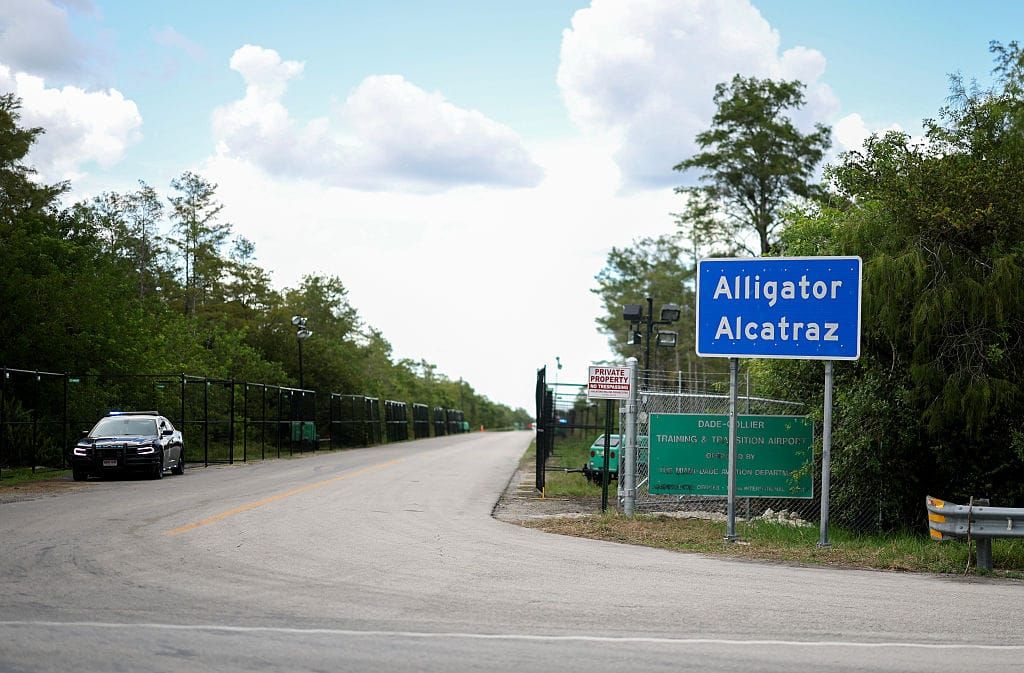
The “Alligator Alcatraz” facility was rapidly built over the past two months at a lightly used, single-runway training airport, under the direction of FDEM. Court filings show that the state operates the site without a direct Intergovernmental Support Agreement with ICE, instead relying on a patchwork of amended 287(g) agreements with nine state agencies, including Florida Department of Corrections, Florida Fish and Wildlife Conservation Commission, and Florida Department of Law Enforcement, to claim authority to detain immigrants on ICE’s behalf. Notably, according to court filings, there is no such agreement with FDEM.
The FIU employee told Prism that morale remains shaken. Some workers have quietly begun exploring other employment options, the source said, concerned not just about the university’s indirect involvement with ICE, but also about possible reprisals from FIU leadership if more details become public.
Editorial Team:
Sahar Fatima, Lead Editor
Lara Witt, Top Editor
Rashmee Kumar, Copy Editor
Author

Alexandra is a Cuban-American writer based in Miami, with an interest in immigration, the economy, gender justice, and the environment. Her work has appeared in CNN, Vice, and Catapult Magazine, among
Sign up for Prism newsletters.
Stay up to date with curated collection of our top stories.