Even as agriculture in Gaza is on the ‘verge of extinction,’ farmers vow to plant their lands
From the U.S. to Gaza, Palestinians are leading efforts to sustain culture and ancestral connection through farming
As Israel’s genocide of Palestinians in Gaza continues without abatement, Yasmin Abu Hamad misses her family, her food, and her connection to home.
Abu Hamad, who is Palestinian and was raised in the diaspora in Bahrain, was in her final year at the University of California, Berkeley, at the time of Al Aqsa Flood, Hamas’ uprising on Oct. 7, 2023. Through participation in Berkeley’s Gill Tract Community Farm, Abu Hamad built relationships with friends, classmates, and members of the broader community. Because Abu Hamad has no family stateside, she knew early on she would have to grow connections—literally.
In the spring of 2024, Abu Hamad and other student farmers at Gill Tract planted seeds of Palestinian molokhia, a nutritious leafy green that’s similar to spinach. Not all of the seeds matured, and not all of the vegetables survived to harvest, but many took root, reminding Abu Hamad who and where she came from.
“When I tried the leaves, I’m like, this is home,” Abu Hamad said. With so many different varietals of molokhia growing around the world, she said it’s “really special to eat something that reminds you of your family and your land.”
The molokhia tasted like her childhood because the seeds planted at Gill Tract arrived in Berkeley by way of Palestine, thanks to seed keeper Anan Jardali Zahr and the Pennsylvania farm Truelove Seeds, which provides urban and rural farmers with seeds that sustain culture and ancestral connection.
“The plants make me super emotional,” Abu Hamad said. “I sit and pray in front of them. I cry with them.”
Members of Abu Hamad’s extended family are now invested in the progress of the seeds. Aunts, uncles, and cousins text her to ask how the molokhia are coming along. The seeds have also taken on new meaning. Abu Hamad’s reverence for the seeds isn’t just about their significance to history; it’s also about their potential.
“To plant a seed is to believe in the future,” Abu Hamad said, paraphrasing seed keeper Vivian Sansour. In other words, sowing seeds isn’t just about what you can harvest in your own lifetime, but about making sure generations not yet born have something to harvest. There’s at least one other varietal of molokhia being grown in the U.S. from Palestine, which Abu Hamad said will help ensure the species’ genetic diversity—something that cannot be “taken away by bombs or any occupation.”
Replanting the land
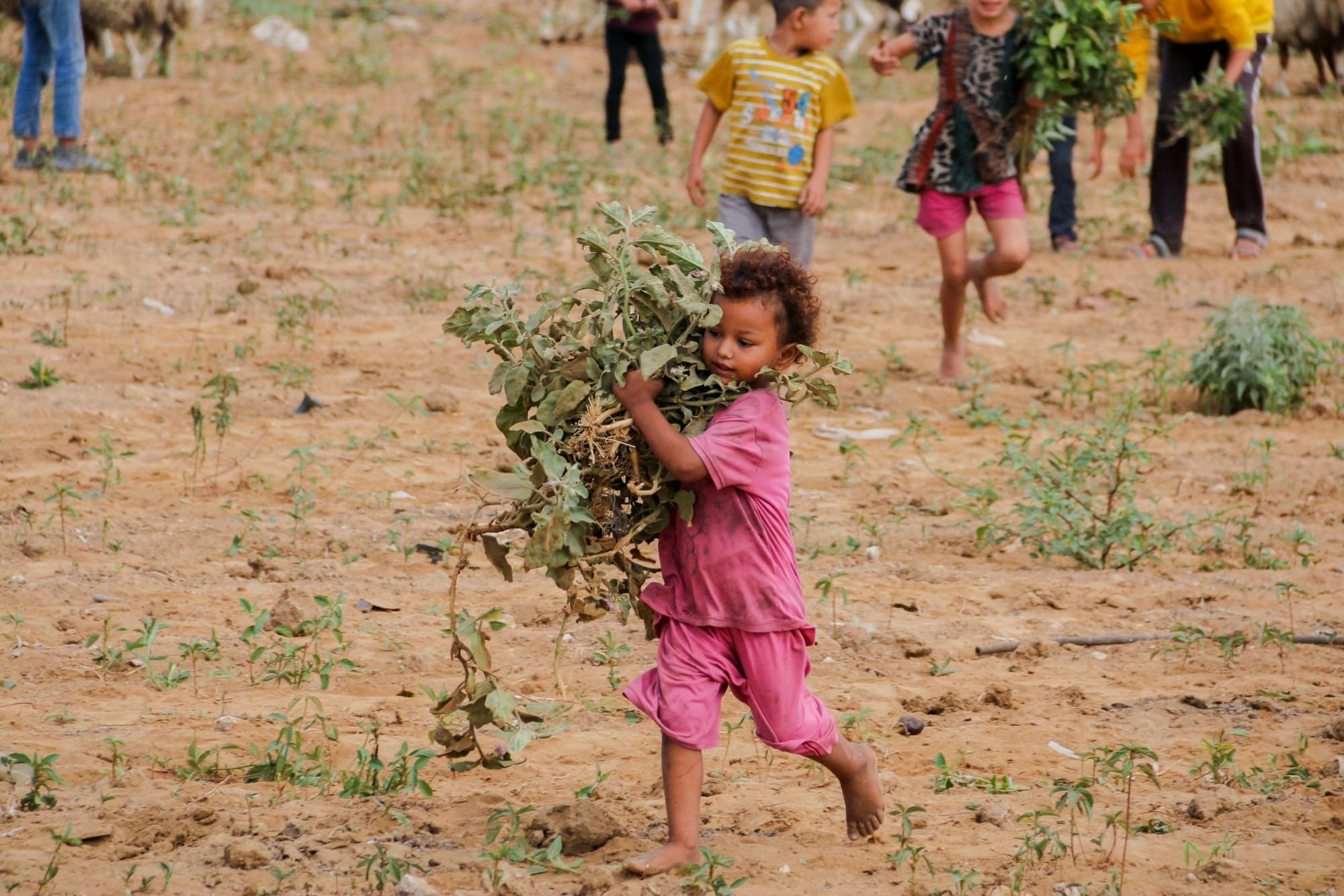
Gazan farmers are also building toward a future beyond occupation—liberated from the daily injustices of energy shortages, water rationing, and dependency on foreign agencies for food.
In a way, the seeds helped sow a different kind of direct connection between Gill Tract Farm and farmers in Palestine. Throughout June and July, the Pennsylvania seed farm Truelove ran a fundraiser: All of the proceeds from molokhia and kusa seed sales were donated to a campaign to support Gazan farmers and revive their farmland. Truelove ultimately raised $1,765.44.
The campaign was organized by the Arab Group for the Protection of Nature (APN), which stewards natural resources and supports farmers in Arab countries. Over the past 20 years, the organization has planted upward of 2.9 million fruit-bearing trees, constructed nearly 100 water wells, and provided farmers with seeds and chickens to restore the functionality of their farms.
Beyond the war crimes of regularly targeting and killing civilians, the Israeli apartheid government routinely attacks farming infrastructure to make it even more challenging for Palestinians to survive. For instance, during the years of the second Intifada starting in 2000 and lasting until 2012, Israel killed three million olive trees. The plant is not only a symbol of Palestinian life but literally holds it together, providing necessary income, food, and legal claims to land tenure.
Typically, the Arab Group for the Protection of Nature waits until the end of an Israeli military onslaught before attempting to repair farmland in Gaza. That was the case in 2008, 2012, 2014, and 2021, which saw the indiscriminate killing of thousands of Palestinians across the densely populated strip that’s just 25 miles long. These previous battles between an occupied people and the occupying regime ended within a few days or weeks. But the most recent war on Gaza continues, and there’s little indication when it will cease. More than a year into the genocide, Israel’s biggest backer, the U.S., will not commit to an arms embargo.
Last winter, APN began receiving calls from farmers who wanted support replanting their land, repairing greenhouses, and regaining access to seed. On March 30, also known as Palestinian Land Day, the organization launched Revive Gaza Farmland, a campaign aimed at helping farmers accomplish these goals.
In the months since, the nonprofit has helped 270 farmers rehabilitate 600 dunams, a unit of measurement equal to a quarter of an acre. APN has also helped plant nearly 400,000 seedlings of eggplant, tomatoes, cucumbers, zucchini, and cauliflower. In later phases of the campaign, the organization plans to offer resources to repair greenhouses, rehabilitate the region’s fishing sector, and offer beehives, said Mariam Jaajaa, executive director of APN.
No one in Gaza has access to enough food or water, and without immediate and drastic intervention, there is a risk of widespread starvation. But even when factoring in the germination and growth time of a seedling, it’s still the fastest and most secure way to provide fresh food, according to the executive director.
“There is no political will by development organizations” to push for the entrance of food, water, and support to repair the strangled agricultural sector, JaaJaa said. The World Food Program and United Nations agencies “haven’t pushed for the entrance of one seed; haven’t revived one water well,” she added.
Rather, organizations have limited their aid work to distributing grains, canned food, and water bottles. This allows Gazans to feed themselves but doesn’t address the underlying desire and need to be self-sufficient, to grow food, and to determine one’s own relationship with and reclaim the land.
Farming is an original practice of Palestinian culture. Olive trees remain in families for generations. For centuries, Palestine was known for its sweet oranges, high-quality olive oil, and creamy dates. And agriculture remains central to Palestinian life. Farmers, even as they are being hunted, want to return to their land and grow food for their people. It might confound a Western audience, how, even in the face of death, there is desire to live. It’s not odd; it’s self-evident. As Jaajaa intoned: What other choice is there?
“[Planting] is the only means of food and existence,” Jaajaa said. “If they don’t cultivate with their food, they die. There is no other option but to keep on resisting in this way.”
Colonial imports of food as a commodity
For nearly eight decades since the state of Israel was created through a United Nations decree in 1948, land has been central to the Palestinian struggle for liberation—and it has been central to the occupation’s goal of subjugation and, now more explicitly, annihilation. Without land, you cannot grow food. Without land, you cannot grow an empire. In Palestine, these two aims stand diametrically opposed to each other. Palestinians want to live, grow food, and eat from the land. Israel wants the land.
For just as long as Israel has existed, it has attempted to change the relationship Palestinian farmers have with the land—either through outright displacement or by imposing foreign agriculture practices upon them that weaken local economies and degrade the culture built in relationship to the land.
Lina Ismail, a co-founder of the Palestinian Agro Ecological Society, said colonial imports of monoculture farming, harmful pesticides, and non-Native seeds turn food into a commodity, where historically food was only that—food.
Even as Israel continues its assault on Gaza, bombing schools, killing journalists, and beginning yet another ground invasion in the north, the Palestinian will—not just to survive but to live—is strong. The method and the means is agroecology, a nonextractive farming that prioritizes land health and a farmer’s relationship to the land, Ismail explained to Prism. Agroecology isn’t about how much humans can take from the land to earn a profit but about a mutually reciprocal relationship. Belonging to the land rather than its colonial opposite—land as property—threatens Israel’s imperial aims of capturing all of historic Palestine.
“[Agroecology] goes totally in parallel with striving to emancipate ourselves from colonization; our sovereign right to our resources and freedom and liberation for the whole country,” Ismail said.
And despite “the situation in Gaza getting worse by the hour,” Ismail said that she’s in contact with farmers who are ready to return to their land and “determined to go about and farm.”
That determination persists despite agricultural production in Gaza being on the “verge of extinction” due to infrastructural challenges, Ismail said. Compounding challenges related to soil health, now decimated by the use of chemical weapons, compaction from tanks and other heavy machinery, among other pollutants, also dictate what farmers are able to do on their land, she said.
“Nothing like war seems to have a negative impact on soil,” said Giacomo Certini and Riccardo Scalenghe, professors in the Department of Agriculture at the University of Palermo who have studied negative impacts on soil health.
Israel has dropped three times the number of bombs on Gaza that were dropped on Hiroshima during World War II. Pollutants such as heavy metals, polycyclic aromatic hydrocarbons, and dioxins can remain in soil for decades, Certini and Scalenghe told Prism in an email. Radionuclides, which are present in many munitions and missiles that contain depleted uranium, can remain radioactive in the soil for hundreds or thousands of years.
And the longer weapons stay in the soil, the greater the threat there is that any food grown will contain those chemicals. For example, 50 years after the Vietnam War, leafy vegetables in seven wards surrounding the two most severe chemical hotspots still contain significant quantities of the toxins, the researchers said. To make matters worse, the biome of the soil, made healthy from centuries of interactions between bacteria, microbes, and mycelia networks, may be irredeemably lost, they said.
“There are methods for decontaminating soil, on-site and off-site,” the two wrote to Prism, “but these are often very expensive and, as such, impracticable in many cases without international cooperation.”
But without that international cooperation, Gaza’s people may starve. Israel continues to blame the lack of humanitarian aid making its way into the region on Hamas, a now reflexive excuse the occupation uses for any blame it does not want to shoulder. Following the recent U.S. demand that Israel has 30 days to address the humanitarian crisis in Gaza or else risk its military support, Linda Thomas-Greenfield, the U.N. representative for the U.S., said “Food and supplies must be surged into Gaza, immediately.”
Author

ray levy uyeda is a staff reporter at Prism, focusing on environmental and climate justice.
Sign up for Prism newsletters.
Stay up to date with curated collection of our top stories.