Never eat the candy on your pillow: Honor your elders
The elderly are forgotten in prison, but some of us behind the fence do what we can to make them feel seen and heard

Dear Reader,
Who cares for the old people in your life? In prison, most elderly people have only themselves to depend on. The prison medical department has no time for caregiving, and there are no old folks homes behind the fence. People in prison grow old and they die, stripped of the dignity and care we all want for the elders in our lives.
When you become old and frail in prison, you are forgotten. Rarely do family members come by or send cards. And those children you once doted on and provided for? Chances are you won’t receive any compassion from them either.
I’ve written before about Sandman, an elderly man also incarcerated at the Northpoint Training Center here in Kentucky. Sandman first entered prison as a teenager, and he is now a senior citizen living behind bars. No one knows better than Sandman how cruel incarceration is to the elderly. But in our own ways, those of us inside do what we can to honor our elders.
“What do you see when you stare off into space like that, old man?”
“I reckon it’s my future,” Sandman said.
Sandman and I stood side-by-side outside the dorm, in the small bullpen that overlooks the green pasture filled with cows and a freedom we could only observe through double rows of 10-foot-tall chain-link fences and razor wire.
“How so?” I asked.
Sandman started with one of his speeches about how birds fly, insects buzz, and we all long for the things we can’t have. Some people look at the sky and see limitless potential, he explained. Others only see empty space. I wondered what any of this had to do with my question, but I’d spoken to Sandman enough over the years to just go with the flow.
“You smell that?” he asked, interrupting his own speech.
The field was full of cows, which meant the air reeked of manure. I stared at the brown cows and the spotted ones, the calf and its mother. The hawks with seven-foot wingspans gliding overhead.
“What else do you smell? And if you say ‘shit,’ I’ll never let you hear the end of it,” Sandman said.
All I could smell was the obvious. Rather than saying that, I closed my eyes and breathed in.
“Rain,” Sandman said. “It’ll be here soon. I didn’t need these old bones of mine to ache like they do to tell me that either. The clouds, the air, the smell of it all is a sure enough sign for me.”
Did I smell rain coming? I did not. As I said, the cows were having themselves one hell of a field day.
“Could be rain, or maybe it’s just the lake,” I said.
Sandman was the one to tell me about the local waterways near the prison, the way the Dix River feeds into Herrington Lake beyond the horizon of the prison. According to Sandman, on the right day and with the proper gust of wind, you could smell the brininess of the fish and nearby barbecues. He swore that if you listened closely enough, you could hear motorboats and laughter.
“The lake,” Sandman said wistfully. “It’s been more years than you’ve been alive since I sat on the lake. And even longer since I held a fishing pole or threaded a worm onto a hook.”
Sandman’s dad used to take him fishing every summer, back when grocery stores didn’t have a frozen food section stocked with fish fillets and fish sticks. If Sandman wanted to eat fish, he had to catch it himself—and his dad made easy work of it. The two of them caught bucketfuls of bluegill, he told me.
“I’ve never caught a fish,” I said.
“Never?”
“Nope.”
“Ain’t nothin to it,” Sandman said. “You just have to drop your line, relax, and wait for the fish to bite, boy. That’s what Daddy always said. He was right too. Old folks just know things.”
I watched a car drive down the road outside the fence. For a moment, I pretended to be in the passenger seat as the vehicle climbed the hill and disappeared beyond the fence line. The car was so far away, I couldn’t even tell its make, model, or color. Just that it was going someplace I couldn’t.
The wind blew another gust of rain-scented air in our direction.
“What was your favorite fish to catch?”
Sandman inhaled deeply, then coughed. “Bass. Bluegill. Whatever was biting that day. They all eat the same when you hungry. Even old catfish is tasty with enough salt, pepper, and fried with lard in a cast iron skillet.”
“I don’t like catfish.”
“You just weren’t hungry enough,” Sandman said. “You see that cow out there?”
“Which one?”
“Pick one,” he said. “You know damn well I can’t see them cows no more. Just fix your eyes on one and describe it to me.”
“There’s a calf and its mother out there.”
“Where?”
“They are standing next to the wall surrounding the graveyard,” I described. “The calf is smaller than the other newborns out there and follows the mama wherever she goes.”
“How many newborns?”
I counted the ones I could see. “Five, maybe six or so,” I said. “They’re spread out all over the place. It’s hard to be sure.”
“Yep,” Sandman said. “Sounds about right.”
I watched as another car glided past and disappeared.
“How did your doctor’s appointment go?”
“They told me I’m old,” Sandman said. “Did you feel that? Either one of them hawks just pissed on me, or else it’s starting to sprinkle.”
The clouds were rolling in, big gray and black cushions of darkness.
“It’s going to storm.”
“We used to say, ‘April showers bring May flowers.’ I reckon we’ll have to change it up a bit. The seasons are getting later and later. It’s May, and we’re just now getting downpours,” Sandman said.
“How are you feeling?” I asked.
“Like I’m almost there,” he said. “Some days are like I’m a kid again. Others, it’s an ordeal to put my damn shoes on.”
“How are you feeling?” I asked.
“Like I’m almost there,” he said. “Some days are like I’m a kid again. Others, it’s an ordeal to put my damn shoes on.”
Sandman has cancer. His cheeks sink in like a mummy, and his eyes are glossed over with cataracts. How he ever makes it outside on his own is hard to tell. I put my arm around his bony shoulders and willed my warmth into him as he shivered in the breeze.
“Yeah, my knees are starting to hurt these days,” I said.
“It lets you know you’re alive,” Sandman said. “You still watching the road?”
“Always,” I said.
“You shouldn’t. It’s torture. Ain’t worth it, Trumbo. Take my word for it. Your time will come, and when it does, this’ll be behind you.”
“You ready to go in, old man?” I asked.
“Nah, let me feel the rain a bit longer,” Sandman said. “There’s a lake out there. Just on the other side of that horizon. Did I ever tell you that?”
“A lake?” I asked.
“Herrington Lake,” Sandman said. “They barbecue and drive motorboats on it. My daddy used to take me fishing on that lake. Did you know that?”
“No, sir. Tell me about it.”
“You really want to listen to an old man tell his stories?”
“I sure do.”
“My daddy used to take me fishing every summer. You ever go fishing?”
Editorial Team:
Tina Vasquez, Lead Editor
Carolyn Copeland, Top Editor
Rashmee Kumar, Copy Editor
The Right to Write (R2W) project is an editorial initiative where Prism works with incarcerated writers to share their reporting and perspectives across our verticals and coverage areas. Learn more about R2W and how to pitch here.
Author
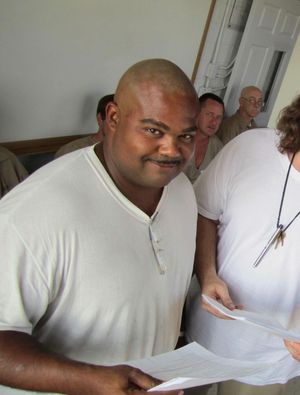
Derek R. Trumbo, Sr., a multiple-time PEN Prison Writing Award winner, is an essayist, playwright, and author whose writing has been featured in "The Sentences That Create Us: Crafting A Writer's Life
Sign up for Prism newsletters.
Stay up to date with curated collection of our top stories.