Mail went digital in Alabama prisons. Families are saying their mail isn’t being delivered.
Incarcerated people and their families are raising concerns about long delays, difficulties sending legal documents, and invasions of privacy
Real journalists wrote and edited this (not AI)—independent, community-driven journalism survives because you back it. Donate to sustain Prism’s mission and the humans behind it.
Kenneth “Swift Justice” Traywick has been incarcerated in Alabama and separated from his family for over 16 years. But things took a turn for the worse when he was placed in isolation at Bullock Correctional Institution after going on a 35-day hunger strike. Bullock does not allow the use of tablets in isolation, Traywick says, and as of last fall, that is the only way people incarcerated in Alabama can receive mail, aside from legal mail.
“You’re actually infringing on my constitutional rights to have mail brought to me and utilize the mail services to stay in touch with my family or my lawyers,” Traywick said he told authorities. After his complaints, he said the facility started allowing inmates in segregation to receive mail, but Traywick was still unable to access his.
“What they’re wanting to do is separate us from our loved ones, and I consider it dehumanization. They want us to have nothing to do with the outside world,” Traywick said.
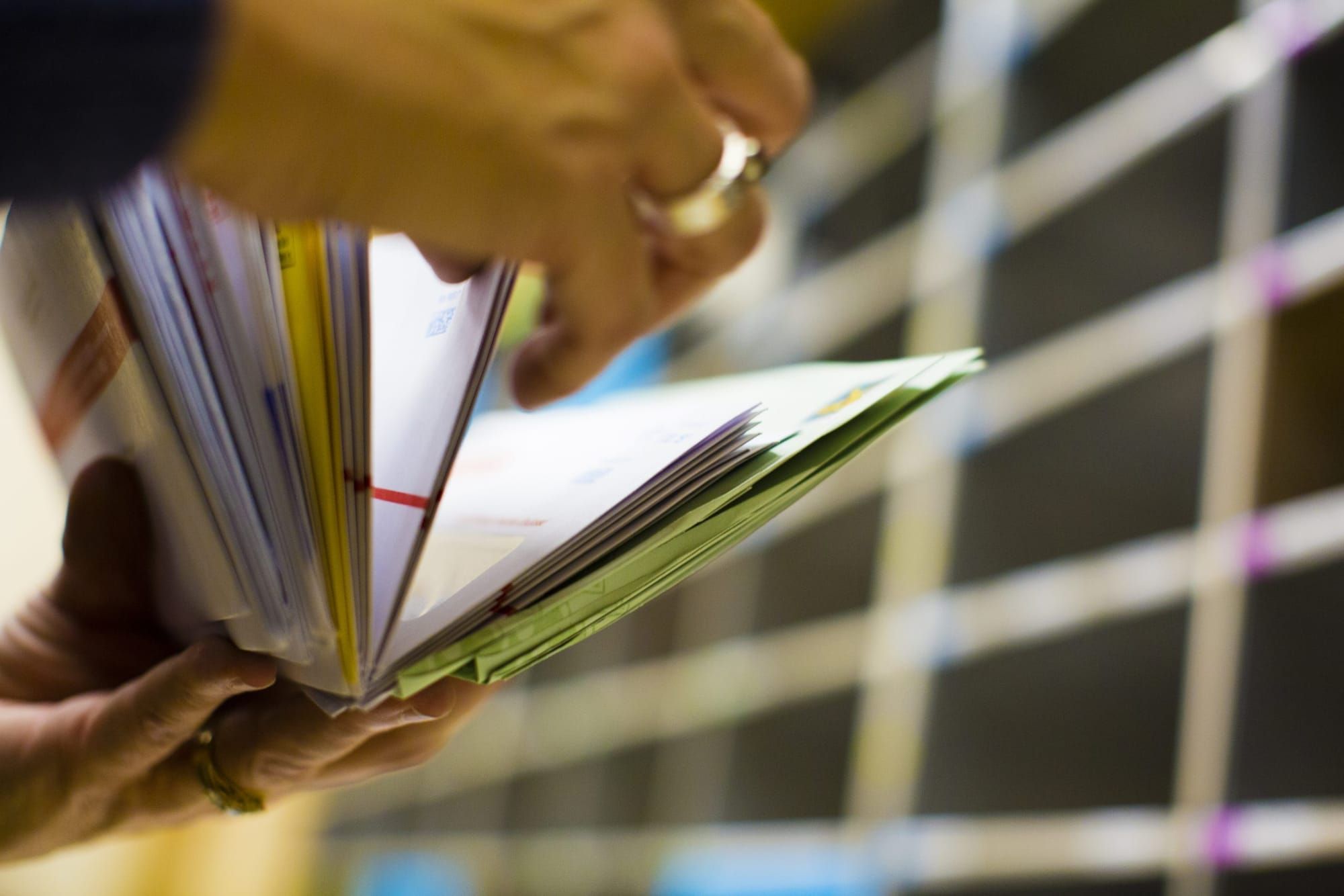
As of Oct. 27, mail sent to inmates within the Alabama Department of Corrections (ADOC) went digital, in partnership with IC Solutions, a private contractor. All mail, except legal mail and packages, must be sent to a P.O. Box in San Antonio, Texas. From there, it is taken to be scanned and uploaded to tablets that are distributed to inmates at ADOC facilities.
“Most state corrections departments are moving toward a paperless system,” said Kelly Windham Betts, public information manager at ADOC, in an email response. “In addition to the green implications, paper can be used to introduce illegal substances.”
Wanda Bertram, the communications strategist at the Prison Policy Initiative, told Prism that states first began adopting mail scanning around 2017. As of 2025, the Prison Policy Initiative found that 25 states had made the switch.
“So it’s really ramped up in the last couple of years,” Bertram said. “And I think this is just the process of a policy that, despite having a lot of problems and getting a lot of pushback, is becoming normalized.”
Delivery failures
Difficulties with mail and phone calls are nothing new, according to Traywick’s wife, Elizabeth. When her husband was previously incarcerated at Fountain Correctional Facility, he sometimes wouldn’t receive the letters or documents she mailed him when he was representing himself in legal proceedings.
“I would have to send them two or three times before he would actually get them,” she said.
“And then once they went to the digital mail-only system, nobody at Bullock was getting any of the mail on their tablets,” she added. “Half of the tablets don’t work, and then you have to pay a fee. … And a lot of us don’t have the money to just keep spending and spending.”
Traywick sees a larger-scale problem amid the delivery failures.
“What they’re doing is they’re stopping guys from representing themselves pro se, and [from] allowing them to get documents, evidence, and affidavits from places where they need to get it,” he said. “It forces us to hire a lawyer to give us legal mail. And if I can’t afford a lawyer to represent me, that means, if I can’t choose to represent myself, you are hindering my rights to access the courts the way I want to access the court.”
Ruby Hayes, whose fiancé is incarcerated at the William E. Donaldson Correctional Facility in Jefferson County, Alabama, said she has faced similar problems. She and her fiancé have businesses together for which she often needs to send him mail to be signed and notarized. She is no longer able to do that with the new digital system, she said. When she called and spoke to someone at the prison, she was told that she could send it like legal mail, she said.
“So I spent all this money to send all these documents in legal mail … only for them to be rejected once they got there,” she said.
Hayes said the facility is now telling her that only attorneys can send legal mail.
“We’re a small business, and it’s already hard enough on families to provide everything for them while they’re in there, with everything being so expensive. So [it’s] hard to incur additional expenses of having to try to find and retain an attorney just to send legal documents,” she said.
ADOC did not respond to Prism’s request for confirmation about whether only attorneys can send legal mail. In response to questions about complaints over mail delays, ADOC said in an email that it “has a system for inmates to lodge complaints regarding communication.”
Bertram, of Prison Policy Initiative, said that mail scanning has been associated with huge delays up to several weeks or even months, citing anecdotes similar to what Prism heard from families. Mail scanning can also result in poor-quality mail, such as blurry or discolored photographs, Bertram said.
“The effect of this is all to push family members to use paid communication services instead. But there’s families who cannot do that,” Bertram said. “There’s a limit on how much families can pay, and so as a result, people are left with a more tenuous connection to their loved ones, and that really hurts people’s mental health.”
IC Solutions, which handles all communications for those incarcerated at ADOC, charges $0.08 per minute for a domestic phone call, $0.30 per photo for inbound photo-sharing services, and $0.25 per message for voice messaging. These costs add up quickly, families say.
Privacy concerns
Elizabeth Traywick also has concerns about the privacy aspect of this new digital system of mailing things to her husband.
“I may have to send him a letter saying what the courts have said; well, that’s not something ADOC is supposed to … be keeping track of,” she said.
And then there’s the personal aspect.
“One of the biggest predictors of reducing recidivism is maintaining family connections and community connections, and it’s really hard to maintain those connections when they can’t get the mail,” Elizabeth Traywick said. “Or the mail is being put into a computer system and digitally kept for who knows how long.”
One of the biggest predictors of reducing recidivism is maintaining family connections and community connections, and it’s really hard to maintain those connections when they can’t get the mail.
Elizabeth Traywick, wife of Kenneth Traywick who is incarcerated in Alabama
It takes a lot longer for the mail to first be sent to Texas, await scanning, and then be accessed on tablets in Alabama, she explained, compared with sending it from within Alabama and it taking only a couple of days to reach the correctional facility.
Hayes also said that while many of her letters never made it to her fiancé, the ones that did were heavily redacted.
“There are entire pages that he cannot read,” she said. “I’m not sure why they’re censoring certain things out. I just kind of feel like it’s their sense of control,” Hayes said.
She said she doesn’t understand why there is a lack of confidentiality based on alleged security reasons.
“It does not feel good to feel like your privacy is invaded and that your most secret thoughts and things are being shared between who knows who,” she said. “Who knows who’s reading what, who knows what they’re saying, who knows what they’re sharing.”
ADOC did not respond to Prism’s questions about mail censorship.
Inmate rights advocates have long argued that the practice of mail scanning—either performed at the prison or off-site using a third-party vendor—often strips away the privacy and the sentimentality of mail, which is often the least expensive and most-used form of communication between incarcerated people and their loved ones, according to Prison Policy Initiative.
“They’re not getting physical mail that they can hold on to and keep and reread and have,” Hayes said. “If their tablets break, they’ve lost all of their mail. It doesn’t come back on a new tablet. It’s just gone.”
Research in other states where mail scanning was implemented in an effort to curb the introduction of illegal substances through mail has shown that mail scanning doesn’t have a significant impact in reducing drugs entering the prison systems. For example, in July 2022, the Missouri Department of Corrections barred inmates from receiving physical personal mail and opted for a digital scanning system similar to the one implemented in Alabama. However, the Riverfront Times reported in October 2022 that overdoses inside Missouri prisons rose by about 10% in the first three months of the new mail policy, and the average number of drug overdoses increased from 35 to 39.
“There are a lot of reasons that mail scanning, in my view, is a really bad idea. And one of them does have to do with the effectiveness,” said Bertram. While there is not a lot of data on the issue, Bertram pointed to a few other states for some insights.
After Pennsylvania switched to mail scanning, for instance, the percentage of tainted mail decreased by only 0.1% over the course of one year, Bertram said.
In New Mexico, an internal Corrections Department report found that positive random drug tests climbed after the implementation of mail scanning. “It was a reversal of three years of reduced drug use,” Bertram said.
IC Solutions has also had issues in the past with keeping incarcerated people connected with their loved ones. In Wisconsin early last year, IC Solutions apparently failed “to keep up with increasing demand for its call and messaging services,” Wisconsin Public Radio reported.
“All because you have a security issue doesn’t mean that you are allowed to be trampling on constitutional rights,” Kenneth Traywick said. “You have a duty to find another way to tackle your issues.”
Editorial Team:
Sahar Fatima, Lead Editor
Carolyn Copeland, Top Editor
Stephanie Harris, Copy Editor
Author

Nayanika Guha is a journalist who focuses on writing about social justice, health, and politics. She has a MFA in journalism from NYU and a background in psychology and social work, which informs her
Sign up for Prism newsletters.
Stay up to date with curated collection of our top stories.