Miami Coalition to Advance Racial Equity founder quits to launch new coalition to fight policies targeting homelessness
David Peery is launching a new Florida organization aimed at advocacy and legal challenges to repressive state and federal laws
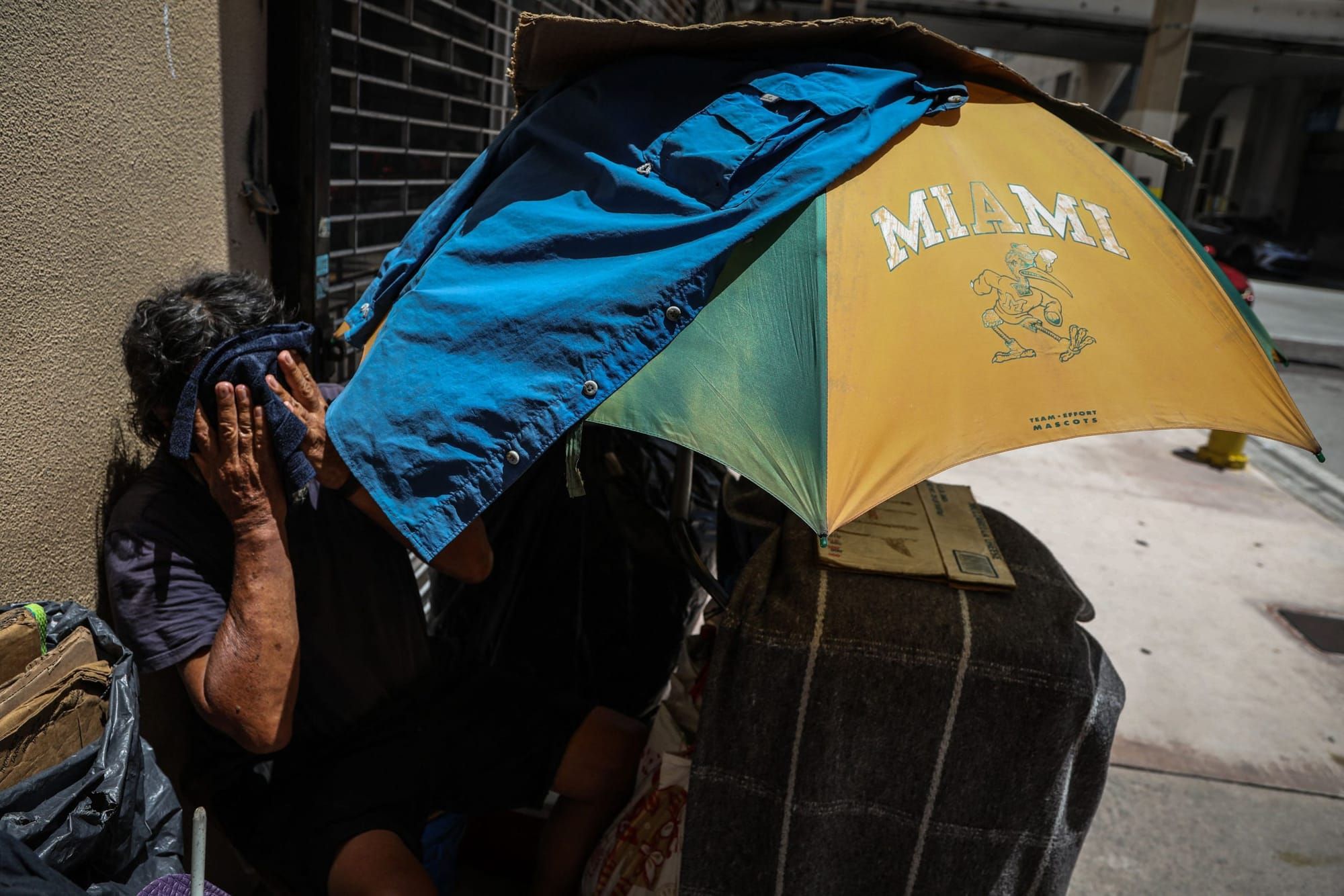
David Peery, one of Miami’s most active advocates for racial equity and the rights of unhoused people, has announced that he is stepping away from the Miami Coalition to Advance Racial Equity (MCARE) to build a broader statewide coalition aimed at challenging Florida’s increasingly repressive policies on homelessness.
Peery, who founded MCARE in 2021 as a collaborative advocacy hub, said conflicts between board members and a drift away from the group’s mission pushed him to chart a new path.
“I never formed MCARE to get bogged down into internal stuff, I formed it to advocate,” Peery told Prism. “I never intended to be an executive director or any kind of corporate executive. We just have a difference of opinion with our board members in terms of what’s the most effective use of our time and resources. I believe that a majority of what we do should be devoted towards advocacy, and they don’t think so.”
MCARE’s board members did not respond to requests for comment.
Initially conceived as the South Region field office for the National Coalition for the Homeless, MCARE broadened to include local initiatives such as racial equity awards for community leaders who are driving social change. But, Peery said, internal disputes about finances and governance stalled momentum. He now plans to launch the Florida Coalition to Advance Racial Equity, a statewide organization that will center not only advocacy but also impact litigation.
Peery’s move comes as Florida escalates its crackdown on homeless encampments and the Trump administration dismantles Housing First programs. Miami advocates say the courts are now the strongest remaining defense against policies that criminalize poverty.
“Our courts are our last bastion now against all this anti-democratic and racist stuff that the Trump administration is doing. The courts are the only bulwark against this rise of repression,” Peery said. “We really have to start pushing alternative legislation through the city and county commissions and through the state legislature.”
Peery said his new organization will prioritize litigation in four areas: ending homelessness, stopping criminalization, protecting voting rights, and defending First and Fourth Amendment freedoms, including the right to protest. Peery, a former lawyer, is preparing to take the Florida Bar exam and hopes to establish a litigation unit by mid-2026. He is also considering organizing the group as a 501(c)(4) organization, which would allow it to engage directly in electoral politics.
No stranger to litigation, Peery served as the lead plaintiff in a case defending the Pottinger consent decree, a landmark agreement protecting unhoused people in Miami from arrest for sleeping in public. That experience introduced him to legal advocacy and set the stage for his later work with MCARE and pushing for systemic reform.
Peery’s pivot comes amid sweeping state and federal crackdowns on unhoused people. Florida’s HB 1365, in effect for the past eight months, bans encampments on public property and allows private citizens to sue municipalities that fail to enforce it. On the ground, Peery said the impacts are dire.
“The immediate impact is it’s been harder to find the homeless,” Peery said. “They’re scattered. People are panicked. People are in a very high state of alarm, and that just makes it so much more difficult to get out of homelessness, because now the service connections have been broken between homeless and outreach workers who would get the homeless off the streets.”
At the federal level, advocates are bracing for the fallout from President Donald Trump’s July executive order that cut funding for Housing First and harm reduction programs, redirecting money into block grants and opening the door to so-called sanctioned encampments, detention-style sites that advocates fear resemble internment camps.
“The private prison companies are overjoyed, because they’re already making record profits,” Peery said. “GEO Group just reported some really crazy second-quarter profits, and they announced the stock buyback. GEO Group is the nation’s largest private prison company based in Boca Raton, Florida, and they’re a big client of Ron Book, the chair of the Miami Dade Homeless Trust.”
Michael Langley, the executive director of the Florida Justice Institute (FJI), said the executive order is a “deliberate tactic.”
“The separation of powers matters,” Langley said. “Article Three courts were enshrined in the Constitution to really serve as a true check and balance on maybe an overzealous or an overreaching executive, perhaps looking at laws that have been unconstitutional in the past.”
Langley said FJI is preparing to challenge the order and continues to litigate locally, including successful lawsuits against anti-panhandling ordinances and ongoing cases against the Florida Department of Corrections for excessive heat in prisons.
Peery sees Florida as a testing ground for policies that could spread nationally, citing connections between Gov. Ron DeSantis, the private prison sector, and federal directives. Still, he believes resistance is growing.
“I think people were kind of paralyzed and shocked at the wide range and breadth of Trump’s dismantling of the federal government,” Peery said. “What gives me hope is that these policies have had such a huge impact on such a wide ranging group of people, many groups that voted for Trump. I see that there’s going to be a huge groundswell coming up in the next few months, a groundswell of public opposition to these right-wing policies, and a new reawakening of people’s consciousness.”
Langley pointed to the economic math that drives the crisis. If Florida’s minimum wage is $13 an hour, but someone would need to make at least $37 an hour to afford a market-rate unit—and in Miami Beach, it’s closer to $65, Langley said—then arresting people for being poor only ensures that they’ll never get housing or jobs, because then they’ll have a record.
Advocates say repeated arrests for status offenses such as homelessness or panhandling amount to civil rights violations.
“We believe these people are being targeted for their circumstances, their inability to afford the basics,” Langley said. “When you have the state that has decided that they’re going to criminalize someone for a class, we believe that that is a civil rights violation, and we will act accordingly. And for us, we don’t believe that criminalizing someone for their identity, their lifestyle, or their circumstances makes any sense. It’s impractical, it’s expensive, and we believe that it is both a moral and an economic imperative that folks have an opportunity for self-determination, and that’s what’s at the heart of this.”
Despite what he calls a “terrifying” political landscape, Peery said he feels energized by the new chapter. He envisions the new organization as more democratic and mission-centered than MCARE, with horizontal leadership and board members directly leading projects rather than policing compliance.
“I just can’t wait to start suing the DeSantis and the Trump administration,” Peery said. “[The work is] never boring. Sometimes terrifying, but never boring.”
Editorial Team:
Sahar Fatima, Lead Editor
Carolyn Copeland, Top Editor
Rashmee Kumar, Copy Editor
Author

Alexandra is a Cuban-American writer based in Miami, with an interest in immigration, the economy, gender justice, and the environment. Her work has appeared in CNN, Vice, and Catapult Magazine, among
Sign up for Prism newsletters.
Stay up to date with curated collection of our top stories.