Filed Under:
The Colorado River’s right to exist
As part of the burgeoning Rights of Nature movement that grants ecosystems and water bodies rights, the Colorado River Indian Tribes last year secured a personhood resolution for the 1,450-mile waterway

ray levy uyeda
Real journalists wrote and edited this (not AI). Independent, community-driven journalism survives because you back it. Donate to sustain Prism’s mission and the humans behind it.
Real journalists wrote and edited this (not AI)—independent, community-driven journalism survives because you back it. Donate to sustain Prism’s mission and the humans behind it.
By the time the Colorado River Indian Tribes passed a personhood resolution in November, granting the Colorado River an elevated legal status that formally recognizes its right to exist and thrive, the river’s water levels had plummeted to historic lows, with nearly 60% of the watershed in severe drought.
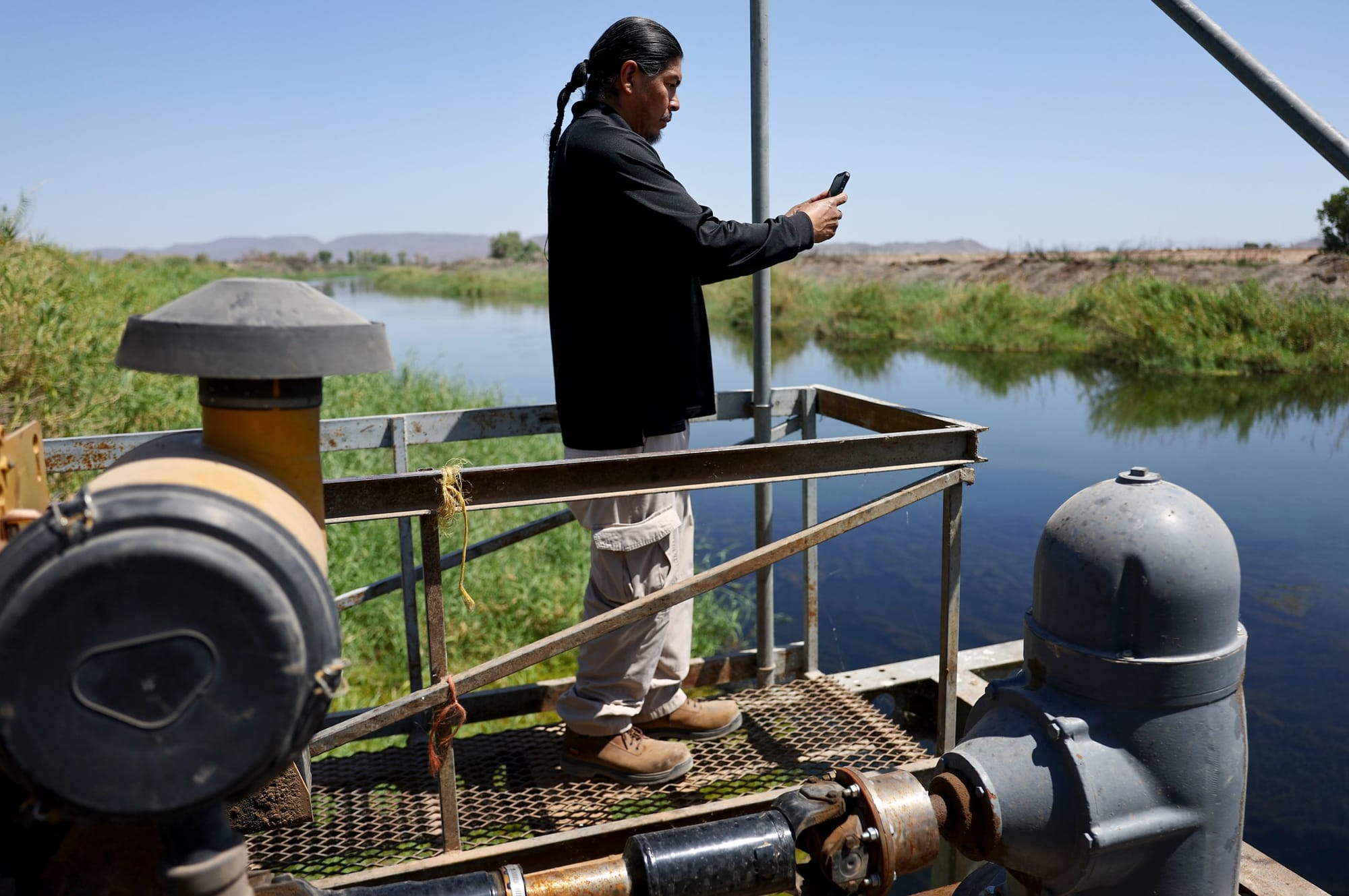
“The river is a living being, just like we are living beings. We are made up of water,” said Amelia Flores, who is Mohave and serves as the chair of the Colorado River Indian Tribes (CRIT). The consortium of four tribes—the Mohave, Chemehuevi, Hopi, and Navajo—collectively steward a 300,000-acre reservation that abuts the Colorado River, the body of water that has given Indigenous peoples of the land their life since time immemorial.
For decades, the prevailing attitude in discussions of the watercourse’s flow, health, and productivity hinged not on what the river is, but rather, what it does. The 1,450-mile Colorado River provides water to between 35 million and 40 million people—about 1 in 10 U.S. residents. Almost one-third of the water is used for industrial animal agriculture, and hydroelectric power generated at the Hoover Dam provides electricity for more than 1.3 million people. For a century, seven state signatories of the 1922 foundational legal agreement known as the Colorado River Compact have negotiated the terms by which they may each pull water from the river and its tributaries, theoretically leaving enough for Mexico, where the river crosses the southern border, later feeding into the Sea of Cortez.
These negotiations have largely taken place without the input of the Indigenous peoples who built life alongside the river for thousands of years and know best that a relationship built on mutuality can sustain both the river and the people dependent on it. But if the states wish to support the continued flow of the river, it will require following in the footsteps of the Indigenous tribes at the helm of the burgeoning Rights of Nature movement, where ecosystems and water bodies are granted rights.
Before legal doctrine
Rights of Nature is a new name for an ancient movement: the formalization of Indigenous worldviews into Western law in an effort to ensure the health and integrity of ecosystems that many governments perceive as subservient to human and industrial interests. Dominion over the nonhuman world is so naturalized into American governance that it often goes unnoticed and unquestioned. This entitlement to taking—from forests, oceans, rivers, and grasslands—runs up against the Indigenous worldviews that could reroute humanity’s catastrophic fate.
It’s not that the Colorado River Indian Tribes believe the river is human and thus, deserving of rights. However, the tribe does assert that the river is endowed with inherent rights that merit formal recognition that can be held up in court. Personhood and Rights of Nature resolutions give lawsuits seeking to protect ecosystems from harm the legal grounds to sue, which is also known as “legal standing.” With the personhood resolution approved, the river can be protected under tribal law. Among other stipulations, tribes are required to evaluate the impacts to the river in all future decision-making processes.
CRIT is one of many tribal governments to afford ecosystems their rights. In 2016, the Ho-Chunk Nation amended its tribal constitution to include a Rights of Nature declaration, one which banned fossil fuel extraction on tribal lands. In 2018, the White Earth Nation passed a Rights of Nature resolution intended to protect manoomin, or wild rice. At least seven other tribes have passed Rights of Nature resolutions, personhood resolutions, or approved constitutional amendments to uphold and affirm the sovereignty of nonhuman living beings.
According to writer Robert MacFarlane, author of “Is a River Alive?”, a treatise on the animus of the nonhuman world, “River rights have become the commonest form of novel legal subjectivity in dozens of countries around the world.”
In the U.S., the Rights of Nature movement began with a river, a sickened band of water in Tamaqua Borough, Pennsylvania, that was so depleted by the dumping of sewage and coal mining refuse that, in 2006, the Tamaqua Borough Council recognized the river as a legal person.
A decade later, the Community Environment Legal Defense Fund (CELDF), a leader in the Rights of Nature movement, filed the first major federal lawsuit seeking rights for a major ecosystem: the Colorado River. The legal organization sued the Colorado attorney general, asking the court to declare the river a legal person capable of bearing rights.
Rivers are a good way to open a conversation about why American law legalizes the destruction of rivers and the rest of the natural world.
Will Falk, Co-coordinator of community resistance and resilience at the Community EnviRONment Legal Defense Fund
“Just about every ecological problem that we face—whether that’s climate change or biodiversity collapse or overconsumption, all of those things—directly affects rivers,” said Will Falk, the co-coordinator of community resistance and resilience at the CELDF. “We found that rivers are a good way to open a conversation about why American law legalizes the destruction of rivers and the rest of the natural world.”
The river, in Falk’s words, was the entry point for highlighting that not only have environmental laws failed to protect ecosystems from harm, but these laws have also allowed for harm to be committed. And this harm has immiserated the natural life-giving processes of these ecosystems, certain to impact those who have long denied that our lives are tied to the health of these ecosystems. As Indigenous water protectors say: Water is life.
“We thought that we could use rivers to show people how environmental destruction, how ecocide, how the violations of rights of nature directly harm humans as well,” Falk told Prism.
Many Rights of Nature resolutions passed by tribal governments center the aliveness of rivers, which those in the movement regard as a reflection of the significant role that they play in the water system. Snowpack that melts in the spring and summer traverses thousands of miles into the ocean. Millions of years ago, this water helped carve out the Grand Canyon and now supports 70% of native fish endemic to the river. Equally important are the ways that the Rights of Nature movement talks about rivers, focusing on the connection between humans and rivers that predates legal doctrine and negotiations of flow rates. Our connection to rivers tells us something about our bonds to nonhuman life and, for some, elucidates a forgotten truth about what it means to be alive.
Not only has modern environmental law failed to protect ecosystems from harm, but also there’s doubt among some scholars that environmental regulations were ever really intended to safeguard the commons. The Trump administration’s rewriting of hundreds of environmental pollution standards illustrates that environmental rules merely dictate acceptable levels of pollution for industries’ continued operation. Meaningful penalties for pollution are rarely given out, and government subsidies support the very corporations that are on record as engendering the climate crisis and hiding its impacts.
A web of laws, regulations, and cultural opinions
In February, after Colorado, New Mexico, Utah, Wyoming, Arizona, California, and Nevada blew past the mandated deadline for a resolution on water use, the federal government’s Department of the Interior stepped in to provide options, most of which the states are not happy with. The conflict is as simple as it is entrenched: The Upper Basin states of Colorado, New Mexico, Utah, and Wyoming want the Lower Basin states to enact a significant portion of the cuts, arguing that their usage is largely responsible for the river’s drought.
Meanwhile, water levels are sinking lower, and a dry spring is approaching. With no agreement as to how the Colorado River will be treated, business proceeds as usual, portending a point of no return for the river and the living creatures—including humans—that depend on it. If a river can die, which is the underlying fear around failed Colorado River negotiations, then they can also be alive. Every policy decision—each irrigation line, dam, and hydropower facility—represents an investment in the river’s longevity.
Monti Aguirre, the Latin America program director for the nonprofit International Rivers, which works to protect rivers globally, has long championed Rights of Nature movements. She told Prism that only 17% of rivers around the world remain free-flowing, occluded by more than 50,000 dams. It’s commerce’s effort to corral, constrict, and impede river flows for the benefit of energy generation and municipal development that prevents rivers from playing their incisive and critical role in the earth’s water system.
Historically, rivers are among the least protected water bodies precisely because of their threadlike being, Aguirre said. Like the Colorado River, many rivers are managed by multiple actors. Unlike lakes, marshes, and forests, the web of laws, regulations, and cultural opinions toward rivers make it challenging to draw a boundary around a section of water and declare certain protections.
In shifting the public’s thinking, Aguirre said that there can be a tension when “protecting [rivers] becomes an ethical duty rather than a management choice.”
By radically reforming human relationships to ecosystems through amending Western law, the Rights of Nature movement seeks to instill a kind of cultural and social change that shifts public opinion, hopefully allowing for investments in river health.
“The end goal is not to change only the legal system that views nature as an object, not as a subject of rights, but what mainly needs to happen is that we need to change society,” said Nati Green, director of the Global Alliance for the Rights of Nature. For over a decade, the organization has led efforts to secure the Rights of Nature movement. This includes the movement’s first win in Ecuador, when in 2008, voters approved a constitutional amendment supporting ecological right to well-being.
According to Green, society needs to start viewing the more-than-human world for what it is: “Our mother, that we are part of nature.”
Editorial Team:
Tina Vasquez, Lead Editor
Lara Witt, Top Editor
Stephanie Harris, Copy Editor