Workers strike after Cobalt Abortion Fund fires two union members, reassigns third to new role
The Denver-based organization has engaged in union-busting and retaliation, union members allege
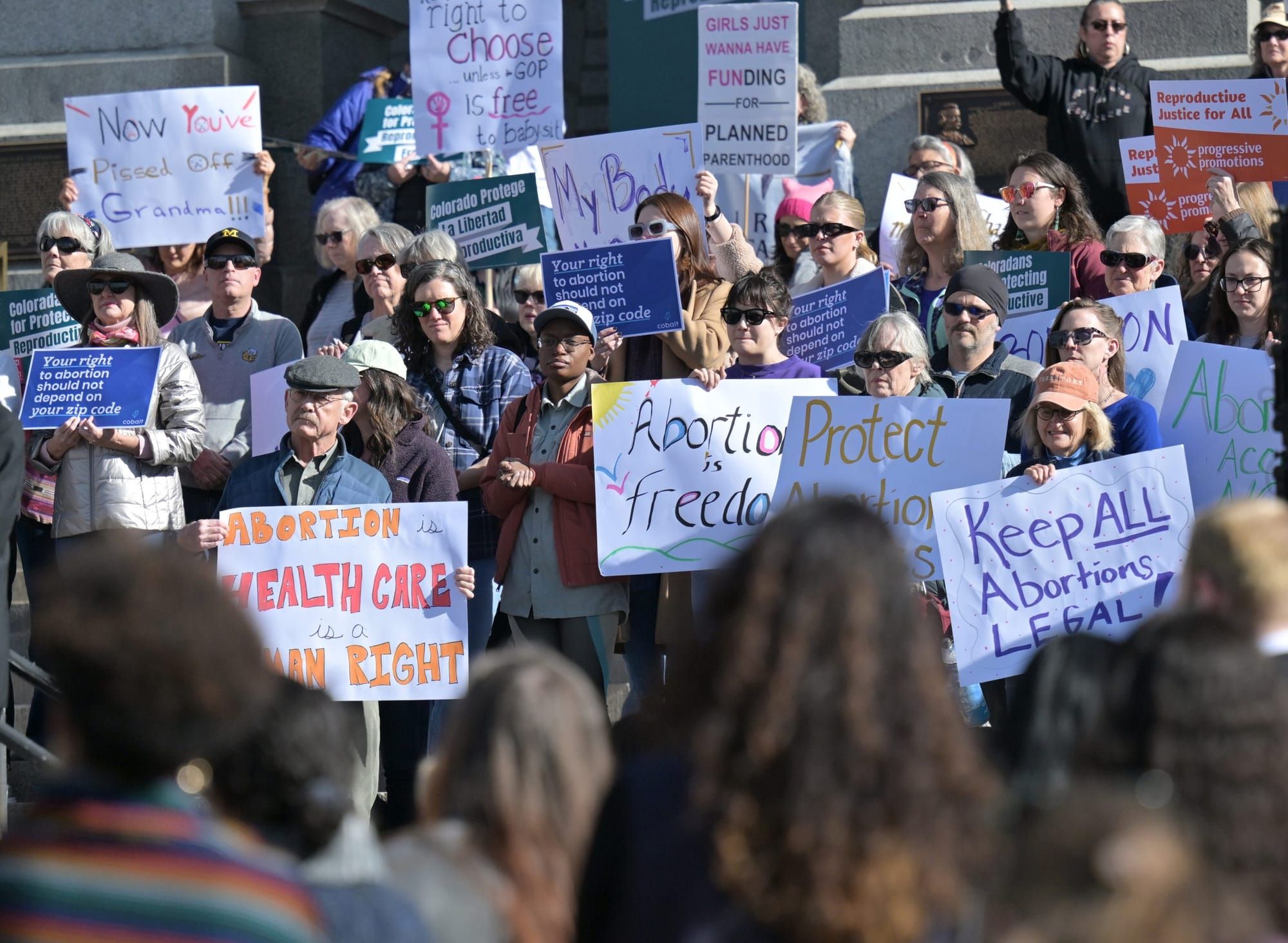
Unionized workers at the Denver-based Cobalt Abortion Fund went on strike this month after the organization terminated the positions of two key union members and reassigned another unionized worker, who now reports to the external affairs department. Cobalt Workers United is demanding that the fund reinstate the terminated workers, Cidney Fisk and her mother, Debora Fisk, who were dismissed as Cobalt claimed that it was making a “strategic shift” from organizing to policy development.
“We’re on an unfair labor practice strike,” Cidney Fisk, who was fired from the position of field manager, told Prism during the strike, which was held from Feb. 14 to 19. The three workers’ positions are under status quo protections, Fisk said, which prevent employers from unilaterally changing working conditions without negotiating a new contract with the union.
According to workers, this is Cobalt leadership’s most recent retaliatory action against unionized workers, after months of tension that started when workers formed the union in June 2024. The abortion fund is still negotiating contracts with the union, which under federal labor law means that no changes can be made to current employees’ roles, the workers say.
“Cobalt’s attempt to restructure and eliminate union positions during this period is a blatant violation of federal labor law, and seeks to undermine Cobalt Workers United,” the union said in a press release on Feb. 15. “These illegal actions not only threaten our jobs but also jeopardize the critical reproductive rights work we do in Colorado. Cobalt’s leadership must be held accountable for these attacks on workers’ rights.”
On Feb. 19, the Southern Colorado Labor Council sent the Cobalt Abortion Fund an email urging the organization to engage in good-faith negotiations with the union, according to a screenshot shared by the Cobalt union in a social media post. “We call on Cobalt to recommit to a constructive bargaining process, one that reflects the principles of fairness, equity, and mutual respect,” the email reads.
The Cobalt Workers United is asking supporters to sign a petition to support the strike and donate to a hardship fund for the affected workers. On Feb. 24, Development Coordinator Jess Rosero resigned in protest of Cobalt’s decisions. In an email to leadership, Rosero wrote, “While I have valued my time working with our team, I can no longer continue in an organization that disregards labor rights and unlawfully terminates union members.”
Cobalt Abortion Fund did not respond to multiple emails and social media messages from Prism sent over the course of one week.
The demand for Cobalt’s services has increased sharply as the attack on abortion rights has intensified across the country. The abortion fund reported that it spent more than $1.94 million in 2024 to support the expenses of abortion-seekers, who include nearly 3,000 patients who received funding for their procedures and about 1,300 who had associated costs covered, such as travel and child care. That’s up significantly from the $212,000 it spent in 2021, the year Roe v. Wade was overturned, according to a May 2024 Associated Press article. AP reported that the majority of the abortion-seekers Cobalt had helped that year were from Texas, which implemented severe abortion bans post-Roe.
Unionized workers said that Cobalt’s “restructuring,” which the union said it did not know of in advance, is the latest retaliatory move against the union from leadership.
“This seems like an escalation from the outside, but internally, these things have continuously been building slowly within the organization because of the lack of transparency and communication from leadership,” said Sydney Haney, the third worker whose job was changed to what she said is an unclear role that has not yet been communicated to her. Haney previously worked as a digital organizer in the organizing and field work department; according to Cobalt’s notification to the union, her position was “eliminated,” and she has been moved to a “new position and duties, new title and reporting relationship to Digital Associate reporting to External Affairs.”
When Cobalt Abortion Fund workers first unionized last June, leadership did not voluntarily recognize Cobalt Workers United as a bargaining unit. Unionized workers also told Prism that there was immediate retaliatory action after the formation of the union, as unionized workers were no longer welcome at board and staff meetings they had previously attended regularly.
“[There were] harsh conditions that were imposed against us,” Cidney Fisk said. “We used to have open staff meetings where anybody could talk about the work they were doing. There were a lot of huge shifts in rules, in the environment. And we ultimately had to go to an [National Labor Relations Board] election because our leadership wouldn’t recognize us in a timely manner.”
In addition to the three workers who faced action in February, a fourth worker also told Prism that she was directly targeted by leadership because of her unionizing efforts. In August, during a mandatory diversity, equity, and inclusion (DEI) staff training session, intern Sophia Johnson responded to a question from leadership and said she was fired a couple months later.
“In the meeting, Cobalt leadership asked us how Cobalt could support us as repro workers,” Johnson told Prism. “And I responded by saying that Cobalt could support our work by supporting our union and [that] being anti-union is racist. A week later after that DEI training, I received a letter that ended my employment for the fall semester in December, even though I was not hired on as a student intern, and my internship was never renewed on a semester basis.”
After the incident, the union filed a charge of unfair labor practice against the Cobalt Abortion Fund with the NLRB.
“On August 29, 2024, Cobalt Foundation engaged in intimidation, threats, and other verbal restraints against bargaining unit member Sophia Johnson, who expressed pro-union opinions at a staff-wide event,” the filed charge reads. “Roughly one week later, in retaliation for Johnson’s protected concerted activity and to interfere with, restrain and coerce employees in the exercise of their Section 7 rights, Cobalt Foundation unilaterally modified Johnson’s terms and conditions of employment by disciplining her and implementing a termination date for her employment.”
Johnson had already filed an unfair labor practice petition against Cobalt after the abortion fund’s leadership refused to include her title of intern as a bargaining unit position. The petition alleged unilateral changes in the employment contract, refusal to bargain, and coercive statements. During the hearing for the case, Cobalt leadership argued that internships should not be unionized positions, and Cobalt Workers United argued the opposite. The outcome of the hearing is still pending.
“Long-standing issues”
According to unionized workers interviewed by Prism, there were “long-standing issues” at Cobalt Abortion Fund that motivated the formation of the union.
“There were people getting laid off and hired with no transparency and no accountability,” Cidney Fisk said. “We had goals with health insurance coverage. And people were largely dissatisfied with pay. There were a lot of issues with inter-staff relationships, and we have no HR department, so there’s nowhere to take any of our grievances. And when those grievances were popping up, we felt they were being handled in a way we weren’t satisfied with.”
For Debora Fisk, whose part-time job was eliminated due to restructuring, there was no transparency with regard to hiring and firing.
“Certain people that were doing the same amount of work or more were being let go, while others who didn’t do as much work were being promoted,” she said. “There’s a lack of transparency, so when people are hired, fired, promoted, demoted, there’s no explanation given to us.”
According to Cidney Fisk and the other two workers who were targeted in February, there has been no direct communication from the organization about the job terminations, and while leadership offered to negotiate severance, no proposals have been presented. “The only communication we’ve received is the letter that was forwarded to our union organizer,” Cidney Fisk said. “We haven’t really been able to have a direct conversation with them about it. And the responses we have gotten, there’s not really one reason nailed down [for the restructuring].”
Not only are we workers just like everybody else, we also provide a unique and critical service to our communities.
Cidney Fisk, terminated Cobalt Abortion Fund employee
The alleged union-busting at Cobalt Abortion Fund raises questions about workers’ rights in progressive organizations, especially in the reproductive justice space, which is experiencing a wave of layoffs amid political attacks from the Trump administration. The workers interviewed by Prism described themselves as passionate and dedicated to their work, but they also felt that employers take advantage of that commitment to reproductive justice and abortion care. In Cidney Fisk’s opinion, the rights of reproductive care workers should be a part of the scope of the reproductive rights movement more generally.
“Not only are we workers just like everybody else, we also provide a unique and critical service to our communities,” she said. “If we want the reproductive rights movement to have the same momentum as it has had in the past 10 years, then we have to keep our workers supported. So, whether you’re an abortion fund coordinator or you’re on the political side of things, your energy is critical to this movement, and we can’t keep abusing folks because they have bleeding hearts.”
Editorial Team:
Sahar Fatima, Lead Editor
Carolyn Copeland, Top Editor
Rashmee Kumar, Copy Editor
Author

Nicole Froio is a writer and researcher currently based in Rio de Janeiro in Brazil. She has a doctorate in Women's Studies from the University of York. She writes about gender in pop culture, social
Sign up for Prism newsletters.
Stay up to date with curated collection of our top stories.