Mamdani administration moves forward with building a megajail in Chinatown
Chinatown residents have pushed back for years against the Manhattan “jailscraper,” which is part of the city’s plan to shut down Rikers Island
Real journalists wrote and edited this (not AI)—independent, community-driven journalism survives because you back it. Donate to sustain Prism’s mission and the humans behind it.
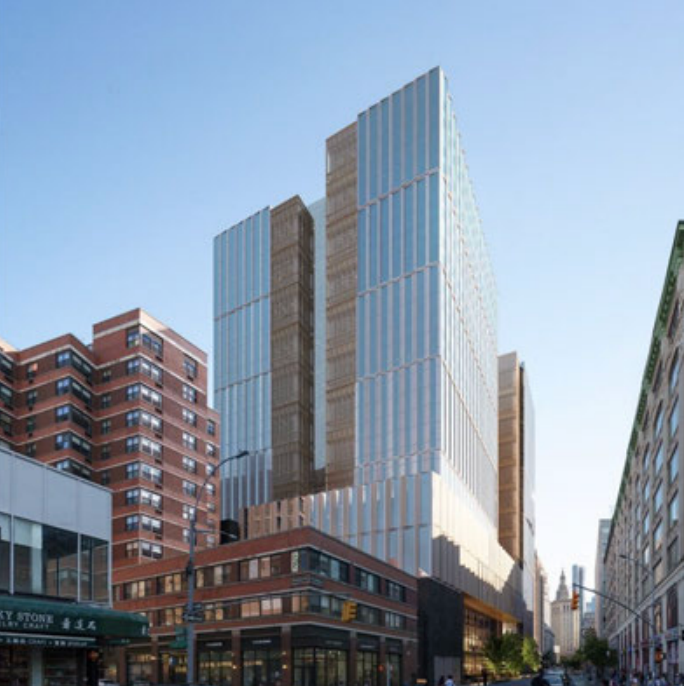
After years of delays and protests, a controversial 295-foot, or 16-story-tall jail in New York’s Chinatown is set to break ground in February under Mayor Zohran Mamdani’s administration.
On Thursday, officials from the New York City Department of Design and Construction (DDC) and the Mayor’s Office of Criminal Justice held a construction kickoff briefing to announce the project’s schedule—marking a decisive blow to the Chinatown community’s yearslong campaign for an alternative to what is set to be the world’s tallest correctional facility.
The Manhattan “jailscraper” is part of the city’s $16 billion borough-based jail program, conceived under former Mayor Bill de Blasio to replace the Rikers Island jail complex with one smaller facility in each borough except Staten Island. An existing jail complex in Chinatown was demolished to serve as the site for the Manhattan mega jail.
The Chinatown community has organized around a competing proposal to build affordable housing at the Manhattan site, despite objections from the jail’s proponents that deviating from the current plan would further delay Rikers’ closure.
“How can it be that we are supposed to be entering a new era for New York City, but instead we are seeing the same disastrous policies continue?” said Alice Chou, a member of activist group Youth Against Displacement who protested the announcement outside of the construction site. “We know that new jails will not keep us safe. … We are asking Mayor Zohran Mamdani: Don’t continue the harm of your predecessor.”
Mamdani, who signed a pledge during his State Assembly run opposing the construction of new jails, has not publicly stated a position on the Chinatown facility or detailed how his administration plans to meet the legal deadline to close Rikers Island by 2027, despite DDC’s acknowledgement that the replacement jails will not be completed until 2032.
Mamdani’s office did not respond to multiple requests for comment. However, Zachary Katznelson, a member of Mamdani’s Committee on the Criminal Legal System, told Prism that Chinatown residents’ proposal to build the jail site elsewhere was not feasible as it “would set us back years and years, maybe looking at another decade before a new jail would be built.”
“People don’t love having jails in their midst, obviously, but the locations that were chosen were chosen carefully and are the ones that make the most sense for our city as a whole,” Katznelson said.
The logistical and moral conflicts pose a potential crisis for the nascent Mamdani administration, which must oversee a costly six-year construction project while advancing its housing and cost-of-living agenda. Meanwhile, the clock continues to tick toward the deadline to close Rikers Island—its likely lapse threatening to mark yet another broken promise to reform the city’s jail system.
A “jailscraper” for a gentler Gotham
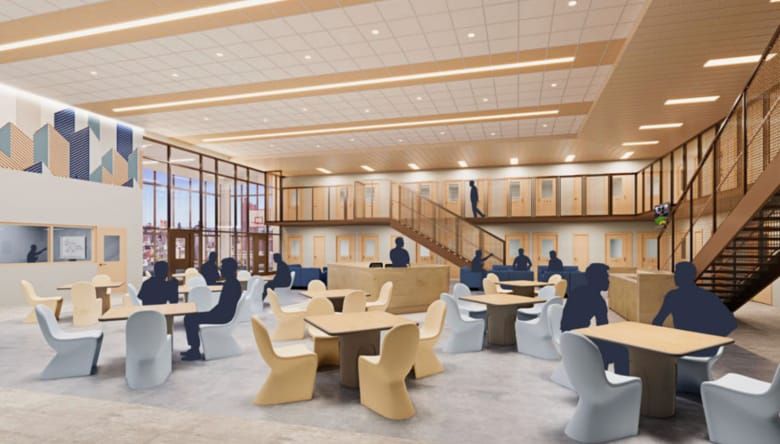
The eclectic design of the new Chinatown jail includes roughly 20,000 square feet on the ground floor for what officials describe as “people-based community and retail space,” intended to foster “connectivity, comfort, and activation.”
Inside the secure areas, incarcerated people will have access to therapeutic dayrooms, vocational classrooms, a full library, horticulture programming, chapels, and outdoor recreation space. Toilets and sinks will be separated, and group showers will be eliminated.
The building design features undulating facades and brick-textured materials intended to blend with the surrounding neighborhood.
“I don’t think people are going to notice that it’s even a jail,” said Vidal Guzman, a criminal justice advocate who was formerly incarcerated at Rikers Island. “You have window access for people to actually see the world, rather than just being a hamster in a cage.”
For neighboring residents, however, improved jail conditions and aesthetic congruency are not sufficient justification for the harm they say the project will inflict on their community. Construction is scheduled to run from 6 a.m. to midnight on weekdays and is expected to generate prolonged noise, dust pollution, and traffic congestion. The city has not made the project’s environmental studies publicly available.
The local Chinese community is already facing a steep demographic decline driven by rising costs and a shortage of affordable housing, one of Mamdani’s key campaign focuses. Years of construction-related disruption could further accelerate that exodus, advocates say.
“Incarceration for profit is still the model,” said Jan Lee, a leading activist opposing the new jail. “Why are we building jails in neighborhoods, and they’re always bigger and never smaller?”
Despite contention over the size of the new jail, some policy analysts say the finished facility’s 1,040-bed capacity would still fall short. The Manhattan jail accounts for one quarter of the borough-based jail program’s total 4,160-bed capacity, while Rikers Island averaged roughly 7,170 people in custody in 2025—more than 3,000 above the replacement system’s capacity.
To reduce the jail population to that level, the city-endorsed blueprint calls for hundreds of new psychiatric beds, expanded supportive housing, criminal legal reforms, and a robust electronic monitoring system.
So far, the Mamdani administration has not disclosed any concrete plans to implement the programs needed to reduce the incarcerated population. A spokesperson for the mayor did not respond to multiple requests for clarification.
A movable deadline
Legally, the 2027 deadline, which Mamdani has previously described as “functionally impossible,” carries less force than it suggests.
“The notion of a deadline is totally city-invented,” said Stephen Louis, former head of the Legal Counsel Division of the New York City Law Department. “We’re at the point where something
has to give. Obviously, one solution or part of a solution is to just come up with a new, more realistic deadline.”
Louis said changing the deadline would require a straightforward legislative process: The City Council would amend the law, the mayor would sign it, and related planning documents would be updated. Courts, he added, typically intervene only if the city fails to act altogether, not when it adjusts timelines while continuing to pursue closure.
Amending the law would not only limit potential legal liability, but also give Mamdani additional time to implement measures to safely reduce the size of the incarcerated population.
A more flexible timeline could also create the opportunity to rework the borough-based jail program, enabling the city to explore modifications to the current proposals. A more sweeping reimagining of the program, however, would likely meet significant resistance.
“Starting over again is just a terrible idea,” Katznelson, the member of Mamdani’s criminal legal system committee, said.
Pressure is also mounting from advocates who view any delay in postponing Rikers’ closure as a moral failure. Fifteen incarcerated people died on Rikers Island in 2025, a 200% increase from 2024. After the 14th death, advocates delivered more than 1,000 postcards to Mamdani’s office, urging him to honor the 2027 deadline to close the jail.
“We need a mayor who’s going to choose humanity over brutality, a mayor who chooses justice over the inertia we’ve seen over the past four years,” said Darren Mack, an adviser to the Independent Rikers Commission, which devised the blueprint for the borough-based jail program.
But if the Mamdani administration hopes to build real momentum toward shuttering Rikers, it will have to move beyond managing timelines and instead confront the system that produced the humanitarian crisis on the island in the first place, advocates say.
Organizations like the Center for Justice Innovation and the Vera Institute have long championed allocating resources away from detention and into policy changes and interventions. That means investing in housing, mental health care, and community-based alternatives—and reshaping public safety in a city that has long relied on incarceration to manage harm rooted in poverty and racial inequality.
Without those structural shifts, advocates say, the construction of another jail in Chinatown would leave the city’s reliance on incarceration largely intact, even as officials continue to promise reform.
Editorial Team:
Sahar Fatima, Lead Editor
Carolyn Copeland, Top Editor
ray levy uyeda, Copy Editor
Author

Morgan Gu is a journalist based in Brooklyn with a background in documentary film production. Her work has covered immigration, criminal justice, and the Chinese diaspora.
Sign up for Prism newsletters.
Stay up to date with curated collection of our top stories.