‘It’s about stamina and the belief that we will win’: Chinatown abolitionist groups fight to end jails in NYC
Organizers with Chinatown Art Brigade and Wing on Wo Project spoke to Prism about why the city’s plan to replace Rikers Island with four borough-based jails is a dangerous continuation of the carceral system.
New York City’s borough-based jails plan has a long and storied history.
First proposed in 2018 by former Mayor Bill de Blasio’s administration, the plan was to replace the deadly Rikers Island jail complex with four borough-based jails in Manhattan, Brooklyn, the Bronx, and Queens. Abolitionist groups have long opposed these new jails. Although they agree that the Rikers facilities must be shuttered, these groups argue that the investment of billions of public dollars into new facilities, with a combined capacity of 4,400 beds, represents a continuation of a notoriously dangerous and violent carceral system.
In recent years, rising inflation and mayoral transitions have delayed construction on the borough-based jails, making it unlikely that the city will be able to close Rikers by its legally mandated deadline of August 2027. Complicating matters further, in November 2023, Manhattan’s top federal prosecutor asked a federal court to strip Mayor Eric Adams’ administration of control of Rikers Island. The following year, the court pushed for a federal takeover, holding the Adams administration in “civil contempt” of more than a dozen provisions designed to make Rikers safer. The ruling sets the stage for a federal takeover of the facility, where five people have died since the beginning of the year.
Despite the potential takeover, in Manhattan’s Chinatown, the city has completed demolition of the former Manhattan Detention Complex as part of its borough-based jails plan, though construction has yet to begin on the new, 300-foot-tall facility activists refer to as a “mega-jail.”
Chinatown is characterized by a predominantly immigrant and working-class population, and under a second Trump term, residents are grappling with increased economic precarity and anti-immigrant attacks. Amid this larger political context, local abolitionist groups are working to sustain a long-term fight against the borough-based jails. In March, Prism spoke with three Chinatown-based abolitionist organizers about their efforts.
Anna Ozbek works with an intergenerational, cultural organizing collective called Chinatown Art Brigade (CAB) that has fought the borough-based jail project since it was first announced. Mei Lum and Di Wang work with Wing on Wo Project (W.O.W. Project), a women-, queer-, and trans-led organization that uses arts and activism to protect community interests in Chinatown. CAB and the W.O.W. Project discussed their recent anti-jail programming, the importance of cultural organizing, and their commitment to mutual aid as a form of base-building. This conversation has been edited for length and clarity.
Jess Zhang: Talk to me about the anti-jail programming you’ve recently planned.
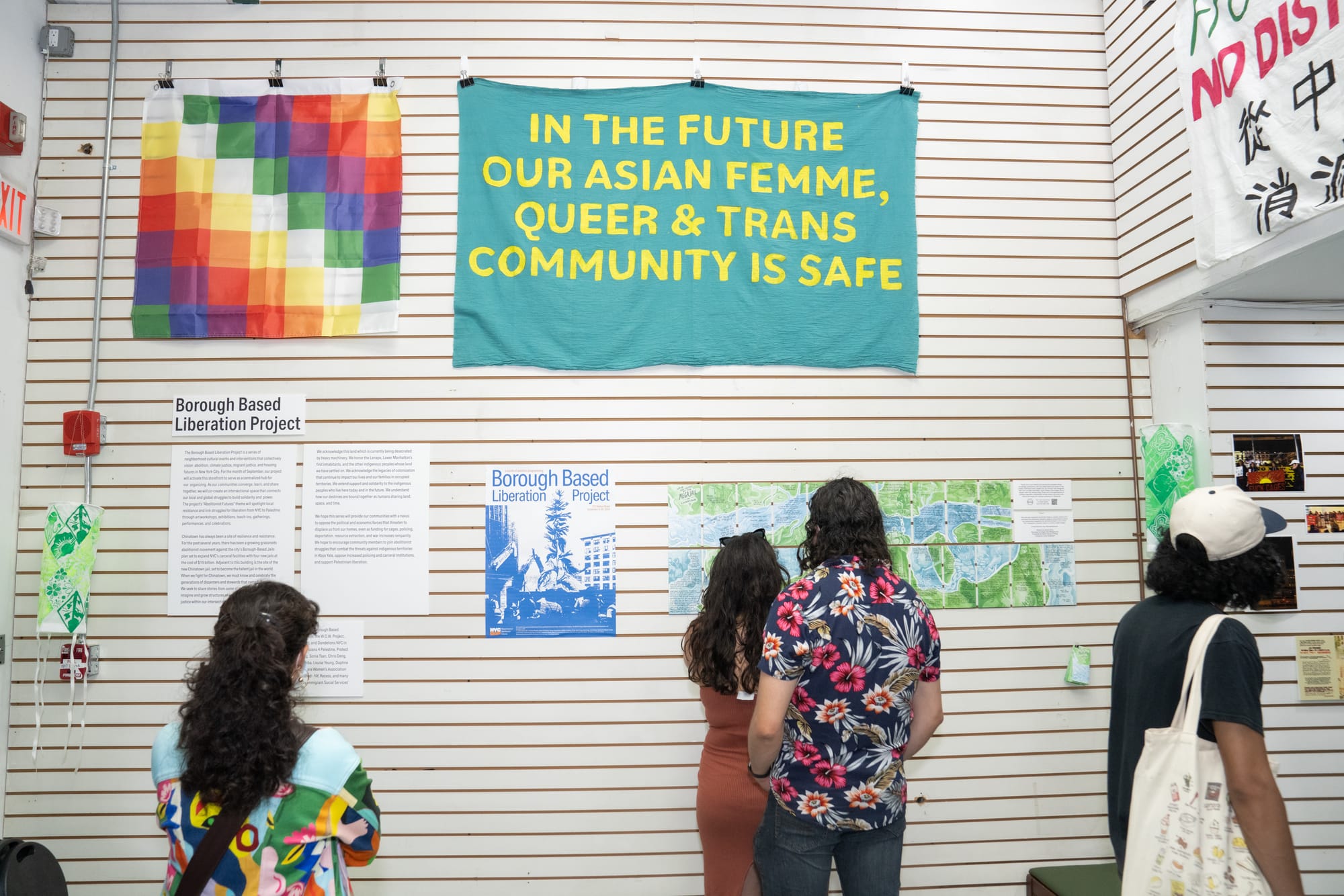
Anna Ozbek: In September of 2024, the Borough-Based Liberation Project, W.O.W. Project, Chinatown Art Brigade, Black Indigenous Liberation Movement, and Dandelions NYC came together and held an autonomous abolitionist space in Chinatown.
We had an art exhibit dedicated to opposing the jail, but we also were talking about the liberation of Palestine and transnational Indigenous solidarity. This was a site where the back of the building literally touches the jail site. We wanted to transform that into an activist space and reinvigorate this movement against the jail that had somewhat cooled down since the pace of the jail [construction] itself had slowed.
Di Wang: After the election last year, we are turning towards: What it’s like to do base building right now? How do we practice abolition?
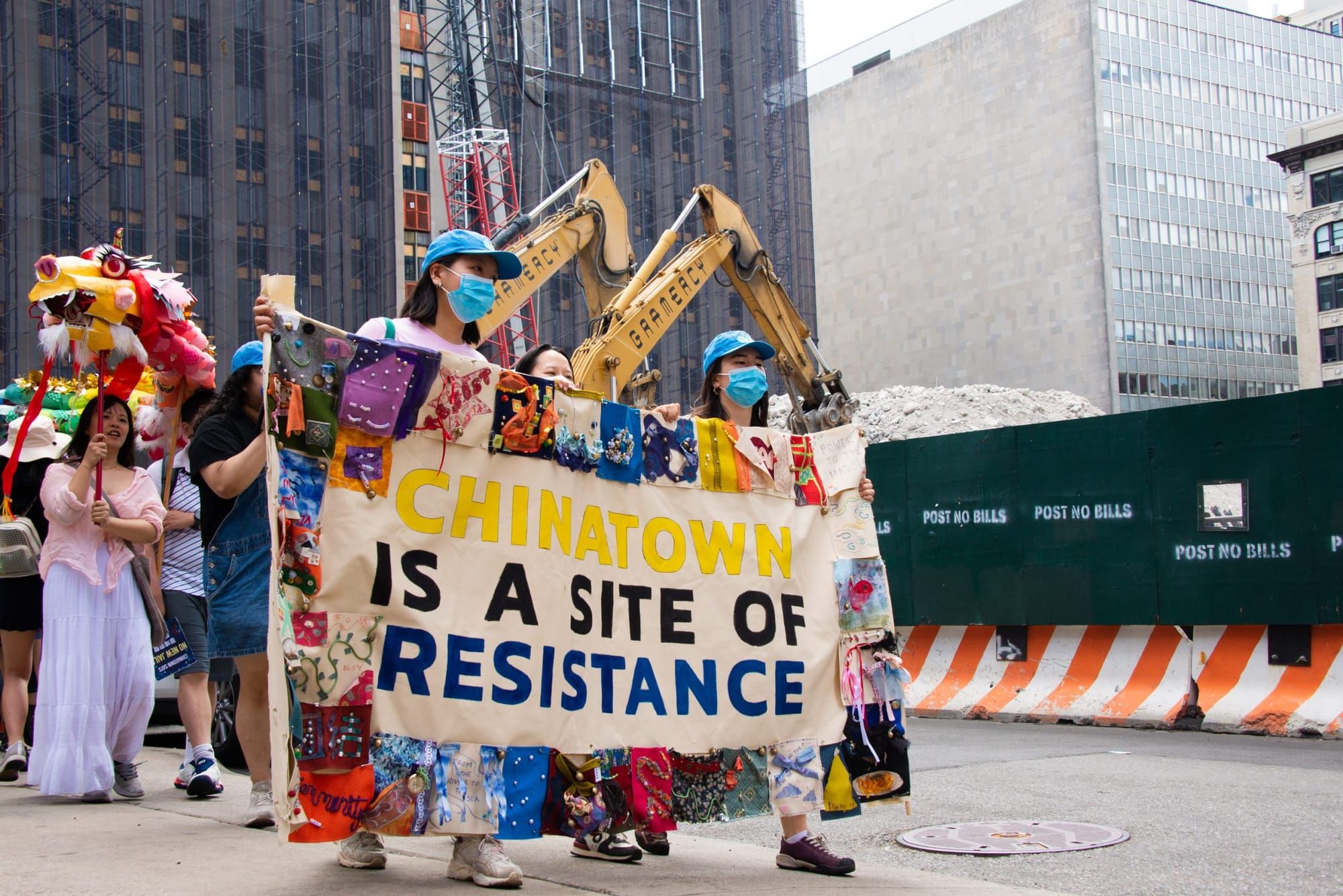
Every Lunar New Year, we have this mutual aid program working with small businesses in Chinatown. The anti-jail fight has been a focus for this year’s program. People might not necessarily be thinking about the jail actively in everyday life, but trying to survive. So, how can we show up? We did a resistance walk around historical sites of resistance around Chinatown that connect to the carceral state. But behind those public programs, we also reached out to small businesses and talked to them about what they are facing. We sensed hopelessness about the jail.
A grassroots organization like ours needs to take on the responsibility at this moment to continue the hope, to say, “We still believe the jail will disappear, and we’re going to work with you throughout this hard time, and we’re always getting mobilized to fight in any possible opportunity.”
Zhang: Can you talk me through the resistance walk and what the intentions were?
Mei Lum: We were trying to take the opportunity of Lunar New Year to expand on what we started with the 2023 mega-jail zine, using it as a political education moment, but also for us to understand the existing city projects that are happening in Chinatown and how they might be connected to the mega-jail proposal.
One of them is the contested opening and closing of Park Row, which has been ongoing since 9/11. That was basically a land grab by the police to create an extension of One Police Plaza, the headquarters of the New York City Police Department. Park Row has been a main thoroughfare of Chinatown for a very long time and has been an economic gateway for us to have traffic flow from other boroughs. We have been watching the Park Row fight and trying to understand what it means to think about policing in the neighborhood. Where are residents in their understanding of what policing of a neighborhood means and what safety means?
During the resistance walk, we were trying to connect the current Park Row fight with the other sites that we ended up visiting, which were the African Burial Ground, Thomas Paine Park, and the mega-jail site itself. We wanted to not only share the history of resistance in the neighborhood, but also think about the future and what this all means. What is the bottom line city strategy with all these projects? Because they are inherently connected. It has real impacts on our daily lives, but from a more strategic level, how can we make connections and share these with the community?
Wang: We were not trying to organize a one-off protest. We’re trying to transform people’s experience, to raise consciousness so they will see movement history through this physical space and see the land in a different way, and then they will become an agent of change. And the next time we’re about to mobilize people, they will have some embodied connection with abolitionist values.
Wang: During the walk, we held an image of door gods, illustrated by Singha Hon to open the streets; to tell all the ancestors buried in the space that we are coming through; that this is our intention; that we are groups of queer people; that we are groups of people that care about this community. We bring our own queer community protectors—symbols of prosperity, resistance, and history—that are also culturally relevant.
Zhang: Why did you choose Lunar New Year as the time to mobilize?
Lum: It’s one of the most celebratory times in the neighborhood. We have the most foot traffic during that time. It’s important that we not only root ourselves in joy, but also to own this duality: that there is an urgency to the things that we’re being confronted with. Lunar New Year is a time when we get to ground ourselves in our collective strength and set intentions, like traditions call for, but in a more politically oriented way.
For Chinatown, so much of our neighborhood vitality was built through sustaining a cultural fabric. And that’s what holds our community together.
Mei Lum, wing on wo (W.O.W.) Project
Zhang: Let’s talk about cultural organizing more broadly. How do you strike a balance between drawing on tradition while also questioning or expanding tradition?
Lum: When we’re thinking about cultural organizing, we’re trying to use art and culture to build community power and work towards political change. In order for us to have transformative change, it has to happen with culture itself: cultural narrative, ideology, and ways of being together. For Chinatown, so much of our neighborhood vitality was built through sustaining a cultural fabric. And that’s what holds our community together. Rooting ourselves in that context, that’s how we’re going to achieve a cultural shift in Chinatown. By tweaking these traditional motifs and ideas, we’re thinking more expansively about a cultural tradition. Regarding the door-god motifs, we wanted to choose something that could be immediately recognizable to an older generation, but also make their head tilt a little bit, like, “Huh, what are these femme-looking door gods?” That could invite us to have more conversation. It was really cool to see our door gods around the neighborhood in the way that we often see very traditional symbols of Lunar New Year.
Wang: I was ready to tell aunties and uncles, “Door gods can be ladylike.” The exposure of queer, trans, and nonbinary messages—which might not currently exist within the neighborhood’s cultural traditions—was part of our design.
Zhang: I’m also curious about how cultural organizing can encourage mobilization across different classes, ages, and languages.
Lum: There’s something about arts and culture that transcends language. It allows people to see, feel, and make connections to their own history and memory. That moves people in a different way. Language is often about logical thinking and interpreting exactly what the definition of that word or that sentence is. It fixates you on something that takes you outside of yourself and doesn’t allow you to uplift your own experience. That’s what I love about arts and culture. The possibilities for interpretation and for everyone to contribute their own lived experience allow it to grow into something that we won’t know until we are all in the same room together.
Wang: I think about the concept of tradition. Sometimes people grow up with an idea of Chinese tradition, that it’s all patriarchal or backwards. Door gods absolutely have to be men, therefore, it’s anti-queer. Instead of embracing that, we queer the tradition and take it for our own use. This works very well across generations. When the old school auntie or uncle standing on the street recognizes things that they have cultural knowledge about, it creates a moment of interaction. It provokes them, and they talk to us.
When people have different class status, they can’t afford different ways of organizing their time on a day-to-day basis. Not everyone wakes up and listens to the news. Using art or culture—something that can catalyze an immediate conversation—that helps mobilize across class. But, I absolutely don’t think that’s the solution for cross-class solidarity. At the end of the day, as someone who grew up with socialist ideology, I do believe in shifting material conditions in order for a more systematic change in class struggle.
Zhang: How do you see the mega-jail project intersecting with some of the other problems affecting Chinatown communities?
Lum: It’s important for us to see the relationship between racial capitalism, mass incarceration, and speculative real estate development. The framing of this borough-based jail plan is, “We’re building better and more humane jails.” Things that make carceral design feel like they’re inherent to improving mass incarceration. A similar narrative is being pushed regarding gentrification and luxury development in the neighborhood: “We’re bettering the neighborhood. We’re creating safer and better homes.” Ultimately, who is this for?
Wang: They put the capital first; the real estate interests first. When I read the blueprint for the new jail, they talk about it as if this is going to be the new community center for the neighborhood.
Ozbek: When the borough-based jail project started, it was given a price tag of $8 billion. It’s since gone to $16 billion, and I expect that the cost will continue to increase. Everyone can imagine $16 billion going into different things. For example, preserving affordable housing in Chinatown. CAB has historically organized with rent-stabilized tenants in Chinatown. Rent stabilization is really the only reason there’s still a large working-class population—much of which is an immigrant population—in Chinatown. Landlords have historically used a variety of techniques to try to change rent-stabilized properties into non-rent-stabilized properties.
There are just so many ways in which Chinatown needs funding. And instead it’s like, ”Let’s build this skyscraper jail.”
anna ozbek, Chinatown art brigade (CAB)
There’s been a massive influx of expensive businesses and tenants with more money, which are symptoms of the gentrification that we’re talking about. One of the things CAB originally started pushing back against was the more than 100 galleries that were in Chinatown at one point. The galleries were driving up the property costs of everything around them. They were replacing mom-and-pop stores—places that couldn’t compete in terms of paying those kinds of rents.
We could reinvest that [$16 billion] into things like the Chinatown Working Group Plan, which was a community-led plan that would protect Chinatown through a series of rezoning measures, the building of affordable housing, and rent caps for businesses. There are just so many ways in which Chinatown needs funding. And instead it’s like, ”Let’s build this skyscraper jail.”
Lum: We’re also thinking about the anti-immigrant climate in this country. We are using this as a reference to help our neighbors think through the jail and why we’re against it being built. Every time I see the [Immigration and Customs Enforcement] raids and anti-immigrant actions, I can’t help but think that, if they built the mega-jail now, they would fill it with immigrants.
Zhang: What are some unique challenges with anti-jail organizing in Chinatown?
Lum: It is really hard to organize a working-class community where folks are just trying to survive the day-to-day. That’s what [Wang] was saying earlier about us checking in with folks through our mutual aid program and understanding what they’re concerned about. We have to support their day-to-day survival in order to get to a place where we can organize towards something bigger.
It’s a really hard economic time. A lot of folks lack the capacity to pay attention. There have been so many city-led conversations about the jail. And residents haven’t seen any changes. It’s just tiny incremental things that shift, or there are times when things are put to a halt. The cadence and rhythm of the jail project are hard for them to keep track and make sense of.
The W.O.W. Project is thinking about political education as a main organizing tool. That is a way to shift people’s hearts and minds, to understand how to be in relationship with each other in a different way. But it’s really hard to balance urgency and responsiveness with learning and education. How do we explain the importance of political education when there are other things that are happening?
Ozbek: The Chinatown jail is deeply unpopular in Chinatown. But something that we have tried to do is the much slower work of coalition building—specifically, organizing with people who do not already identify as abolitionists. Abolition is a complex and difficult thing to think about. This was made apparent to us during those first two years of COVID when there was a spike in what people call “anti-Asian hate.” Some people were turning to carceral solutions. Of course, the city did—there was a NYPD Asian Hate Crimes Task Force. But just jailing people—people of color in particular—doesn’t make anyone more safe, right?
Educating people about abolition is easier said than done, especially if people are feeling really vulnerable. And also especially for people who are not English speakers. In the Borough-Based Liberation project, there was a Chinese-speaking group about how to do abolitionist outreach within our own communities, our own families, and neighbors. That’s been pretty successful.
Thinking about that longer-term, sustained work is what we’ve been trying to work on, beyond just this one jail.
Lum: Speaking of language, decoding city planning language and keeping track of an ever-changing timeline and budget is really tough. Oftentimes, these things are changing because of city leadership and the different handovers. If someone doesn’t have their finger on the pulse at all times, it can fall through the cracks really easily.
There is a borough-based jail community liaison office catty-corner to the Chinatown jail site. It is never open. Even for us, we’re having a really hard time understanding where the reconstruction plan is right now. The demolition has finished, but nothing has been active visually at the Chinatown jail site for a bit. I’m sure it’s mirroring the chaos within the Adams administration. Sustaining consistent organizing for an issue that spans many years is about stamina and the belief that we will win. That’s hard when other bigger political things are happening that are meant to fatigue you.
Wang: The carceral state doesn’t want to talk to us. They make talking to them very bureaucratic and difficult to ensure that an exchange of knowledge or debate will never happen. That’s a delay tactic.
Ozbek: We need to re-mobilize with the other anti-jail groups across the boroughs and move together as a united front. Obviously we wanna stop the Chinatown jail, but we wanna stop all the jails.
Editorial Team:
Tina Vasquez, Lead Editor
Carolyn Copeland, Top Editor
Stephanie Harris, Copy Editor
Author
Jess is a writer and researcher based in Brooklyn, NY.
Sign up for Prism newsletters.
Stay up to date with curated collection of our top stories.