Chicago police may have broken sanctuary law during ICE raid, advocates say
Immigrant rights advocates are demanding an investigation into the Chicago Police Department’s appearance alongside Immigration and Customs Enforcement during a June 4 raid
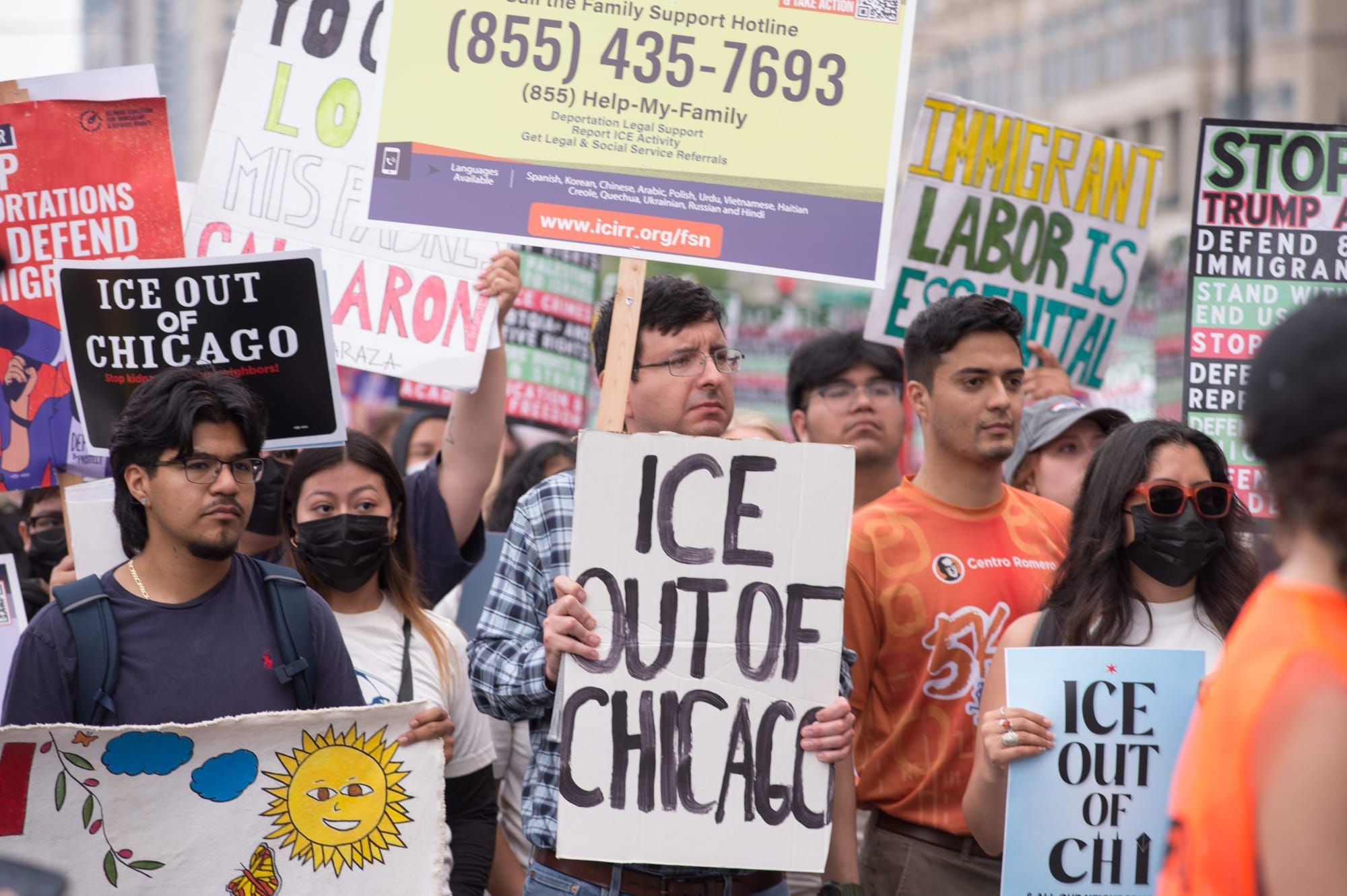
Immigrant rights advocates are demanding an investigation into whether the Chicago Police Department (CPD) broke the city’s sanctuary policies after police appeared at an immigration supervision office in the South Loop neighborhood, where federal immigration officers were conducting arrests earlier this month.
Civilians documented on June 4 that CPD was present outside the office during the raid and communicated with Immigration and Customs Enforcement (ICE). Activists say that this appeared to be a collaboration that may have violated Chicago’s Welcoming City Ordinance, which prohibits CPD from supporting federal immigration enforcement activity.
CPD did not respond to Prism’s multiple requests for comment. However, CPD officials claimed to organizers on the ground and in a later statement that they were in their full right to be there and did not assist any immigration enforcement activity. Still, organizers are concerned by what CPD’s presence on June 4 could mean for immigrant communities in Chicago and around the nation.
“People will be even more scared to call the city for help [or] call police departments because they won’t know if they’re actually going to get the help or if next thing you know, they’re being detained by police who are going to hand them over to ICE,” said Ángel Naranjos, an organizer with the Chicago Alliance Against Racist and Political Repression (CAARPR).
The scene unfolded when immigrant participants of ICE’s Intensive Supervision Appearance Program received text messages instructing them to appear at the government subcontractor’s office for a routine check-in, according to media reports. When they arrived, however, more than 10 people were detained by ICE.
Prism was present when rapid response immigrant rights groups across the city mobilized at the scene. When CPD arrived around 2 p.m., there were dozens of civilians present outside the office to document ICE’s activity.
Organizers quickly pointed out the potential illegality of CPD’s presence, which CPD spokespeople denied on the scene. A CPD official told the crowd, including officials, that officers were there in response to an officer-assist call and only stayed because of the crowd outside. The CPD later reiterated in a statement that it did not collaborate or assist ICE in any way and remained solely responsible for managing crowd control. Those at the building that day say differently.
“We saw blatant collaboration between ICE and CPD,” said Naranjos, who was also present outside the office. “There are videos of ICE and CPD agents talking to each other inside one of the buildings, and as soon as they realized they were being recorded, the ICE agent walked away. And when residents were trying to protest what was going on, CPD was there blocking them from interfering with ICE.”
Protesters outside the office were not free from ICE’s aggression. Chicago City Council’s Alderman Anthony Quezada, who was present at the protest, told Block Club Chicago that he was pushed to the ground by ICE agents and recounted numerous other accounts of excessive force from immigration officers.
“We had an ICE agent [in] a white van zoom through the alley and almost run us over,” said Gio Araujo, a University of Illinois Chicago student and community organizer who was at the back of the building. “There was one person who was hit on the shoulder with the van.”
ICE did not respond to Prism’s request for comment.
ICE’s escalation in tactics and the protest response follows the White House increasing the agency’s quota to 3,000 arrests a day. But communities are organizing to fight back.
“The attacks on Chicanos, Mexicans, Central Americans, [and] immigrants in this country have been happening for decades. What the Trump administration is doing is ramping that up,” Araujo said. “And so as Trump ramps up his attacks on our communities, so will the resistance against this oppression.”
The video evidence and firsthand accounts of the interactions between CPD and ICE earlier this month have caused a stir in the streets and offices of Chicago. Since June 4, numerous protests have taken the city by storm, including a massive anti-ICE march through downtown on June 10. Community members led a rally in Pilsen a few days after the raid, calling for an end to CPD and ICE collaboration.
Omar Flores, chair of CAARPR’s Immigrant Rights Working Committee, called for the mayor’s office to take action on any CPD and ICE collaboration that may have occurred. “If that’s not considered collaboration, I would be very confused as to what would be,” Flores said at a press conference preceding the rally.
Louise Carhart, an immigration attorney in Chicago, told Prism that she believes CPD violated the law, even if officers only showed up in response to officer assistance calls.
“If this had been a [Drug Enforcement Administration] officer or an [Alcohol, Tobacco, Firearms] officer, we’d be having a different conversation. But because it’s ICE and because they were executing an enforcement operation, to me, that seems like a violation of the Welcoming City Ordinance,” Carhart said. “They were there providing support to an enforcement operation.”
Many advocates across Chicago believe that CPD should not have been present at all.
Shortly after the arrests, Alderman Andre Vasquez introduced an order to investigate the CPD’s presence at the ICE raid and share any communication that may have occurred between federal immigration enforcement and Chicago offices, departments, or agencies. Co-sponsored by Quezada and Alderperson Maria Hadden, the order is a harbinger of the battle to bolster Chicago’s sanctuary laws. Hadden said in a statement that the order would “take review, reflection and communication inside City government to make sure that we are upholding our laws and protecting our residents under these new attacks from the federal government.”
CPD and ICE collaboration seems to be the start of this attempt to make the city’s sanctuary status useless and ultimately get rid of it.
Gio Araujo, University of Illinois Chicago student and community organizer
Many of those fighting the battle for immigration justice are doing so not in offices, but in the streets. Protests have erupted nationwide, triggered by the collective action in Los Angeles and the deployment of the National Guard and Marines. LA, another sanctuary city, is on the main stage in the conversation about immigration justice.
While a coalition of LA-area mayors has demanded that President Donald Trump roll back the mass deportations that sparked these protests and remove troops from the city, the Los Angeles Police Department is still being utilized to control crowds and has been documented using excessive force on protestors and journalists. As in Chicago, ICE activity in LA is being protected by local police departments through crowd control and officer support. As Trump’s mass deportation agenda heightens in intensity, advocates say that local law enforcement bending the rules of sanctuary law poses risks to immigrant communities, increasing the risk for violence and escalation, as seen in LA.
“CPD and ICE collaboration seems to be the start of this attempt to make the city’s sanctuary status useless and ultimately get rid of it, pushing forward Trump’s mass deportations campaign,” Araujo said.
Advocates said police support of ICE proves that the end of the battle against deportations is nowhere near in sight, especially after ICE’s hypermilitarized Special Response Teams was deployed to five cities, including Chicago. Organizers, mindful of the challenge they are up against, are working hard to build the movement even stronger during this moment of mass mobilization.
“There’s going to be heightened attacks on our people, but there’s also going to be heightened resistance and a fight by the immigrant communities and our allies,” said Naranjos. “While these spontaneous uprisings are very important, we need to sustain this movement, and we can only do that through organization. So I urge people to get involved with an organization.”
Editorial Team:
Sahar Fatima, Lead Editor
Carolyn Copeland, Top Editor
Rashmee Kumar, Copy Editor
Author
Wei Zhou is a freelance journalist based in Chicago. They got their start in writing and press as a community and political organizer, where they learned the power of a strong narrative to help build
Sign up for Prism newsletters.
Stay up to date with curated collection of our top stories.