Chicago’s quick mobilization of resources for new migrants reopened wounds in America’s most segregated city
Texas has sent 40,000 migrants to Chicago, fueling racial tensions in Black neighborhoods where residents have spent decades fighting for their communities’ needs
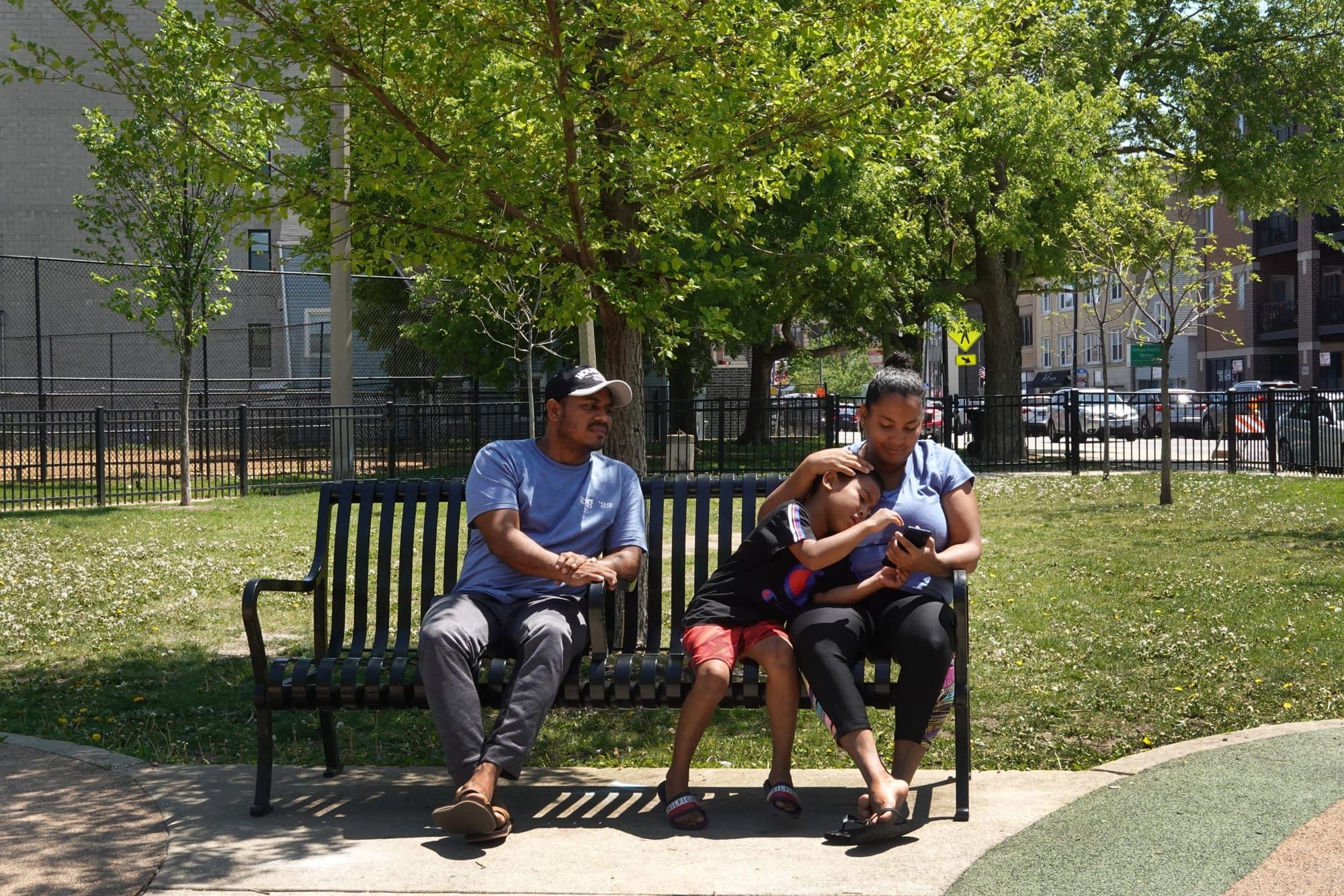
I met Karla on a Sunday afternoon last summer in Chicago, as she sat beneath an underpass in the West Loop neighborhood near the migrant shelter where she stayed. She is only using her first name for safety reasons, as she and her husband are newly arrived migrants trying to make their way in the U.S. Her husband runs a small makeshift barbershop where he earns money cutting hair.
Less than a mile away, former Vice President and presidential hopeful Kamala Harris took the stage at the Democratic National Convention, proclaiming that Democrats negotiated the strongest border security bill in decades, a contrast to her earlier criticism of the first Trump administration’s immigration policies.
Karla, who entered the U.S. from the southern border, didn’t arrive in Chicago by happenstance. Texas Gov. Greg Abbott first announced in April 2022 that he planned to bus migrants to Democrat-led cities. His stated goal was to recreate the “border crisis” in so-called sanctuary cities so that “the rest of America can understand exactly what is going on.”
But the border existed in Chicago long before Abbott sent buses. It existed between segregated Chicago neighborhoods where Black residents experience disinvestment, while wealthier and often whiter neighborhoods thrive. As Chicago’s government struggled to accommodate new arrivals, racial tensions between neighborhoods competing for resources erupted, as 40,000 migrants struggled to build new lives in the city.
Borders are complicated and contain multiple realities. While they may cause division, they can also create new cultures and ways of being. Amid government inaction in Chicago, neighbors stepped up to reimagine care.
To better understand the complex layers of Chicago’s humanitarian crisis, I spoke to dozens of migrants, organizers, nonprofit leaders, and academics across three countries. They shed light on how what has transpired in Chicago tells a bigger story about our divided country.
“Punish the population”
Since 2014, more than 7.7 million Venezuelans—or 1 in 4—have left their country. Angel is one of them. The 23-year-old, who is only using his first name for safety reasons, grew up during Hugo Chávez’s presidency when state oil revenues alleviated poverty. He has few memories of that time, but what he does remember is how drastically his life changed in 2013. Like many of his classmates, Angel often went to school hungry and without school supplies, wearing tattered shoes. At home, brown water came out of the sink.
Many factors led to Venezuela’s deterioration in 2013, including rapidly dropping oil prices and the death of Chávez. Then came sanctions, further crippling Venezuela’s oil revenues. First in 2005, then in 2015, and again in 2017 when, during his first administration, President Donald Trump broadened the sanctions in an attempt to oust President Nicolás Maduro by targeting the state-owned oil company and cutting off Venezuela’s access to the U.S financial system.
“The goal of these sanctions … is to punish the population enough so that they will change their government,” said Geo Maher, a sociologist and author of “We Created Chávez: A People’s History of the Venezuelan Revolution.” “The political chaos we’ve seen is no surprise. The Venezuelan people are mad at their government, like anyone suffering in an economic crisis.”
While the sanctions targeted Venezuela’s leaders, regular citizens faced the most impact. A report by economists Mark Weisbrot and Jeffrey Sachs estimated that from 2017 to 2018, more than 40,000 Venezuelans died due to the Trump administration’s sanctions. Inflation also made essential items like food, water, gasoline, and medicine unaffordable.
Despite the conditions gripping his home country, Angel always found ways to feel joy. His brother introduced him to music and taught him how to play the cuatro, a traditional Venezuelan instrument. “Music relaxes us and makes us travel to beautiful times, or to dark and ugly times. But mostly it brings us joy and peace,” he said.
The dark times often outweighed the beautiful times—especially once Venezuela’s high cost of living worsened. Angel’s mother joined the exodus of Venezuelans fleeing the country to work in Peru. “She sacrificed years without us so we could eat better, so we could be a little more carefree,” Angel said.
Karla was a public school teacher who regularly protested the Maduro government for higher pay, stronger social security, and better access to education for working-class students. In Venezuela, she earned just $10 a month.
In early 2024, Venezuela’s opposition parties prepared for a presidential run against Maduro. Despite the hopes surrounding the election, Maduro remained in power, triggering massive protests and arrests.
“I trusted that it was going to be OK”
A week after the election, while sitting in a cafe in Chicago, Angel recalled how over time, it felt impossible to stay in Venezuela.
“You saw the town empty, sad, desolate, people poorer,” he said. That’s why, in the fall of 2020, his mother bought him a bus ticket to leave the country. Karla left Venezuela for similar reasons, arriving in Chicago in April 2024. She told her parents that she was headed to the U.S. for better opportunities. They were sad but understood. Shortly after, she and her kids started the first leg of their journey: a 12-hour bus ride to Colombia.
Angel reunited with his mother in Peru, where he lived for three years, working to save money for their journey to the U.S. By the time he reached Guatemala in August 2023, Angel had traveled through a half-dozen countries with his mother. Once in Guatemala, he heard that police officers were soliciting bribes at the border to enter the country—a rumor that turned out to be true.
Guatemala was also the first foreign country Harris traveled to as vice president in March 2021, when she delivered a clear message to migrants: “Do not come.” “If you come to our border,” she said at a news conference, “you will be turned back.” It was an early sign of the Biden administration’s rightward shift on immigration.
During the early days of the Biden administration, the U.S. began funding deportation flights from Panama and construction to seal the deadly Darien Gap, where hundreds of thousands of migrants risk their lives each year to cross between Colombia and Panama. Joe Biden also signed agreements with Mexico, Guatemala, and Honduras to deploy National Guard troops throughout the region to detain migrants.
In September 2024, just down the block from the Guatemalan Congress, I met a family of six from Venezuela sitting outside a McDonald’s asking pedestrians for change on one of Guatemala City’s busiest streets.
Like many Venezuelans, the family could not afford the high cost of living and left the country. They counted 14 dead bodies while traversing the Darien Gap, and they were later robbed by Guatemalan police. “That was the money for the children’s food. It was money for the trip,” said the father. After the robbery, the family focused on saving money for food, guides, the raft to cross the southern Mexican border, and to pay off additional police along the way.
Looking ahead, they said they feel anxious knowing they’ll have to pay armed cartels on the Mexican side of the border to take them further north. This is a common concern. One migrant who eventually made it to Chicago told me that the most difficult country for an immigrant is Mexico and that “the jungle is easy” in comparison.
A few days after bribing police in Guatemala in August 2023, Angel and his mother reached Mexico City penniless. So they did what many migrants do: They traveled atop freight trains.
Along the way, they applied for an appointment through the CBP One smartphone app, which the Trump administration has since done away with. At the time, the app scheduled an appointment for migrants to request asylum at an official port of entry, though the app was known for major glitches and long wait times. When Angel and his mother finally reached the southern border in September 2023, they decided not to wait for their CBP One appointment and instead waded across the Rio Grande into Texas.
On the other side of the river, Border Patrol agents were waiting. At a processing center, officials separated Angel from his mother. “I was trying to calm down,” he said, “because I trusted that it was going to be OK”
Two days later, after Angel received humanitarian parole, Border Patrol transferred him to a new location run by another agency unknown to Angel, likely the Texas Division of Emergency Management. Officials asked him where he wanted to go: Dallas, Chicago, or New York. He chose Chicago, where he had a friend.
When Angel stepped onto the bus, he was stepping into a theatrical performance choreographed to inflame anti-immigrant sentiment during an election cycle.
He didn’t know then, but when Angel stepped onto the bus in September 2023, he was stepping into a theatrical performance choreographed by the Texas governor to inflame anti-immigrant sentiment during an election cycle. Border crossings were at the highest level in years, with nearly 2.7 million migrants encountered in 2022. Abbott’s targets were sanctuary cities that purported to have protections for immigrants. Juan González, a senior research fellow at the University of Illinois’ Great Cities Institute, called the move “a masterful Machiavellian ploy.”
While on the bus, Angel finally heard from his mother. She was still in Texas and said she would meet him in Chicago. Once in downtown Chicago, Angel was ushered off his bus, and a stranger added him to a shelter waitlist before putting him on a school bus. He ended up at a police station in Chicago’s Austin neighborhood on the west side.
Outside of the station were dozens of other migrants. Angel quickly befriended another Venezuelan who gave him a tour of the area. Inside the police station, many migrants slept on the floor. Outside were about 20 tents, a staging area for food, water, donations, and a microwave for leftovers.
Similar encampments were springing up at police stations across Chicago. Abbott’s mission to ship the border to Chicago was well underway.
In August 2022, Johannes Favi, the deputy director of the Illinois Community for Displaced Immigrants (ICDI), alerted the Chicago mayor’s office to the first bus of 79 migrants. While uncertainty was in the air, the number of arrivals was initially small enough to mostly go unnoticed. “We will continue to welcome them with open arms,” said former Chicago Mayor Lori Lightfoot at a news conference. “I refuse to turn our back on them.”
However, Abbott’s political stunt soon escalated into a humanitarian crisis in the spring of 2023, shortly after Chicago elected a new mayor, Brandon Johnson, who ran on a bold, progressive platform. When news broke in April 2023 that the city would host the Democratic National Convention, Abbott escalated his tactics.
Buses arrived every day, sometimes at night or in faraway suburbs, with no warning to the city. In one case, migrants were dropped off on the side of a highway.
With an overwhelmed shelter system that had suffered years of disinvestment, the city had nowhere to house migrants. The federal government also failed to provide work permits or substantial funding to help integrate the newly arrived migrants into the city. Police stations became the only facilities to immediately house them.
“It’s a huge failure on all levels of government,” said Cynthia Brito, a youth organizer in suburban Oak Park. “There’s no reason that will justify children sleeping outside on concrete floors.” The city brought in porta-potties for the tent cities, but they “were overflowing,” recalled Brito. “It was very unsanitary and honestly dangerous.”
Soon it was summer in Chicago, and the mayor’s new administration was overwhelmed. At one point, nearly 3,000 migrants slept at police stations. Mutual aid volunteers and nonprofits from surrounding communities quickly stepped up.
“Anytime an emergency response is initiated like that, you will always need the support of the community because they can respond faster than the government,” said Maggie O’Keefe, an organizer who volunteered at Chicago’s 20th District police station and spent many mornings cooking meals for migrants in her kitchen.
Police station response teams were soon organized across the city. Each station had a WhatsApp group where volunteers coordinated meals, donation drop-offs, rides, and more.
Throughout 2023 and 2024, the nonprofit Chi-Care coordinated nearly 700,000 meals over six months at various police stations. ICDI dispatched case managers and volunteers. A food pantry run by New Life Centers on the southwest side soon noticed a large number of new migrants utilizing their services. The worker center Latino Union gave know your rights trainings to migrant workers in the informal economy. The Mobile Migrant Health Team, a group of medical students and health care workers, provided basic health care to migrants. Chicagoans showed up.
In October 2023, mutual aid organizer Betty Alzamora even helped Angel reunite with his mom at O’Hare International Airport. Angel said that when he reunited with his mother, he felt “normal” again. Alzamora described the emotional reunion as difficult to watch. “I was just standing there going, ‘Don’t cry. Don’t cry. Shit, I’m crying,'” Alzamora said.
When they returned to the police station, Angel put a sheet on the floor where his mother would sleep. It was fall and quickly getting colder, but it was all he had.
As the weather worsened, Alzamora said she saw a young boy “turn blue.”
“It was at that point that those of us who were there said they needed to go indoors. …This tragedy is about to get far worse,” the organizer recalled.
Soon, the city’s biggest priority became opening brick-and-mortar shelters and moving migrants indoors before winter arrived. The Johnson administration rapidly identified and opened new shelters, nearly one a week. However, the quick mobilization of resources reopened unhealed wounds in America’s most segregated city.
“Scarcity mentality”
When Lightfoot was still in office, she announced in December 2022 that the city would turn a vacant elementary school in the southside neighborhood of Woodlawn into a migrant shelter. Outrage erupted in the historically Black neighborhood.
At a packed community forum, speaker after speaker opposed the shelter, citing poor planning and lack of Spanish-speaking resources. Some questioned why migrants got immediate resources while Black residents in Woodlawn continued to struggle.
When one community member asked if the city would help his family in need, another shouted, “They would do nothing for us!” The Woodlawn shelter opened as planned in February 2023.
Despite the hope ushered in by Chicago’s new mayor, the racial division in the city was palpable. On his first day in office, Johnson visited a police station to meet migrants. He later told reporters, “I’m confident that there’s more than enough for everyone in this city, and no one has to lose at the expense of someone else winning.”
But Woodlawn’s response was repeated across Chicago. When a shuttered high school in South Shore and a community college on the southwest side were proposed as shelters, residents gave stiff opposition, just as they did in Edgewater and when a southside hotel in Kenwood and a former grocery store in Morgan Park were proposed as shelters. At each of these sites, neighborhood groups and local alderpeople expressed frustration. Some neighborhoods even prevented shelters from opening.
“They had every right to protest and push back,” said Crystal Gardner, a community organizer based in Austin. But according to Gardner, the community’s protest was also difficult to hear. “Black folks from this community, from Austin, were sounding like their white oppressors: ‘Why can’t they just go back? Why can’t we just put them on the bus and return them? We don’t have enough room here for them. We got our own issues.’ So all of that hurt.”
City Council meetings also became hotbeds of tension. When a group of conservative council members introduced an ordinance to remove Chicago’s status as a “welcoming city” to stop Abbott from bussing migrants, immigration organizers sprung into action.
And so did opponents.
Miguel Alvelo Rivera, executive director of Latino Union of Chicago, an organization that provides support to day laborers and other contract workers, argued that a “scarcity mentality” is pitting communities against each other. “If somebody else gets something, then I get less. If new migrants get support, then that means I’m not getting support,” he explained.
“Part of the solution is, if you want to support migrants and long-term residents, you need to address the core of the structural issues in our cities,” Alvelo Rivera said, adding that it requires “serious political will.”
Playing the long game
By December 2023, migrants were moved from police stations into brick-and-mortar shelters with little fanfare. As of January 2025, Chicago has spent over $600 million on migrant shelters, most of which went to the vendors operating the shelters. Despite the high cost, reports quickly emerged of subpar conditions.
Investigative reporting by Borderless Magazine revealed that at Chicago’s largest shelter in the southwest side Pilsen neighborhood, there were complaints of spoiled food, frigid temperatures, and dirty bathrooms. With 2,000 people living in close proximity, the shelter was also a hotbed of illness.
It was at the Pilsen shelter where, in December 2023, 5-year-old Jean Carlos Martinez Rivero died, and four others were hospitalized. An autopsy report revealed that the child from Venezuela died from sepsis due to an infection.
“He had a completely treatable ear infection,” said Kelley Baumann, a volunteer with the Mobile Migrant Health Team, an organization that provides health care to newly arrived migrants who are unhoused. “I can only chalk it up to negligence, why he wasn’t given antibiotics, and ultimately passed away from sepsis. … The right kind of medical team would not have let that happen.”
Organizers say that spending millions on short-term shelters has been short-sighted and that the money would have been better spent rehabbing long-term housing.
Beginning in the fall of 2023, organizers and migrants at the Austin police station began meeting with Oak Park City Council members, speaking at board meetings, and holding press conferences to demand that the neighboring more affluent white suburb do more to support new arrivals.
The first time it snowed in 2023 was on Halloween. Condensation collected on the inside of tents, and cold water dripped on children.
“Earlier that day, we organized to take some of the kids trick-or-treating,” Brito recalled. “We went back in the middle of the night. … It was bad, like it was so cold. The kids were crying. You could hear babies crying. And I was just like, ‘Fuck this.’”
Brito moved migrants, including Angel and his mother, to the Oak Park police station, a designated warming center. Oak Park’s mayor later showed up at the Austin station. Distraught, the mayor called her pastor, who turned their church into a temporary overnight shelter. A week later, two additional shelters were set up. In one of them, Angel finally had a room of his own. He was also connected with an immigration attorney, who assisted with his asylum and work permit applications.
Organizers eventually formed the Oak Park Resettlement Task Force, a group dedicated to finding permanent housing for new arrivals. With a combination of government funding and extensive private fundraising throughout the winter, organizers identified apartments and paid nearly a year’s rent for over 200 migrants. Angel and his mother were recipients of the aid. By April 2024, families who had slept on the floor of the Westside police station now had their own independent apartments.
“Shelter housing is not efficient. Finding apartments for people … that model is more sustainable over the long term. Imagine if we had had the support of the [government] to make what we did as volunteers more operational and more scalable?”
Betty Alzamora, mutual aid organizer
“Shelter housing is not efficient. Finding apartments for people … that model is more sustainable over the long term,” Alzamora said. “Imagine if we had had the support of the [government] to make what we did as volunteers more operational and more scalable?”
The work done in Chicago is substantial, but in Trump’s America, gone are the days of “all are welcome here.” The administration’s efforts toward mass deportations are well underway, beginning in Chicago with large-scale immigration raids.
Locally, the humanitarian crisis bussed to Chicago has come to define Johnson’s time in office, reflected in his abysmally low approval rating of 14%. Trump, on the other hand, increased his support in Chicago by nearly 10%.
“They played the long game with us. … Governor Abbott and [Florida Gov. Ron] DeSantis bussing and flying migrants here was an effort to seal the election,” Gardner said. “It was just an effort to create divisiveness, confusion, and chaos.”
It’s been eight months since the last bus of migrants arrived in Chicago, though the city is still reeling from the aftermath. The multiracial movement that elected a union organizer to the mayor’s office has largely unraveled. Chicago officials appear unsure of how to address the systemic inequalities that made quick investments in migrant shelters an offense to so many. Homelessness in Chicago is at an all-time high as immigration raids terrorize immigrant neighborhoods, leaving many new arrivals fearful of leaving their homes. The future seems uncertain for everyone.
The Chicago winter proved too harsh for Karla. She is looking to leave the city with her husband for somewhere warmer, maybe Miami or Las Vegas.
At this point in his young life, Angel has fled the U.S.-backed economic collapse in Venezuela, border regimes throughout Central America and Mexico, and is thus far surviving in a major American city with a hollowed-out social safety net. He’s doing odd jobs to make ends meet as he works toward a more stable future, which he hopes will one day mean starting a school to teach classical Venezuelan music.
“I want to be here in this country,” Angel said. “I want to grow. I want to start something.”
If only the U.S. will let him.
Editorial Team:
Tina Vasquez, Lead Editor
Carolyn Copeland, Top Editor
Rashmee Kumar, Copy Editor
Author
Ankur Singh is a Cicero-based, Chicago-adjacent freelance journalist and organizer
Sign up for Prism newsletters.
Stay up to date with curated collection of our top stories.