Chicago is now the largest US city to call for a ceasefire
The Chicago City Council passed a ceasefire resolution, making it the latest city to demand an end to the U.S.-backed Israeli assault on Gaza
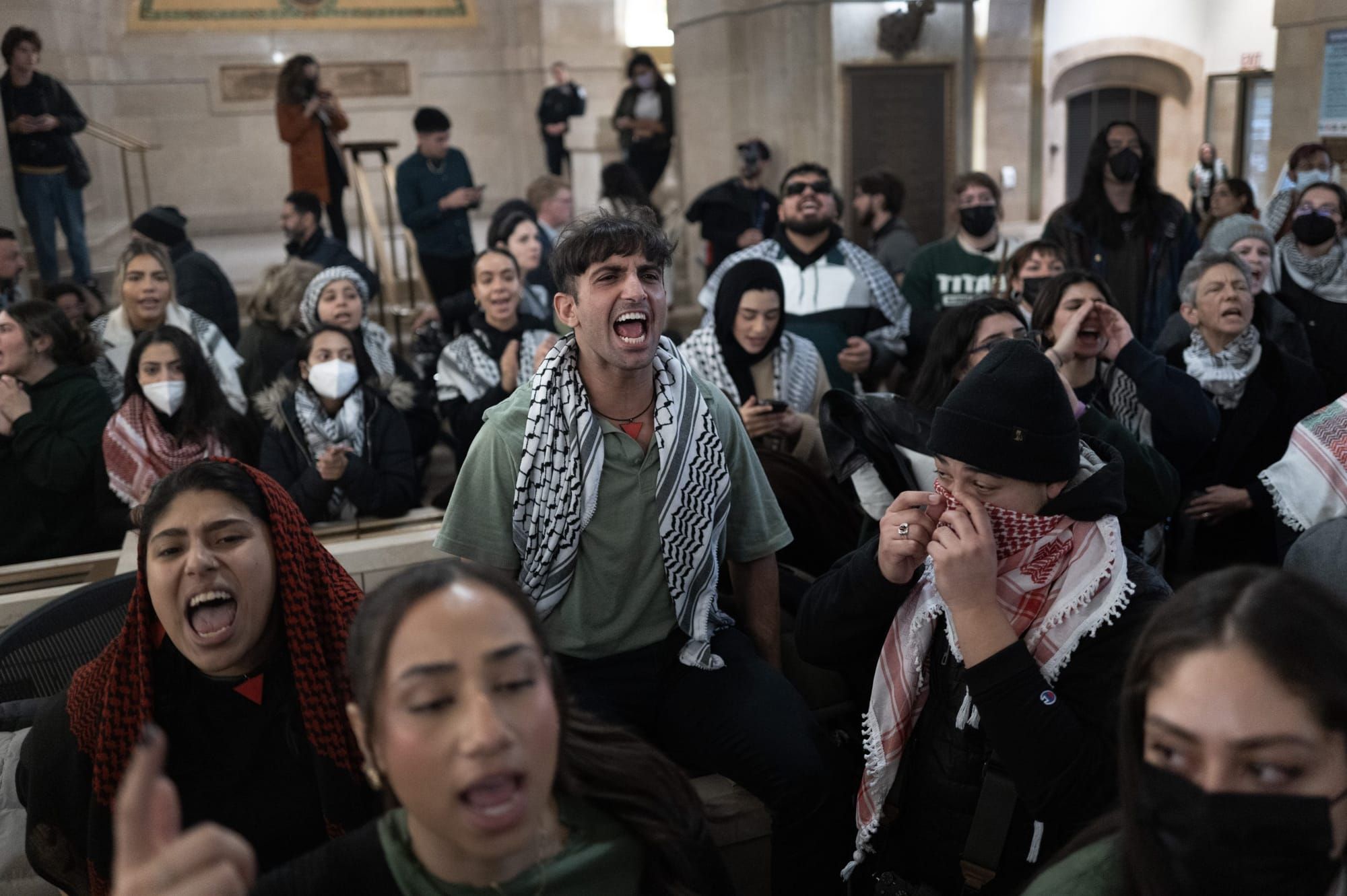
On Wednesday, Chicago became the largest city in the nation to endorse a resolution calling for an immediate ceasefire in Israel’s war on Gaza.
The 24-23 vote came after a full-throated debate among City Council members. Mayor Brandon Johnson broke an initial 23-23 tie by supporting the measure, ensuring its passage.
The resolution, known as “Uniting for Peace,” was introduced by Alderpersons Rossana Rodríguez Sánchez (33rd Ward) and Daniel La Spata (1st Ward) and was based on a motion recently put forward at the U.N. General Assembly that earned the support of more than 150 nations (the U.S. cast one of 10 votes against it). In addition to supporting a ceasefire, the Chicago City Council resolution calls for the release of hostages and the supply of additional humanitarian aid to Gaza.
Nearly 27,000 Palestinians, mostly women and children, have been killed by Israel’s bombardment of Gaza since the attacks began in early October, and more than 90% of the enclave’s 2.3 million residents have been displaced. There is a dire lack of food and clean water. The U.N. Secretary-General has called the situation facing Gazans a “humanitarian catastrophe.”
In a case brought by South Africa accusing the Israeli government of committing genocide, the International Court of Justice ruled last week that Israel must prevent genocidal acts and allow humanitarian aid to civilians, among other measures. Israel was given a month to submit a report to the court showing the country’s compliance with those mandates. South Africa framed its case within its longstanding contention—echoed by other critics—that Israel’s decades-long occupation, systematic denial of Palestinians’ basic rights and freedoms, and blockades on food and other vital resources amount to a system of apartheid.
During the public comment portion of Wednesday’s City Council meeting, a number of residents spoke in support of the ceasefire resolution. Ceasefire advocate Marty Levine, a member of Jewish Voice for Peace, said, “I do this because I believe it is what I, as a Jew, must do.” He continued, “The lesson we are required to learn from the Holocaust is that it can never happen again, and we can never allow it by action or inaction to happen again … ‘Never again’ is not for some people; it is for all. We are all created in God’s image. We are taught that to save one life is as if we had saved all of humanity.”
Jennifer Husbands, a 40th Ward resident, said, “We have borne witness to the mass murder of innocent civilians in Palestine.” Noting that a majority of likely voters and three-quarters of Democrats support a ceasefire, she argued that “our tax dollars are being used to carpet-bomb civilians and force Palestinians out of their homes” rather than fund services like housing, education, and gun violence prevention.
“As Tupac said, ‘They got money for war, but they can’t feed the poor,’” said Husbands.
The Chicago area is home to the largest Palestinian population in the U.S. More than 18,000 Palestinians live in Cook County, which includes the city.
Wearing a keffiyeh scarf, Rama Izar, a pro-Palestine activist, spoke of the regular street protests against Israel’s assault that have engulfed the city: “We have been chanting on the streets of Chicago every single week about freedom, about liberation, about justice.”
“Israeli Minister of Defense Yoav Gallant said Israel is fighting human animals,” Izar continued. “How on earth is a ceasefire still up for debate? … There is no business as usual as long as this genocide persists.”
Those opposing the resolution cited the Oct. 7 attacks by Hamas and killing of 1,200 Israelis as a reason for Israel to continue its attacks on Gaza.
Mayor Johnson appealed for peace in the chamber after a number of disruptions to speakers. When Alderperson Debra Silverstein (50th Ward) rose to speak in opposition to the resolution, she faced so many interruptions that the mayor called for a recess and cleared the public from the gallery. Silverstein is the author of a separate resolution of support for Israel that the City Council passed in October following Hamas’ attack.
Last week, Johnson came out in favor of the “Uniting for Peace” ceasefire resolution, saying, “I believe we’re looking at 25,000 Palestinians that have been killed. The killing has to stop. So, yes, we need a ceasefire.”
“I can say from a very personal note: I know that for Black liberation, we had to make statements that may [not have had an immediate] impact,” the mayor said prior to the council meeting. “But I’m not mayor of the city of Chicago if people weren’t pushing the government to recognize people’s humanity and understand the value [of] liberation—what it means for people, groups, and nations. And in this instance, people should be liberated.”
Nearly 50 cities across the U.S. have now passed pro-ceasefire resolutions, including San Francisco, Minneapolis, and Detroit.
Rev. Jesse Jackson, who supports a ceasefire, was in the room for the vote. Along with his Rainbow PUSH coalition, he had penned a letter urging City Council members to back the resolution.
Labor unions in the city, including members of the Chicago Teachers Union, United Auto Workers (UAW), National Nurses United (NNU), and Service Employees International Union (SEIU), held a press conference on Monday supporting the ceasefire resolution. SEIU, the UAW, and the NNU are among national labor unions that have voiced support for a ceasefire and an end to violence in the region, in what Carl Rosen, general president of United Electrical, Radio, and Machine Workers of America, called “the biggest expression for peace by the labor movement in a full generation.”
On Tuesday, hundreds of Chicago Public Schools students walked out of class and rallied at City Hall in support of the resolution. Kiera Hines, a junior at Kenwood Academy on the South Side, told Block Club Chicago: “The students and the younger generation really care about Palestinian people. Even though we’re not being bombed [in the U.S.], we are indirectly affected by this—seeing our peers, even children and adults, we’re seeing this can happen to other people. It almost feels like a threat.”
The week of action helped proponents of the resolution build majority support. Ahead of the vote, Alderperson Nicholas Sposato (38th Ward), who opposed the measure, lamented, “We got outworked.”
The passage of the resolution was an undisputed victory for Chicago’s progressive and pro-Palestine movements that have organized and protested for months, demanding a ceasefire in Gaza. Many of the left-wing groups that make up these movements were also instrumental to last year’s election of Johnson and other progressive leaders in the city.
The Chicago City Council joins Democratic elected leaders in Illinois who have called for a ceasefire, including Sen. Dick Durbin and Reps. Delia Ramirez, Jesús “Chuy” García, and Jonathan Jackson.
Some supporters of the Chicago resolution see it as a way to put pressure on the Biden administration to put an end to Israel’s assault. The Democratic National Convention, where the party is expected to officially nominate Biden for president, will be held in Chicago in August, and the city formally calling for a ceasefire could put the administration in an uncomfortable position if it doesn’t change its unconditional support for the Netanyahu government’s bombardment. With his wholesale backing of Israel’s actions, the president has seen his support crater among Arab Americans and young people, both key constituencies, especially in swing states such as Michigan.
“Chicago matters a lot in terms of the national political landscape,” Rodríguez Sánchez told WBEZ. “We know that the DNC is going to take place in Chicago, and what Chicago does is important for the rest of the country … It has a ripple effect.”
This article is republished with permission from In These Times magazine and is available at inthesetimes.com.
Author

Miles Kampf-Lassin, a graduate of New York University’s Gallatin School in Deliberative Democracy and Globalization, is a Web Editor at In These Times. Follow him on Twitter @MilesKLassin
Sign up for Prism newsletters.
Stay up to date with curated collection of our top stories.