Caregivers across the U.S. mobilize for Gaza’s kids
As children continue to bear the brunt of Israeli genocide in Gaza, parents in the U.S. take action with their kids
The shrouded body of a 10-year-old girl, pink roller skates still strapped to her lifeless feet. A weeping father clutching the birth certificates of his newborn twins, killed with their mother by an Israeli airstrike as he registered their births. A six-year-old child’s terrified voice, trapped in a car and begging for help before Israeli tanks fired. “Will you come and get me?” she asked before she was killed alongside her family. “I’m so scared.”
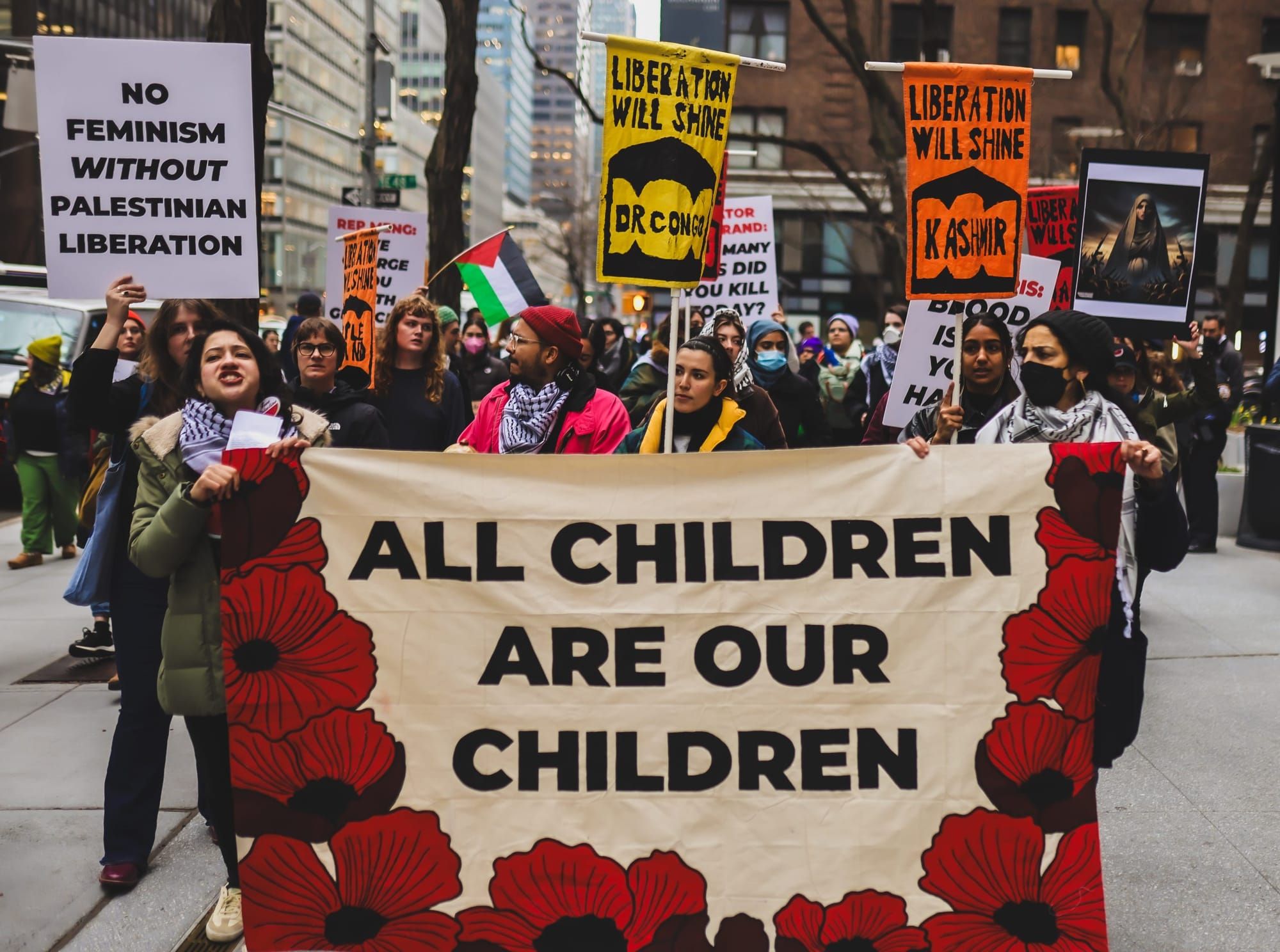
For the last year, images and videos of Palestinian children suffering and being killed by Israel have flooded social media feeds. While these images have left an indelible mark on many viewers, they’ve struck a particularly painful chord for parents. That pain has galvanized caregivers across the country to channel their grief into action, leveraging their parental identities in their organizing—and bringing their children with them.
“We want to create a world where we don’t hide this from our children, but have them participate in the process of making it less dark and horrible,” said Tala Abu Rahmeh, a Palestinian mother living in Brooklyn with her partner and their two-year-old.
Abu Rahmeh didn’t think twice about whether to bring her daughter to the marches and protests that sprung up around New York City after Oct. 7. As a teenager in Palestine during the second intifada, Abu Rahmeh and her family often took to the streets together. As a parent, protesting is still a family affair. Abu Rahmeh is careful to leave protests early to avoid interactions with the police, and she keeps an eye out for unrest that might put her daughter at risk.
“It just felt unconscionable to not participate, considering it would be very different if I were home [in Palestine],” she said. “It would be a reality we’re all living under, versus being isolated and disconnected like we are here.”
Parents and caregivers fighting for Palestine in the U.S. are carving out spaces to challenge that disconnection. In the face of a genocide that has claimed the lives of more than 16,000 children, according to the Gaza Health Ministry, and separated more than 20,000 from their families in Gaza, these organizers are creating events that not only welcome kids but center them.
“We recognize that political work is intergenerational work,” said Bhavana Nancherla, a Brooklyn, New York-based parent and longtime organizer. “The power of movement spaces inherently depends on making room for everyone—and that really includes children.”
Forces for change
On a humid, windy day in August, Todd Neufeld set up a small table in New York City’s Prospect Park with his seven-year-old son Arshile and some of his friends. It was the culmination of a project dreamed up by Arshile: a watermelon lemonade stand for Gaza. A keffiyeh served as a tablecloth, and the kids helped pour glasses of tart lemonade mixed with watermelon juice and seltzer for visitors who made donations. Beside the table on the grass were screen-printed T-shirts for sale that read “GAZA,” made with the help of another parent.
Neufeld, who grew up in a Jewish family, has gently navigated the subject of Palestine with his son over the last year as Israel’s onslaught continued. He has tried his best to explain what’s unfolding in an age-appropriate way, which isn’t always easy.
“I just involve him with honesty, but with respect for the fact that he’s a seven-year-old child,” said Neufeld. “He can’t handle everything; I can barely handle everything. But it’s been a beautiful thing, taking him to protests and teaching him about the subject in a very measured way.”
In late September, Gaza’s Ministry of Health published a 649-page document listing the names of more than 34,000 identified Gazans who have died since October 2023. The first 710 names in the document, which reports deaths through Aug. 31, belong to infants. The document is a stark testament to the disproportionate toll Israel’s genocide has taken on children, 11,355 of whom were Gazans under 18 years old.
These catastrophic numbers are difficult to grasp for adults, let alone kids. But caregivers and parents who spoke to Prism emphasized that trying to shield their children from the tragedy—or disguise their own grief—can do more harm than good. Rather than overwhelming them with frightening information, bringing kids into advocacy spaces can also help empower them to see their communities as forces for change.
Colleta Macy, a member of the Wasco, Warm Springs, and Nez Perce Tribes, lives on Warm Springs Reservation in north central Oregon. As an Indigenous parent, ensuring her kids understand the parallels between what’s happening in Palestine and what has happened to their own people is essential.
“It’s the same thing that our ancestors went through,” said Macy. “They’re 76 years into their genocide, and we’re 500-plus years into ours.”
There are always kids running around Macy’s house. She has three of her own children, and her partner has five. Scrolling on TikTok this past year, she saw the children of Palestine as indistinguishable from her own, whether watching them cry for a lost parent or finding joy while playing with other kids in an encampment. Even the stray dogs of Gaza remind her of the res dogs at home. Helping her kids understand what’s happening in Palestine is one way of investing in their futures.
“When you teach your younger generations these things, they know that they have things to fight for,” said Macy. “We’re trying to make a better world for them. I’m praying, inshallah, that within our lifetime, the freedom of Palestine will happen. But Allah could take me at any time, and so teaching our kids these things, they’re our future generations, and they’re going to be left with this. For them to know and to be educated is key.”
Mary Hunt, a Brooklyn-based parent of two, brings their kids to protests to show them how communities can take action together in the face of tragedy. They believe the choice to spare children from the scary truths of the world can do more to protect a parent than a child.
“So much of what is delivered to children today is based off of this idea that they are too young to understand, or that it’s inappropriate to make children feel sad or uncomfortable,” said Hunt. “I think that has more to do with our discomfort with them feeling sad…I think children feel inherently more safe when they’re being seen and talked to as the participants that they are in this world.”
Including children in organizing doesn’t just help them understand the complexity of the world around them. Nancherla and other caregivers emphasized that the presence of kids in organizing spaces also strengthens their advocacy—and it changes how adults interact.
“Kids remind us that we can be playful, even when we’re doing serious work, and also can inspire us to do better,” Nancherla said. “I notice that people will see each other with a little more kindness, will try a little harder.”
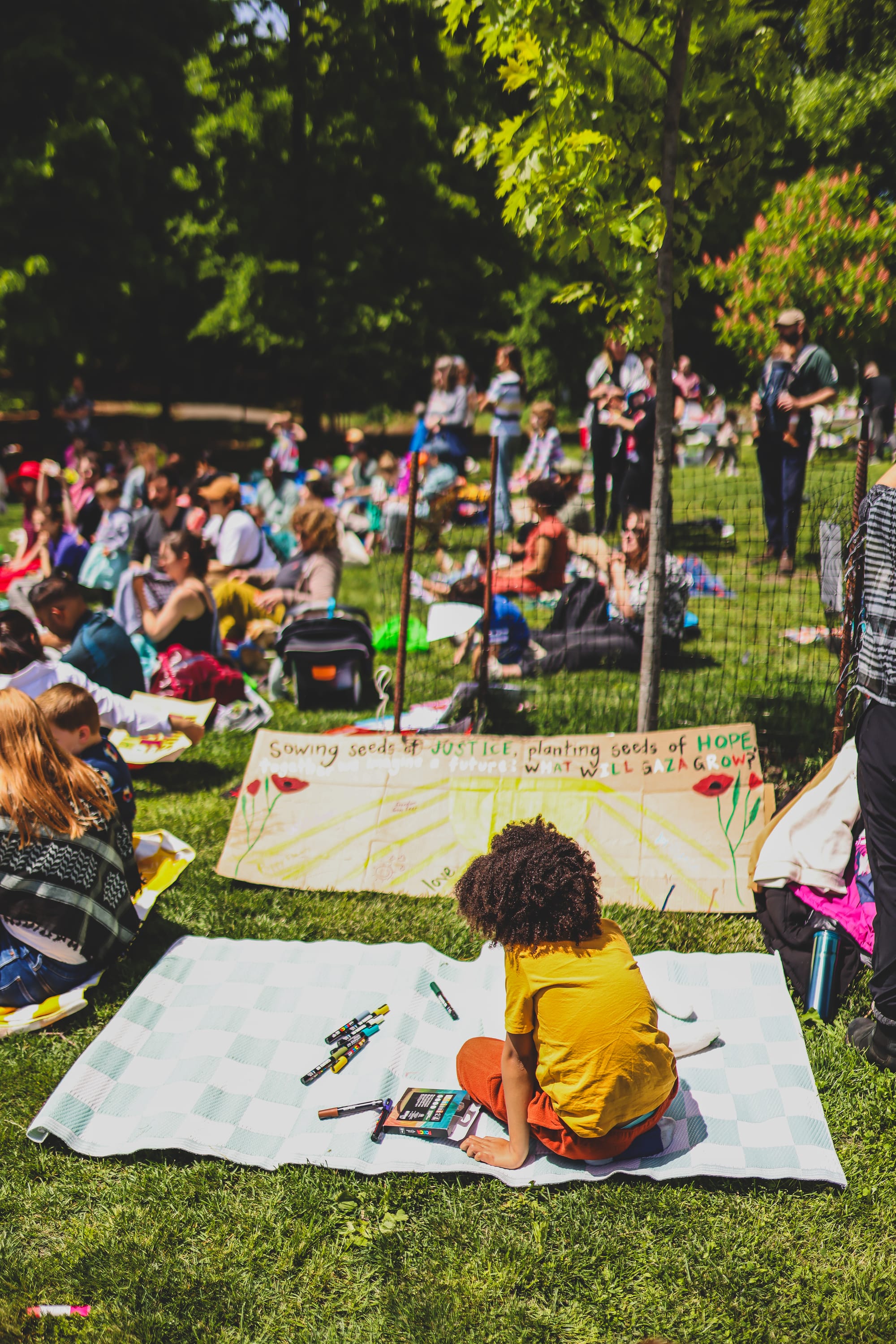
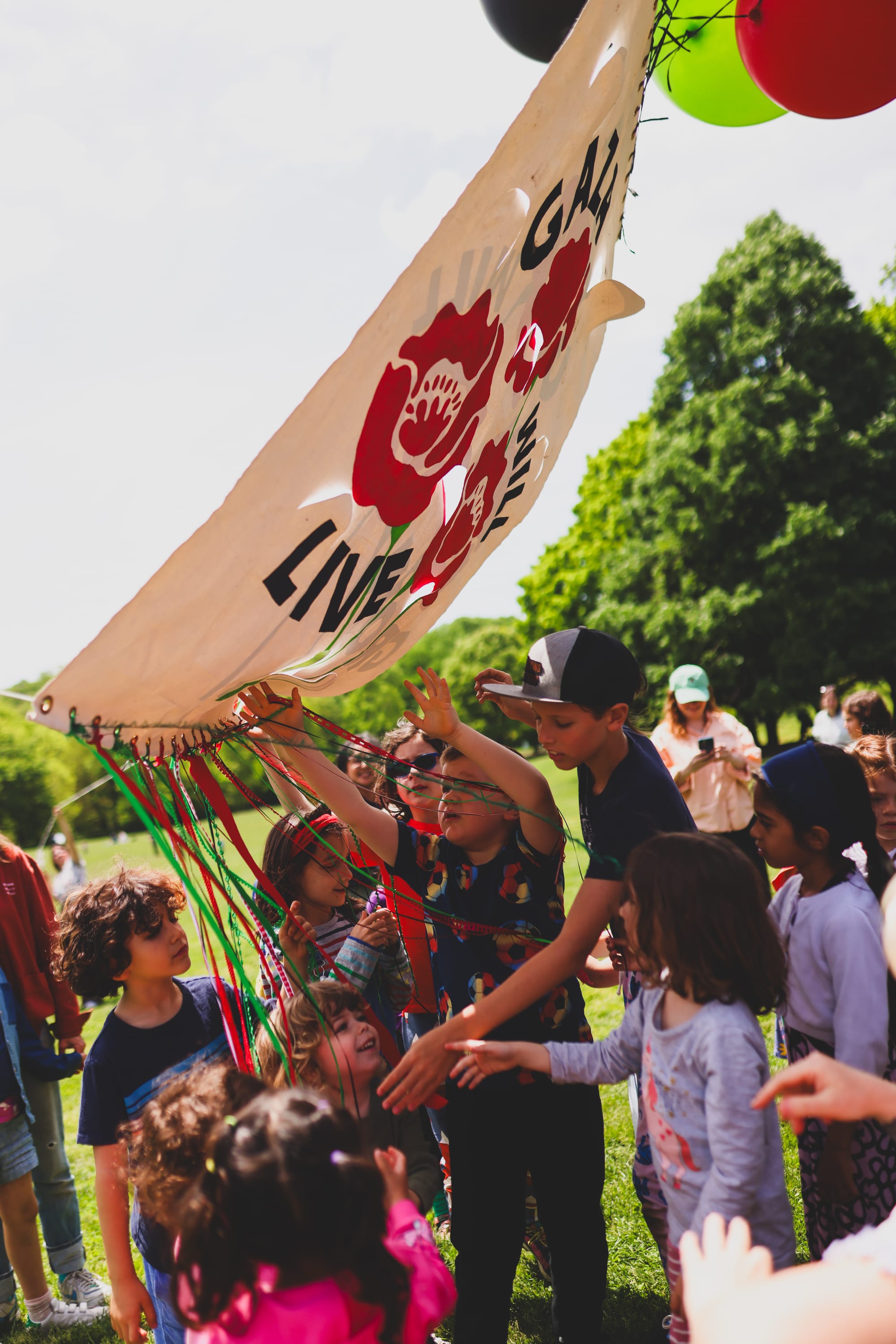
At a Mother’s Day event earlier this year for Gaza in Prospect Park, the spirit of play was front and center. Kids decorated pots and planted poppy seeds, scrawled on placards with markers and crayons, ran around, sang, and together they flew a huge kite tied to balloons that read “Gaza Will Live.” The screams of kids during their parents’ speeches were received by families not as interruptions, but as an inevitable part of the picture. Parent organizers are eminently familiar with chaos, and rather than futilely trying to control every detail of an event involving dozens of kids, the disarray operated as a beautiful lesson in making space for everyone.
Lessons from Palestine
The work of parents and caregivers like Nancherla is situated in a long, global history of organizers centering their identities as mothers. From the antinuclear movement to mothers organizing for gun control, to Argentine mothers of people disappeared for challenging the junta, parental identity has proven to be a powerful political tool.
Dartmouth professor Annelise Orleck, a historian of women’s activism in the U.S., sees today’s organizing for Palestine as part of a long continuum of “parents wielding the moral authority of parenthood to make points about the morality of their political stance.” More recently, she sees echoes of the protests challenging Trump’s family separation policies at the border. Images of kids in cages, separated from their parents or shivering under plastic thermal blankets in detention centers, were widespread and drew many parents to protest.
Arresting images have historically helped draw attention to familial causes. As part of a series of actions in 1971, a group of Black, working-class mothers in Nevada shut down the Las Vegas strip in a historic march with their kids after the state welfare director cut already paltry benefits for poor families. Orleck chronicled their fight to feed their families in a book. The mothers and kids marched down the strip and into Caesar’s Palace Hotel and Casino, stopping tourists in their tracks and grinding business to a halt.
One of the most memorable images captured that day, Orleck said, was of a child holding a sign above a craps table that read, “Nevada Starves Children.”
“Those little skinny arms holding that sign do more to call into question the state’s stance as the defender of morality against fraud-perpetrating welfare recipients than anything else they could do,” said Orleck. “The impact of the images of children in protest is very powerful.”
While vignettes of kids taking center stage in movements for social justice can capture attention, the last year has been an ugly lesson in the limited power of images of children suffering. One year into Israel’s most recent war on Palestinians, images and stories of the injured and dead in Gaza and the occupied West Bank, and now Lebanon, still stream across social media feeds as the genocide continues. As Palestinians document and share the horror that surrounds them, the real-time, graphic record of Israel’s crimes hasn’t translated into accountability or safety. Palestinian American poet Hala Alyan observed earlier this year that the sheer number of images can have a dehumanizing and numbing effect: “There is a saturation point of horror, where the collective psyche either recoils or normalizes, where the metric for horror begins to shift. What’s another dead child in the face of twenty thousand?”
Orleck agrees that many have become inured to the violence.
“For me, that’s stunning,” said Orleck, who was tackled and arrested by police at a student-led encampment at Dartmouth in May. “It’s terrifying that we have come to a place where these images of children aren’t enough to move people.”
Amid the pictures of hunger, disease, and death, there are still images of joy and play as survival. Kids fashioning a seesaw out of the rubble of their homes during Eid; drawing pictures of their communities in Rafah; learning Dabke from a dance troupe. For Nancherla, many lessons in caregiving and organizing come straight from Palestine.
“There is so much about how I actually want to be in community, be in caregiving, be in relationship with my own kids, with family, that is connected to looking at some of the practices of care in places that are facing such extreme oppression,” Nancherla said. “Palestine is both the site of deep harm and also the site of deep resistance and modeling of care as resistance.”
‘It’s a luxury to be able to make that choice’
Though it can be powerful, including children in activism is not without risks. In March, organizers in New York City held a rally in front of Sen. Kirsten Gillibrand’s office that culminated with a circle of parents and caregivers kneeling in the street, holding what was made to look like shrouded children. The action was a nod to a widely circulated photo of Palestinian Samia al-Atrash cradling the body of her two-year-old niece.
Alexandra Egan was among the participants who knew they would likely be arrested for obstructing traffic. In addition to the fake child in her arms, Egan strapped her two-and-a-half-year-old child to her back. She planned ahead to hand off her child to a friend when police intervened, and prior to the action, Egan explained to her child what would happen. As a single parent, the choice to bring her child to the protest was both political and logistical. Like many parents who spoke to Prism, she pointed out that the prohibitive cost of childcare often necessitates bringing children to organizing spaces. Paying a babysitter $25 an hour wasn’t an option, Egan said, and she wants her child “to grow up feeling like she is an active shaper of the world.”
“I knew it might be scary, but I also knew that the presence of a child at a protest about children would make it much more powerful,” Egan said, noting that she and her daughter have a strong relationship and that her child has the resilience to handle the outcome. Still, Egan said, “It’s a luxury to be able to make that choice.”

Almost immediately, Egan says the presence of her child drew attention and scrutiny from some of the police officers. She was the first person arrested. Hunt, who was also part of the action, saw Egan’s arrest as a strategic choice by the police.
“I think they wanted to remove the child to remove the power of that statement and to disempower our group a little bit,” said Hunt.
Egan says she was also held an hour longer than other protesters at the precinct following their arrests. Roughly two weeks later, all charges against them were dropped. Then, Egan received an alarming call from Child Protective Services (CPS): One of the police officers filed a complaint against her for “using her child in the commission of a crime.”
The case was terrifying for Egan. Two CPS social workers visited her home and asked her about her mental health, whether she took antianxiety medication, and if she had previous contact with the criminal legal system. After their first visit, it wasn’t clear what would happen. “I’m a single mother, I’m a Black mother, I just applied for and received food stamps,” said Egan. “These are the things that will count against you.”
Though CPS scheduled a second visit in May, the case was ultimately dropped, to Egan’s relief. She is still glad she brought her child to the protest that day, but she wrestles with the fallout of that choice.
“I feel really strongly that I want to raise her to be an empowered activist in the world, someone that feels like it’s important for us to do what we can to make a change, that it’s not futile,” said Egan. “But I also worry that I was a bit selfish or naive in involving her in that way.”
“I definitely will not be participating in direct actions with her in the foreseeable future,” Egan added.
‘How dare you continue the killing?’
After Oct. 7 of last year, a friend called Nadeen Bir and told her she wanted to organize an awareness-raising event for mothers in Durham, North Carolina who wanted to collectively call for a ceasefire. Bir, who is Palestinian American, was eager to get involved. The event quickly snowballed and many community members reached out wanting to contribute. Some brought food, others planned children’s activities, and Bir’s daughter even spoke. By all accounts, it was a huge success. A few weeks later, some of the moms in the group took their kids with them to Rep. Valerie Foushee’s office. They carried red roses and signs drawn by children. This is how Mothers for Ceasefire was born.
The group has continued to organize over the last year, hosting kid-friendly events, calling on their city council to pass a ceasefire resolution, and disrupting a June speech by President Joe Biden in Raleigh, North Carolina. Bir recently hosted an orientation for new members, and their work continues. But ultimately, she emphasizes that they are working toward becoming obsolete.
“We were not doing an event [last October] to build an organization, we were doing an event to raise awareness and help end this,” Bir said. “I want the war to end…and I would be happy if Mothers for Ceasefire could disband.”
Until that happens, Mothers for Ceasefire and their kids are turning their attention to Kamala Harris.
“We need to do everything we can to push her for an arms embargo, for a ceasefire,” said Bir. “How dare you continue the misery? How dare you continue the killing?”
These questions—and the anger, disbelief, and grief that accompany them—reverberate through homes and organizing spaces as the grim one-year anniversary of Oct. 7 passes. For Nancherla, the pain is especially acute in moments when they are caring for their own children, holding or feeding them while carrying the knowledge that kids and parents in Palestine are deprived of nourishment and safety.
“This time has been one where I feel stretched across impossible contradictions,” Nancherla said. “I feel such incredible heartbreak, and at the same time I know that the only time I feel different is when I’m taking action in the street.”
Author
Rebecca McCray is a journalist based in New York. Her reporting has been published by The Guardian, New York Magazine, Rolling Stone, Gothamist, The Daily Beast, New York Focus, Slate, and other outle
Sign up for Prism newsletters.
Stay up to date with curated collection of our top stories.