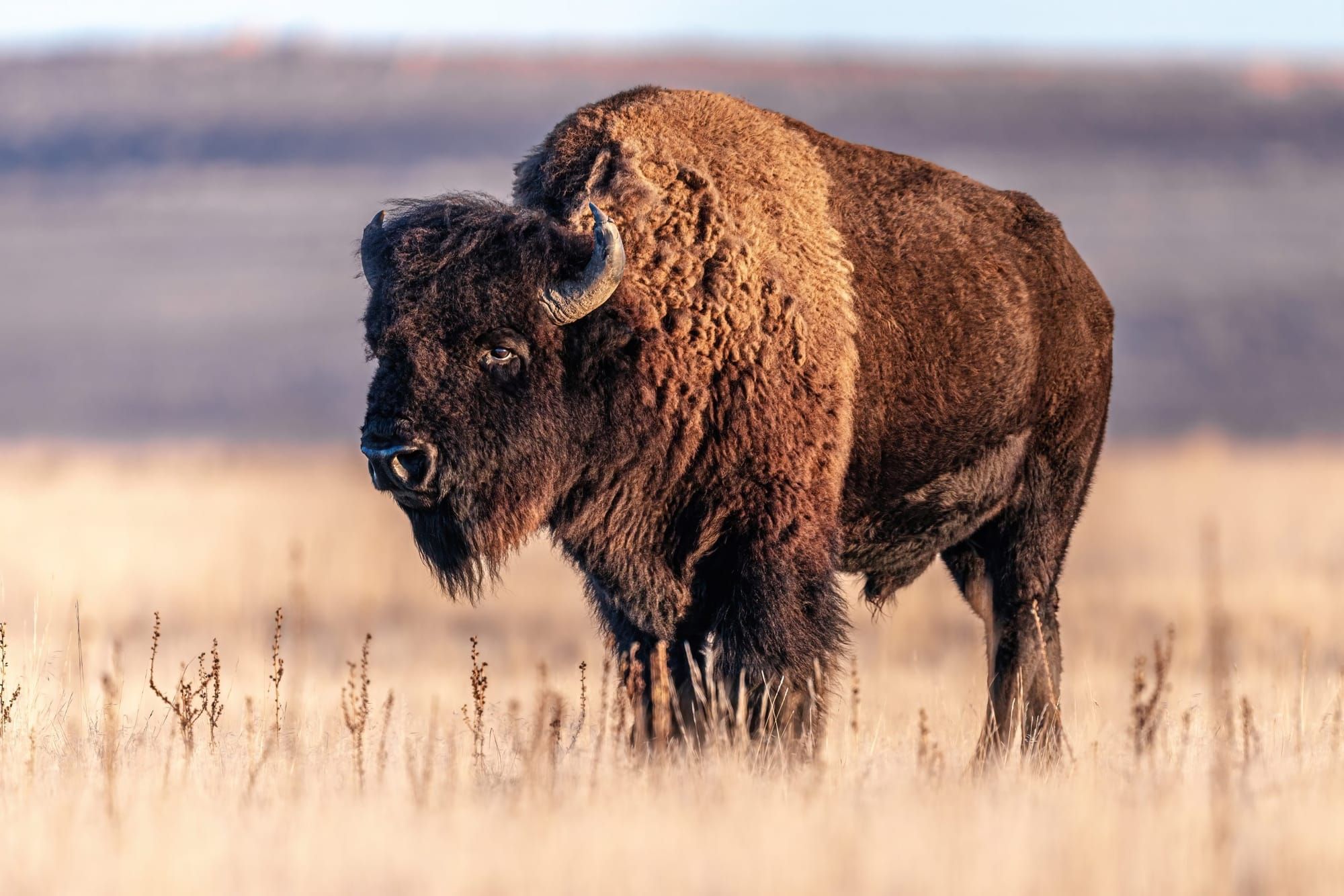
Indigenous communities are hard at work restoring a relative: the buffalo
Back from the brink of extinction, buffalo are at the center of an ecological revolution led by Indigenous leaders
Real journalists wrote and edited this (not AI)—independent, community-driven journalism survives because you back it. Donate to sustain Prism’s mission and the humans behind it.
Come spring, a new relationship with the land in Letcher County, Kentucky, will be born. Or rather, a relationship will be reborn, as buffalo begin their return to Appalachia for the first time in over 100 years.
For more than a century, a thirst for coal strip-mined the land in the hills of Eastern Kentucky. The tops of mountains were blasted off, sending chemical deposits and toxins deep into the soil and down river, depleting the environment of its nutrients. In turn, surrounding communities, once held in place by a coal economy, were drained of their financial security. That’s why in 2006, when Rep. Hal Rogers recommended a new prison build atop the land in Roxana for the sake of jobs and a supposed economic stimulus, some locals felt they were being offered a raw deal, once again based on extraction.
A cross-racial, cross-regional coalition argued that the prison would displace people from their home communities and entrench an economic system predicated on the violence of incarceration. They argued, Why not add back to the land rather than take from it?
In the final months of 2024, an Indigenous-led organization known as the Appalachian Rekindling Project finalized the purchase of 63 acres of land that the Bureau of Prisons had hoped to use for the medium security prison Rogers recommended. Prison construction was slated to cost a minimum of $500 million, and last June, the Trump administration announced that it was rescinding the funds.
Now, when the ground thaws this spring, the Appalachian Rekindling Project will begin to line the perimeter of the land with fencing fit to hold buffalo. Four of these animals, known for their force of strength and ability to jump six feet into the air, are making a triumphant return to Kentucky—land that was their birthright before the arrival of European colonists.
Since time immemorial, Indigenous peoples across the continent lived in relationship with buffalo, relying on their meat, hide, bones, and characteristics as a keystone species for their own existences. Extractive economies required land that buffalo lived on, including Southern plantations growing cotton, tobacco, and sugar, and later the Midwest’s fossil fuel extraction and monocropping.
According to Tiffany Pyette, one of the founders of the Appalachian Rekindling Project, buffalo herds once migrated from Appalachia to Canada. The Cherokee, Shawnee, and Yuchi peoples of what’s now Central Appalachia made their home with buffalo. After centuries of continuous dispossession—from land, culture, and the connection between the two—buffalo and Indigenous peoples are returning to the land.
“Buffalo aren’t just an animal,” Pyette said. “They are also this incredible tool of resetting a balance of everything. We get to share this model for how you can deal with mountaintop removal damage [by] listening to Indigenous knowledge and letting a species return.”
Across the U.S., Indigenous peoples are leading an ecological revolution to return buffalo to their homelands in order to heal cultural ties severed by federal policy and restore the wellbeing of ecosystems that once thrived with the buffalo. But Indigenous leaders, ranchers, and organizers are up against major challenges, from land access to climate change. Still, they remain adamant that buffalo return is a spiritual journey, a faith that might lead the buffalo home and heal the land.
Restoring a relative
With the help of the U.S. Cavalry and Army Corps of Engineers, early settlers pursued the Great Plains for business and pleasure. Federal policy granted land to settlers to build homesteads and facilitated the removal of Indigenous peoples from their ancestral homelands to reservations and prisoner of war camps. As part of these allowances, settlers were also encouraged to kill buffalo for sport—as many as possible, as quickly as possible.
Prior to European contact, there were 30 to 60 million buffalo roaming from Oregon to New Jersey, the Arctic circle to Mexico. By the time settlers were through using buffalo for target practice, nearly all had been killed. In 1902, there were fewer than 1,000 buffalo in Yellowstone National Park, where since 1894 it had been illegal to kill them.
The federal government understood the connection between Indigenous tribes and the buffalo. Early surveyors of what would become the American West saw how tribes relied on buffalo meat for sustenance, their hide for warmth, and their presence for spiritual kinship with the land. Colonists, traders, and military leaders understood the life-giving connection insofar as they used it against Indigenous peoples, with one colonel telling a settler deputized with a rifle, “Kill every buffalo you can. Every buffalo dead is an Indian gone.”
“It is really very systematic,” said Jason Baldes, an enrolled member of the Eastern Shoshone Tribe. Baldes is also the vice president of the InterTribal Buffalo Council, an organization focused on buffalo restoration, and the founder of a nonprofit organization called the Wind River Tribal Buffalo Initiative, which aims to bring buffalo back to the land, and thus, strengthen the relationship between Indigenous peoples and the lands that their ancestors cared for. “It was intentional to destroy the food source for Native American people, to subjugate us onto reservations and take our land.”
The policies of genocide against Indigenous peoples and extermination of the buffalo are what led to the Dust Bowl of the 1930s.
More than a century after the period of federal Indian policy demanding the removal, relocation, and termination of Indigenous tribes, the land bears the manifold scars of colonial dispossession. Buffalo are no longer able to play the stabilizing role in the ecosystems they once did, and the land—now privatized for the agricultural production of commodity crops—is essentially an ecological wasteland.
Over thousands of years, buffalo coevolved with the land, breaking up soil with their hooves, offering birds warm fur to nest with, and promoting plant biodiversity through their grazing habits, among many other contributions. The country’s national mammal, also referred to as bison, now number approximately 400,000. They are no longer considered at risk of extinction, largely due to efforts by private entities with deep pockets and sociocultural backing, such as conservation organizations and ranchers. The federal government has also reversed its position on the buffalo; where it once advocated for the species’ decimation, it now disperses funding for tribes to restore buffalo herds in order to heal grasslands and prairies. The Bison Project, launched in 2023, is managed through the Department of the Interior’s Bureau of Indian Affairs.
The tide is turning because of Indigenous leadership, recognizing buffalo not just for what they do, but what they are.
“When we are trying to restore buffalo in a meaningful way for tribes, it isn’t always about gaining the dollar,” Baldes said. “It’s about restoring our relative back to our people.”
Baldes told Prism that the Wind River Tribal Buffalo Initiative, which is affiliated with the Eastern Shoshone and Northern Arapaho Tribes, started with 300 acres, a strong launch point but not enough room to sustain a large herd.
Baldes solicited donations from funders and secured $10 million, allowing the land mass to expand to 2,000 acres while increasing the herd size. It is effortful work, buying back land that was once taken from his people. But it’s part of a larger project that, as Baldes said, “changes the trajectory of our history, promotes eco-cultural restoration, and helps to reconcile those atrocities of the past.”
The Nature Conservancy, a global environmental conservation organization, raises 11 herds of buffalo across 10 states. About 6,000 animals are at work restoring soil and plant species of the grasslands and prairies. Some of the most significant parts of The Nature Conservancy’s work have been the ways in which the organization follows the leadership of the InterTribal Buffalo Council and other buffalo advocacy organizations like the Tanka Fund, said Corissa Busse, the buffalo restoration program manager for The Nature Conservancy.
In 2020, The Nature Conservancy began annual transfers of buffalo from its herds to the InterTribal Buffalo Council, which was then able to offer buffalo to the tribal nations it works with. That first year, 70 buffalo were transferred. In the years since, a total of over 3,000 buffalo have made their way to Indigenous tribes.
That’s important because buffalo, which are codified as a treaty right, are not easily accessible to most Indigenous peoples. Treaties, which carry the weight of any international document dictating government-to-government relations, arose out of need: with buffalo eradicated, tribes hoped that signing over land might engender new sources of food or income.
Today, 25% of Indigenous peoples do not have regular access to food. This reality is largely set by policy decisions of the past, including those that separated Indigenous peoples from their historical food source of buffalo, and those that made housing, stable incomes, and access to adequate public services hard to come by.
The ripple effects of the COVID-19 pandemic and government shutdown in the fall of 2025 also wreaked havoc on tribal communities, with tribal governments stepping in to fill the gaps that the pause on programs such as the Supplemental Nutrition Assistance Program and the Food Distribution Program on Indian Reservations created. Many tribes harvested buffalo from their local herds and distributed the meat to families on the reservation whose needs were not being met by either government program.
On the Pine Ridge Reservation, Charles Brewer runs the Charging Buffalo Meat House, which harvests buffalo that is then sold to the commodity program so that tribal members can purchase local buffalo meat for an affordable price.
Brewer, who is Oglala Lakota, said that the processing facility can harvest up to 15 buffalo per week during harvest season. The Charging Buffalo Meat House has operated for 10 years and employs about eight people. But more than food or employment, buffalo butchery provides a connection point to Lakota culture and foodways.
“Since we got into doing this, we noticed the ripple effects of colonization,” Brewer said. “We discovered it was hard to find workers, and when we did find a worker, we had to start them from square one: how to sharpen a knife, how to keep yourself clean, how to cut, how to start skinning.”
Learning how to hunt and harvest buffalo is a right of passage in Lakota culture, one that federal policies encouraging buffalo hunting and discouraging Indigenous cultural practices have effectively withheld. Now, because of operations such as Brewer’s, these skills are being woven back into daily life.
Foster Cournoyer-Hogan is the Buffalo Nations coordinator for NDN Collective, an organization dedicated to supporting the sovereignty and self-determination of Indigenous peoples and tribes. NDN Collective launched a campaign to distribute buffalo meat during the government shutdown. Cournoyer-Hogan told Prism that a forced dependence on beef and commodity foods changed what Indigenous peoples were accustomed to or found flavorful. Buffalo, once a staple in Indigenous cuisine, now tastes, to many, both familiar and foreign.
“Our palates have changed over generations,” said Cournoyer-Hogan, who is Sicangu Lakota and a tribal citizen of the Rosebud Sioux Tribe.
Many Indigenous ranchers are also learning how to raise buffalo, converting cattle ranches to those that support buffalo, said Zintkala Rivera. The enrolled member of the Oglala Lakota tribe in South Dakota works as the range ecologist for Tanka Fund, a nonprofit organization that supports individuals wanting to raise buffalo.
“There’s quite a bit of Natives who come from a ranching background and cattle, but they don’t know where to start when it comes to buffalo, even though buffalo is our cultural animal that our people have been around for ages,” Rivera said.
“There’s been so much transition in history where both the animal and culture were taken away from Native people strategically by the government, and so we’re kind of at that phase where cultural revitalization and bringing back the buffalo are going on at the same time. They’re really interconnected.”
Tanka Fund supports buffalo ranchers in a number of ways, from providing funding for native seed plantings and mapping out prescribed grazing plans, to figuring out just how many buffalo the land can support based on forage production. The organization also helps ranchers apply for funding through the U.S. Department of Agriculture for conservation ranching practices.
Buffalo naturally engage in practices that the world of regenerative agriculture refers to as “rotational grazing,” the practice of moving animals through pasture to improve soil, plant, and animal health. Rivera said Tanka Fund is interested in tracking how the land heals after buffalo reintroduction. Research shows that buffalo are more adaptable than cattle to the consequences of climate change and that the animals directly support the regeneration of biodiversity on grasslands needed to counteract the prevailing force of rapid ecological shifts. Buffalo usually calve annually starting at the age of 2, which advocates say is an overwhelming benefit because research shows the more buffalo on the land, the better the land will do.
The same is true for Indigenous communities, which Rivera said “could see the difference when the buffalo was brought back. It felt like their culture was getting stronger and their community was strengthening.”
Still, the biggest hurdle, Rivera said, is access to land. Farmland is prohibitively expensive in the U.S., with more ranchers leaving animal husbandry every year. Closed system economies, whereby Indigenous ranchers sell to tribes or Indigenous-run businesses, may help raise needed funds to grow or start businesses.
Land return is another option.
NDN Collective is in the beginning stages of a larger campaign to return buffalo to their ancestral homelands, part of what the organization claims will be the largest LANDBACK effort to date. Since the organization launched in 2018, the return of Native lands off reservation by private and public entities has been core to its work. Cournoyer-Hogan told Prism that this more recent campaign launch goes hand in hand with earlier iterations of LANDBACK. But instead of speaking with and on behalf of tribal communities, NDN Collective is playing an advocacy role for buffalo.
The vision is a buffalo corridor connecting the lands from Wind Cave National Park in the Black Hills, extending all the way to the Missouri River. Reservation lands dot the current blueprint for the corridor—the Great Sioux reservation, the Pine Ridge Indian Reservation, the Rosebud Indian Reservation—and there’s a “checkerboard” of off-reservation lands, Cournoyer-Hogan said. But until now, buffalo haven’t been permitted to roam freely.
Soon they might, and it will change everything.
Editorial Team:
Tina Vasquez, Lead Editor
Lara Witt, Top Editor
Stephanie Harris, Copy Editor
Author

ray levy uyeda is a staff reporter at Prism, focusing on environmental and climate justice.
Sign up for Prism newsletters.
Stay up to date with curated collection of our top stories.