The case of the Boeing Five: How a controversial Ohio law is helping prosecute organizers for Palestinian liberation
After protesters were arrested in March for blocking access to a Boeing facility in Ohio, prosecutors are leaning heavily on Marsy’s Law, which gives extensive rights to alleged victims
In Ohio, the mornings in March are cold. They’re even colder when you’re hanging off of a bridge.
This was the position some activists took up on the morning of March 11, when workers began to arrive at the Central Ohio Aerospace and Technology Center in Heath, Ohio, only to find that pro-Palestine protesters blocked all access points to the facility. Protesters had deployed three separate blockades on each of the facility’s access roads. They blocked two overpasses using a suspended cantilever system involving weighted blockades with protesters hanging from ropes below. Two other protesters locked themselves to a stationary car.
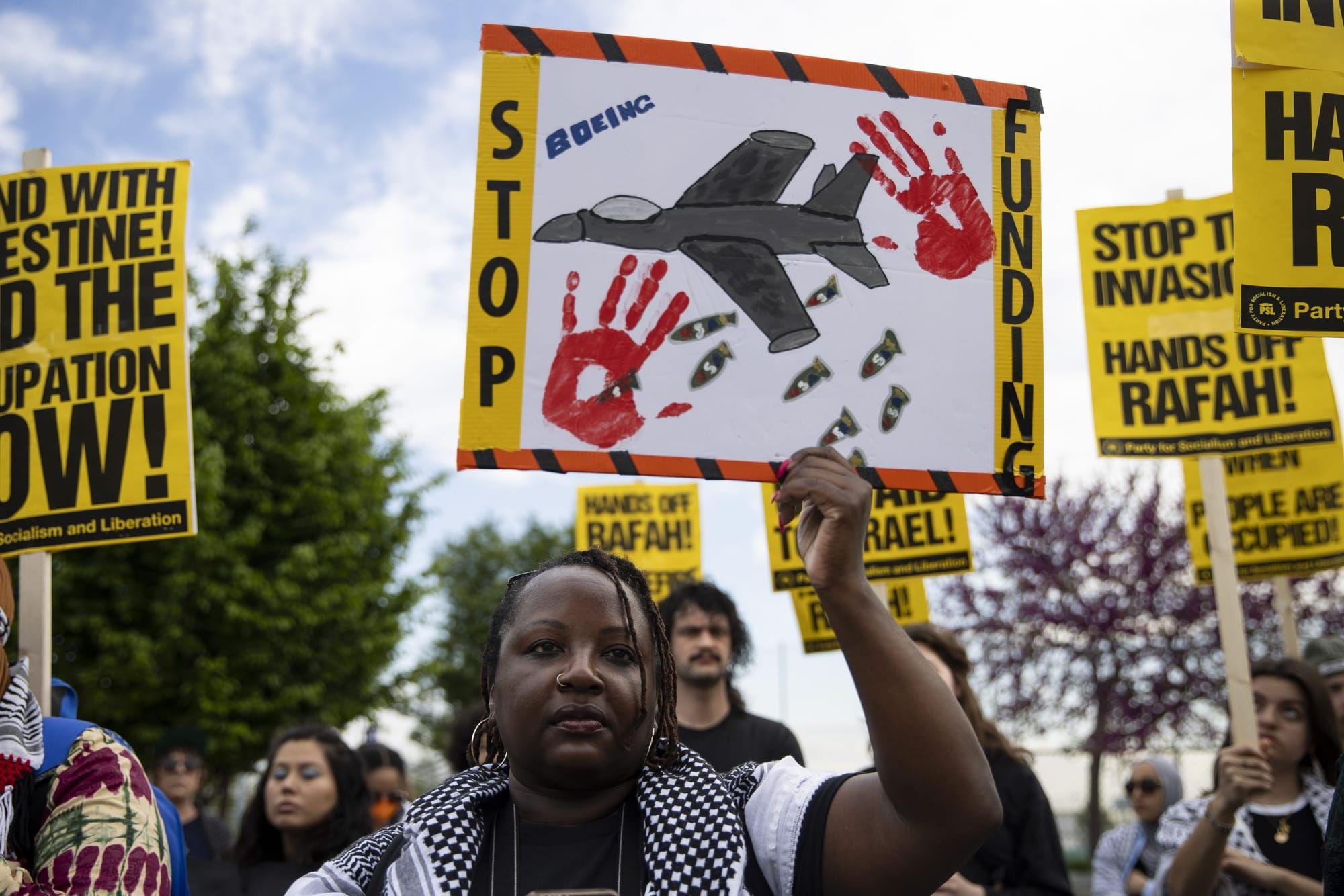
Multiple contractors operate out of the manufacturing center, but the activists’ primary target was the Boeing Guidance Repair Center, which builds missile guidance systems, aircraft, and unmanned aerial vehicles at the Ohio facility. In recent months, Boeing has come under intense scrutiny by activists for their partnership and supply of weapons to Israeli occupation forces in Gaza.
After an intense and frightening day for the activists, police arrested five individuals in and around the blockades. Initially, the activists, who have come to be known regionally as the “Boeing Five,” were charged with a variety of offenses, including felony charges of obstruction of a business and failure to comply with a police order. Since then, the felony charges have been amended, and the activists now face multiple misdemeanors each.
However, in the months since their arrests, their paths forward have been anything but clear. Prosecutors in Licking County, Ohio, have leaned heavily on Marsy’s Law, a controversial statute that grants extensive rights to alleged victims of crimes, which, in this case, prosecutors have deemed as Boeing and the other companies operating out of the targeted facility. Now, activists told Prism, they are concerned that the law is being used to repress and punish those organizing for Palestinian liberation.
“The reason why they’re being stiffer on sentencing is because of the restitution amounts these companies have come out with in the Marsy’s Law victimhood process,” said Seth, one of the accused activists whose last name is omitted for privacy.
Under Marsy’s Law, which was passed through a ballot initiative in 2017, alleged crime victims are entitled to be present at proceedings, to be notified when accused individuals are released, and crucially, it allows for victims to provide input on plea deals offered to the accused. Additionally, the law entitles victims to receive restitution as a result of financial losses they may have suffered. However, civil rights advocates in Ohio have sharply criticized the initiative, which they say bolsters the power of the state. Prior to the passing of the law in 2017, the ACLU of Ohio released a statement arguing against the provision, which it said threatened “fundamental rights” and would result in “longer prison sentences and higher incarceration rates” as well as depriving the accused of constitutional rights.
In Licking County, the prosecutor for the Boeing Five case identified Boeing and all of the other companies at the Aerospace Center as “victims,” entitling them to the full range of powers dictated under Marsy’s Law. As a result, protesters said that they have had to face many layers of additional scrutiny.
Following the Boeing Five arrests, Boeing and other companies at the facility requested $300,000 in restitution from the activists. Later in the process, as part of ongoing plea negotiations, weapons manufacturers stipulated that they wanted social media posts of the protest removed as a condition of the defendants’ plea deals. Defendants also believe that prosecutors in Licking County are facing pressure from aerospace companies to amend their current misdemeanor charges back into felony-level prosecutions.
The Licking County Prosecutor Jenny Wells’ office did not immediately respond to Prism’s request for comment.
Prince Shakur, a community organizer and activist coordinating legal support for the Boeing Five, said the harsh legal penalties the activists are facing are part of the wider national crackdown on activists organizing for Palestinian liberation.
“I view this as a multi-pronged attack on pro-Palestine movements,” he said. For activists, the connections between state prosecutors and private companies can have broad implications. “I think there’s layers to how repression is showing up and how these companies are kind of involved or encouraging police to sow more terror and resort to more surveillance as well.”
Boeing has a long history with Israel and has been supplying weapons to the nation’s military since 1948. Following Hamas’ offensive on Oct. 7, Boeing fast-tracked the delivery of more than 1,000 bombs to be used in Israel’s continuous air strikes on Gaza. Since October, Gaza’s Health Ministry estimates that more than 40,000 Palestinians have been killed by Israeli forces, many of them civilians killed in aerial bombings. Boeing did not immediately respond to Prism’s request for comment.
Police, fire, and emergency medical service teams had to work in tandem to remove the activists from their blockades and to arrest the protesters. For Joel Atkinson, who was locked to the interior of the fortified car, the experience was tense.
“They used jaws of life to remove the entire top of the vehicle while we were locked to it,” he said. “I definitely had anxiety around getting my arm injured. But one of the things that helped me through the experience was thinking about, in comparison, the things that Palestinians have had to endure.”
Other activists, including Seth, who was suspended from a bridge, claim law enforcement’s response put their safety at risk. “Two or three times an emergency vehicle almost hit the rope I was connected to,” they said, adding that additional supporters were arrested trying to prevent law enforcement from damaging the blockade’s safety infrastructure. “People literally had to jump in front of a police car,” said Seth. The Heath Police Department did not immediately respond to Prism’s request for comment.
Prosecutors in Licking County previously rejected plea proposals from the defense teams of the five anti-Boeing activists. In their most recent round of negotiations, the state agreed to drop the request for restitution but is still seeking a jail sentence of up to 30 days for the activists. At this point, it is unclear if any of the arrested protesters will be able to reach an agreement with the state ahead of their scheduled trial dates in early September.
However, Atkinson, who has been awaiting trial since the car blockade, hopes that the legal battle of the Boeing Five will demonstrate that the pressure exerted by protesters is working and that it will further mobilize activists in the U.S. to organize against the companies enabling the genocide in Gaza. “They’re going to use any tool at their disposal to try to silence people speaking up for the rights of Palestinians, but I don’t think that it’s going to work … I’m not intimidated by their tactics because, to me, it’s a sign that a movement has a lot of momentum and that they’re intimidated by us,” he said.
If a plea agreement is not reached, the first of the Boeing Five will head to trial this September.
Author
C. Frances is a freelance journalist from the American South. Her work currently centers around protesters facing state repression, resistance to environmental degradation, and radical politics in rur
Sign up for Prism newsletters.
Stay up to date with curated collection of our top stories.