Who shows up when Black women die during childbirth?
About 20 Black women die each year in New York City from pregnancy-related causes. The grassroots group Movement to Birth Liberation helps the families left behind
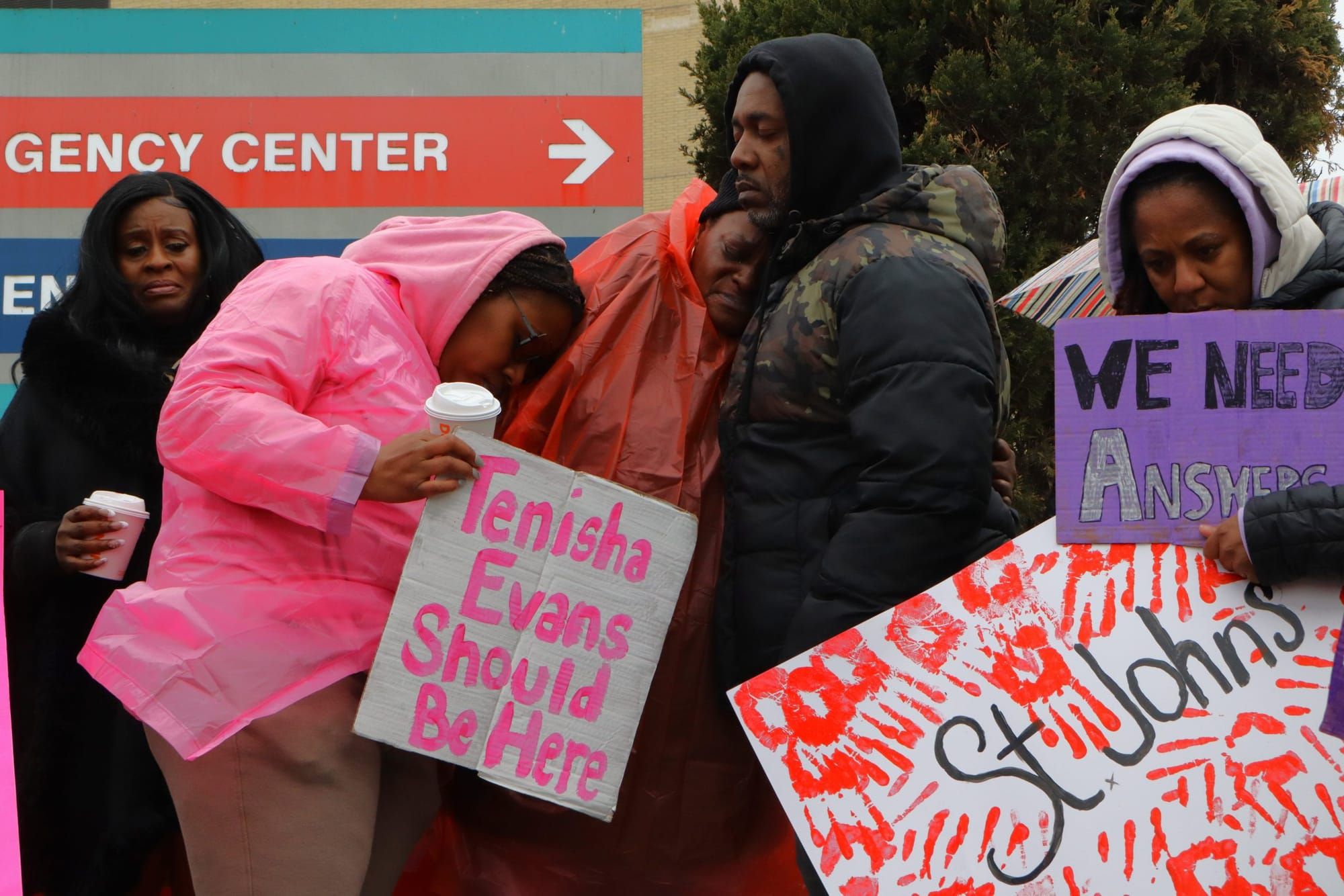
A group of families, doulas, and midwives in purple and pink shirts encircled Lynette Williams during an April protest demanding justice for her daughter, 24-year-old Tenisha Williams, who died after giving birth to twin boys in Queens, New York.
“I should have never sent her here,” 53-year-old Williams said, her voice breaking through the megaphone as she spoke to the crowd gathered outside St. John’s Hospital, where she said her daughter experienced medical mismanagement and neglect. “She should have been here raising her boys. … She wanted to be a mom, and now, I gotta be a mom for them.”
After speaking, Williams was overcome with grief and fell into the arms of her niece Jaleesa McCrimmon, who has become indispensable to her as they both care for Tenisha’s children.
Tenisha’s case is not a new or isolated tragedy. It is part of a systemic maternal health care crisis that disproportionately impacts Black mothers across the U.S. The same is true in New York City, where every year about 20 Black women die due to pregnancy-related causes.
But after the funeral and the news stories—if there were any to begin with—fade, what becomes of the families left behind? For Tenisha’s family and many others, there is New York’s Movement to Birth Liberation (MBL), a nonhierarchical network of reproductive justice advocates who organize on behalf of women who have died. The group also helps provide care and organizes mutual aid funds for families who have lost loved ones. It is one of many groups nationwide advocating for Black mothers.

A preventable crisis
Across the U.S., decades of data and personal testimonies from Black women show that systemic failures such as racism in health care, gaps in postnatal care, and doctors’ failure to believe and treat Black women’s pain, are primary factors that drive Black maternal mortality.
Last year, the New York State Department of Health released two reports illustrating how, despite recent efforts to reduce maternal mortality, pregnancy-related deaths among Black women persist. A total of 121 pregnancy-related deaths occurred in New York City from 2018 to 2020, with Black women experiencing a pregnancy-related mortality ratio five times higher than white women.
The longest state-led initiative to address maternal mortality, the New York State Perinatal Quality Collaborative, is only 15 years old. Despite the longstanding issue of Black maternal mortality, New York has only recently made other efforts to better understand and address Black maternal health and deaths.
In 2019, the state formed its first Maternal Mortality Review Board, and in 2023, Gov. Kathy Hochul passed legislation that allocated $4.5 million in annual funding for Regional Perinatal Centers. She also made doula services eligible for Medicaid coverage beginning Jan. 1, 2024. According to Mayor Eric Adams, President Donald Trump’s Big Beautiful Bill will not impact the doula program. However, analysis from the Congressional Budget Office shows Trump’s bill will reduce Medicaid spending by nearly $800 billion over the next decade, robbing an estimated 10 million people of health care coverage and no doubt worsening the U.S. maternal mortality crisis.
Well before the bill’s passage, its impact on New Yorkers was top of mind for MBL coordinator and midwife Katy Cecen.
“The government undermines the infrastructure that most Black Americans and most Black New Yorkers rely on [for] health care,” Cecen said at the April rally for Tenisha. “Two-thirds of Black people use Medicaid as their primary form of insurance when giving birth. And when we cut and cut and underfund and underfund that program, there is no way we can expect safe care.”
An estimated 65% of Black women in the U.S. rely on Medicaid for pregnancy and postpartum care. On July 17, Hochul convened a cabinet meeting to discuss the impacts of Trump’s bill on New York state, which includes an anticipated $13 billion cut from New York’s health care system and 1.5 million New Yorkers being stripped of health insurance coverage. More than 300,000 New York households are also expected to lose some or all of their Supplemental Nutrition Assistance Program benefits.
“While Republicans in Washington callously slash funding for vital programs across the country, my administration is standing up for New Yorkers to soften the blow of these cuts amidst an affordability crisis,” Hochul said.
But Hochul doesn’t always stand up for New Yorkers in need—including families impacted by maternal mortality. The governor has vetoed the Grieving Families Act three times. The bill would expand the state’s wrongful death statute, allowing families like Tenisha’s who’ve lost loved ones to seek compensation for grief and anguish.
In a statement to Prism, New York State Health Commissioner Dr. James McDonald said Hochul has given the health department “unwavering support” to combat maternal mortality.
“Giving birth is supposed to be a time that is exciting, beautiful, and supportive. Unfortunately, for some families, it can be a different experience,” McDonald said in an email. “Our goal is to eliminate disparities so that all people who give birth have birthing experiences that are safe and empowering. No person should die while giving birth or after bringing a life into this world.”

“It’s about showing up”
Just 15 days after Tenisha gave birth in January via cesarean section to twin boys Angel and Liam, her family found her unresponsive in her bed at home. She was rushed to St. John’s, where the young mother died at the same hospital where she gave birth to her sons. Her family believes her death was the result of complications related to her C-section, but they claim the hospital has yet to provide any concrete information about Tenisha’s death.
Sadly, Tenisha is not the first woman Cecen has organized on behalf of. Since she started MBL in 2021, her fledgling organization has worked to uplift the stories of multiple Black women who died after giving birth. Nearly half of maternal deaths occur within the first year postpartum, and a majority of these deaths are preventable.
The first woman whose story MBL uplifted was in 2021, marking the one-year anniversary of the passing of Amber Rose Isaac, a 26-year-old who died after an emergency C-section at Montefiore Medical Center in The Bronx just days after tweeting she was going to write an exposé on “dealing with incompetent doctors.” Also in 2021, the group organized around the death of Denise Williams, a 29-year-old mother of two who sought treatment for postpartum depression in August 2021 at Queens Hospital. Forty-eight hours later, Williams was dead. At the time, her family alleged the hospital provided no information about her cause of death. It was later revealed Williams died of a pulmonary embolism. In 2022, MBL rallied around the family of Elaina Boone, a 36-year-old who died at the Bronx Care Hospital Center after her family said she was pressured to have an emergency C-section to deliver her first child.
In 2023, MBL demanded justice for 30-year-old Christine Fields, who bled to death after giving birth at Woodhull Hospital in Brooklyn.
“It’s not about how many people show up, it’s about showing up,” said Jose Perez, Fields’ fiancé, at a rally for Tenisha. “It’s not about how big the crowd is; it’s about being a crowd. … It’s about making a stance.”

Perez has attended all of Tenisha’s rallies with his son and daughter, and he is one of a few fathers who speak out about Black maternal mortality. This has led to Perez developing his own community with men who have also lost their partners. He said he now regularly gets 3 a.m. calls from other newly widowed fathers who are grieving. As painful as this is, one of the reasons he continues to speak out is because he’s fearful for his own child.
“I have a 4-year-old daughter. My daughter is going to get older, eventually she is going to grow into a woman. I worry about my daughter coming into a hospital and ending up in the situation that her mother ended up in,” Perez said.
Fields is not the only woman who recently died after giving birth at Woodhull. In 2024, MBL showed up at the hospital again to rally around the family of Bevorlin Garcia Barrios, a 24-year-old who was sent home from the hospital after complaining of stomach pain and nausea. She was admitted three days later and died after her baby was delivered by an emergency C-section. She was the third woman to die during childbirth at Woodhull Medical Center since 2020, according to the New York Times. This year, while rallying around Tenisha’s family, MBL has also demanded justice for Laqueeinea Singletary, who died in 2022 after an emergency C-section and whose family is suing Mount Sinai. She was a mother of four.
The families left behind all say their loved ones’ deaths were preventable.
“It makes no sense that we’re losing mothers at this rate,” said True Tierra Johnson, who attended a rally for Tenisha. Her own sister-in-law experienced health complications after a C-section and passed away in July 2024.
One group that consistently shows up to MBL rallies to support families impacted by Black maternal deaths is doulas. This includes Far Rockaway resident Lene Elizabeth Warren, a 38-year-old who has been a doula for 10 years. The April rally for Tenisha was Warren’s first time protesting the death of a woman during childbirth.
“Change takes time, but rallies are useful,” Warren said. “Some people didn’t even know Tenisha or that maternal deaths like hers happen here. We need these events for awareness.”
Warren is also an ambassador for Irth App, which allows users to view prenatal, birthing, postpartum, and pediatric reviews of care from other Black and brown women.
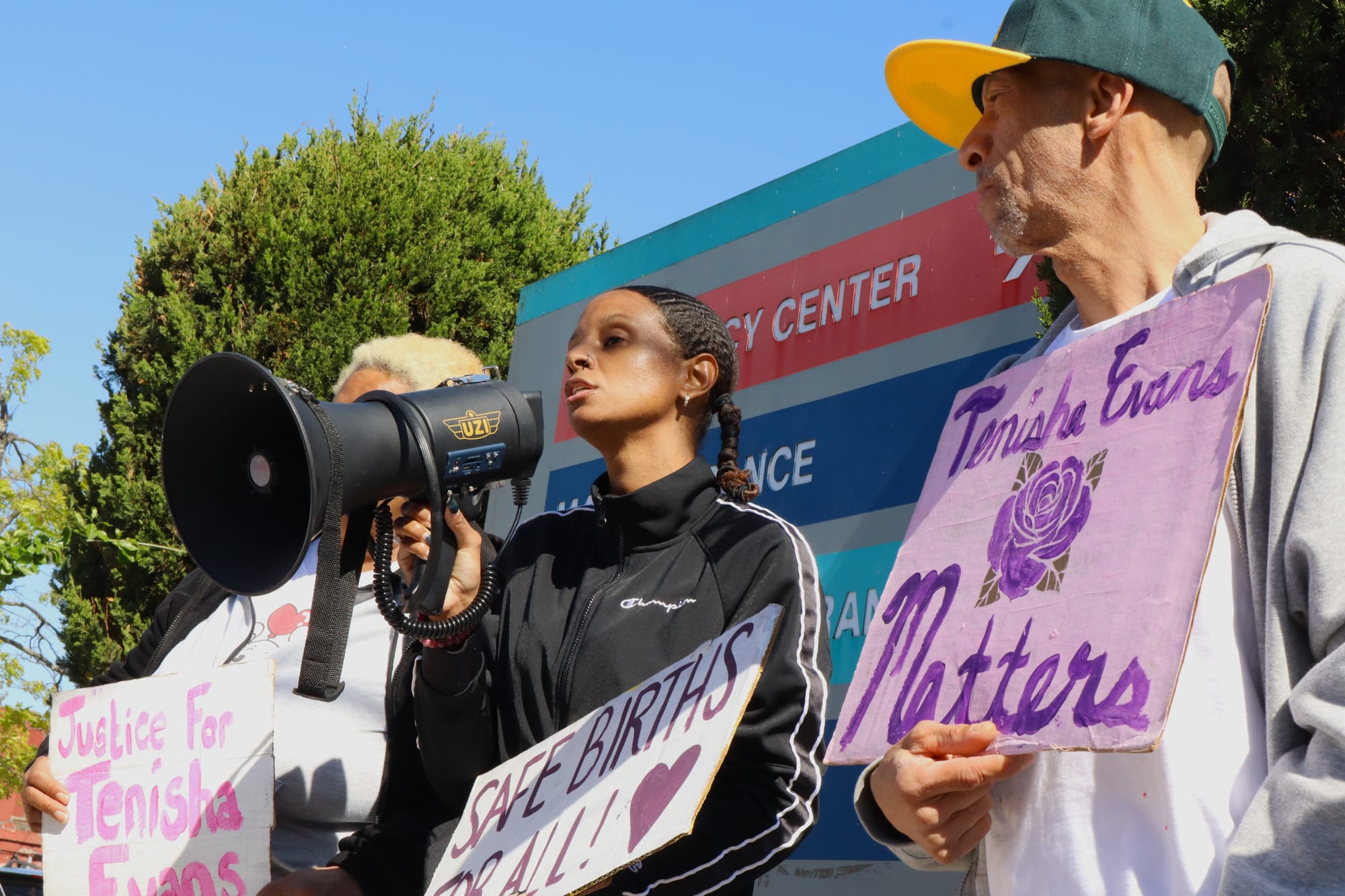
While pastors, bishops, and other local leaders have come to MBL rallies to demand justice for Black women who received negligent hospital care, there are also noticeable absences, namely hospital representatives and reporters. Bishop and activist Boyde Yeremiyah Singletary, cousin to Laqueeinea, said their presence is necessary.
“Media … don’t come out,” the bishop said, “because they don’t think it’s important enough.”
While some of these women’s deaths have been the subject of stories written by large publications such as the New York Times, once the headlines faded, the families were left alone to manage their grief, take care of the children who were left behind, search for answers about their loved ones’ deaths, and continue uplifting the women’s stories—until MBL emerged to help carry some of the load.
And through rallies and protests, MBL helps keep women’s memories alive, while also demanding accountability from hospitals. The group sees its role as centering families’ stories, instead of allowing the public and the media to rely only on cold, vague statements from hospital administrators. The group also provides actionable steps the public can take to support families, such as donating to fundraisers and participating in meal trains.
Jaleesa McCrimmon, Tenisha’s cousin, tirelessly uplifted Tenisha’s story on social media, until it got the attention of MBL. While the additional support is critical, the family is still struggling with the aftermath of Tenisha’s death.
“What could justice look like to me? I do not think there is really any,” McCrimmon said. “But what could come out of it [is] … Gov. Kathy Hochul signing the Grieving Families Act. So that doctors or nurses or anybody who is in labor and delivery are held accountable so these things do not happen.”
Editorial Team:
Tina Vasquez, Lead Editor
Lara Witt, Top Editor
Stephanie Harris, Copy Editor
Author

Mariana Navarrete Villegas is a community engagement journalist at The Connecticut Mirror. She holds an M.A. in bilingual journalism and reports on reproductive justice, immigration, and labor through
Sign up for Prism newsletters.
Stay up to date with curated collection of our top stories.