Filed Under:
Trump’s push to end birthright citizenship is part of broader nativist strategy
From draconian immigration enforcement to prioritizing denaturalizations, President Donald Trump’s agenda is sinister
Pablo Andreu
Real journalists wrote and edited this (not AI). Independent, community-driven journalism survives because you back it. Donate to sustain Prism’s mission and the humans behind it.
Real journalists wrote and edited this (not AI)—independent, community-driven journalism survives because you back it. Donate to sustain Prism’s mission and the humans behind it.
Update, June 30: In a 6-3 vote, the Supreme Court upheld birthright citizenship, striking down President Donald Trump’s January 2025 executive order that sought to bar citizenship for babies born in the U.S. to undocumented immigrants and temporary foreign residents.
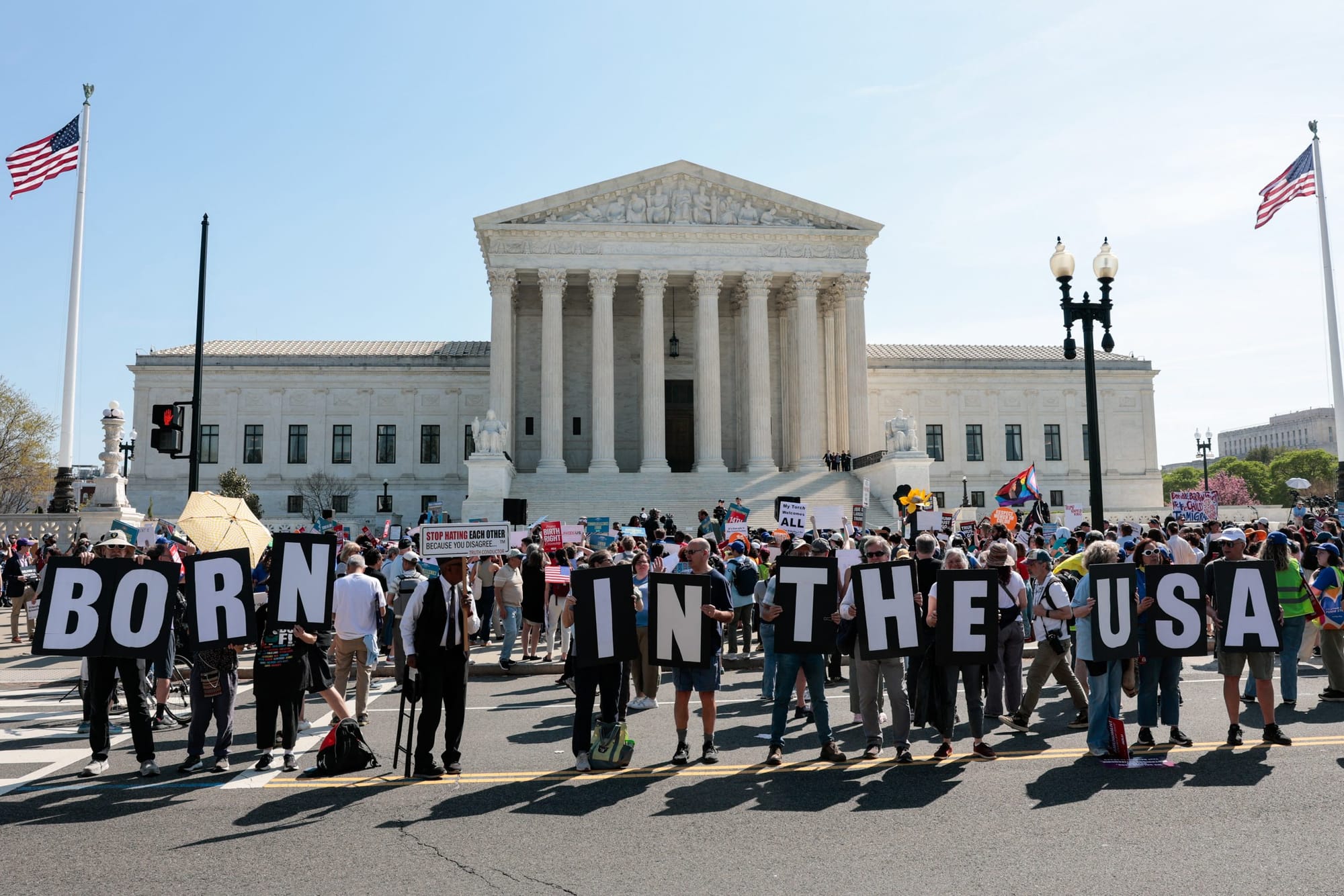
The Supreme Court will make a decision this month on President Donald Trump’s executive order attempting to end birthright citizenship. Though it appears that the highest court in the country is poised to rule against Trump, the executive order represents a broader strategy: to control the ethnic and racial makeup of the U.S.
During oral arguments, the federal government hinged its case on the “jurisdiction thereof” language of the 14th Amendment, insisting that “illegal aliens” and temporary residents are not subject to the jurisdiction of the U.S. Even the Supreme Court’s conservative justices appeared skeptical of the government’s arguments. When the government’s attorney contended that modern developments such as “birth tourism” justified a restriction of birthright citizenship, saying, “We’re in a new world now,” Chief Justice John Roberts offered a terse rebuttal: “It’s a new world. It’s the same Constitution.”
As part of the public relations campaign to further bolster its case, the Trump administration has argued two additional points: one, that birthright citizenship codified so-called anchor babies, or U.S. citizen children born to undocumented parents, thereby facilitating chain migration. And two, that few countries in the world maintain birthright citizenship.
These claims do not survive scrutiny.
While many countries do not maintain birthright citizenship akin to the U.S., it’s an exaggeration to claim that the U.S. is unique. Most countries in the Americas have unrestricted birthright citizenship. Though automatic birthright citizenship no longer exists in Europe, conditional versions of jus soli, or “right of the soil,” do exist. For example, France first introduced jus soli in the mid-1800s. The formation of the European Union (EU) also obviated the utility of birthright citizenship, since EU citizens can move across the continent freely.
It’s also easy to poke holes in the claim that undocumented immigrants use birthright citizenship to gain a residential foothold in the U.S. A child who gains citizenship via birthright must wait 21 years to petition for their parents’ residency and eventual citizenship. For nearly a quarter-century, those undocumented immigrants would need to live on the fringes of society in order to evade detection by the authorities. Even a minor infraction could upend their lives, and result in their detention and deportation. It’s a preposterously inefficient and risky means of achieving citizenship.
With arguments against birthright citizenship wilting under the heat of logic, we should turn to the timing of Trump’s executive order to glean insights into his administration’s true motivations.
Trump signed Executive Order 14160 on Jan. 20, 2025, the first day of his second term. He is the first president to attempt to roll back birthright citizenship since Congress established jus soli by ratifying the 14th Amendment in 1868. It begs the question: Why now?
Answering this question requires a bird’s-eye view of the Trump administration’s approach to immigration, residency, and citizenship. When viewed together, his nativist governing comes into sharp focus.
The most egregious example of Trump 2.0 nativism lies in its draconian immigration enforcement, believed by many to be the brainchild of the administration’s immigration czar, Stephen Miller, also the architect of the family separation policy. Trump’s first year in office was the deadliest year for immigrants detained by Immigration and Customs Enforcement (ICE) since 2004. ICE detention deaths are on a similar trajectory this year.
The administration sidesteps these grim figures by claiming it’s rounding up “criminals.” Analysis by Austin Kocher, a data scientist and researcher who uses data provided by ICE, consistently showed over the last year that as the population of detained immigrants has grown, the proportion of detained immigrants with criminal convictions has shrunk.
This statistic should come as no surprise, since ICE has made a habit of detaining people—noncitizens and citizens alike—without cause or due process. One of the most high-profile examples is Kilmar Armando Ábrego García, a Salvadoran man whom the administration detained and deported to CECOT, a maximum security facility in El Salvador notorious for its human rights violations. This was done against the orders of the Maryland Supreme Court and the U.S. Supreme Court.
One arguing in bad faith might attempt to make the case that ICE isn’t targeting ethnic and racial groups but rather, the scaling up of immigration enforcement created a nation-sized dragnet that inadvertently caught innocent people. But it’s not easy to maintain this position for long, after the Supreme Court’s decision last year in Noem v. Vasquez-Perdomo that allows for racial profiling on a “massive scale,” according to the American Civil Liberties Union.
More broadly, the administration exhibits blatant double standards in its immigration policies, initiatives, and tactics. For example, last year after stripping 675,000 asylum-seekers from Afghanistan, Burma, Cameroon, Haiti, Honduras, Nepal, Nicaragua, South Sudan, Syria, and Venezuela of Temporary Protected Status (TPS), this year Trump limited the refugee program to a record low of 7,500 people—6,665 of whom were white South Africans.
Proposed bills, executive orders, and memos during Trump’s second term have also shown that his double standard applies to U.S. citizens. Last December, Sen. Bernie Moreno, R-Ohio, introduced the Exclusive Citizenship Act of 2025, legislation that would force Americans with dual citizenship to choose between the two countries granting them legal status. Though Moreno’s bill is unlikely to pass because of 14th Amendment protections, it’s a reminder that this administration and its acolytes perceive citizenship not as an unassailable right, but rather as a tiered system that should favor white people. Last June, a memo from the U.S. Department of Justice revealed that it would prioritize denaturalization, a process that allows the government to strip someone of their American citizenship. Historically, denaturalization was largely reserved for Nazi war criminals.
It’s no secret which groups of people will become targets of denaturalization efforts. In 1970, the Latino population in the U.S. numbered 9.6 million, or about 5% of the population. In 2024, that number reached 68 million, or 19.9% of the overall population. The breakneck growth of the Latino population fuels white supremacists’ paranoia of “the Great Replacement,” a racist conspiracy theory positing that hospitable immigration policies are part of a larger plot to “replace” white political power and culture in Western countries.
When viewed in isolation, the revocation of birthright citizenship in the U.S. is intellectual fodder for constitutional wonks. It may even make sense to moderates: “Maybe the child of undocumented immigrants shouldn’t automatically get citizenship?” But the Supreme Court case can only be seen as part of the Trump administration’s larger litany of racist and xenophobic efforts.
Trump’s campaign promises amount to a sinister agenda: to bar immigrants from entering the U.S. and drastically restrict the naturalization of Black and brown people.
Editorial Team:
Tina Vasquez, Lead Editor
Lara Witt, Top Editor
Rashmee Kumar, Copy Editor