Pro-Israel group’s threats to Palestine organizers send shockwaves through campus communities
Betar US’s former head claimed in an interview with Prism that the group works with the Trump administration and police to identify protesters. Student organizers say Betar’s actions, including distributing “pagers,” are making students feel unsafe
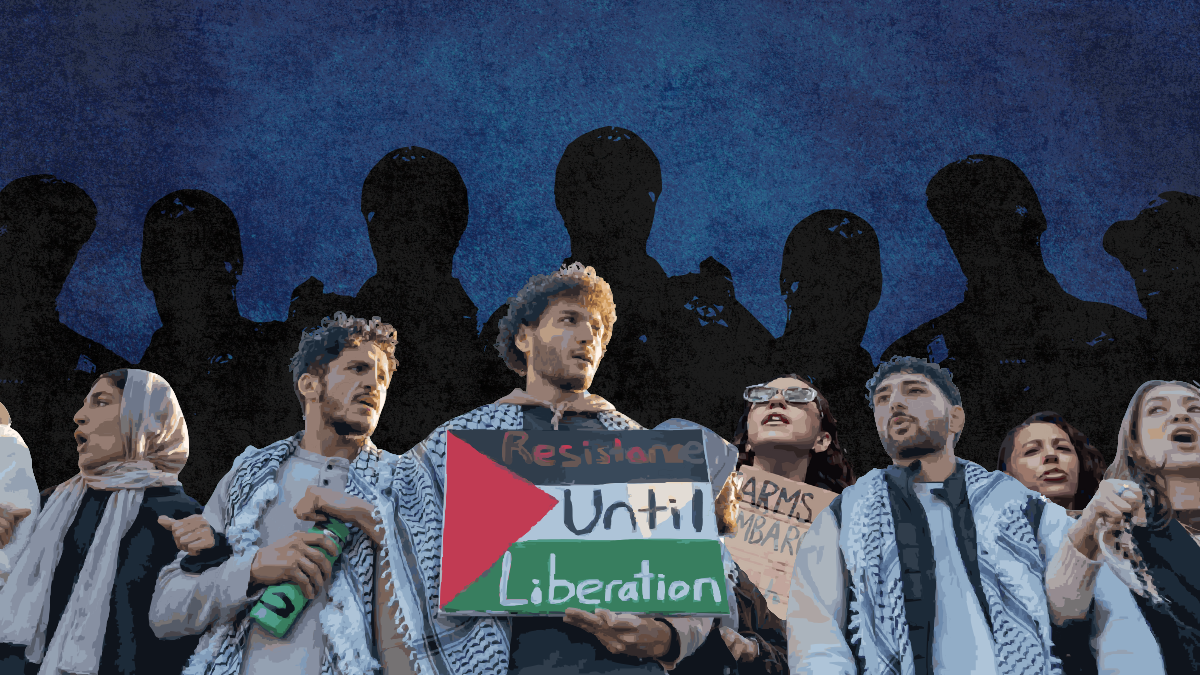
Over the last few months, the Trump administration has been rounding up pro-Palestine students who it claims support terrorism, despite a lack of evidence to back up these assertions. A Zionist advocacy group, Betar US, has claimed to be helping identify anti-genocide protesters for Trump officials and local law enforcement to target. The group’s former executive director detailed that process to Prism in a wide-ranging interview.
Ross Glick and Betar US, the North American branch of an international far-right pro-Israel group, have been investigated for issuing bomb threats against student protesters and have played a visible role in shaping campus policy discussions. The group regularly threatens to distribute pagers to Palestine supporters, according to the group’s social media posts, referencing Israel’s violent attack in Lebanon and Syria last September that killed 37 and injured 2,931. Many experts, diplomats, and advocates have described the attack—during which pagers purportedly used by Hezbollah politicians and members, civilian employees, and health care workers exploded simultaneously—as an act of terrorism.
Betar declined to provide comment to Prism. In an X post on March 23, the organization wrote, “We have deleted posts about beepers because they are distractions. Let’s stay focused on evil jihadis who hate america and hate Jews. These violent jihadis have no place in America.”
Students and other activists spoke to Prism about how third-party groups such as Betar and Canary Mission have spread incessant hate speech, death threats, and misinformation that take attention away from the purpose of the demonstrations themselves: Israel’s ongoing genocide of Palestinians.
Third-party group involvement
The Trump administration has cited an “explosion of anti-Semitism” on U.S. college campuses and detained at least 10 people speaking or writing critically about Israel without due process. (Three of the students were released on a judge’s orders, though their deportation cases are ongoing.) While the administration initially terminated more than 1,800 international student statuses starting in January, the Justice Department announced that all visas would be restored April 25 after pressure from courts as well as restraining orders.
Secretary of State Marco Rubio and other members of the Trump administration have provided little to no evidence for why Immigration and Customs Enforcement (ICE) is targeting organizers. In the case of former Columbia University student Mahmoud Khalil, NBC News reported that the government has been relying on unverified tabloid articles about him. The U.S. State Department also found no links between Tufts University student Rümeysa Öztürk, who was detained March 25, and antisemitism or terrorism.
However, third-party organizations such as Betar, Canary Mission, and StopAntisemitism have been playing a key role in profiling, doxxing, and reporting pro-Palestine students to law enforcement.
Betar, which has called itself the “fastest growing Zionist movement,” told The Guardian in March that it submitted a “deportation list” of “thousands of names” of university students and faculty to the Trump administration and claimed credit for Khalil’s detainment. The group also targeted Mohsen Mahdawi, a Palestinian student at Columbia who was arrested April 14 at an appointment where he was called to take his citizenship test. A month earlier, on March 14, Betar posted that Mahdawi was “next and also on the deport list.” Canary Mission also has profiles for Khalil and Mahdawi on its website. Mahdawi and Öztürk were later released from ICE detention on a judge’s orders.
While Betar members have appeared publicly at protests, mostly in New York, Canary Mission is run much more covertly.
Neither the Department of Homeland Security (DHS) nor the State Department provided on-the-record comments to Prism. The DHS responded to Prism’s questions about Betar with an explanation of how the department regularly reviews student records to ensure visa holders are in compliance with program requirements, which could result in visa revocations. The DHS also said the State Department can revoke visas independently of the DHS notifying the department. During a March 31 press conference, State Department spokesperson Tammy Bruce refused to confirm whether a list provided by Betar exists.
Glick, who helped revive Betar in 2023 and served as executive director until February 2025, attributed much of the targeting of pro-Palestine protesters to Betar’s and his own work. Glick claimed that many students, including Khalil, were under investigation during the Biden administration, but the conversations of attempting to deport students began after Donald Trump took office.
As we started to understand that Trump was looking to utilize these laws for people here on visas, it then started to create some possibilities, and we then started to formalize this initiative.
Ross Glick, former executive director of betar
“As we started to understand that Trump was looking to utilize these laws for people here on visas, it then started to create some possibilities, and we then started to formalize this initiative,” Glick said. “I started leveraging and contacting my contacts in D.C.”
Glick also claimed that Betar actively helped the New York Police Department (NYPD) identify “bad actors” after Oct. 7, 2023. The NYPD did not respond to several Prism requests. The department has cracked down violently on anti-genocide protesters multiple times, particularly on college campuses, including firing a gun during April’s raid of Columbia’s Hamilton Hall.
Glick said he has attended rallies regularly in New York City and sometimes Pittsburgh to confront or document pro-Palestine protesters. He and other Betar members published the content to their personal Instagram accounts in order to identify the protesters, at a time when many were losing their jobs over opposing the genocide. He also claimed to have worked with people using facial recognition technology to identify protesters, including to track down and analyze protesters’ social media accounts.
Since leaving Betar earlier this year, Glick claimed to be working as a “Zionist independent,” meeting with elected officials to push for policies targeting anti-Israel sentiments within the U.S. However, he said his contacts in D.C. preceded his work with Betar because he previously owned a digital agency.
“Beepers” threats
Among Betar’s more distressful actions to activists are the group’s continued threats to send Palestine supporters “beepers,” going as far as placing a plastic beeper in American Jewish political scientist Norman Finklestein’s pocket while he was walking down a street in New York, according to social media videos credited to Betar’s account. The video has since apparently been removed from Betar’s Instagram page. In a post on X that appears to have been deleted, the organization also offered a $1,800 bounty to anyone who hands a beeper to Nerdeen Kiswani, a former law student at the City University of New York and co-founder of the Palestinian liberation organization Within Our Lifetime. Kiswani has said she has been physically and virtually harassed by supporters of Betar, Canary Mission, and StopAntisemitism. A Columbia student and friend of Kiswani’s, who did not want to be named due to safety concerns, said he has seen Glick and members of Betar at protests dozens of times over the last few months.
“ [Glick] truly does not see anybody who stands against Israel in his head as human,” the organizer said. “You are like a rat or you are a roach, and he will say anything to you.”
“He says things and then violence follows. … Whether it’s directly from his words or not, it’s that rhetoric that’s getting constantly recycled through Zionist organizations. They’re just becoming more and more emboldened because they haven’t gotten in trouble for shit,” the organizer continued. “ You see Glick and all these other people speaking to politicians and all these high-profile people, and they must feel like they’re immune to all of this.”
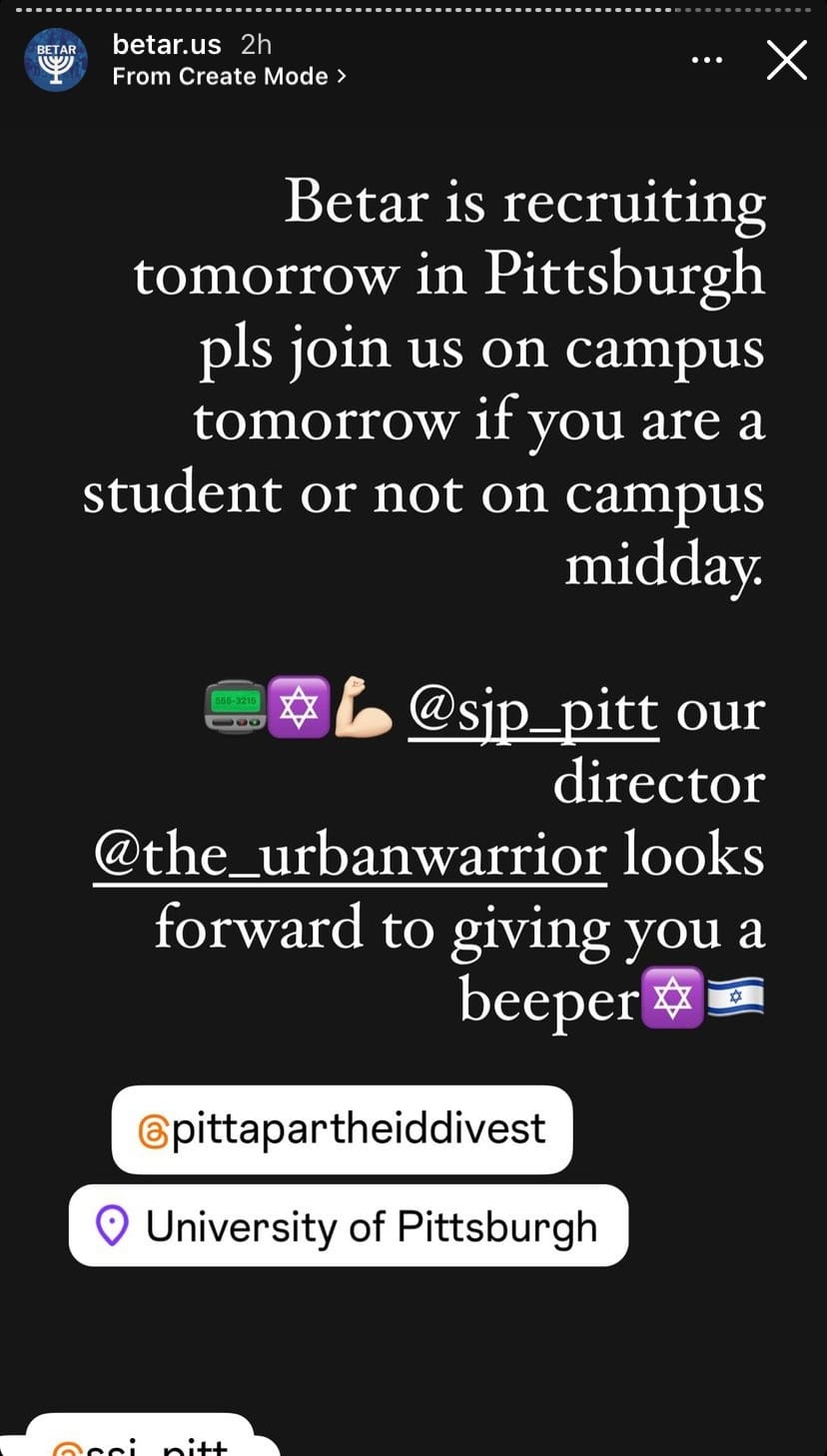
In November 2024, Meta blocked Betar’s social media accounts after the organization posted that it would give “pagers” to the Students for Justice in Palestine (SJP) chapter at the University of Pittsburgh. The threat led to a police investigation, but police ultimately dropped the case, and the university ended up suspending SJP, an outcome Betar pushed for, according to Glick.
A member of Pitt’s SJP, who did not want their name published due to safety concerns, showed Prism screenshots that students obtained of Betar’s since-deleted Instagram Stories that sparked the saga. One of the posts about a Betar recruitment event on campus tagged SJP and said that Glick “looks forward to giving you a beeper.”
“A lot of community members [and] students started emailing the school asking them to take this seriously as they would take any other instance of hatred,” the SJP member told Prism. “I was contacted by the assistant dean of students, and the [University of Pittsburgh] police asked what we wanted to do, and it ended up in filing a report.”
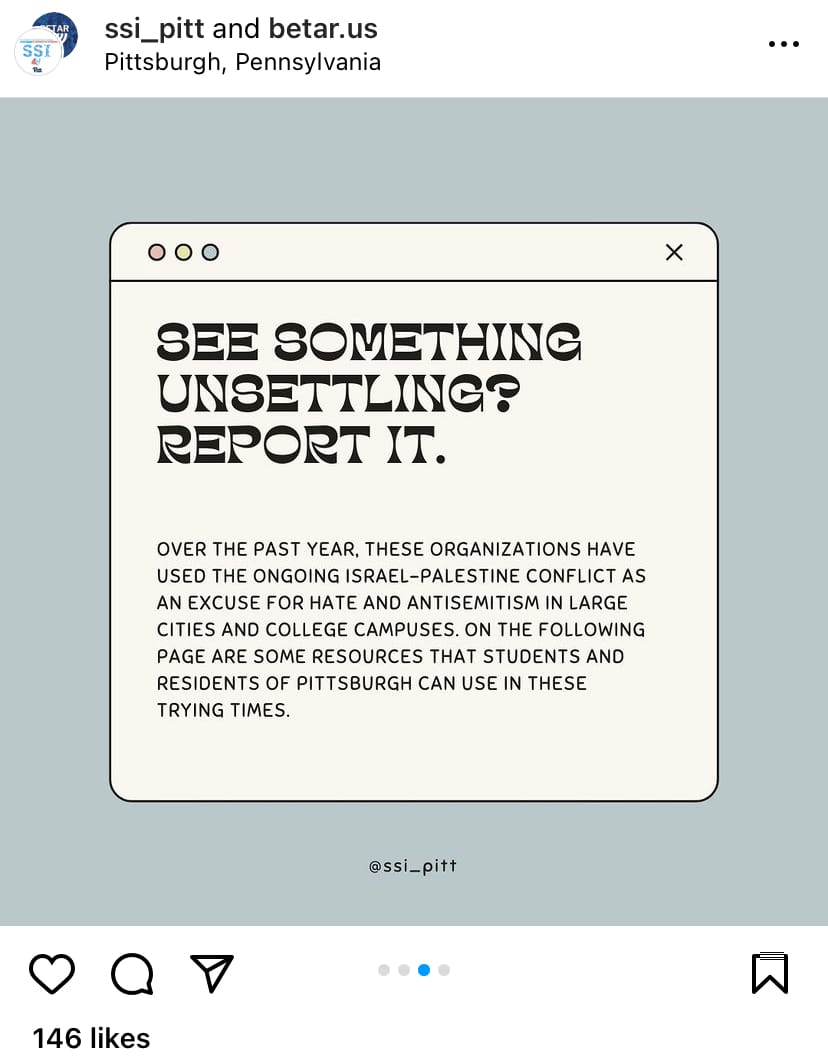
The student also showed Prism a screenshot of a since-deleted Instagram post from October 2024, prior to Betar’s threats, that the University of Pittsburgh chapter of Students Supporting Israel (SSI) shared in collaboration with Betar, asking students to report antisemitism on campus. SSI did not appear to be involved in making threats to students. SSI did not respond to Prism’s request for comment.
Another student organizer with SJP at Pitt took issue with a student group collaborating with Betar, an organization inspired by the early Zionist militant leader Vladimir “Ze’ev” Jabotinsky who believed only an “iron wall,” or a strong military, could compel Palestinians to accept a Jewish state on their lands.
“It was just very alarming,” the student said of learning about Betar’s ideological roots. “They’re very proud about what they espouse.”
The student also said Betar’s threats reflected a “double standard.”
“ I can’t imagine a national pro-Palestinian organization ever making a bomb threat against Jewish students or pro-Israel students,” they said. “ Because [Pitt police] weren’t able to locate an IP address or IP addresses for individuals with the account, they couldn’t file charges. It was a very cursory investigation. I don’t know if you can even call it that. All they did was try to subpoena the IP addresses. They didn’t seem to know that [Glick] was even in Pittsburgh.”
Glick told Prism that the FBI was eventually involved. The FBI declined three requests by Prism for confirmation or comment. The University of Pittsburgh Police Department, the Pittsburgh Bureau of Police, and the Pitt chancellor’s office did not respond to Prism.
Pitt’s administration officially suspended the SJP chapter indefinitely in March after a “liberation study group” hosted by SJP in December 2024 “did not comply with university event policies,” according to school officials. Students who organized and attended the study-in said they remember numerous armed police officers surveilling them in the library. The American Civil Liberties Union in Pennsylvania filed a federal free speech lawsuit on April 15 against the university on behalf of the SJP chapter.
Several prominent Zionists have invoked pagers with little to no repercussions. In March, former Israeli Prime Minister Naftali Bennett joked about sending exploding pagers to pro-Palestine protesters during an event attended by hundreds at Harvard University, which has punished even the mildest student and faculty actions against genocide, citing harm to Jewish students. Israeli Prime Minister Benjamin Netanyahu gifted gold and silver pagers earlier this year to President Donald Trump and Pennsylvania Sen. John Fetterman, respectively. A Betar-branded video posted to social media shows Glick complaining to Fetterman about Meta blocking Betar’s accounts in response to the beepers “joke,” to which Fetterman responded, “The beepers thing, I love it.”
Glick said that Betar’s social media director posted the “satirical dark joke” about giving beepers to Pittsburgh SJP members that was “funny to us but not to them.”
“ I was put under investigation by the FBI, and so I began a fight with SJP around Pitt and we started putting a lot of pressure on Pitt, demanding that SJP be banned,” Glick said. He claimed that the charges against him were dropped once Trump took office. “The FBI gave me a call and kind of laughed it off.”
Betar members have also reportedly attempted to hand pagers to Rep. Rashida Tlaib, the only Palestinian in Congress, and Rep. Ilhan Omar, another Muslim congresswoman who is also critical of Israel.
Glick said someone complained about him making bomb threats to the U.S. Capitol Police (USCP) in Washington, D.C., which he frequently visited for meetings with officials. He claimed that Capitol Police officials also laughed off the report. Capitol Police declined to comment on whether this was true and said “the USCP does not discuss potential investigations” for safety reasons.
“It was a joke,” Glick said. “And that is the beauty of America and the freedom that we have.”
But Glick and Betar have actively advocated against freedom for American residents, visa holders, and even citizens who exercise speech against Israel. While Glick justified his right to joke about bomb threats against protesters, he boasted about spearheading the “deportation list” he claimed Betar provided to the Trump administration.
Legal actions
Rifqa Falaneh, a fellow at advocacy and litigation support organization Palestine Legal, said requests for legal support in immigration-related matters have spiked, with more than 2,900 requests for legal support in total coming in since Oct. 7, 2023. Hundreds involved employment concerns over Palestine advocacy, including from 157 people since January 2024 who said they had been fired. Falaneh emphasized the importance of university institutions standing their ground against the Trump administration’s demands.
“[The third-party organizations are] destroying the lives of people, and they’re working with the government to even destroy more by deporting students who are on a visa,” said Falaneh. “ They attack people getting professional degrees so that they can strip this licensing away from them. They really like to go after lawyers, dentists, doctors, where they can really attack their livelihood. But, of course, they also go after anyone who speaks out.”
The U.S. House Education and Workforce Committee sent Northwestern University a letter alleging “illegal, anti-semitic conduct” by the law school, which provides free legal counsel to students, some of whom have been involved in pro-Palestine advocacy, such as Falaneh. The committee’s letter cited a Canary Mission profile of Falaneh. The committee withdrew the investigation into Northwestern’s law school clinics after professors there filed a temporary restraining order alleging a violation of their free speech rights. While several universities, such as Columbia, have agreed to the Trump administration’s demands, rejections of these asks by Harvard and Northwestern may prompt other campuses to follow suit.
The reason why this all began is because of the Palestine exception and because we see the student movement being so vocal on their campuses about Palestine.
Rifqa Falaneh, Palestine Legal fellow
“ While it’s important to highlight the First Amendment and free speech component [on campuses], I think it’s also important to recognize why people like Khalil and other students were being targeted to begin with,” Falaneh said. “The reason why this all began is because of the Palestine exception and because we see the student movement being so vocal on their campuses about Palestine.”
Liv Kunins-Berkowitz, media coordinator for Jewish Voice for Peace (JVP), wrote in an email statement to Prism that far-right groups such as Betar and Canary Mission regularly target and dox Jewish people, including JVP members. Betar in particular “endangers Jewish people,” for instance, by threatening “vigilante violence” against pro-Palestine protesters, including Jewish protesters, at UCLA. Canary Mission has profiled JVP as an “anti-Israel organization,” while Betar has begun compiling a list of “anti-Israel Jews” it says should be banned from visiting Israel.
“These groups do not work to stop antisemitism,” Kunins-Berkowitz said. “In fact, these groups inaccurately conflate criticism of Israel, a country that is currently carrying out a genocide against Palestinians in Gaza, with antisemitism, hatred, or bigotry against Jewish people. False accusations of antisemitism sow confusion and make it harder to stop actual antisemitism.”
Author
Neha Madhira is an award-winning gender, health and politics reporter with a focus in South Asia and the Middle East. Previously, she was a breaking news reporter in Austin, Texas, where she broke the
Sign up for Prism newsletters.
Stay up to date with curated collection of our top stories.