Barnard College expels three students who protested for Palestine in unprecedented move
These are the first official expulsions for protests on Columbia’s campus since 1936, according to Columbia University Apartheid Divest

On Feb. 21, Barnard College, an undergraduate college affiliated with Columbia University, expelled two pro-Palestinian protesters for allegedly disrupting a Columbia class called “History of Modern Israel.” A third student was also expelled a week later for allegedly protesting the university’s investments in genocide and participating in the occupation of Hamilton Hall (renamed “Hind’s Hall” by the protesters) last spring.
While both Barnard and Columbia have suspended multiple students and taken disciplinary actions against those protesting the genocide in Palestine, these are the first official expulsions for protesting on Columbia’s campus since 1936, according to Columbia University Apartheid Divest (CUAD), when student Robert Burke was expelled for criticizing the university’s ties to Nazi Germany.
The first two expelled students were initially issued “interim suspensions” by the Barnard Office for Student Intervention and Success, a new disciplinary body established last fall, for allegedly disrupting the class. This entailed the students being banned from all campus facilities, including dorms, libraries, health services, and dining halls. They were then put through a rushed investigative process, resulting in their expulsions, according to CUAD.
Sellotape, a graduate student at Columbia and a member of the Collective Defense Working Group, which is part of the CUAD, said the investigation “used a lot of evidence that is sort of negligible, as our understanding that those processes were conducted with the idea of guilt from the beginning, and that the burden of proof was unfairly placed on the students allegedly involved.”
Barnard did not respond to a request for comment by the time of publication.
One of the expelled students, who declined an interview with Prism due to privacy concerns, stated in a press release on Feb. 22, “[At Barnard], I was told countless times the value of voicing my opinions and standing up for what I know to be true and good. … The fact that my removal has taken place so baselessly, simply because I believe that a Holocaust of the Palestinian people is unequivocally wrong has completely shattered the illusion of what I thought Barnard stood for.”
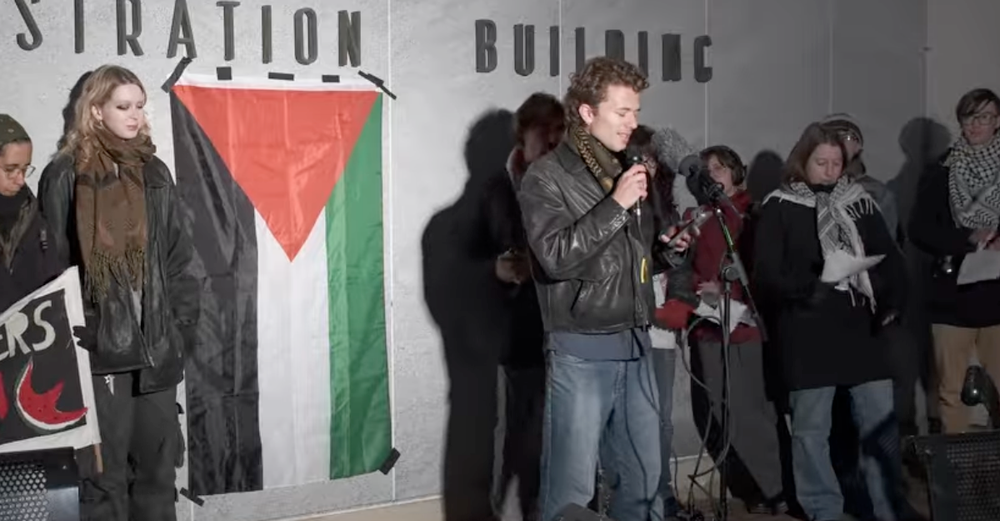
In response to the expulsions, on Feb. 26 the Collective Defense Working Group led a sit-in at Barnard’s dean’s office, with nearly 100 students.
“We wanted to stage a nonviolent way of expressing that we had mass support against these expulsions. It was set up alongside a letter-writing campaign as well as a phone zap,” Sellotape said. “They were designed to sort of show ‘here are the members of the Barnard community.’ They’re out in force to say, ‘This is not something that we want to be something that can happen to a member of our community at any time.’”
After the multi-hour standoff, Barnard President Laura Rosenbury and Barnard Vice President and Dean Leslie Grinage agreed to negotiate with students regarding the expulsions based on certain conditions. However, two faculty intermediaries emailed the student negotiators shortly before the agreed meeting time, saying that the student negotiators would need to be unmasked during the meeting and that they could not audio record the meeting, going back on terms that had been previously agreed upon.
“The university had agreed that those students were to be registered and enrolled students at Barnard College and that the students were to be masked in the negotiations,” Sellotape said. “We made that stipulation, not only because masking of the students is obviously necessary for their safety, in terms of being identifiable and therefore reprisable by the university—which has been demonstrated to be unfair in their ability to reprise and willingness to reprise— but it also was for the safety of our community. We have immunocompromised members.”
“The University reneged on those responsibilities and on the terms that they had set and prevented negotiations from beginning,” they added.
On March 5, Columbia students resumed the sit-in at the Milstein Center library, reclaimed as the “Dr. Hussam Abu Safiya Liberated Zone.” In a statement posted online, they said that they “were left with no choice but to resume the sit-in because Barnard has shown they will sabotage negotiations unless we hold them accountable.”
The third expulsion came on the same day that the U.S. Department of Justice issued a press release announcing that the Federal Task Force to Combat Antisemitism would be visiting 10 university campuses that have allegedly experienced antisemitic incidents since October 2023, including Columbia University. According to a press release by CUAD, Columbia was privately informed of the task force’s impending visit a day before Barnard expelled a third student.
“Rather than engage with students or divest, Barnard has rushed to satisfy the U.S. Department of Justice by sanctioning and expelling students,” the press release said.
“The letter-writing campaign is still ongoing. The phone zap campaign is still ongoing,” Sellotape said. “We’re still participating very actively in the general structure that the university has set up for appealing these expulsions. We always work through every avenue possible in order to support our comrades, and so we’re going to continue to do that.”
Editorial Team:
Carolyn Copeland, Lead Editor
Lara Witt, Top Editor
Rashmee Kumar, Copy Editor
Author

Nayanika Guha is a journalist who focuses on writing about social justice, health, and politics. She has a MFA in journalism from NYU and a background in psychology and social work, which informs her
Sign up for Prism newsletters.
Stay up to date with curated collection of our top stories.