In the face of empty promises, Baltimore residents take on environmental injustice in their communities
South Baltimore Community Land Trust and Baltimore Compost Collective are two local organizations fighting to “put the life of the people first”
As Maryland’s ambitious climate goals struggle to progress, communities of color in South Baltimore suffocate under the weight of air contamination caused by the high density of incinerators, coal terminals, and chemical plants in the area. With about 70 stationary polluting facilities in the Curtis Bay neighborhood alone, South Baltimore has some of the highest asthma and cancer rates in the country.
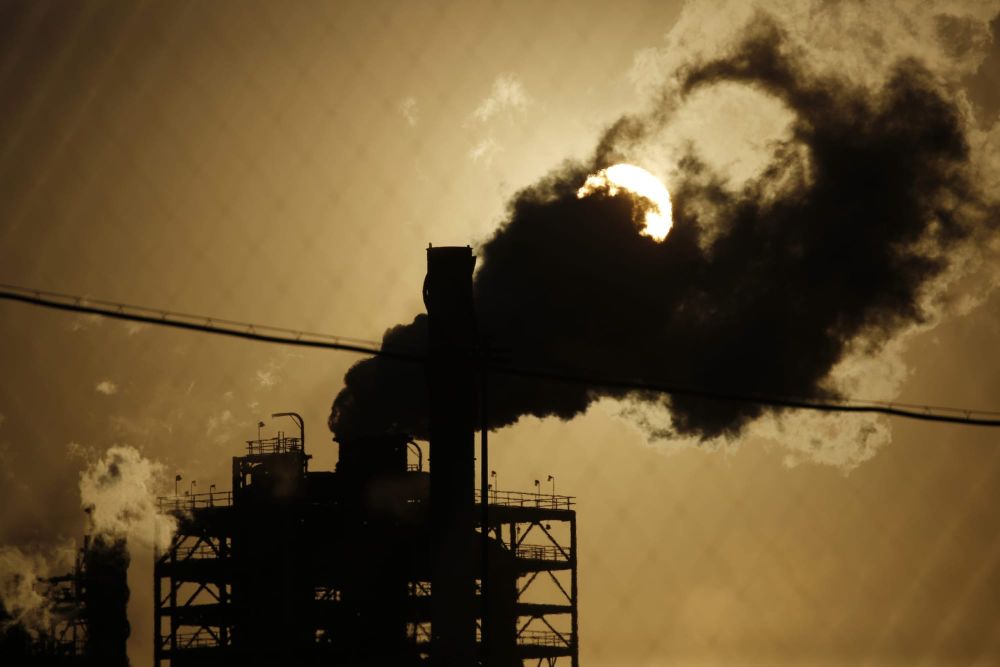
The Trump administration’s efforts to limit the Environmental Protection Agency’s (EPA) power may affect the federal agency’s ongoing civil rights investigation into Baltimore City’s most controversial polluter: the Wheelabrator Baltimore Refuse Energy Systems Company (BRESCO) incinerator, a waste-to-energy facility that emits 36% of all air emissions from Baltimore City industry, costing Maryland and neighboring states $55 million annually in human health problems.
However, since 2011, Maryland has classified waste-to-energy incineration as a Tier 1 renewable energy source under the often-criticized Renewable Portfolio Standard (RPS), which requires electric utility companies to source a portion of their energy from renewable energy sources like solar or wind. Between 2012 and 2022, over $100 million in subsidies have been granted to the trash incinerator to maintain operations, despite emissions of more greenhouse gas per unit of energy produced than other power sources—even coal.
Baltimore climate organizers like Carlos Sanchez, a youth outreach specialist with South Baltimore Community Land Trust (SBCLT), the organization that filed the EPA complaint, know that the EPA likely won’t shut down the Wheelabrator incinerator. But they remain hopeful that Maryland Senate President William Ferguson will pass the Reclaim Renewable Energy Act this year, which would remove trash incineration from the RPS and divert $10 to $12 million to less-invasive renewable energy sources.
“That bill is calling for having the RPS do what it was meant to do initially, which was fund clean renewable energies like wind and solar,” Sanchez said. “We can be examples of how things should be done, ultimately putting the life of the people first over profit, over anything. This is where people live. This is where they grow their families, where they spend time with their loved ones. Those are human beings, and those are what should be put first, above all.”
No food to waste
While SBCLT maintains pressure on Ferguson to pass the bill, the organization and its coalition partners aren’t waiting around for the city or federal government to deliver environmental justice.
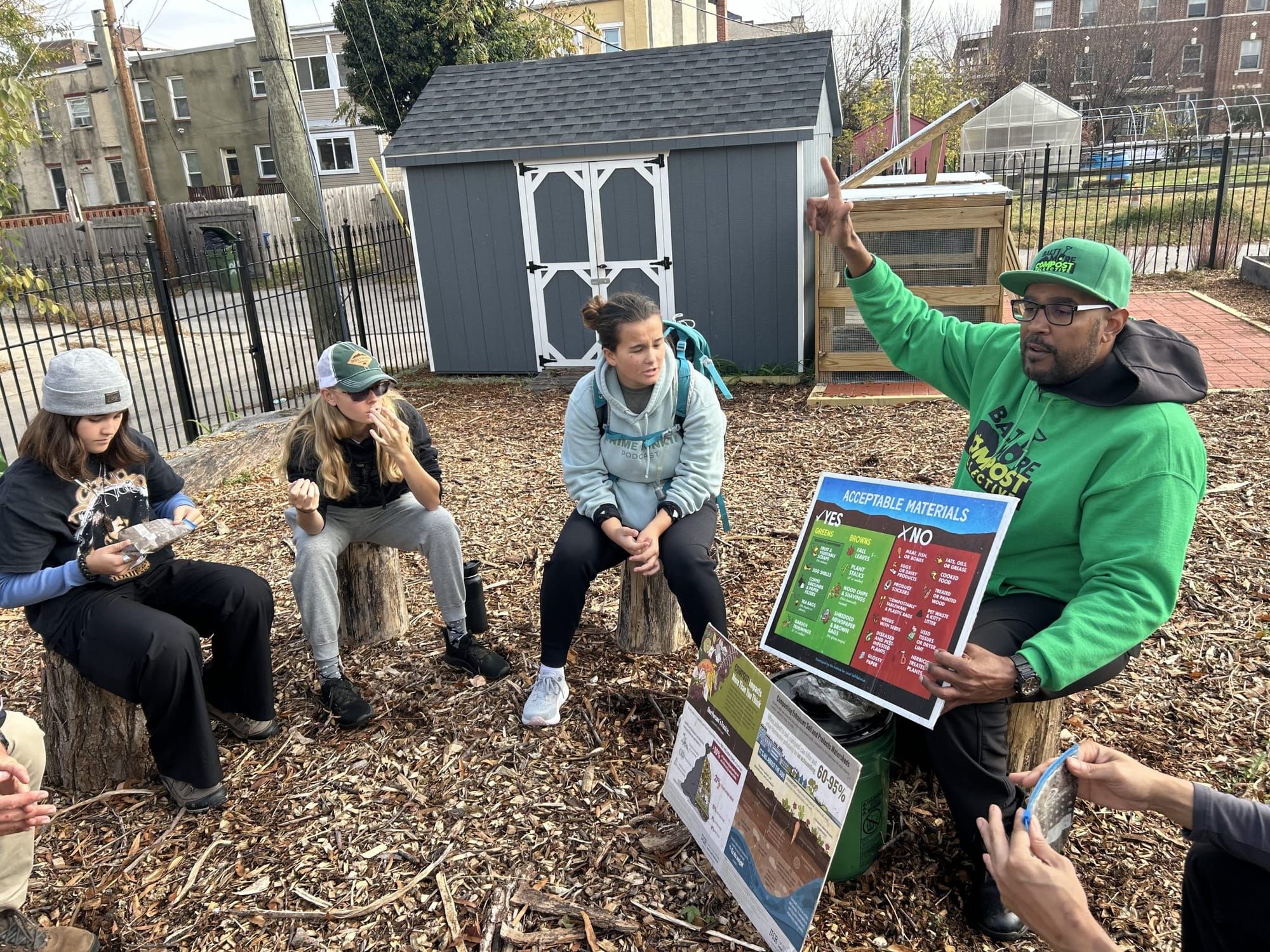
Instead, locals like Marvin Hayes, founder of the Baltimore Compost Collective (BCC), alchemize community empowerment with “black gold.” He and his team of youth entrepreneurs run a citywide household compost pickup, transforming food scraps into compost that supports organic produce to combat food apartheid in South Baltimore. Organic materials that would generally burn in the Wheelabrator incinerator are sequestering carbon within nutrient-rich soils.
“Eighty-five percent of what’s being burned in the incinerator can be composted or recycled, and 25% of that is food, organic material,” Hayes explained. “I don’t use the term ‘food waste’ because I don’t waste it. I turn it into beautiful, black, crumbly goodness that we call black gold to feed residents and give a hand to soil that is lacking.”
Since he started BCC nearly 10 years ago, Hayes and his team now serve over 400 residents with a five-gallon bucket compost pickup. They process some compost in local gardens and larger amounts an hour’s drive south at the Prince George’s County Organics Compost Facility, diverting 1,500 to 2,000 pounds of organic material from the incinerator each week. The resulting compost is returned to South Baltimore gardens to remediate soil with high levels of lead and metal.
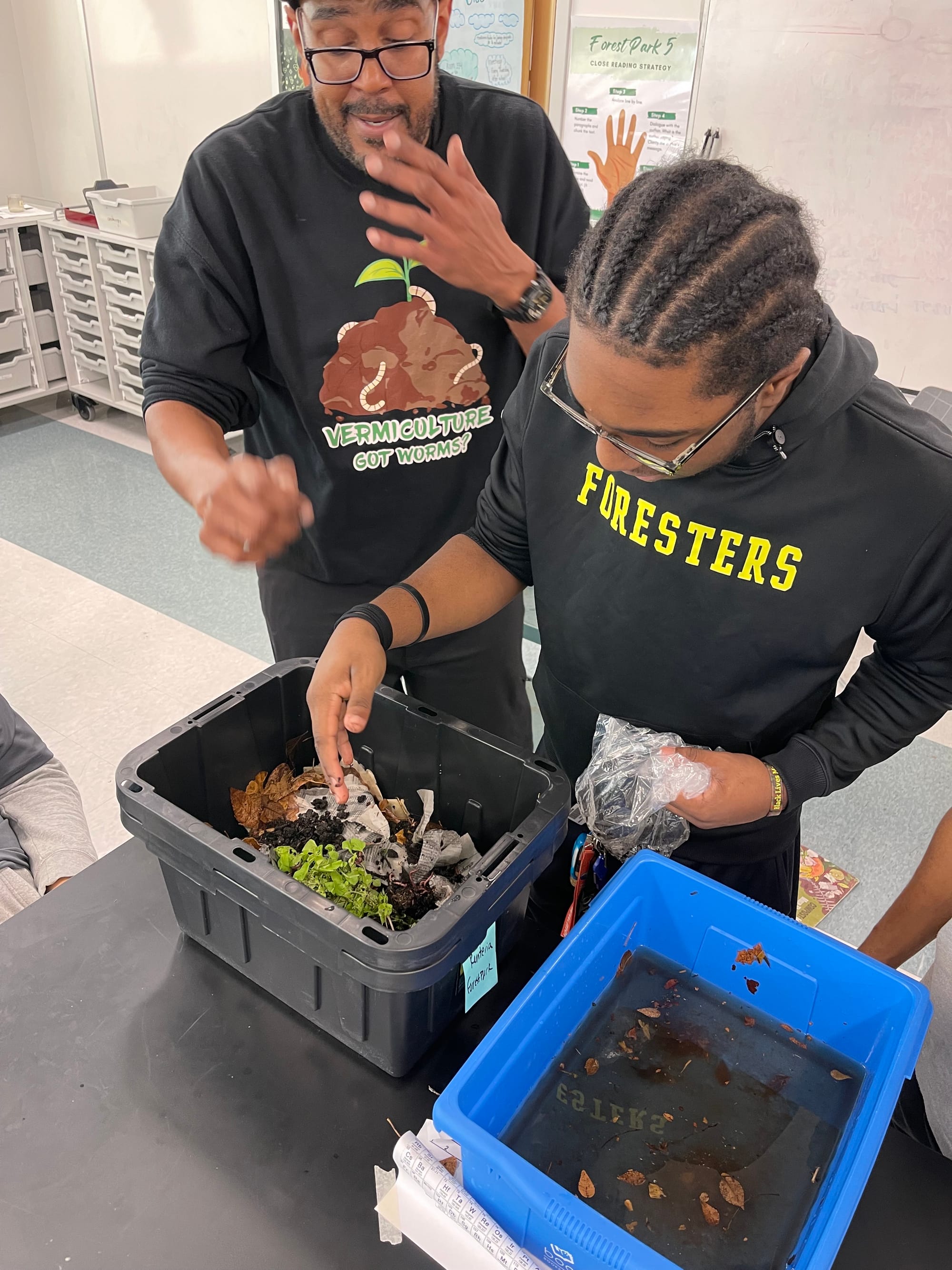
Hayes has leaned into his role as an educator and community bridge, whether he’s working with the city to implement community compost drop-offs at the farmer’s market, organizing drop-off sites for local community gardens, hosting soil science workshops, teaching his teenage employees skills like financial literacy and public speaking, or spreading his message through his poetry.
“The goal for the Baltimore Compost Collective is to bring those youth to the table so that they can be leaders,” Hayes said. “I may not see the end of incineration here in Baltimore in my time, but hopefully, I have inspired and educated and supported the next environmental justice leader that will lead Baltimore City out of incineration and create municipal compost pickup for Baltimore City.”
“Basic human rights”
While Hayes’ strong suit is popular education, he often partners with SBCLT, which focuses more on legal action. Together, they engage in community demonstrations and workshops while also placing pressure on the city to incorporate more zero waste policies.
According to Hayes, getting to zero waste is likely a longshot, so he has set his sights on diverting at least 90% of organic materials. The city’s Department of Public Works is building its first large-scale composting facility, which can then serve as a medium-sized transfer station for local groups. “Hopefully, that will lead us out of incineration,” Hayes said.
SBCLT’s origin story goes back to 2012, when a group of teens from Baltimore’s Benjamin Franklin High School formed the organization Free Your Voice to stop city plans to build a new incinerator block from their school. Their efforts were successful and ultimately led to the formation of SBCLT to investigate other issues confronting overburdened communities, including medical waste, housing vacancies, homelessness, and the Wheelabrator incinerator. Sanchez joined the effort in 2019 as a 13-year-old student under the mentorship of SBCLT co-founder Shashawnda Campbell.
SBLCT now empowers Curtis Bay, Lakeland, and Cherry Hill residents’ involvement in city-wide environmental decisions while advocating for development without displacement. The group leaves flyers in public places and on doorsteps, calls households, and sends email blasts about city council meetings and permit hearings. Above all, they respond to community requests.
“That’s always our priority … making sure that the community knows what’s going on, and they have the right to attend,” Sanchez said.
Last year, SBCLT collected data and published a report with the state’s environmental regulator, the Maryland Department of the Environment (MDE), proving that coal dust from a local coal export facility was entering Curtis Bay households and affecting the health of residents, whose complaints were ignored by the city. SBCLT encouraged residents to give testimonials at the October 2024 at the export facility’s permit hearing.
While the MDE can’t deny the permit or shut down the facility, it is considering the report’s findings and community testimonials to tighten contamination regulations on the pier.
“We’re fighting to make sure that they can breathe clean air, they can have clean environments, clean parks, and everything that is their basic human rights,” Sanchez said.
As part of these broader goals, members of SBCLT co-penned Baltimore’s Fair Development Plan for Zero Waste, which the city council adopted in 2020. By 2040, it calls for the city to achieve a 90% waste diversion rate, grow the economy by designating 25% of recycling and organics processing to small businesses and nonprofits, and end its contract with Wheelabrator Baltimore.
However, the city has already renewed its contract with Wheelabrator through 2031, triggering an EPA Title VI civil rights complaint in May 2024 from SBCLT and environmental watchdogs Chesapeake Bay Foundation and the Environmental Integrity Project.
The complaint alleges that the city’s reliance on the incinerator violates federal civil rights law by disproportionately targeting Black and Latinx communities and that the city’s 10-year solid waste plan doesn’t allocate enough financial resources to move away from the incinerator. While the investigation remains open, the Trump administration’s job, budget, and program cuts to the EPA—and the explicit targeting of anything related to “DEI”—may put the investigation at risk.
“We’re trying to push the city to stay true to the commitment of moving away from incineration, but they’re still burning trash,” Sanchez said. “When the communities try to do something about it, their voices are shut down or not even taken into consideration. They don’t want polluting industries in their communities, and they are tired of politicians making promises and people backing out of their word.”
Cherish the community
SBCLT, BCC, and their citywide partners continue to pressure local governments to crack down on polluting industries, partly by advocating for the passage of the CHERISH Our Communities Act. The proposed law would force the MDE to create cumulative impact assessments, aiming to reduce the collective pollution that communities are subject to.
Polluting facilities currently cannot surpass a certain level of emissions, but communities do not experience pollution in a vacuum. They inhale the contaminants from all existing facilities, which compounds the health and environmental effects.
One person is not going to shut down that incinerator and start composting. It takes a collective to find places where we can work together.
Marvin Hayes, Baltimore Compost Collective founder
“If that analysis shows that those facilities would harm the community, then the MDE needs to deny the renewal permits or take some other steps to save communities from harm,” said Jennifer Kunze, the Maryland organizing director of Clean Water Action, to Inside Climate News.
Organizers understand that forcing the government to work for the people can take years of tireless pressure, reports, and demands at local, regional, and federal levels. Until then, advocates who spoke to Prism said they would continue to support local residents, whether it’s through compost pickup or housing support.
“One person is not going to shut down that incinerator and start composting,” Hayes said. “It takes a collective to find places where we can work together. Putting together a great team, making sure everybody does their part to hopefully stop this environmental injustice from happening, not only here in Baltimore, but nationally.”
Editorial Team:
Tina Vasquez, Lead Editor
Carolyn Copeland, Top Editor
Rashmee Kumar, Copy Editor
Author
Lorena Bally is a freelance writer and communications activist who focuses on Indigenous rights, campesino perspectives, and community-based solutions for environmental justice. As a Swiss-Mexican-Ame
Sign up for Prism newsletters.
Stay up to date with curated collection of our top stories.