At UMass’s flagship campus, concern grows over patterns of pro-Palestine repression
Student Kivlighan de Montebello faces suspension after protesting for Palestine on campus, while some activists also raised concerns about the end of an Arabic language program
Real journalists wrote and edited this (not AI)—independent, community-driven journalism survives because you back it. Donate to sustain Prism’s mission and the humans behind it.
When Kivlighan de Montebello started as a freshman at the University of Massachusetts (UMass) Amherst in the fall of 2023, he expected a typical college experience. He thought he would join the jazz club, play club sports, and grind away at his studies. He certainly didn’t think he would spend the weeks before final exams navigating disciplinary hearings, gathering signatures for a petition, and enlisting the help of a lawyer.
Now a junior, de Montebello faces a suspension after being charged with violating the student code of conduct during an on-campus pro-Palestine protest this fall. As he appeals the sanction, he’s left feeling disillusioned by how his expectations differed from reality at a college that touts the slogan “Be Revolutionary.”
“There was just no foundation for any of these charges,” de Montebello said in an interview. “It’s extremely disappointing. I’ve been just learning about—or sort of unlearning—what the world really is and what universities are. And learning that the university is not a place of education, but is a place of profit and is a component of the U.S. war machine.”
De Montebello and other activists say his disciplinary proceedings are part of heightened repression of campus speech and academic freedom at the state university system’s flagship campus in Western Massachusetts. Some activists also shared concerns about the termination of an Arabic language program by a consortium of colleges in the area.
UMass officials said the assertion that the administration is suppressing free speech “does not reflect who we are.”
“The university recognizes and is committed to protecting the wide range of voices and perspectives in all aspects of the university’s work,” Emily Gest, a university spokesperson, said in an email statement. “We understand and agree with the need to protect academic freedom: That is why the university has staunchly defended faculty’s rights to teach and research without censorship and why we protect the campus community’s rights to exercise free speech.”
But de Montebello’s suspension “is probably the most egregious First Amendment issue that [the National Lawyers Guild] has seen in a while,” said Jon Cubetus, a Guild attorney representing de Montebello in his student conduct case. “It’s pretty outrageous to suspend a student for exercising their First Amendment rights.”
UMass Amherst this summer was designated a “hostile campus” for anti-genocide protesters by the Council on American-Islamic Relations—hostility that de Montebello said has continued to build since the start of Israel’s genocide in Gaza. The Palestinian death toll has since surpassed 70,000, according to recent reports, which experts say is likely a severe undercount. Meanwhile, the Israeli military has repeatedly violated an October ceasefire agreement.
De Montebello said his suspension stems from his participation in a Students for Justice in Palestine demonstration at a September campus career fair, where he was protesting the presence of a subsidiary of RTX Corporation, a weapons company that manufactures missile components for Israel’s air defense system.
UMass protesters have called on the university to cut ties with RTX, formerly called Raytheon Technologies, since October 2023. University officials say that as a public institution, UMass must remain content-neutral on which companies join career fairs or recruit students.
“It is up to each student to make their own choice to engage or not engage with an employer; it is not the role of the university to make that choice on their behalf,” said Gest.
After the protest, the university’s Student Conduct and Community Standards Office reviewed de Montebello for five conduct violations: threatening and disruptive behavior, creating disturbance, failure to comply, and violating the picketing code, according to a student conduct office notice obtained by Prism. De Montebello said he was the only student at the protest who was referred to the conduct office. UMass declined to confirm if that was true, with Gest saying the school cannot comment on individual student conduct cases.
The email cited a description of the protest’s events from members of the university’s Demonstration Response and Safety Team. That team, formed in 2024, is a group of administrators that aims to monitor demonstrations and facilitate the free speech rights of protesters and others on campus, said Samuel Masinter, an associate vice chancellor in university relations and a member of the response team.
According to the summary and de Montebello’s account, de Montebello was using a bullhorn to lead protest chants. As the protesters entered the building where the career fair was held, response team members asked de Montebello to stop using the bullhorn.
The summary alleges that de Montebello continued chanting and then restarted using the bullhorn around an hour later, but de Montebello denied that claim and said he complied. After the response team moved the protesters to a designated area, they eventually started chanting again and were told to leave, according to both accounts. They complied.
In November, de Montebello received notice of his disciplinary sanctions. The most stringent: a suspension, effective immediately, until the end of May 2026. In order to resume enrollment next fall, de Montebello must meet with a student conduct staffer in June to assess his “eligibility and readiness to return to the university,” the notice said.
De Montebello appealed the suspension at a Dec. 5 hearing. He and Cubetus, the National Lawyers Guild attorney, argued that UMass infringed on de Montebello’s First Amendment rights. Universities can justify punishments for protest actions that substantially disrupt school activities or operations, Cubetus said, but the administration lacks evidence for substantial disruption in this case.
“Their argument is that they had to close the doors to the career fair,” Cubetus said. “That’s not nearly enough of a disruption to justify suspending someone, much less punishing them at all.”
This isn’t the first time de Montebello has run into trouble for his role in campus demonstrations. He was first arrested in October 2023 along with 56 other students at a sit-in and a second time in spring 2024 after police swept a protest encampment, arresting around 130 students.
Conduct cases are considered on an individual basis, so there are no “typical sanctions” for violations, according to a FAQ page about the UMass conduct process. The student’s demeanor, past conduct record, the severity of disruption, and other factors can all be taken into account in determining sanctions.
Disciplinary cases for protesters aren’t unique to UMass. Across the country, “students are being surveilled, investigated, suspended, arrested, and threatened with deportation, all for support of Palestinian freedom or criticism of Israel,” said a September article from Palestine Legal, a legal organization dedicated to upholding Palestinian rights. The University of California, Berkeley, last week suspended a lecturer who went on a 38-day hunger strike for Gaza and discussed pro-Palestine views in the lecture hall. And Swarthmore College earlier this year suspended a student for using a bullhorn indoors, which the college categorized as “assault.”
In Amherst, UMass’s four-skilled Arabic language program will be discontinued after the fall 2026 semester, university officials confirmed. That program, within the university’s language department, was funded through an Arabic Language Initiative of the Five College Consortium, a partnership between UMass and four other colleges: Amherst, Hampshire, Mount Holyoke, and Smith. The consortium voted this fall to terminate the Arabic initiative, citing low enrollment.
UMass students can still take Arabic courses through a different track under the Judaic and Near Eastern Studies department. They can also enroll in four-skilled Arabic classes at Smith College through the consortium, Gest said.
“No UMass program, credential, or certificate has been discontinued,” Gest said.
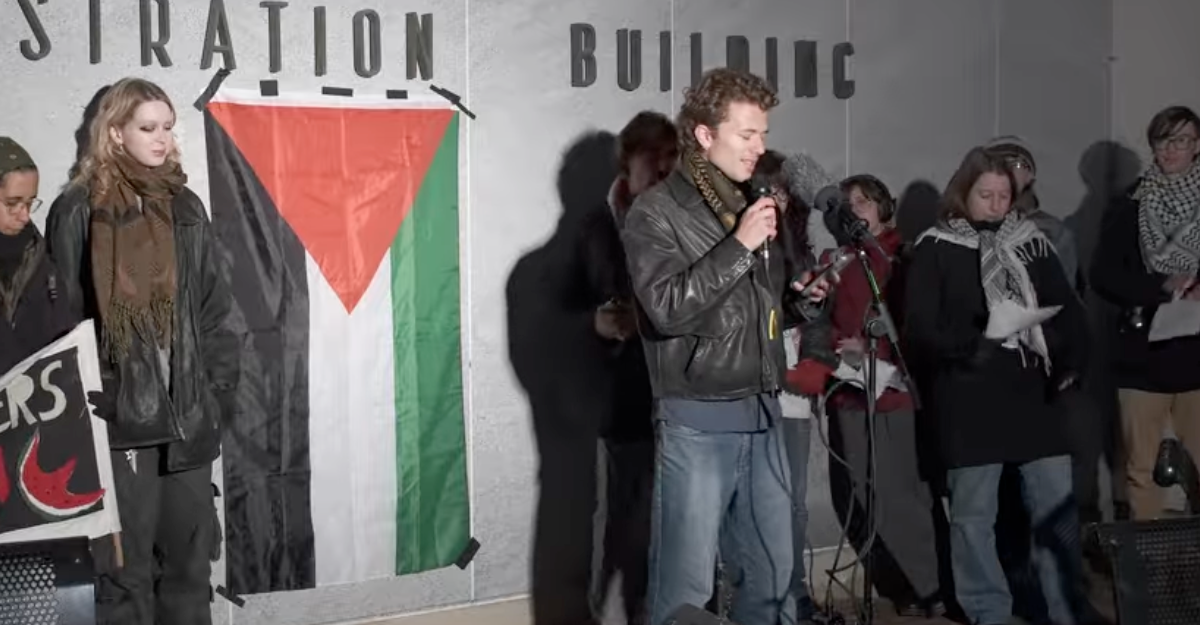
But the more intensive four-skilled track “was the only opportunity that UMass offered for students to learn not only how to read and write in Arabic, but also to speak and listen in Arabic,” Katlyn Durand, a Ph.D. candidate researching U.S. imperialism, wrote in a statement read aloud by activists at a Dec. 4 press conference highlighting campus repression.
The lecturer who teaches the four-skilled program will remain on payroll until March 2027, Gest said. The lecturer did not respond to Prism’s request for comment.
“In a time when politics in the Middle East and Middle Eastern languages are so vital to understanding the world that we live in, … [the cancellation] is problematic,” said Cedric de Leon, a sociology professor at UMass Amherst.
It raises concerns about academic freedom, he said, but also about the educational mission to help students “engage in the world” and discuss complex issues.
“UMass talks a pretty big game about having a long history of student activism,” he said. “But what we’re watching before our very eyes is basically the decimation of that entire political culture.”
Editorial Team:
Sahar Fatima, Lead Editor
Carolyn Copeland, Top Editor
Stephanie Harris, Copy Editor
Author
Maddie Khaw is a journalist based in Portland, Oregon, and Boston, Massachusetts. She is currently finishing her undergraduate degree in Journalism at Emerson College in Boston, where she is also mino
Sign up for Prism newsletters.
Stay up to date with curated collection of our top stories.