Anti-transgender legislation accelerates in early 2026
The scope and coordination of the proposals in state legislatures across the U.S. mark a new phase in a campaign that has been building for a decade, policy researchers say
Real journalists wrote and edited this (not AI)—independent, community-driven journalism survives because you back it. Donate to sustain Prism’s mission and the humans behind it.
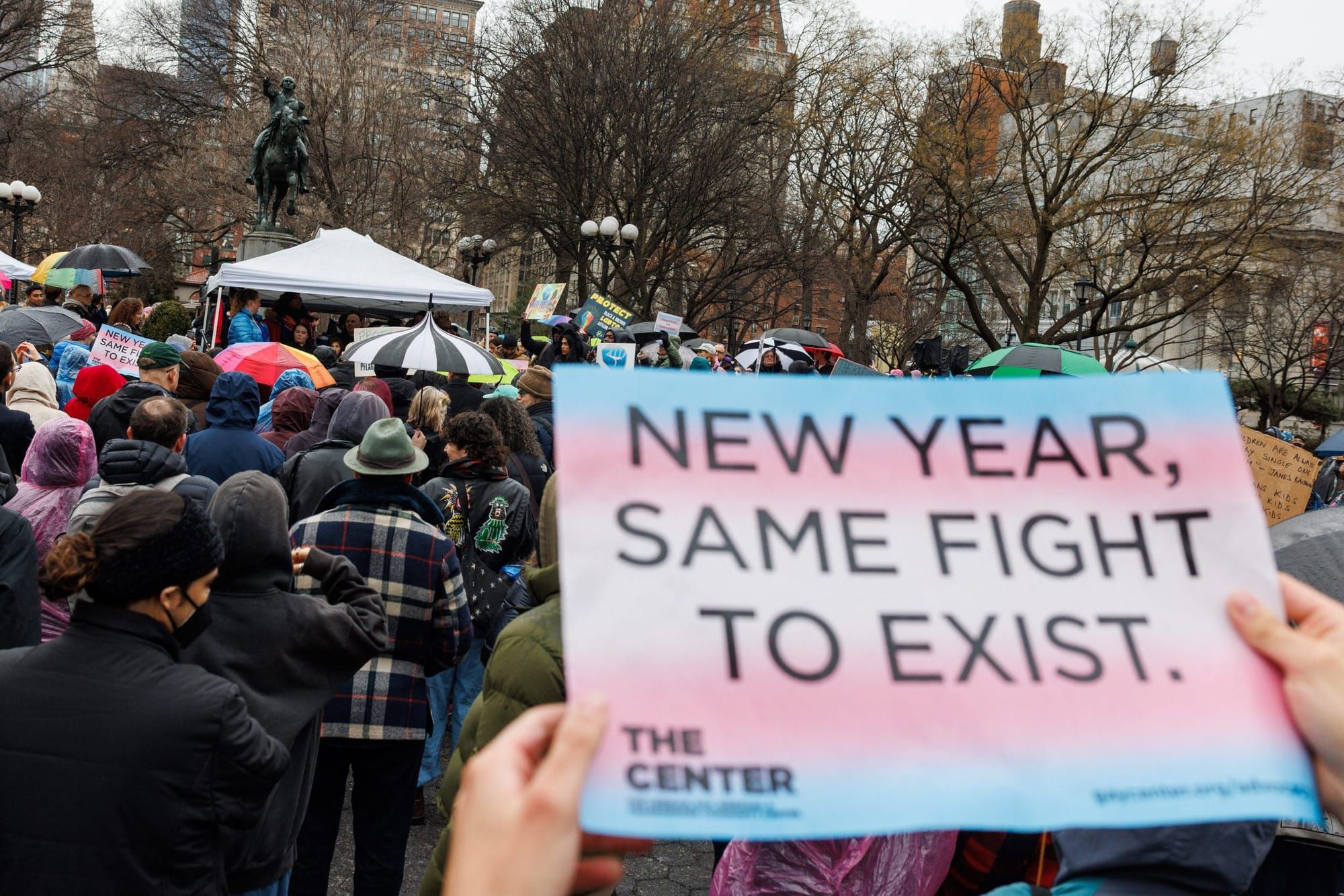
Lawmakers across the country have introduced hundreds of bills targeting transgender people in the first month of 2026, a surge that advocates said reflects a decadelong political strategy that has steadily escalated since major court victories for LGBTQIA+ rights.
The American Civil Liberties Union is tracking just shy of 400 anti-LGBTQIA+ bills in state legislatures nationwide, including measures carried over from prior sessions that remain active this year. Meanwhile, Trans Legislation Tracker notes 645 anti-trans bills as of Feb. 9, three of which have passed and 17 of which have failed. These also include bills carried over from last year. While totals vary by methodology, policy researchers said the scope and coordination of the proposals mark a new phase in a campaign that has been slowly building since at least 2015, when the Supreme Court legalized same-sex marriage.
“It’s not new that law and policy shapes queer and trans people’s lives,” said Logan Casey, the director of policy research at the Movement Advancement Project, part of the national LGBTQIA+ rights organization GLAAD. “What is relatively new is, over the past five to six years, [we’ve seen] a really dramatic escalation in legislation explicitly targeting LGBTQ people and especially transgender people across virtually every aspect of our lives.”
The three anti-trans bills that already passed this year include Kansas Senate Bill 244, which combines a sweeping bathroom ban with restrictions on transgender people’s ability to update gender markers on identity documents, following a state Supreme Court ruling that protected those updates. New Hampshire also passed SB 268, which would amend the state’s anti-discrimination law to allow people and organizations to classify individuals based on biological sex, including in bathrooms, locker rooms, sports, and certain institutional settings, by specifying that such classifications do not constitute unlawful discrimination. Wisconsin SB 146 makes it a felony for anyone convicted of a violent crime to legally change their name, bans them from obtaining new legal names, and imposes criminal penalties for violations.
The escalation in legislation has also reached the federal level. In January, a three-judge panel of the U.S. Court of Appeals for the District of Columbia Circuit heard oral arguments in Talbott v. USA, a challenge to President Donald Trump’s transgender military ban, one of the administration’s first actions after returning to office.
From marriage equality to a new political target
Before the Supreme Court ruled in favor of same-sex marriage in Obergefell v. Hodges, Casey said there were relatively few anti-trans or anti-LGBTQIA+ bills at the state level. According to him, those who were pushing the broader anti-LGBTQIA+ agenda have seen that they have “lost the question” of marriage equality.
“Broader public acceptance for LGBTQ people, including for trans people, was growing across the country,” Casey said.
Early attempts to shift the focus of attacks toward transgender people largely failed. In 2016, North Carolina’s bathroom ban sparked widespread backlash from corporations, musicians, sports leagues, and the public, and was repealed the following year. The backlash, Casey said, demonstrated that certain types of anti-trans legislation were difficult to sustain politically at the time.
But those efforts did not stop. Instead, he said, conservative lawmakers and advocacy groups regrouped, testing narrower approaches until they found one that could survive both public scrutiny and legal challenge.
Sports bans as a foothold
A foothold emerged around 2020, when bans on transgender students participating in school sports began to gain momentum. Unlike earlier bathroom bills, sports bans were proposed as protecting fairness rather than explicitly targeting transgender people, a framing that proved politically effective.
“Sports bills really started to stick and take off,” Casey said. “Those spread very quickly, and that has been a bit of a foot in the door for other anti-trans legislation.”
From there, lawmakers expanded outward, reviving health care bans, bathroom restrictions, and identity document limitations, while also refining bill language based on what survived court challenges.
By 2022, Casey said, the number of anti-trans bills introduced annually had exploded, and each year since has brought both new categories of legislation and more aggressive versions of existing ones.
A shift from targeted bans to structural exclusion
That evolution in proposed legislation is visible in the bills dominating early 2026. In addition to familiar attacks on health care and schools, lawmakers are advancing so-called “sex definition” or “gender regulation” laws.
Casey described these measures as “a much more meta sort of approach,” explaining that instead of targeting individual policy areas, the laws redefine sex across entire state legal codes in ways that exclude transgender and nonbinary people from legal recognition.
Those measures are best understood as a reaction to the Supreme Court’s 2020 decision in Bostock v. Clayton County, which held that discrimination against transgender people constitutes sex discrimination under federal law, Casey said, with lawmakers now trying to “define sex” more narrowly.
Casey pointed to Kansas as an example of how these efforts intensify after court losses. Following a state Supreme Court ruling that protected transgender people’s ability to update identity documents, lawmakers advanced new legislation combining identity restrictions with sweeping bathroom bans, in some cases rewriting bills after hearings to avoid additional public input.
Research shows that the harm of such legislation extends beyond whether bills pass. Political debates surrounding anti-trans policies have been linked to increased anxiety, depression, and stress among transgender people, particularly youth.
A federal ban with national consequences
That same logic underpins the transgender military ban under review in Talbott v. USA, attorneys argue. The lawsuit, brought on behalf of 30 transgender service members and recruits, challenges a policy that would result in what attorneys describe as a mass discharge of qualified troops based solely on transgender status.
“As the government concedes, these plaintiffs are highly qualified and have met every standard,” said Shannon Minter, the legal director at the National Center for LGBTQ Rights, who argued the case before the court. “They have deployed before, during, and after transition.”
Minter told the court that the policy does not reflect military judgment or medical practice, pointing to a district court ruling that found the ban was “soaked with animus and dripping with pretext,” and likely unconstitutional. That ruling, issued in March by U.S. District Judge Ana Reyes, imposed a nationwide preliminary injunction blocking the ban’s implementation.
The case now sits in contrast with a parallel challenge in the 9th Circuit, where the Supreme Court allowed a separate injunction to be stayed. Attorneys argue that the key distinction is that the lower court in Talbott made explicit findings, more than 80 of them, that the policy was driven by bias rather than evidence.
In their appellate filings, government lawyers acknowledge that the plaintiffs meet all physical and mental standards for military service, but nonetheless argue that the ban advances legitimate military interests such as unit cohesion and readiness, and should remain in place while the appellate process moves forward.
For U.S. Army Second Lt. Nicolas Talbott, the lead plaintiff in the case, the ban has introduced yet another period of uncertainty after years of shifting policy.
Nothing about us as individuals has changed. The only thing that’s changed is the policy. … We’re just asking to be allowed to continue doing our jobs.
U.S. Army Second Lt. Nicolas Talbott, lead plaintiff in Talbott v. USA
“Nothing about us as individuals has changed,” Talbott told Prism in an interview. “The only thing that’s changed is the policy. … We’re just asking to be allowed to continue doing our jobs.”
Talbott, who has served nearly two years, said he spent much of his early adulthood attempting to enlist under fluctuating rules governing transgender service. While he remains on duty for now, he described living in constant limbo.
“It’s very frustrating, and it’s very draining to never know what my entire life might look like by this time next week, just because of policies and politicians and things that are far above my head,” Talbott said.
Talbott emphasized that readiness in the military is judged by competence and trust, not identity.
“All they care about is whether we can do our jobs when we put on that uniform,” Talbott said, “whether the person standing next to you is someone you can rely on and trust to get you out of a life-and-death situation, if it ever comes down to that.”
Disputing the “medical policy” claim
The government has argued that the ban is a neutral medical policy related to gender dysphoria. Minter rejected that characterization, noting that the military conducts individualized assessments for every other medical condition with the explicit goal of retaining trained personnel whenever possible.
“For every other medical condition, the military takes an individualized approach … The only medical condition under this new policy that doesn’t get an individualized assessment is gender dysphoria,” Minter said. “If you’re transgender, you’re out. That’s it.”
Casey said the framing mirrors tactics increasingly used in state legislation, where lawmakers move away from explicit bans and toward structural exclusions designed to withstand legal scrutiny. Many of the bills are framed as neutral policies, but functionally work to exclude transgender people from full participation in public life.
A coordinated state-level surge
Much of the state-level legislation introduced in early 2026 follows a familiar pattern. Conservative legal organizations, including the Alliance Defending Freedom, circulate model bills that are replicated across multiple states with minimal changes, Casey said.
Missouri is once again among the states introducing the highest number of anti-LGBTQIA+ bills, though totals fluctuate depending on which legislatures are in session. Texas, for example, does not meet in 2026, altering year-to-year comparisons.
Over the next 30 to 60 days, advocates said, identity document policies and expanded health care restrictions for adults are likely to be major legislative battlegrounds. Still, Casey emphasized that most bills do not become law.
“The movement has consistently defeated roughly 90% of those bad bills every single year for the past 15 years or more,” he said.
Editorial Team:
Sahar Fatima, Lead Editor
Carolyn Copeland, Top Editor
Stephanie Harris, Copy Editor
Author

Alexandra is a Cuban-American writer based in Miami, with an interest in immigration, the economy, gender justice, and the environment. Her work has appeared in CNN, Vice, and Catapult Magazine, among
Sign up for Prism newsletters.
Stay up to date with curated collection of our top stories.