Judge’s reopening of ‘Alligator Alcatraz’ raises ethical concerns
Advocates say Judge Barbara Lagoa, whose husband represents the state of Florida in other legal cases, should have recused herself from ruling on the detention center
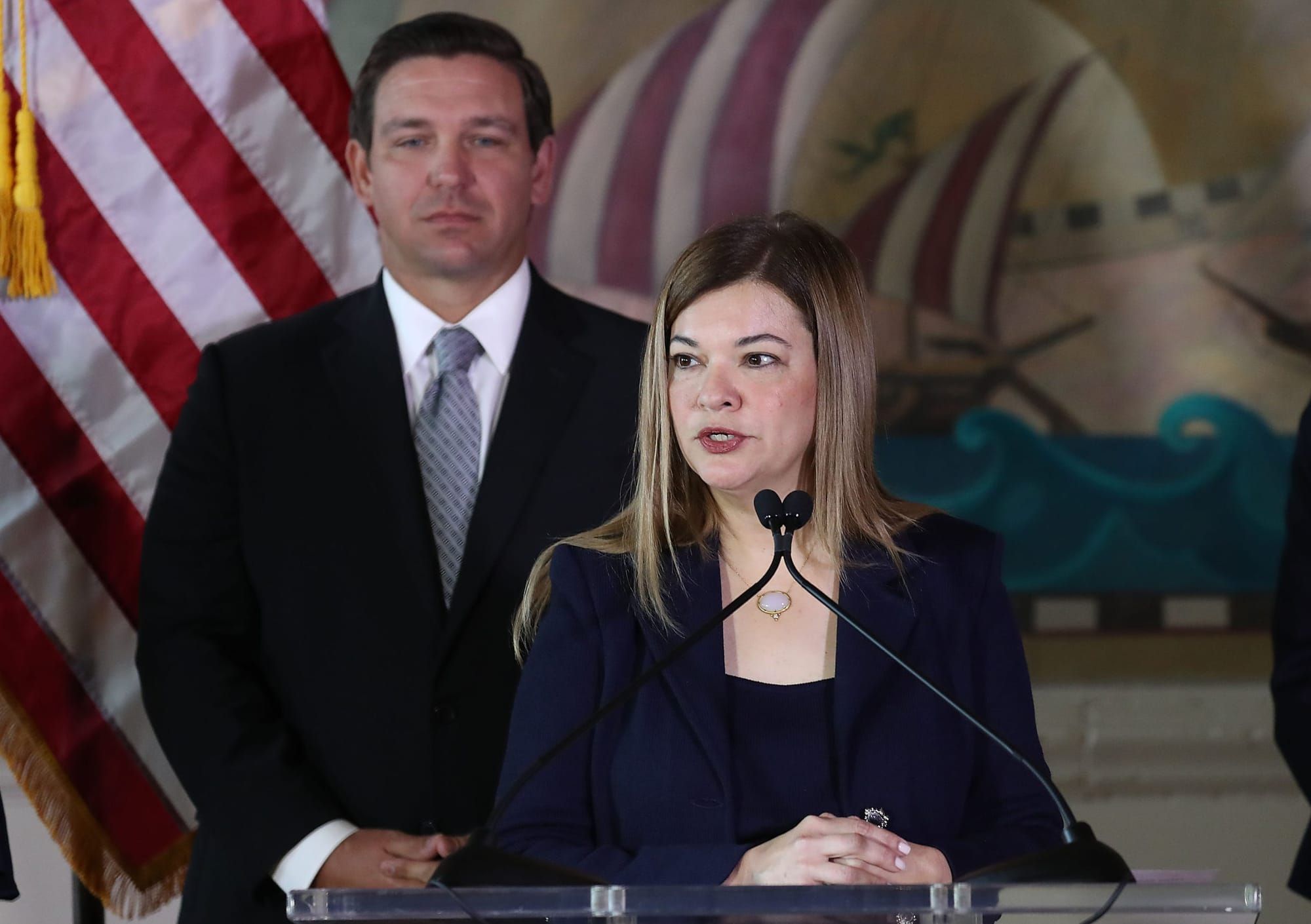
A U.S. appeals court ruled on Sept. 4 to keep Florida’s controversial “Alligator Alcatraz” detention center operating while an appeal plays out, after a district court ruling to shut down the facility. The judge who authored the 2-1 majority opinion was 11th Circuit Court of Appeals Judge Barbara Lagoa.
Some immigrant rights advocates and local leaders argue that Lagoa’s role in overseeing the case, filed in part against Florida’s government, raises ethical concerns. Lagoa is married to attorney Paul Huck, a partner at Lawson Huck Gonzalez, one of Florida’s most politically connected conservative law firms. The firm is earning millions of dollars from contracts tied to the state’s other legal battles. The firm is not involved in the “Alligator Alcatraz” lawsuit.
Critics argue that Lagoa’s decision highlights how the federal bench—where she serves as a Donald Trump-appointed judge once shortlisted for the U.S. Supreme Court—remains entangled with Florida’s partisan legal and political machinery. At the same time, Lagoa’s ruling reopens the door for operations that conservationists say are causing irreparable harm to the Everglades and endangered species in the state.
“She should have recused herself immediately,” said Thomas Kennedy, a consultant with Florida Immigrant Coalition. Her failure to do so erodes public trust, he added.
U.S. District Judge Kathleen Williams had ordered the closure of the Everglades detention center on Aug. 21, citing overwhelming evidence that the hastily constructed facility was harming endangered species, including Florida panthers, and operating without the legally required environmental reviews. But the appeals court’s stay allows state and federal officials to resume operations at the site while appeals in the case proceed.
In response to a request for comment regarding Lagoa’s involvement in the case, the clerk’s office for the 11th Circuit Court of Appeals pointed to judicial ethics rules governing recusals and disqualifications, citing internal operating procedures, federal statute 28 U.S.C. § 455, and the Code of Conduct for U.S. judges. According to the law, recusal is required if a judge has a personal bias or prejudice concerning a party, has previously served as a lawyer or government official in the matter, has a financial interest in the outcome, or if the judge’s spouse or close family member has such an interest or role. It is not apparent that Huck or his law firm has a financial interest in the case.
Lagoa, Huck, and Lawson Huck Gonzalez did not respond to Prism’s requests for comment.
At her 2019 Senate Judiciary hearing, Lagoa emphasized that judicial impartiality as well as the appearance of impartiality is essential to public trust. She said judges must step aside whenever their impartiality “might reasonably be questioned,” citing federal statute and the judges’ code of conduct. Lagoa pledged to review each case individually, consult ethics officials when appropriate, and recuse herself from matters involving her husband or his law firm, as well as cases tied to Florida courts where she previously served. She noted that in her 13 years on the bench, she had occasionally recused herself when she knew a party or witness; she said she would continue that practice as an appeals court judge.
What a judicial expert says
Indiana University School of Law Distinguished Professor Charles G. Geyh, who teaches and has authored books on judicial ethics, explained that federal law is clear: Judges “shall disqualify” themselves when their impartiality could reasonably be questioned.
“There’s no wiggle room. There’s no discretion there,” he said.
However, Geyh noted that recusal decisions are highly fact-specific. Huck is not involved in the detention center litigation, and the firm’s representation of the state in other matters might not be enough to trigger mandatory disqualification.
“In situations like this, courts are really reluctant to go there, unless the relationship is direct,” Geyh said. “Will he benefit, in some ways, by the result resolution of this case? And, in other words, will he be advanced in his career? Will something good happen to him if she resolves it in favor of the state? And it’s not clear that that’s so.”
Still, he warned that the public perception of fairness matters.
“[Judges] hold a public trust,” Geyh said. “From a public perspective, if you were reporting, for example, that there was a clear conflict of interest that the judge was flouting here in that situation, I think you’d be looking at some pretty serious consequences to public trust in the judiciary. If you see that happen often enough, I think the public trust in an impartial judge is going to be compromised.”
Geyh pointed out that courts have wrestled with similar questions in other high-profile cases. In the 9th Circuit, a judge presided over a gay marriage case while his wife worked at the American Civil Liberties Union, which supports marriage equality. Ultimately, they concluded that she wasn’t a party, she didn’t directly benefit, and her advocacy wasn’t enough to disqualify him.
“The fact that she had these ideological perspectives wasn’t really going to be germane,” Geyh explained.
Justice Clarence Thomas also faced criticism during the Supreme Court’s review of the Affordable Care Act, since his wife, Ginni Thomas, was actively working with organizations opposing Obamacare. He did not recuse himself.
“Either we’re going to basically say we can’t have professional couples with one half of them being a judge,” Geyh said, “or we’re going to say that judges and their spouses can have separate professional lives, and that the fact that they may disagree goes with the territory, and that the fact that your spouse has strong views on a matter should not really affect your ability to preside over the case.”
Disqualification is more straightforward when there’s a clear financial stake, such as a judge’s spouse owning significant stock in a company or industry directly affected by a ruling.
Lagoa has previously been the subject of ethical concerns. In 2020, she and fellow Trump-appointed Judge Robert Luck were criticized for failing to recuse themselves from a major voting rights case after previously hearing arguments on the same issue as Florida Supreme Court justices. Their participation helped the 11th Circuit clear the way for a “pay-to-vote” system that could have blocked up to 1 million Floridians with felony convictions from casting ballots. Senate Democrats later pressed both judges to explain why they disregarded clear judicial ethics rules requiring recusal in such circumstances.
Lawson Huck Gonzalez has become a go-to firm for Gov. Ron DeSantis’s administration, securing $5.3 million in contracts during his second term, according to a Daily Business Review analysis, and representing the state in numerous lawsuits targeting diversity, equity, and inclusion (DEI) programs and LGBTQIA+ initiatives. The firm is also co-counsel in a high-profile class-action lawsuit against Target, which alleges that the retailer misled investors about the financial risks of its Pride campaign.
Judicial ethics rules suggest that judges recuse themselves when their spouses’ financial interests could be affected by a ruling. Critics argue that Lagoa’s decision to weigh in on a case central to Florida’s legal agenda undermines public confidence in judicial impartiality, as her husband could stand to profit from the state’s larger legal strategy.
“She’s married to him, and therefore, she has an interest that he does well in his cases, that he maintains a good relationship with the state of Florida, as the state of Florida is his client,” Kennedy, who works with Florida Immigrant Coalition, said. “He has an interest for her to rule favorably for the state of Florida in highly contentious cases, like this one, that go before her.”
Florida state Rep. Anna Eskamani said Lagoa’s role fits into a broader pattern of political court-stacking.
“Gov. Ron DeSantis has stacked multiple courts to reflect his political ideology and his agenda, and we’ve seen this at local and appellate levels across Florida,” Eskamani said.
Trump nominated Lagoa during his first term. Eskamani said there was an “entire conservative apparatus” focused on remaking the judiciary.
It’s concerning to have on such an important case with huge ramifications for the environment a judge with that power to make a decision on this matter with a husband that is working on high-profile political cases on behalf of DeSantis.
Florida state Rep. Anna Eskamani
“It’s concerning to have on such an important case with huge ramifications for the environment a judge with that power to make a decision on this matter with a husband that is working on high-profile political cases on behalf of DeSantis,” she said.
Eskamani said that while Huck is not directly representing the state in this specific case, the family’s financial ties to the state’s legal strategy present an appearance of bias.
“From the most ethical position, she should have recused herself,” Eskamani said, adding that the decision “oozes unethical dynamics” and “further erodes people’s trust in the judiciary.”
“What the United States is known for is our three separate but equal branches of government, which just becomes less and less relevant every day,” she said.
Yareliz Mendez-Zamora, a policy coordinator with American Friends Service Committee, echoed those concerns, calling the fact that Lagoa did not recuse herself “ridiculous.”
“Judges should be held to a higher standard … to be the epitome of professionalism, of transparency, of righteousness,” Mendez-Zamora said. “Her husband is making, quite frankly, a ton of money off of these state contracts.”
GOP-aligned law firms have frequently appeared to leverage political ties into lucrative work from the state of Florida. Alongside Lawson Huck Gonzalez, firms such as Continental PLLC and Holtzman Vogel have also earned millions of dollars from state contracts and cemented themselves as key players in advancing DeSantis’s and Trump’s “America First” legal agenda. Continental PLLC and Holtzman Vogel did not respond to Prism’s request for comment.
All three firms had representatives on Florida Attorney General James Uthmeier’s transition team earlier this year, underscoring their integration into Florida’s legal and political machinery.
And yet, Kennedy and Eskamani pointed out that it was Williams, the U.S. district judge who ruled to halt operations at the detention center, whom state officials called an activist judge, frequently noting that she was nominated by President Barack Obama.
Humanitarian concerns grow
Meanwhile, immigrant rights advocates say the ruling to reopen “Alligator Alcatraz” has dire consequences for people detained at the site.
Conservation groups, Friends of the Everglades, the Center for Biological Diversity, Earthjustice, and the Miccosukee Tribe of Indians of Florida, vowed to continue their legal fight against the detention center, calling the ruling a “heartbreaking blow” to the Everglades.
“It really felt like a gut punch,” said Elise Bennett, Florida and Caribbean director of the Center for Biological Diversity. “We know about considerable, ongoing, irreparable harm that’s happening from the site, and what this order does is allow that to continue.”
Eve Samples, executive director of Friends of the Everglades, said in a press release that the group hopes the preliminary injunction halting operations will be reaffirmed on appeal. “While disappointing, we never expected ultimate success to be easy,” Samples said.
Kennedy said Florida Immigrant Coalition is continuing to support multiple lawsuits challenging the site’s legality and lack of access to counsel, while tracking transfers into the facility and investigating over $315 million in no-bid state contracts linked to its operation.
“This is not over by any means,” he said.
Kennedy said the facility had been winding down, with fewer than 100 people remaining inside, but buses have begun arriving again, signaling that the state is ramping operations back up.
He shared the story of Yaneisy, a Cuban mother whose son was pulled over for a traffic violation, and detained and transferred to “Alligator Alcatraz” without her knowledge. She had no news of him for four or five days, Kennedy said.
He was later deported to Mexico, a country where he has no ties, even though he is stateless and has no citizenship.
“It’s like an insanity that feels far away,” Kennedy said. “And then it’s not—it’s like my son is in there.”
Editorial Team:
Sahar Fatima, Lead Editor
Carolyn Copeland, Top Editor
Rashmee Kumar, Copy Editor
Author
Alexandra is a Cuban-American writer based in Miami, with an interest in immigration, the economy, gender justice, and the environment. Her work has appeared in CNN, Vice, and Catapult Magazine, among
Sign up for Prism newsletters.
Stay up to date with curated collection of our top stories.