‘No detention on stolen land’: Protesters decry ‘Alligator Alcatraz’ ICE facility in the Everglades
The proposed development, adjacent to federally protected lands that are sacred to Indigenous groups, would be Florida’s largest immigration detention center
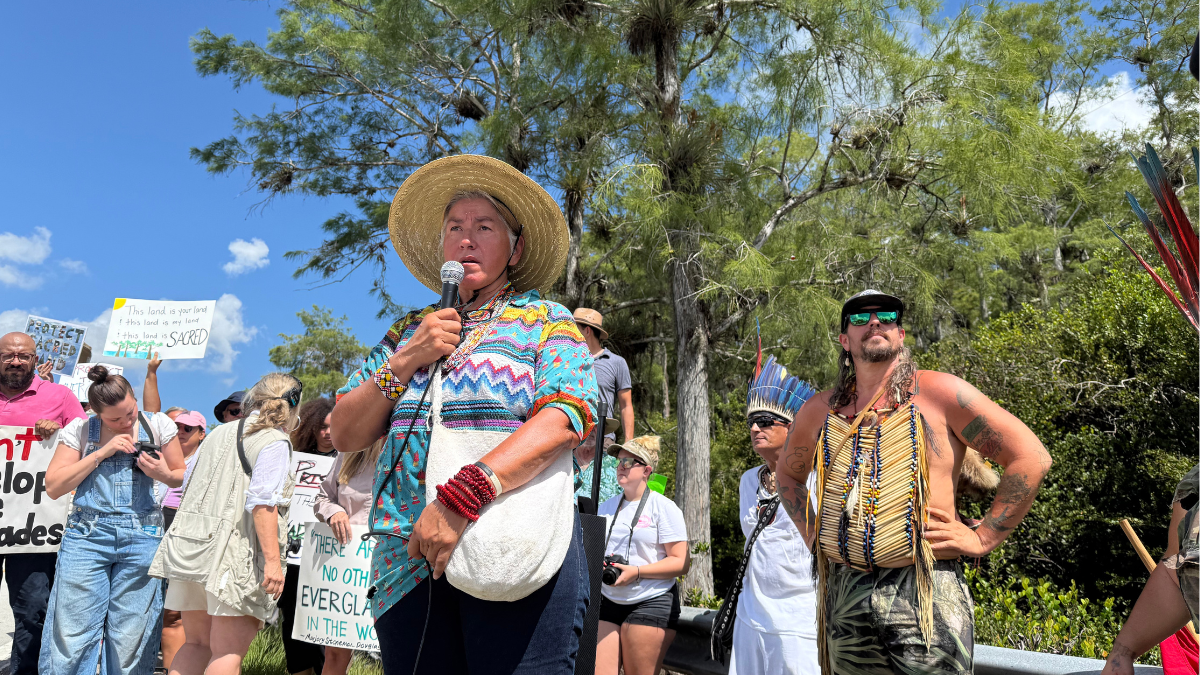
Just west of Miccosukee tribal lands, where the Tamiami Trail cuts through a stretch of the Everglades once saved from ruin, the land is once again under threat—and once again, people are rising to defend it. On June 22, hundreds returned to this storied stretch of Collier County to resist a new intrusion: a massive immigration detention center, 30 square miles wide, rising fast from federal approvals and broken promises. Another protest is planned at Tamiami Trail for June 28 at 10 a.m.
Beneath the sweltering South Florida sun, on the outskirts of canopies of ancient cypress trees and amid a cacophony of supportive car honking, hundreds of environmentalists, tribal elders, policymakers, and local residents gathered on Tamiami Trail’s unforgiving asphalt, across from the proposed site of what would be Florida’s largest immigration detention center. One person held up a sign reading, “No detention on stolen land.”
“We want to make sure that abolition is at the forefront of keeping everybody here who’s sharing the so-called land of Florida safe, and also that our sacred homelands are preserved,” Durante Blais-Billie, a Seminole organizer, told Prism. “[The government has] no legitimate authority to say that anyone’s illegal on stolen land.”
Nicknamed “Alligator Alcatraz,” the development being constructed on land owned by Miami-Dade County is projected to cost the state roughly $450 million per year, according to the Miami Herald. The controversial proposal rapidly gained federal approval, and video footage shows tents and trailers already being set up on the property. The Department of Homeland Security (DHS) Secretary Kristi Noem said in a statement posted to X on June 23 that the project is funded by the Federal Emergency Management Agency’s (FEMA) Shelter and Services Program.
Starting as early as next week, the facility will begin housing detainees in soft-sided, temporary tents, with the potential to add more permanent builds later. This comes as Florida enters what forecasters predict will be an above-average hurricane season, putting thousands of detainees at risk from flooding, severe storms, and extreme heat in one of the state’s most vulnerable regions. While the state says it is working on evacuation plans, no finalized protocol is in place yet, and any response will depend on storm severity and the number of people at the facility.
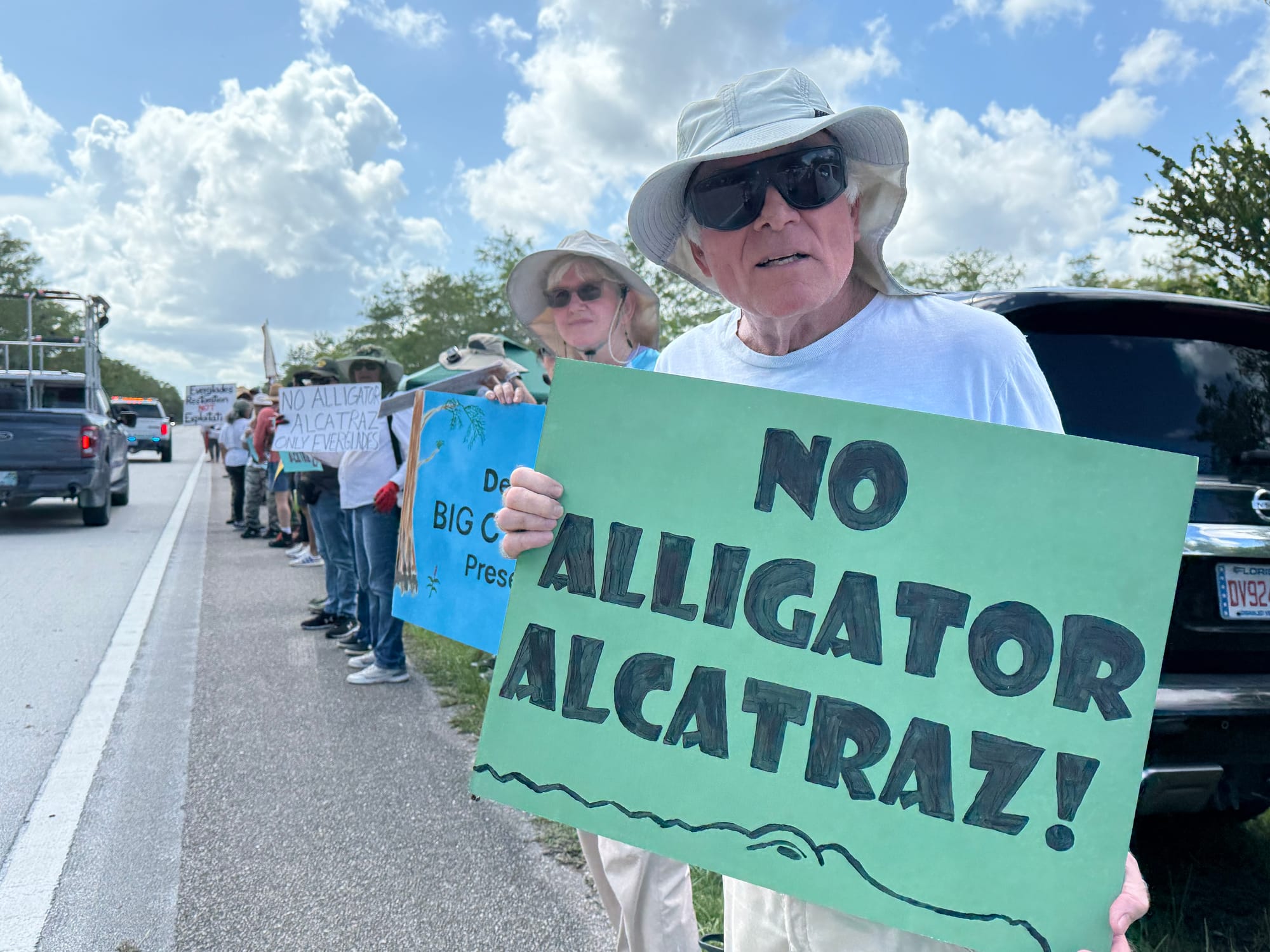
According to an emailed statement from a DHS representative, the facility will be managed by the Florida Division of Emergency Management and will initially open within days with 500 to 1,000 beds, expanding in 500-bed increments. The projected cost is about $245 per bed per day. According to the representative, the site will process individuals arrested under the federal 287(g) immigration enforcement program, with support from the Florida National Guard. Renovated FEMA trailers will be used for staff accommodations.
Florida Attorney General James Uthmeier, who previously served as Gov. Ron DeSantis’ chief of staff, unveiled the proposal on social media, calling it a “great opportunity for Florida.” In an interview with conservative commentator Benny Johnson, Uthmeier said the facility would be operational with 5,000 beds by early July. Despite being recently found in civil contempt by a federal judge over an immigration ruling, Uthmeier is now at the center of what critics see as a high-profile alignment with Trump-era immigration tactics.
DeSantis has not publicly disavowed the plan. Under Florida law, the governor has emergency powers that allow him to override property rights, a legal framework reportedly being used to justify the rapid build-out.
Over the past week, trucks carrying portable restrooms and industrial generators arrived at the site, signaling swift mobilization despite public outcry.
Miami-Dade County Mayor Daniella Levine Cava urged state officials to delay construction, warning in a letter that the plan lacked critical environmental safeguards and could have “devastating” consequences on the fragile Everglades ecosystem.
The timing couldn’t be more contentious. On June 26, chaos erupted at a Miami-Dade County Commission meeting when officers forcibly removed Camila Ramos, an opponent of the County’s jail agreement with Immigration and Customs Enforcement (ICE), which was approved during the meeting. Just days earlier, on June 17, the Miami City Commission narrowly approved a resolution reaffirming its cooperation with federal immigration enforcement, deepening the city’s alignment with state and national policies that many immigrant advocates say criminalize survival.
“Our ancestors fought to be here”
The protest took place just west of the Miccosukee tribal lands, on sacred ground where leaders say a facility like this not only threatens the fragile ecology of Big Cypress National Preserve, but also dishonors the cultural and spiritual fabric of the region.
Miccosukee elder and rally organizer Betty Osceola said in an interview with Prism that when she first learned about the development through a news article, she thought it was a joke. Those pushing the proposal, she said, were “making a mockery of the human life in the area and the significance of the area.”
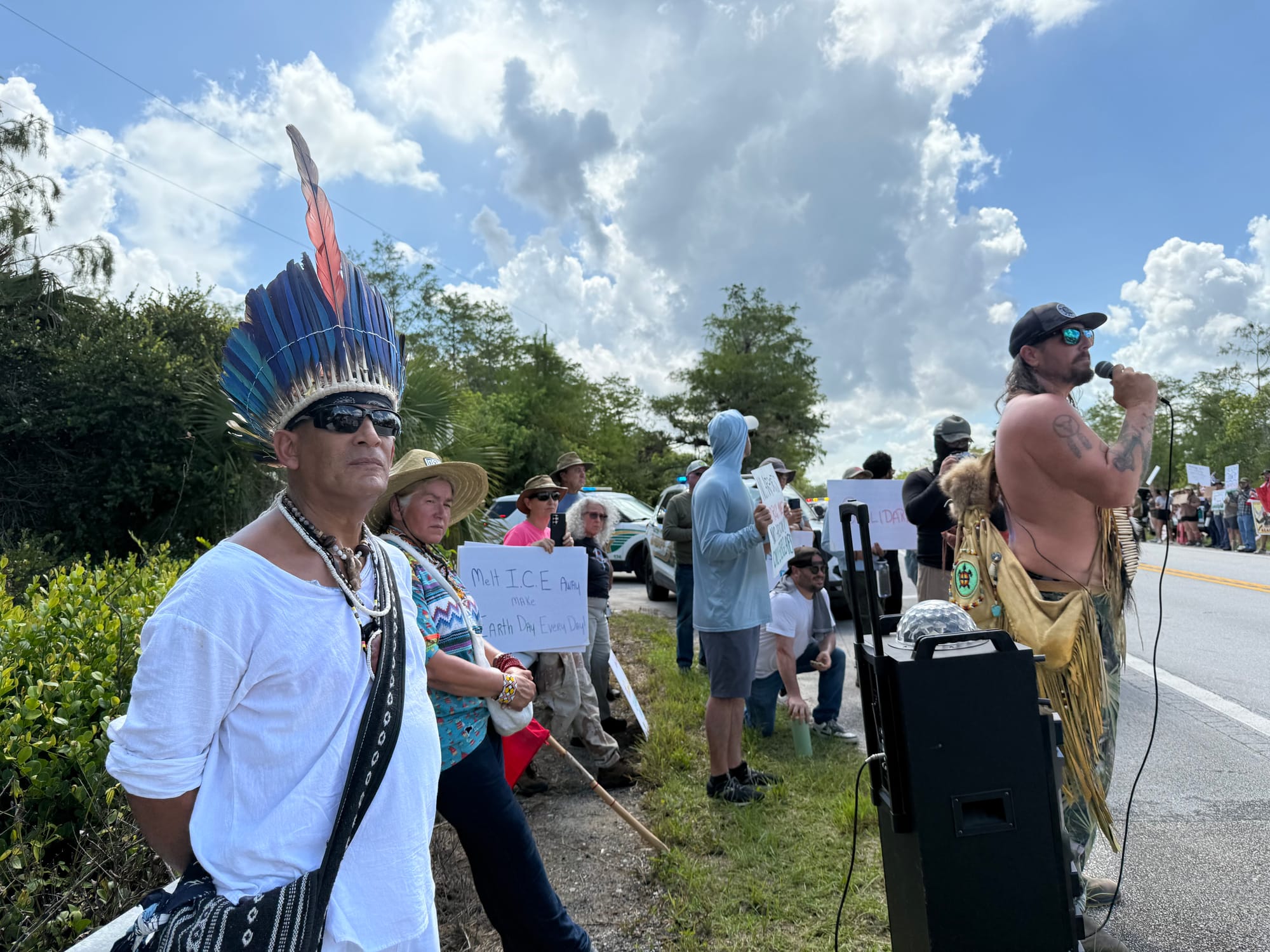
Osceola was especially disturbed by the language used in early media reports, which framed the area as a desolate swamp, devoid of life except for alligators and snakes.
“What about me? I’m out here,” Osceola said. “It’s not a wasteland, and it’s a thriving area.”
For Osceola, the facility is not just another bad land-use decision. It’s the continuation of a cycle of displacement, extraction, and dehumanization faced by Indigenous people that dates back to the Trail of Tears and the Seminole Wars.
“Our ancestors fought to be here, and even today we understand there’s always going to be that threat of someone coming to try to remove you, try to take your land,” Osceola said. “It’s very taboo for us to pass judgment on other people. It’s very taboo for us to incarcerate. We don’t have a jail on our reservation because we’re not supposed to imprison people because you’re asking for that to befall on yourself.”
She noted the cruel irony of Americans—whose ancestors arrived on ships—now building prisons to remove other immigrants.
Fighting for the Everglades
The site is home to lakes formed by the aborted effort to build the Everglades Jetport. Locals have long used the area for fishing, walking, kayaking, and spiritual renewal. But since the detention center proposal surfaced, access has been restricted. A locked gate and surveillance camera now block the road.
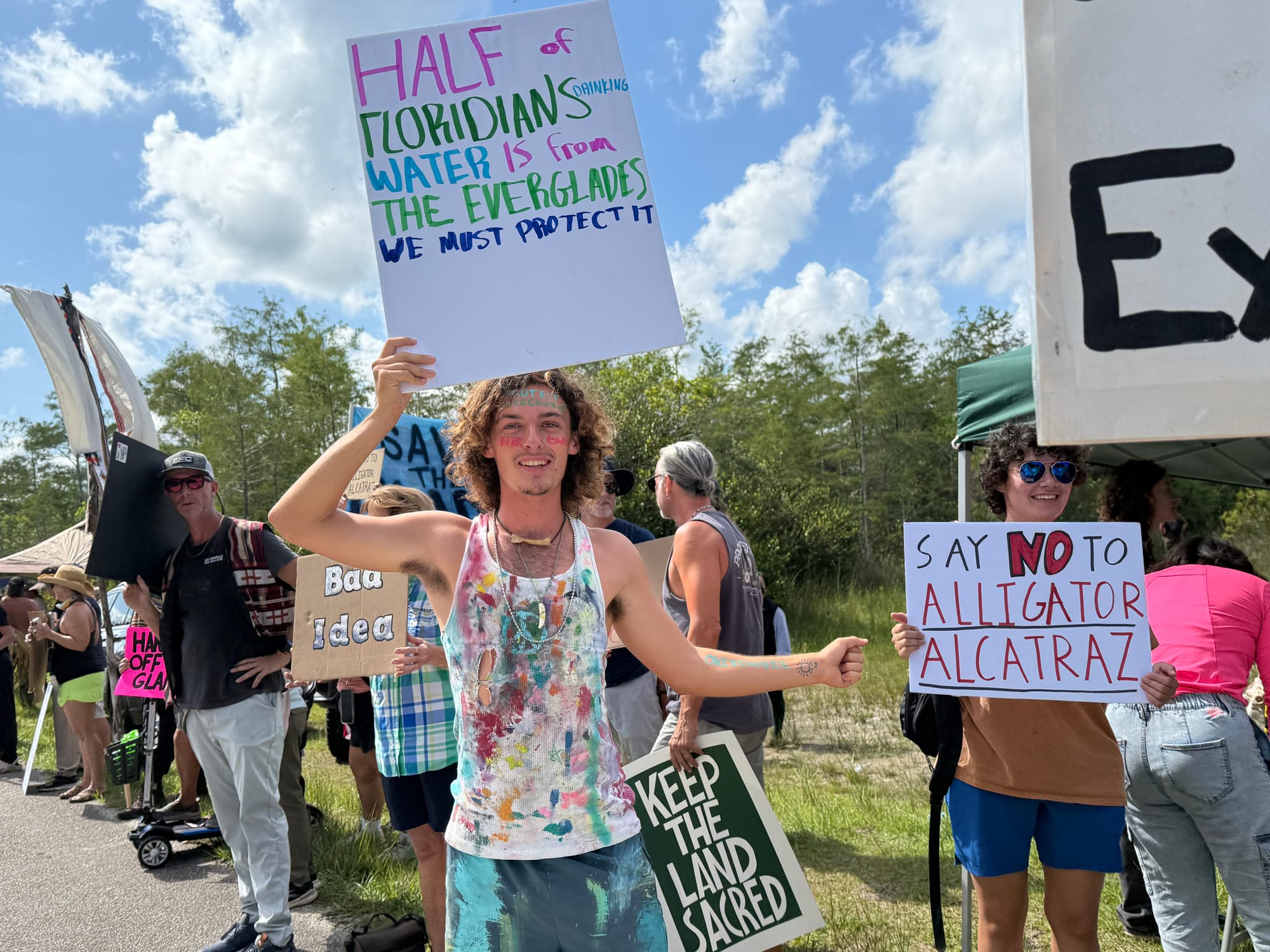
Former Miami City Commissioner and mayoral candidate Ken Russell also addressed the crowd, urging civic leaders to stand up.
“Even though this is 40 miles west of Miami, we are the largest consumer of the Everglades waters that replenish our aquifer,” Russell said. “We need to protect everything here, the tribes, the flora, the fauna, and the water.”
Russell criticized recent decisions by the Miami City Commission, including the agreement with ICE, as part of a broader political agenda. “This is yet another example of policymakers making bad decisions against our own community residents. This is an immigrant community, and so much beyond even the environmental concerns. This is Ron DeSantis saying, ‘I will do anything I can to ingratiate myself to Trump.’”
Russell called on more legislators to take a stand, drawing parallels between this fight and previous victories against golf courses and incinerators proposed on sensitive lands.
One such fight was against the Jetport, a site of historic preservation more than 50 years ago. In 1968, plans were underway to build what would have been the world’s largest airport right in the middle of this fragile ecosystem. The proposed development posed a significant threat to the Everglades’ unique landscape and wildlife.
A diverse coalition of concerned citizens and tribal leaders united in opposition, namely Marjory Stoneman Douglas, a pioneering environmentalist and author of “The Everglades: River of Grass.” Every study on the environmental impacts of the Jetport on Big Cypress and the Everglades showed significant negative impacts, reinforcing the urgent need to protect the area. The coalition’s efforts culminated in a hard-won victory that halted the Jetport project in 1970, effectively preserving the land for future generations. In the wake of this success, a wave of environmental protections were passed, including the Florida Water Resources Act, the Florida Land Conservation Act, and the Big Cypress Conservation Act. Additionally, Friends of the Everglades was born, founded by Douglas in 1969. On Sunday, Eve Samples, executive director of Friends of the Everglades, stood outside the Jetport—which is still occasionally used for flight schools—and reminded the crowd of the battle.
“If we save the Everglades, the Everglades will save us,” Samples said. “We’re all here today, and our efforts are needed again. We need to band together.”
Samples emphasized the environmental risks of a 1,000-bed detention facility,
“We know that if you bring a 1,000-bed prison to this site, the development that would occur, the impact on our water that would occur, the human waste that would occur, would be extremely negative to the greater Everglades, to Big Cypress, to this incredible ecosystem that we’re all out in today,” Samples said.
If we save the Everglades, the Everglades will save us.
Eve Samples, Friends of the Everglades executive director
The proposed detention facility would be built adjacent to federally protected lands, within a region that provides drinking water to 8 million people in South Florida. Critics say it would betray the state’s long-fought commitments to preserve the Everglades and further exploit and insult Indigenous identity by pursuing colonialist ideals through the construction of an immigration detention center.
Activists called on the public to contact DeSantis, Uthmeier, and local and federal officials. They’re also organizing another action on June 28 and considering future prayer walks.
“We’re hoping that with all this outrage and concerns expressed very quickly, that they’ll see the error of their ways,” Osceola said. “But if they don’t and still plan to continue with this, then if we have to do more prayer walks, show up to meetings or wherever, then we’ll plan accordingly.”
The protest came as Miami officials, in a fraught and emotional city commission hearing, voted 3-2 to maintain cooperation with ICE, a decision that left immigrant advocates reeling. Some commissioners cited fiscal concerns, warning the city could lose up to $20 million annually if it defies state mandates requiring cooperation with immigration enforcement. But dissenting voices, including Commissioner Christine King, warned the vote would erode trust. “This is my home, and I feel the pain of our country,” said King, whose parents are Guyanese immigrants. “I think we are on the wrong side if we enter into this agreement.”
As plans for the Everglades detention facility move forward, critics argue that Miami’s embrace of carceral immigration policy on sacred, stolen land further cements its departure from its sanctuary roots and accelerates its transformation into a city willing to trade community trust and ecological stewardship for political favor and federal funding.
“The next steps for this fight are to listen to the Indigenous people who are stewarding this land,” said Blais-Billie, the Seminole organizer, “and to listen to the needs of the communities who are vulnerable right now during this crisis.”
Editorial Team:
Sahar Fatima, Lead Editor
Carolyn Copeland, Top Editor
Rashmee Kumar, Copy Editor
Author
Alexandra is a Cuban-American writer based in Miami, with an interest in immigration, the economy, gender justice, and the environment. Her work has appeared in CNN, Vice, and Catapult Magazine, among
Sign up for Prism newsletters.
Stay up to date with curated collection of our top stories.