A Portland movement journalist is going to trial for her coverage of a pro-Palestine protest
Alissa Azar said her recent arrest is part of a larger pattern of escalating intimidation and harassment by local law enforcement
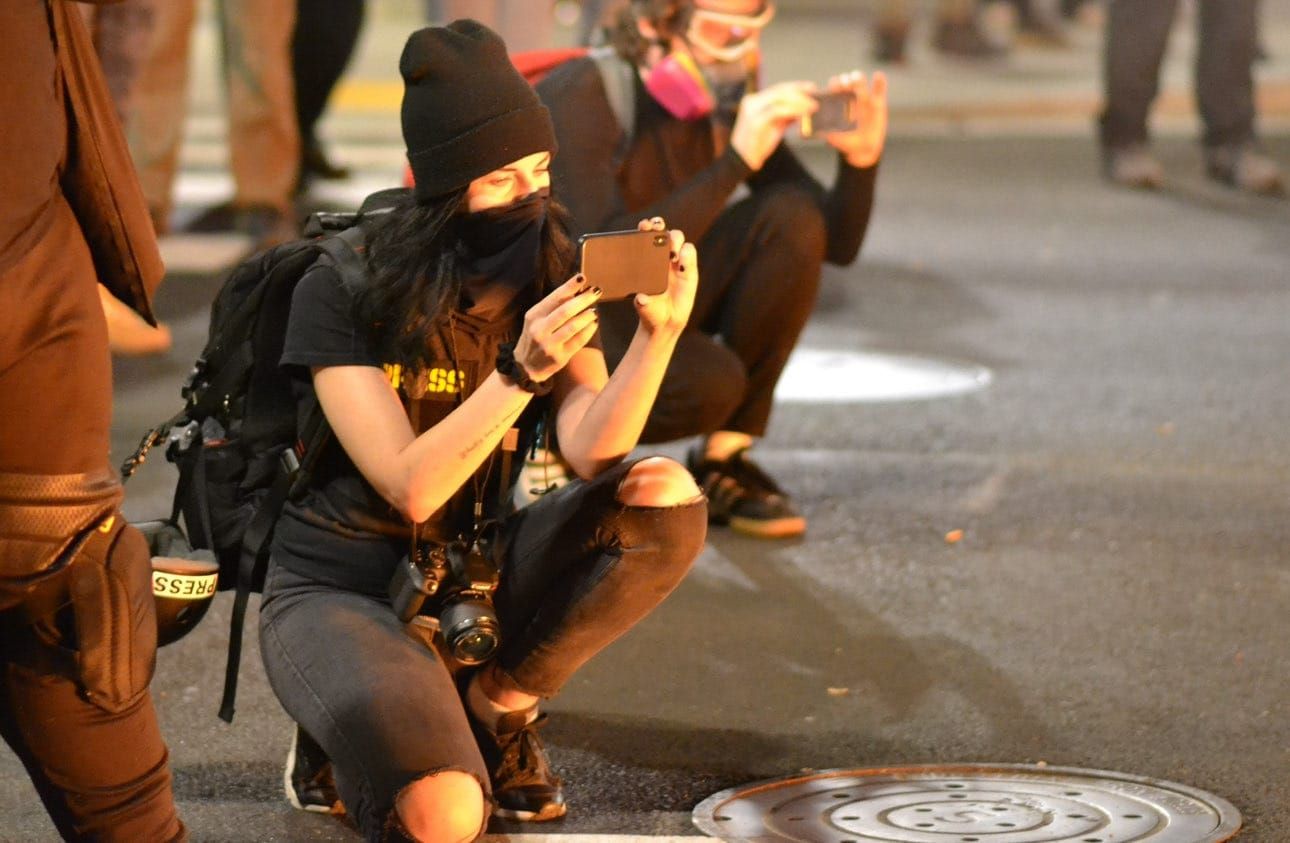
Independent journalist Alissa Azar was arrested and charged with trespassing in May 2024 while recording video at a student-led Palestine protest at Oregon’s Portland State University. Azar said she was singled out in the crowd by a Portland Police Bureau (PPB) officer familiar with her work and later harassed in jail by officers who said they “missed having run-ins with [her].” She said some even took selfies with her in handcuffs on their cellphones.
Azar is one of at least 48 journalists arrested in the U.S. in 2024 and, in relation to a separate case, she is one of only four reporters to have been sentenced to jail since the U.S. Press Freedom Tracker began documenting repression of journalists in 2017. She is now also facing charges for her coverage of the pro-Palestine student protests. Despite support from groups like the Committee to Protect Journalists, the National Press Photographers Association, and the Society of Professional Journalists, Azar’s charges have not been dropped. She has been offered a plea deal twice, which included 16 hours of community service. However, the charge carries a maximum of 30 days in jail. Her trial is set for Jan. 27 in Multnomah County.
Due to a felony conviction in a separate case from August 2024, Azar may face harsher sentencing in this case, which would defy journalistic legal precedent. During the 2024 trial, stemming from a 2021 clash between antifascist activists and the Proud Boys, the state of Oregon called into question Azar’s role as a journalist. They argued that she is not a reporter, but rather an antifa leader.
Azar’s case has brought to light a complex history of harassment, violence, and abuse of power by local law enforcement and reveals a landmark legal condemnation against social media journalists and press freedom in the U.S. Her identities as a self-taught movement journalist, Arab, and antifascist woman puts her at the speartip of state repression—an apparent consequence of going against the status quo and daring to report a counternarrative. In an era when newsrooms are rapidly shuttering and political dissent amounts to “terrorism,” Azar’s supporters say her arrests, jail time, and legal harassment mark a clear erosion of both journalistic and free speech protections. Her mistreatment is a harbinger that should concern all reporters, they say, and especially movement journalists staring down at a second Trump presidency.
False accusations
Oregon’s repression against Azar has been building for years and hit a crescendo last summer.
In August 2024, Azar became the first known journalist in the Pacific Northwest convicted and jailed over covering a protest. While covering a violent clash between the Proud Boys and antifa at Clackamette Park on June 18, 2021, a Proud Boy assaulted Azar and knocked her unconscious. Azar is seen on video deploying pepper spray twice, an act she said was self-defense against far-right protesters, some of whom had previously assaulted and harassed her.
The legal consequences she suffered following her assault were staggering.
Police made no arrests on the day of the protest; instead, they conducted an open-source investigation of the event, combing social media for photos, videos, and posts from that day. Azar received an indictment five months after she was assaulted and was charged with felony riot, a misdemeanor of second-degree disorderly conduct, and another misdemeanor of second-degree use of tear gas/mace. In the initial motion to convict Azar, Clackamas County Deputy District Attorney Josh Cutino said that Azar’s use of pepper spray was a key act that led to her indictment. The maximum sentence for Azar’s charges could have been five years in prison. The pepper spray charge was ultimately dismissed by a hung jury.
The state also charged three Proud Boys for their roles in the clash. Two were charged with felony riot and one with misdemeanor disorderly conduct and harassment. One stood trial in November 2024, pleading guilty to the misdemeanors. As of December 2024, the other two still have active warrants out for their arrests.
Azar’s trial largely focused on the six-week period leading up to the June 2021 clash in Clackamette Park. Cutino scrutinized Azar’s reporting, arguing that she was not a journalist with antifascist viewpoints, but rather an antifa “leader.”
In the weeks leading up to the clash, local activists tipped off Azar about escalating tensions at weekly demonstrations in Oregon City between right-wing groups, antifascists, and Proud Boys. Azar reported the information on social media, calling attention to a right-wing group that initiated weekly recruiting events. The recruitment efforts were met with counteractions from antifascists. In response, the Proud Boys came to march with the right-wing group, and the antifascists continued their counteractions.
Azar posted tweets and photos detailing the events. Her reporting depended on her access to the antifascist counteractions, which included vandalism, communiques after actions, and calls for a community show-out. Cutino claimed that sharing this information was not reporting, but Azar’s personal and intentional advocating for violence and further protest. In part, this is how Cutino framed Azar as being responsible for the counterprotests. He claimed she was a member of “team” antifa.
During the August 2024 trial, Cutino harped on Azar wearing black cargo pants and a tank top at the demonstration, as well as an interaction she had with law enforcement before the clash, where she reportedly “claimed ownership” of antifascist shields. He argued that her outfit and the shields declared her “intent” to riot and commit violence at the park.
When Azar took the stand for cross-examination, Cutino hammered her with leading questions: What were you wearing that day? What does violence mean to you? Do you agree that people should fight back with any means necessary?
“She’s inserting herself,” Cutino argued. “She’s trying to oppose [the far-right organizing]; that’s very different from journalism. … [The journalists] were standing off to the side, not doing opinionated violent actions.”
Cutino’s closing argument was that Azar was not a journalist; she was antifa.
Bearing witness
The landmark trial, Oregon v. Alissa Azar, took place in Oregon City, a former sundown town in the county south of Portland. Ultimately, Azar served two weeks in Oregon City’s Clackamas County Jail and was sentenced to three years probation, which includes provisions that require her to disperse when law enforcement declares an assembly “unlawful.” For the duration of her probation, she also cannot legally wear body armor or a ballistic vest in public—even while covering a protest.
Azar’s trial came on the heels of what she characterized as a pattern of escalating police harassment and fascination with her. It began, she said, when PPB began singling her out during the 2020 Black Lives Matter protests, calling her by name in the crowd. She subsequently endured officers’ “weird, inappropriate comments” about her OnlyFans account as well as alleged stalking. According to Azar, she was followed by people in unmarked cars that sometimes parked outside of her home.
“Activists [and] protesters often will have police follow them around, post outside their homes to intimidate and scare them,” Azar said. “I was very aware of what they were trying to do, and they did that to a lot of people.”
When reached for comment, the Portland Police Bureau said they “do not have any internal investigations regarding any of what is mentioned.”
PPB also noted that its internal affairs division “is also not aware of any of the allegations” and, therefore, “cannot speak to any of them.” They encouraged concerned parties to contact the Independent Police Review division and make a formal complaint.
Azar’s 2021 arrest in Clackamas County was followed by two more arrests in Portland: one in November 2022 after a small rally and another in May 2024 during the pro-Palestine student protests at Portland State University. State authorities have consistently called Azar’s work as a movement journalist into question.
The 33-year-old Syrian American independent journalist has an extensive body of work, largely focused on covering the Pacific Northwest. Based in Portland, Azar has lived in the region since she was 4 years old. In 2020, Azar began posting videos, pictures, text, and livestreams of Portland protests following the police murder of George Floyd. More broadly, her work focuses on documenting violent far-right movements. In 2022, she helped break a major story when over 30 members of the white supremacist hate group Patriot Front planned to attack a Pride parade in Idaho. She’s written for publications like Left Coast Right Watch, and her footage is often distributed across digital, audio, and TV news after being picked up by journalistic outlets and wires, including Getty and Storyful.
Across social media, Azar has amassed over 80,000 followers. Azar identifies as a journalist as well as an “antifascist.”
“This stance encompasses not only the rejection of fascism, authoritarianism, and nationalism, but also a passionate defense of dissenting voices and opposition to the suppression of dissent. A passionate defense of all marginalized people, against racism, misogyny, classism, and all forms of bigotry,” Azar told Prism. “It means actively resisting gender fascism and violence directed at queer and trans folks. It’s advocating for personal and bodily autonomy and civil rights for all people.”
State authorities who question Azar’s credentials often parrot the language of right-wing outlets like Fox News and the Daily Mail, which have referred to her as a “faux” reporter and an “Antifa ringleader.” Azar is referred to as an “independent journalist” by reputable publications who have quoted her, published her stories, or otherwise picked up her work, including the New York Times, the Los Angeles Times, Newsweek, Columbia Journalism Review, Al Jazeera, and Vice.
In traditional journalism-speak, Azar is considered a stringer or freelancer. Her style of work and proximity to her community make her a movement or citizen journalist. Originating in the South, movement journalism prioritizes the stories and perspectives of marginalized or oppressed groups. It is often produced alongside social justice movements, with the reporter getting involved in the action and maintaining deep connections with activists and community members while practicing traditional fact-checking and journalistic standards.
Given her platform on social media, Azar also fits the definition of a news influencer, blending her reporting with analysis and commentary.
Allissa Richardson, an associate professor at the University of Southern California, Annenberg, characterized Azar as both a mobile journalist and a gonzo independent journalist.
“She is transparent about her politics and gets in the action herself,” said Richardson, author of “Bearing Witness While Black: African Americans, Smartphones, and the New Protest #Journalism”. “I feel like with a lot of smartphone reporting, this can be a normal thing.”
Mobile journalism is a form of watching, and typically watching from below, from a position of less power.
Allissa Richardson, author of “Bearing Witness While Black”
Richardson, who founded the first university mobile journalism lab in the U.S., explains that mobile journalists like Azar often report from perspectives that are left out of traditional mainstream journalism and can offer critical counternarratives that challenge and threaten the status quo.
“Mobile journalism is a form of watching,” Richardson explained. “And typically watching from below, from a position of less power, so that somebody is taking account of the powerful misbehaving, or it is sometimes just observing in the moment right away, almost in an instinctive way.”
Richardson calls the process of watching from below “sousveillance,” which creates a fundamental shift in power. “It warns the person who’s trying to be the bully, ‘I’m looking at you too,’” she said.
This act of watching isn’t without risk.
Across the course of Azar’s nearly five-year career, the Press Freedom Tracker has recorded 13 incidents of violence against her, including attacks and arrests by law enforcement, physical violence, and harassment from far-right groups.
What the tracker doesn’t note is the toll that Azar’s work takes on her day-to-day life. She is regularly sexualized and taunted by law enforcement, as well as stopped and extensively searched at airports. In November 2022, the PPB arrested her and searched her home, confiscating electronic devices and even searching through her underwear drawer.
This incident came after a demonstration in August 2022 in which Azar was accused of stealing the cellphone of a far-right livestreamer. She recounted hearing a PPB officer “trying to encourage [the livestreamer] to press charges against [her] …‘So we can finally get her.’” After Azar’s home was searched, she was sentenced to a restorative justice program, and ultimately, all seven felonies were dropped.
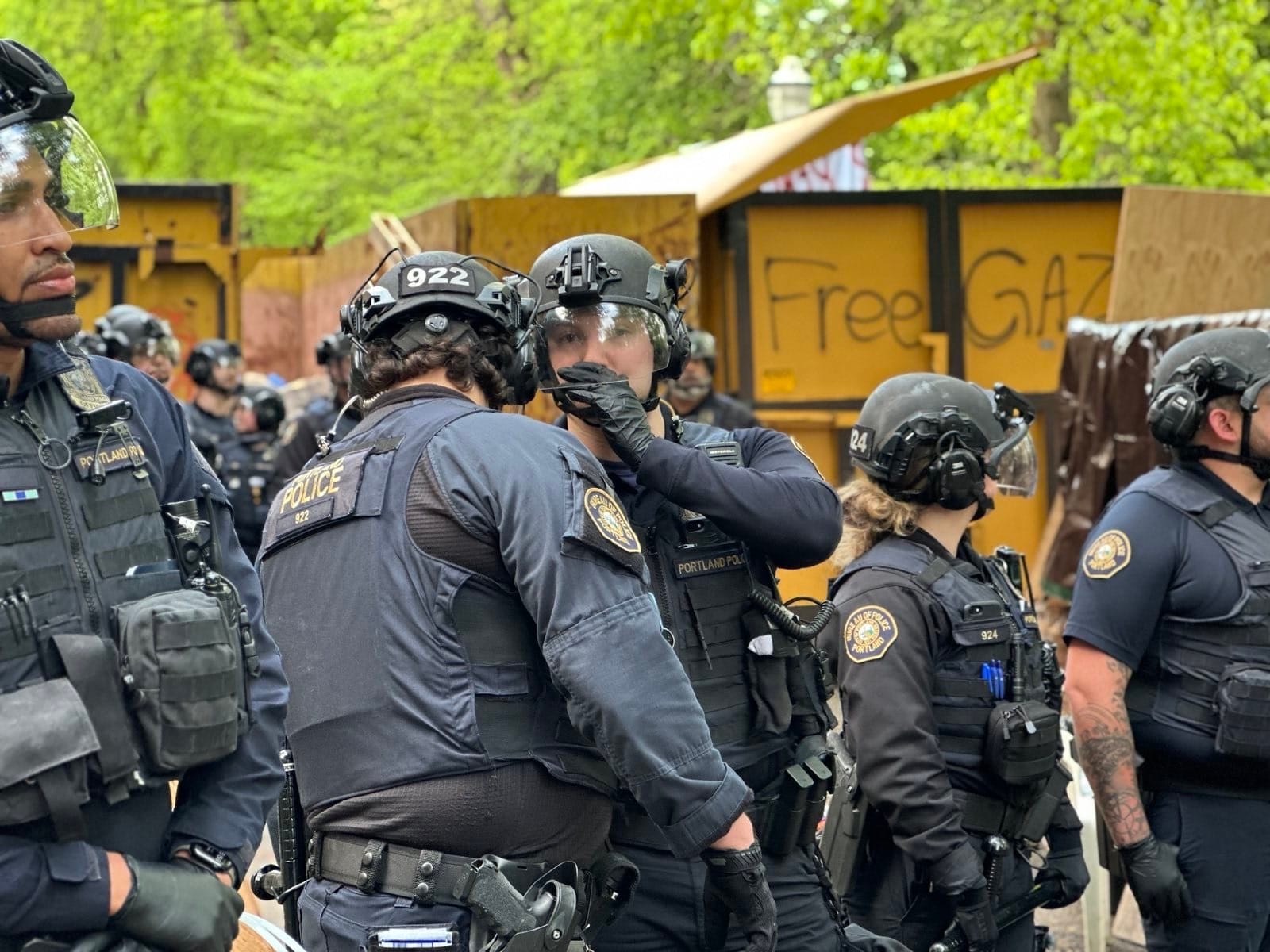
Stephanie Sugars, a senior reporter for the Press Freedom Tracker, explained that Azar’s position as an independent journalist likely contributes to her vulnerability and repeated targeting.
“Independent [journalists] are significantly more at risk because they don’t have the reputational protection of a very formal-looking New York Times press credential,” Sugars told Prism.
She noted that independent journalists often don’t have the financial, legal, or security resources that reporters at mainstream outlets may have. “They are living in these communities, so they’re at much greater risk of repeat exposure to the same groups of people,” she said.
Because of her identities as an Arab woman and an antifascist, Azar said she receives more scrutiny than other independent journalists.
“I don’t think I would get the harassment that I get, whether it’s from unabashed fascists or the state and police, if I wasn’t a woman,” Azar told Prism. “I also don’t think it would be what it is if I wasn’t an Arab. So, both of those things [are] also preceded by being an antifascist woman and an antifascist Arab and an antifascist Arab woman.”
Who gets to decide?
Law enforcement’s framing of Azar as an antifa leader has clear social and legal impacts on her ability to continue reporting safely. Not only is her incarceration a repressive signal to all movement journalists, but her designation as an activist “leader” adds a potential harbinger for any news outlet that reports a counternarrative—and who may also be subject to anti-terrorism crackdowns. Azar’s case also highlights a key rift within the news media landscape, one that was arguably exploited to incarcerate Azar, and that is at risk of getting worse under the second Trump administration.
That is, unless journalists quickly learn to practice meaningful solidarity.
In preparation for the Clackamas trial, Azar’s defense attorney, Lauren Regan of the Civil Liberties Defense Center, called around to local and mainstream press to find support for Azar.
“If I had a dollar for every time someone basically said, ‘Well, she blurred the line,’” Regan. “Almost like an assumption, ‘She got what she deserved because she blurred the line.’ That was a trope that I heard a number of times from mainstream journalists.”
Mickey Osterreicher, general counsel to the National Press Photographers Association, said a journalist’s rights are contingent on being an observer, not a participant.
“The sole reason for journalists being anywhere is to gather and disseminate information on matters of public concern,” Osterreicher explained. “Almost all of the statutes in the various states that talk about unlawful assembly talk about someone being a participant in the assembly, and our argument has always been, ‘Journalists are not participants.’ Journalists are there to observe and exercise the First Amendment, free press rights.”
But the position of movement journalists is more complex.
In her research, Richardson found that there are essentially two types of what she calls mobile journalists. The first are people who accidentally become reporters by witnessing an event and posting about it. As one example, she cited Darnella Frazier, who recorded George Floyd’s murder and received a Pulitzer Prize special citation.
The second type of mobile journalist “is fed up and frustrated” with the way their community has been featured in mainstream media, Richardson said.
“They have become disillusioned with the news media,” she said. “They feel like they have been misrepresented or maligned, and oftentimes, they are tired of asking the mainstream media to get it right. They often fashion themselves as the counternarrative makers, the ones who are telling an opposite story, and an effort to set the record straight.”
It’s that position—the outsider status as well as being embedded in movement spaces—that gains movement journalists unique access to breaking news events. This unique access also helps them act as first responders or early detectors of trends or danger.
“Citizen journalists are the ones who are the EMTs, the first ones on the scene, who often can stabilize an issue,” Richardson said. “They can grab that patient, grab that news story, report on it right away, and sound an alarm.”
As legacy news outlets shutter or impose mass layoffs, the pool of independent freelance reporters will only grow, making an even larger group of journalists vulnerable to attacks and threats. And as the incoming Trump administration vows to crack down on the free press, free speech, and “woke” culture, antifascist movement journalists like Alissa Azar will continue to serve an essential role as digital-first responders.
“Antifascism is, at its core, a resolute stand against fascism—it is beautifully simple and straightforward,” Azar said. “It reflects a profound commitment to justice.”
Author
Jen Byers (they/she) is a visual and investigative journalist who covers domestic conflict, social justice movements and solutions stories. Follow them @gallows.bsky.social.
Sign up for Prism newsletters.
Stay up to date with curated collection of our top stories.